| name |
Amanita
penetratrix |
| author |
Tulloss & Kudzma |
| name status |
nomen provisorum |
| english name |
"Connecticut Penetrating Ringless Amanita" |
| GenBank nos. |
Due to delays in data processing at GenBank, some accession numbers may lead to unreleased (pending) pages.
These pages will eventually be made live, so try again later.
|
| intro |
The following text may make multiple use of each data
field.
The field may contain magenta text
presenting data from a type study
and/or revision of other original material cited in the
protolog of the present taxon.
Macroscopic descriptions in magenta are a combination of
data from the protolog and
additional observations made on the exiccata during
revision of the cited original
material.
The same field may also contain black text, which is
data from a revision of the present
taxon (including non-type material and/or material not
cited in the protolog).
Paragraphs of black text will be labeled if further
subdivision of
this text is appropriate.
Olive text indicates a specimen
that has not been
thoroughly examined (for example, for microscopic
details) and marks other places in the text
where data is missing or uncertain.
The following material is based on molecular research
of Dr. L. V. Kudzma and additional original research of
R. E. Tulloss. |
| pileus |
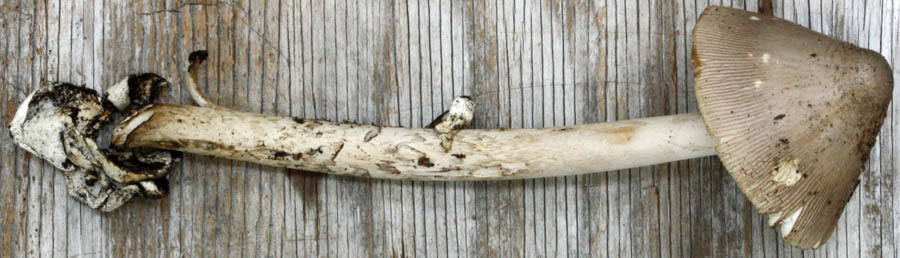
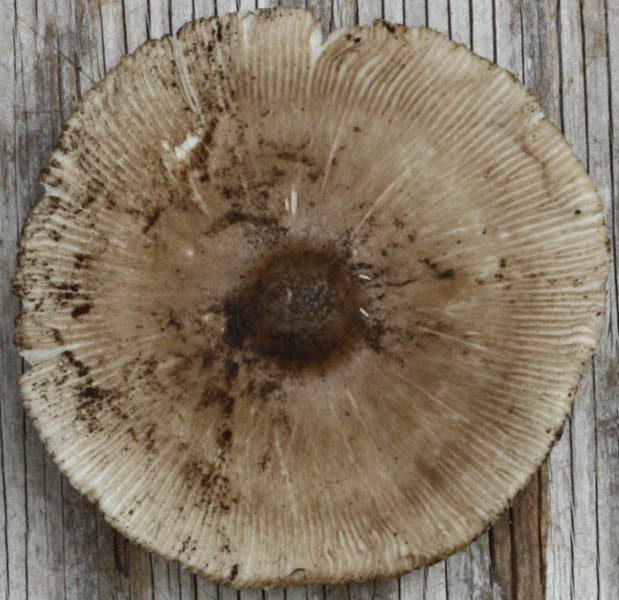
67 - 132 mm wide, medium brown to slightly grayish beige
to medium gray-brown to
gray-brown to white, often virgate, sometimes with
inner/outer area of marginal striations paler than the
outer/inner area of striations,
not staining or bruising when damaged, at first
campanulate to conic then concave to planar, tacky,
viscid when wet, with notable pronounced
umbo (e.g.. 5.5 - 14 mm high and 19 - 30 mm wide) often
grayer or browner than surrounding surface especially in
age;
context 3.5 - 10 mm thick over stipe (excluding
umbo), white, unchanging,
extremely dense in umbo (difficult to cut with razor),
thinning evenly for half to three-quarters of
radius, then membranous to margin; margin
tuberculate-striate [0.25-0.45 (-0.6)R],
nonappendiculate; universal veil absent. |
| lamellae |
free or very narrowly attached to receeding, rarely
with decurrent line on stipe apex, subcrowded to
crowded, off-white to pale cream to cream in mass to
sordid whitish,
off-white to sordid white to faintly yellowish cream in
side view,
not bruising or staining after damage, 4 - 8 mm broad,
broadest at 50 - 60 (-75)% of cap radius; lamellulae
truncate to subtruncate to attenuate (one specimen),
unevenly distributed, of diverse lengths,
plentiful. |
| stipe |
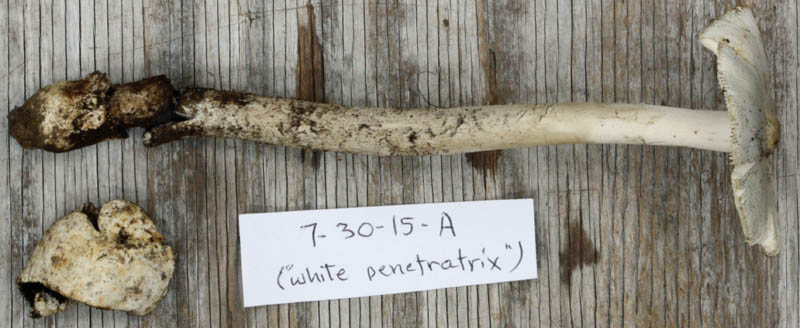
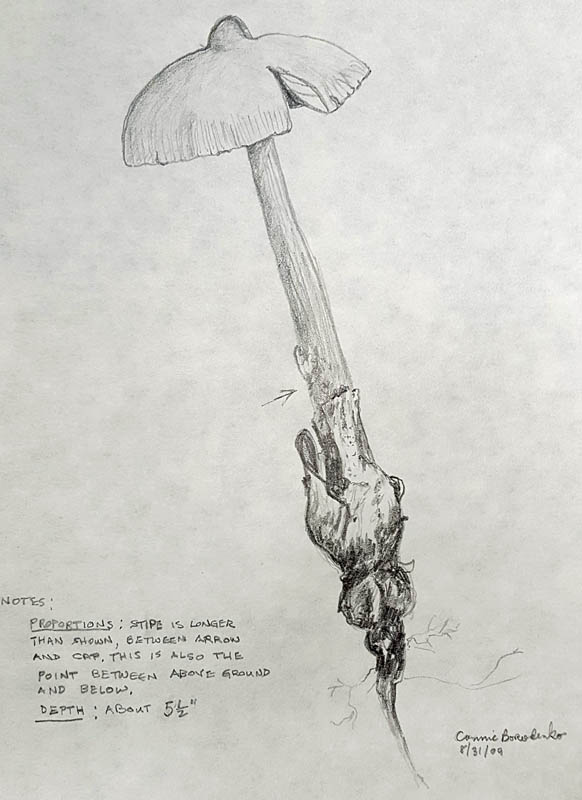
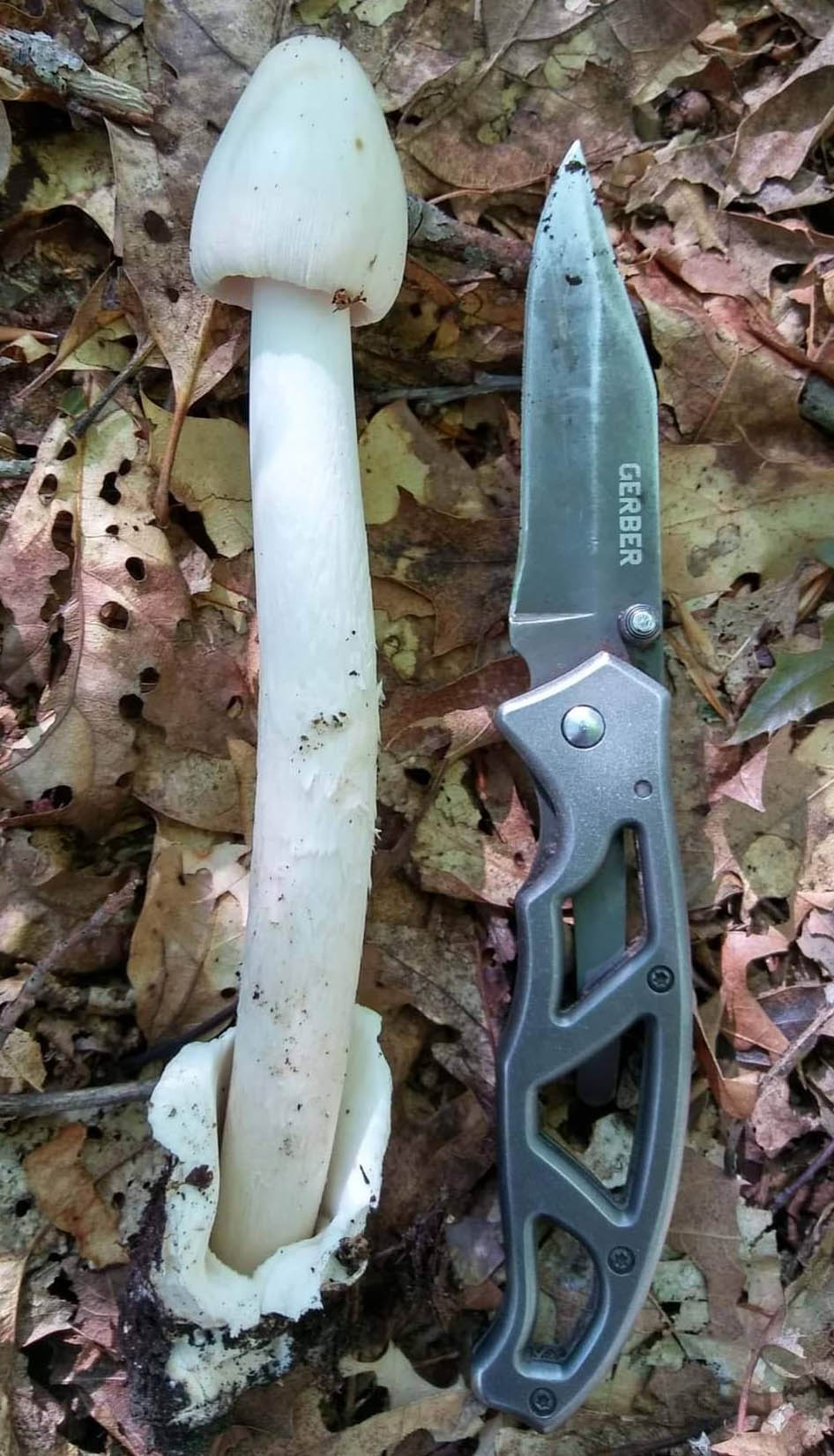
150 - 294 × 9.5 - 19 mm, with (70+-)
104 - 153 mm
embedded in substrate, white to pale cream, sometimes
with upper 20± mm having matte
appearance, unchanging
above substrate surface, picking up some coloration from
soil below that surface, cylindric or narrowing
upward, not or slightly flaring at apex, finely
longitudinally striatulate, with some raised
fibrils (more come below ground), faintly zebroid;
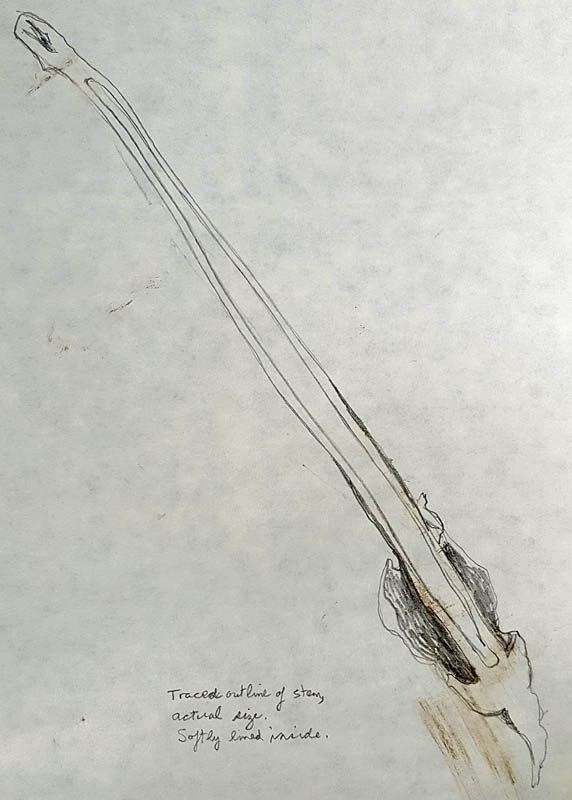
context hollow or loosely stuffed, white to
off-white, unchanging, concolorous in insect tunnels,
with central cylinder
(3 - 8 mm wide) lined with white
cottony fibrils, sometimes stuffed loosely with similar
fibrils; exannulate; universal
veil as saccate membranous volva, white
on inner and outer surfaces, 52 - 95
× 14 - 35 mm, at least sometimes including radicating
base (up to 50 × 12 mm), up to 1±
mm thick at mid-height of limb. |
| odor/taste |
Odor not distinctive. Taste
absent or faintly "nutty" (C. Borodenko). |
macrochemical
tests |
none recorded. |
| pileipellis |
double click in markup mode to edit. |
| lamella trama |
bilateral, divergent. |
| partial veil |
absent. |
| lamella edge tissue |
sterile. |
| basidiospores |
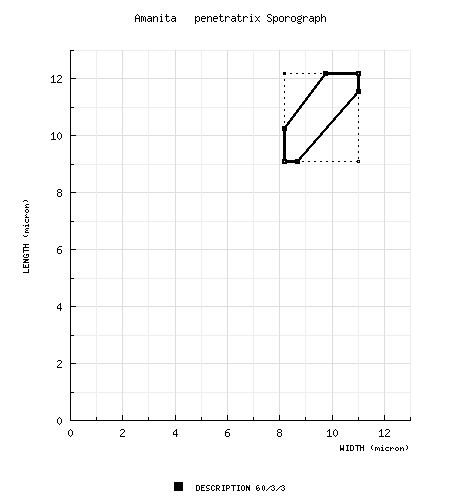
RET: [60/3/3] (8.8-) 9.1 - 12.2 (-14.5) ×
(7.4-) 8.2 - 11.0 (-13.6) μm,
(L = 10.2 - 11.2 μm; L' = 10.6 μm;
W = 9.0 - 10.1 μm; W' = 9.5 μm;
Q = (1.04-) 1.05 - 1.25 (-1.34);
Q = 1.09 - 1.16; Q' = 1.12),
hyaline, colorless, smooth, thin-walled, inamyloid,
subglobose to broadly ellipsoid, infrequently globose,
adaxially flattened, sometimes with giant spores;
apiculus sublateral, cylindric,
prominent; contents guttuluate with additional fine
granules; white in deposit. |
| ecology |
Solitary or in pairs.
Connecticut: In rich, dark, loamy, friable soil or in
sandy loam. In mixed
hardwood forest including Quercus and
Fagus or in mixed conifer-hardwood forest or in
second growth, mixed forest with Pinus strobus,
Betula, Fagus and Quercus.
Pennsylvania: in Tsuga
canadensis-hardwood forest
with Betula and some Quercus. |
| material examined |
U.S.A.:
CONNECTICUT—Middlesex Co. - E. Haddam,
14.viii.2018 Bill Yule s.n. [mushroomobserver
#327540]
(RET 842-7, nrITS & nrLSU seq'd.);
E. Haddam,
Devil's Hopyard St. For. [41.4756° N/ 72.3403° W,
72 m], 31.vii.2015
NEMF2015 foray participant s.n. [Tulloss 7-31-15-K]
(RET 703-1); Meshomasic St. For., 19.viii.1998 S. E. K.
Tulloss & Michaela Slavid s.n. [R. E.
Tulloss 9-19-98-B] (RET 288-5, nrITS seq'd.),
24.viii.2007 Connie Borodenko s.n. [Tulloss
8-24-07-P] (RET 438-7, nrITS-LSU seq'd.), Noel Rowe
s.n. [Tulloss 8-24-07-Q] (RET 438-8, nrITS-LSU seq'd.),
29.viii.2009, John Wheeler & Noah Rowe s.n.
[8-29-09-A] (RET 437-4, "COMA3B"); ca. Moodus,
29.viii.2009 COMA2009 participant s.n. [Tulloss
8-29-09-B] (RET 438-1, "COMA2" nrITS seq'd.);
Salmon River St. For. (S. sect.), 28.viii.2009
Connie Borodenko s.n. [Tulloss 8-28-09-A]
(RET 437-8, "COMA1" - nrITS seq'd.), Rena Wertzer
s.n. [Tulloss 8-28-09-C, "COMA3A" nrITS & nrLSU seq'd.]
(RET 437-7).
New London Co. - Colchester, Day Pond St. Pk.,
24.viii.2007 Rock s.n. [Tulloss 8-24-07-R]
(RET 438-2, nrITS-LSU seq'd.),
28.viii.2009 M. Pack s.n. [Tulloss 8-28-09-B]
(RET 437-3, nrITS & nrLSU seq'd.), 4.ix.2011 COMA2011 participant s.n.
[Tulloss 9-4-11-H] (RET 492-9, nrITS
& nrLSU seq'd.),
31.vii.2015 Clement Ockay s.n. [Tulloss 7-31-15-B]
(RET 704-7, nrITS and nrLSU seq'd.), NEMF2015
participant s.n.
[Tulloss 7-31-15-C] (RET 703-10, nrITS &
nrLSU seq'd.);
Nehantic State Forest, East Lyme,
31.vii.2015 George Yager s.n. [Tulloss 7-31-15-D]
(RET 704-3); New London, Connecticut College campus,
31.vii.2015 Stephen Russell s.n. [Tulloss
7-31-15-A] (RET 704-1, nrITS and nrLSU seq'd.).
Unkn. Co. - unkn. loc., 31.vii.2015
Luke S. s.n. [Tulloss 7-31-15-J] (RET 704-8).
NEW JERSEY—Mercer Co. -Washington
Crossing State Park [40.307° N/ 74.864° W, 35m],
17.viii.2013 Igor Safonov s.n. [mushroomobserver
#143048]
(RET 562-2, nrITS-LSU seq'd.).
NORTH CAROLINA—Surry Co. - Franklin
Twp., Lowgap, Cumberland Knob [36.5501º N/ 80.9086º
W, 871 m], 17.vi. 2017 Geoff Balme s.n.
[mushroomobserver
#279300
(RET 797-10, nrLSU seq'd.).
PENNSYLVANIA—Colombia
Co. - Dogtown [41.1322º N/ 76.1537º W, 403 m],
22.vii.2016 David Wasilewski s.n. [mushroomobserver
#245134]
(RET 769-1, nrITS & nrLSU seq'd.).
RHODE ISLAND—Kent Co. - Coventry
[41.6883º N/ 71.5642º W, 86 m], 9.viii.2017 Spike
Mikulski s.n. (RET 793-2, nrITS & nrLSU
seq'd.). |
| discussion |
Amanita penetratrix is the first North American
species of section Vaginatae in which RET
encountered such a hard-fleshed umbo
associated with such an apparently deep origin for a
primordium—often 100 or more mm below the substrate
surface. The umbo reminds one of the
perferatorium
of Termitomyces taxa that must break their
way out
of concrete-like termite mounds.
"Amanita subsection
Penetratrices"
The present species is one of the first in which we
happened to find the unusual nrLSU 5' motif,
TCTGACCTCAAATCA, which occurs in other genera (e.g.,
Limacella), but, in Amanita, seems to be
limited largely to section Vaginatae.
Within the Vaginataea The unusual motif is present in a
single species outside the Penetratrices
clade—A.petersenii.
The more commonly found version of the motif in the
Vaginatae is "TTTGACCTCAAATCA". Species
with this nrLSU 5' motif comprise about 70% of the
known Vaginatae.
Because several recent publications (as well as
RET's research) show
that members of the present group form an early diverging
clade of the Vaginatae; that is in a sister relationship
to the remainder of the section, we provisionally propose
the rank of subsection for the Penetratrices.
Because, as far as we know, we are the first to notice
this phenomenon, we offer a list of taxa with this
particular motif:
-
A. albemarlensis -
Virginia, U.S.A.
-
A. albiceps -
SE Canada to Texas, U.S.A.
-
A. albidostipes -
Yunnan, China
-
A. annulata -
Yunnan, China
-
A. annulatovaginata -
Cameroon
-
A. audubonensis -
Louisiana, U.S.A.
-
A. brunneoumbonata
- Thailand
-
A. calida - Mediterranean
Europe
-
A. castellae -
Arizona to Oregon, U.S.A.
-
A. chiricahuana -
SW U.S.A.
-
A. cingulata - China
-
A. cinderellae -
Connecticut to New Jersey, U.S.A.
-
A. cistetorum -
S Europe
-
A. coryli -
N Europe (?and North America?)
-
A. degroveitibialis
- Florida
-
A. drummondii -
SW Austalia
-
A. emodotrygon -
Uttarakhand, India
-
A. ferrarii - New York,
U.S.A.
-
A. glenosomma -
Pennsylvania to Texas, U.S.A.
-
A. hahatonka - Missouri,
U.S.A.
-
A. ifeifensis - Osun
State, Nigeria
-
A. insinuans - Maryland
to Louisiana and Mississippi, U.S.A.
-
A. justicei - New Jersey
to Alabama and Missouri, U.S.A.
-
A. kundabungii - SE
Australia
-
A. labiliannulus -
Missouri, U.S.A.
-
A. luteolamellata -
Cameroon
-
A. luzernensis -
Pennsylvania, U.S.A.
-
A. madagascarensis - Madagascaar
-
A. magna - E Canada
-
A. magnivolvata -
type from Finland
-
A. minnesorora -
boreal forest in N. America
-
A. myrmeciae -
SE Australia
-
A. pastorinoi - Texas,
U.S.A.
-
A. penetrans - SE
U.S.A.
-
A. penetratrix -
Rhode Island and Connecticut to Pennsylvania to North
Carolina, U.S.A.
-
A. petersenii - North Carolina,
U.S.A.
-
A. praelongipes - type from Germany
-
A. prudens - southern
Europe
-
A. punctata sensu A. E. Wood
- SE Australia
-
A. saltpointensis
- California, U.S.A.
-
A. scutum - New Jersey to
Tennessee, U.S.A.
-
A. semiobruta -
Missouri to Texas, U.S.A.
-
A. sp-60 - New Jersey in
Atlantic Coastal Plain, U.S.A.
-
A. sp-A06 - North Carolina
to Alabama, U.S.A.
-
A. sp-Arora-01-555 - Northern Prov., Zambia
-
A. sp-AUS08 - SE Australia
-
A. sp-AUS09 - SE Australia
-
A. sp-AUS11 - SE Australia
-
A. sp-AZ31 - Arizona, U.S.A.
-
A. sp-AZ32 - Arizona, U.S.A.
-
A. sp-constricta01
- coastal central California, U.S.A.
-
A. sp-CROAT01 - Croatia
-
A. sp-DEUT02 - Germany
-
A. sp-IN02 - Indiana, U.S.A.
-
A. sp-ITAL02 - Toscano,
Italy
-
A. sp-KY04 -
Kentucky, U.S.A.
-
A. sp-Madagasc01 -
Madagascar
-
A. sp-MO10 - Maryland to
Florida to Missouri, U.S.A.
-
A. sp-N49 - Connecticut, U.S.A.
-
A. sp-N58 - Connecticut,
U.S.A.
-
A. sp-PORT03 - England and Portugal
-
A. sp-PORT04 - Portugal
-
A. sp-S11 - North Carolina,
U.S.A.
-
A. sp-WI03 - Wisconsin,
U.S.A.
-
A. strobilaceovolvata
- Camerooon
-
A. thria - Illinois and
Missouri to Texas, U.S.A.
-
A. trygonion - Louisiana
and Texas,
U.S.A.
-
A. verrucosivolva -
southwestern China
-
A. williamsiae - New York
to
South Carolina in Atlantic Coastal Plain, U.S.A.
There are several additional probable taxa
of the Vaginatae that
have the nrLSU 5' "TCTGACCTCAAATCA" motif and are
genetically distinguishable. These entities
are represented by unique collections in the
Roosevelt herbarium that
currently lack a provisional name (or temporary code)
and a determination:
-
RET 427-7 (France)
-
RET 464-2 (Texas, U.S.A.)
-
RET 463-7 (Texas, U.S.A.)
-
RET 572-7 (Wisconsin, U.S.A.)
-
TENN 12512 clone 1 (Tennessee, U.S.A.)
|
| citations |
—R. E. Tulloss and L. V. Kudzma |
| editors |
RET |
|




 Spore data sets and their composite