| name |
Amanita magnivolvata |
| author |
Aalto. 1974. Karstenia 14: 93, fig. 1. |
| name status |
nomen acceptum |
| english name |
"Aalto's Great Ringless Amanita" |
| synonyms |
≡ Amanitopsis magnivolvata (Aalto) Bon. 1978. Doc. Mycol. 8(29): 36.
= Amanita mairei var. amplivolvata Contu. 1985. Pag. Bot. 7: 12-15, figs. A-C. [Following Fraiture ( 1993. Op. Bot. Belg. 5: 85) who proposed this synonymy.]
The editors of this site owe a great debt to Dr. Cornelis Bas
whose famous cigar box files of Amanita nomenclatural information
gathered over three or more decades were made available to RET for computerization
and make up the lion's share of the nomenclatural information presented on this site.
|
| etymology |
magnus "great" + volvatus "bearing a volva" or "volvate"; hence, "great and volvate" |
| MycoBank nos. |
308569, 308604, 514389 |
| GenBank nos. |
Due to delays in data processing at GenBank, some accession numbers may lead to unreleased (pending) pages.
These pages will eventually be made live, so try again later.
|
| holotypes |
A. magnivolvata—H.
A. mairei var. amplivolvata—CAG??. |
| type studies |
A. magnivolvata—Tulloss. 1994. Mycotaxon 52: 346, figs. 27-28. |
| revisions |
Tulloss, here |
| intro |
The following text may make multiple use of each data field.
The field may contain magenta text presenting data from a type study
and/or revision of other original material cited in the protolog of the present taxon.
Macroscopic descriptions in magenta are a combination of data from the protolog and
additional observations made on the exiccata during revision of the cited original
material.
The same field may also contain black text, which is data from a revision of the present
taxon (including non-type material and/or material not cited in the protolog).
Paragraphs of black text will be labeled if further subdivision of
this text is appropriate.
Olive text indicates a specimen that has not been
thoroughly examined (for example, for microscopic details) and marks other places in the text
where data is missing or uncertain.
The following material not directly from the protolog of the present taxon is based upon
original research by R. E. Tulloss. |
| pileus |
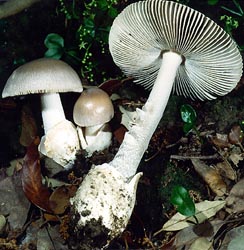
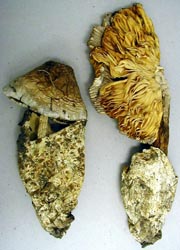
protolog: 80 - 115 mm wide, gray with slight olivaceous, faint deeper gray ring on the inner edge of sulcations, becoming leather brown on drying, hemispheric when young, dry, glossy; context not recorded; margin sulcate (0.25R); universal veil absent on mature specimens, with surface layer peeling for short distance radially after being started by razor scalping in "button" stage exsiccatum.
50 - 120 mm wide, gray with slight olivaceous or beige or hazel nut brown tints, often with faint deeper gray ring on the inner edge of sulcations, with disc sometimes distinctly brownish in button stage, hemispheric when young, becoming convex, and subplanar with depressed disc, dry, glossy; context predominantly white with tendency to become grayish; margin sulcate (0.25R); universal veil absent on mature specimens, with surface layer peeling for short distance radially after being started by razor scalping in "button" stage exsiccatum. |
| lamellae |
protolog: free, cream colored or whitish, drying pale tan (10YR 8/4), with edges white and conspicuously flocculose at first becoming darker and very finely serrate with age, 3 - 4 mm or more broad (nearly 4 mm broad in most mature of exsiccata), thick; lamellulae truncate, unevenly distributed, of varying lengths.
free, subclose to subdistant, cream colored or whitish, sometimes becoming gray with age from edge upward, drying pale tan (10YR 8/4), with edges white and conspicuously flocculose at first becoming darker and very finely serrate with age, 3 - 4 mm or more broad (nearly 4 mm broad in most mature of exsiccata), thick; lamellulae truncate, scattered and unevenly distributed, of varying lengths. |
| stipe |
protolog: 95 - 125 × 15 - 20 mm, whitish, with tomentum of slightly sticky hyphae, with surface fibrils becoming gray with age, finely striate at apex; context not recorded; exannulate; universal veil as saccate volva, membranous, ample, with felty and smooth surface, pure white when collected, after handling sometimes developing small rusty yellow spots on exterior, which persist after drying, about 60 mm from stipe base to tip of highest limb, 5 - 10 mm thick (remaining up to 5 mm thick in most mature exsiccatum of holotype), ovoid in button stage and not showing any constriction below margin of developing pileus, with limbus internus very small at point of attachment to stipe or absent, in button-stage exsiccatum adnate to stipe from point of previous pileus contact with stipe, with surface (in exsiccata) peeling for short distance longitudinally after peel being started by razor scalping.
95 - 150 (-200) × 10 - 25 mm, whitish, with tomentum of slightly sticky hyphae, with surface fibrils becoming gray with age, finely striate at apex; context white, with tendency to become grayish, firmly stuffed, stuffing collapsing upon aging or drying and developing transverse fissures; exannulate; universal veil as saccate volva, membranous, ample, with felty and smooth surface, pure white at first, becoming dingy white with age, after handling sometimes developing small rusty yellow spots on exterior, which persist after drying, 60± mm from stipe base to tip of highest limb, 5 - 10 mm thick (remaining up to 5 mm thick in most mature exsiccatum of holotype), ovoid in button stage and not showing any constriction below margin of developing pileus, eventually elongate-ovoid, with limbus internus very small at point of attachment to stipe or absent, in button-stage exsiccatum adnate to stipe from point of previous pileus contact with stipe downward, with surface (in exsiccata) peeling for short distance longitudinally after peel being started by razor scalping. |
| odor/taste |
protolog: Odor and taste not recorded.
Odor and taste not appreciable. |
macrochemical
tests |
none recorded. |
| pileipellis |
Tulloss (1994): In mature specimen: 30 - 70 µm thick, extensively gelatinized only at very surface, colorless or nearly so to brownish orange, lacking distinct suprapellis; filamentous, undifferentiated hyphae 1.8 - 8.0 µm wide, branching, tightly interwoven, subradially arranged; vascular hyphae 1.8 - 8.2 µm wide, sinuous, coiling, relatively common, occasionally descending into pileus context. In button: 50± µm thick, orange-brown, ungelatinized.
revision: no change. |
| pileus context |
Tulloss (1994): orange-brown immediately below pileipellis, otherwise colorless; filamentous, undifferentiated hyphae 3.0 - 14.0 µm wide, notably dominating, loosely interwoven, frequently branching, with some septa quite close together, with relatively frequent intercalary segments slightly inflated, with those of smaller diameter occasionally in fascicles, with slightly thickened walls (up to 0.5 µm thick in hyphae of largest diameters), occasionally containing one or two refractive guttules; acrophysalides broadly clavate to clavate to elongate, up to 38 × 20 µm, relatively common, with rather uniform slightly thickened walls about 0.5 µm thick; vascular hyphae 3.5 - 10.0 µm wide, branching.
revision: no change. |
| lamella trama |
Tulloss (1994): bilateral; central stratum densely woven, with wcs = 140± µm, with divergence occurring at almost any angle including away from lamella edge; filamentous, undifferentiated hyphae 3.2 - 7.5 µm wide, branching, with swollen intercalary segments (including branched elements) up to 65 × 21 µm, with many of larger diameters having slightly thickened walls; terminal inflated cells not observed; vascular hyphae 6.5 - 7.2 µm wide.
revision: no change. |
| subhymenium |
Tulloss (1994): wst-near = 105± µm; wst-far = 130± µm; a tightly interwoven tangle of frequently branching, often quite short, uninflated to partly inflated to inflated (ovoid to broadly clavate to clavate to irregular) elements, with elements of larger diameters having slightly thickened walls, with basidia arising from elements of all types including branched and subinflated ones.
revision: no change. |
| basidia |
Tulloss (1994): 52 - 82 × 12.5 - 19.0 µm, with slightly thickened walls (up to 0.5 µm thick); about 50% 2-sterigmate, 25% 4-sterigmate, 25% 1-sterigmate, rarely 3-sterigmate, with sterigmata up to 10.0 × 5.0 µm; clamps relatively common to common in holotype.
revision: 52 - 82 × 12.5 - 19.0 µm, with slightly thickened walls (up to 0.5 µm thick); in holotype about 50% 2-sterigmate, 25% 4-sterigmate, 25% 1-sterigmate, rarely 3-sterigmate, with sterigmata up to 10.0 × 5.0 µm; in mature material dominantly 4-sterigmate; clamps relatively common to common in holotype; infrequent in mature material. |
| universal veil |
Tulloss (1994): On pileus of button-stage exsiccatum, exterior surface: 90 µm thick; just at surface comprising widely and unevenly spaced partially gelatinized fascicles of filamentous, undifferentiated hyphae without dominant orientation; below these fascicles comprising a denser (but still rather loosely interwoven) mass of hyphae without dominant orientation; filamentous, undifferentiated hyphae 2.5 - 12.8 µm wide, branching, slightly and smoothly curved or relatively straight, not coiling or twisted, often with a refractive deposit on interior of wall and/or with slightly thickened (up to 0.5 µm thick) walls; vascular hyphae not observed. On pileus of button-stage exsiccatum, interior: filamentous, undifferentiated hyphae 2.8 - 12.2 µm wide, branching, dominant near exterior surface layer, becoming less dominant and finally plentiful toward pileipellis, with a distinct tendency to twist and coil, with those of larger diameters often having constrictions at septa, with those of smaller diameters often in fascicles, with some of larger diameters having slightly swollen intercalary segments, with walls thickened as in hyphae of exterior surface layer; inflated cells terminal, clavate to broadly fusiform to ovoid, up to 96 × 55 µm, scarce near exterior surface layer, becoming more plentiful and finally dominating toward pileipellis, thin-walled or (frequently) with walls 0.5 - 0.8 µm thick; vascular hyphae not observed. On pileus of button-stage exsiccatum, inner surface: a narrow and rather compressed region, otherwise like interior. At stipe base of mature specimen, exterior surface: as on pileus of button, but surface fascicles are not so distant. At stipe base of mature specimen, interior: as on pileus of button, with inflated cells up to 141 × 63 µm. At stipe base of mature specimen, inner surface: extensively gelatinized, orange-brown.
revision: On pileus of button-stage exsiccatum, exterior surface: 90 µm thick; just at surface comprising widely and unevenly spaced partially gelatinized fascicles of filamentous, undifferentiated hyphae without dominant orientation; below these fascicles comprising a denser (but still rather loosely interwoven) mass of hyphae without dominant orientation; filamentous, undifferentiated hyphae 2.5 - 12.8 µm wide, branching, slightly and smoothly curved or relatively straight, not coiling or twisted, often with a refractive deposit on interior of wall and/or with slightly thickened (up to 0.5 µm thick) walls; vascular hyphae not observed. On pileus of button-stage exsiccatum, interior: filamentous, undifferentiated hyphae 2.8 - 12.2 µm wide, branching, dominant near exterior surface layer, becoming less dominant and finally plentiful toward pileipellis, with a distinct tendency to twist and coil, with those of larger diameters often having constrictions at septa, with those of smaller diameters often in fascicles, with some of larger diameters having slightly swollen intercalary segments, with walls thickened as in hyphae of exterior surface layer; inflated cells terminal, clavate to broadly fusiform to ovoid, up to 96 × 55 µm, scarce near exterior surface layer, becoming more plentiful and finally dominating toward pileipellis, thin-walled or (frequently) with walls 0.5 - 0.8 µm thick; vascular hyphae not observed. On pileus of button-stage exsiccatum, inner surface: a narrow and rather compressed region, otherwise like interior. On pileus of mature specimen: inflated cells ellipsoid to elongate ellipsoid to broadly clavate to clavate to cylindric, up to 127 × 100 µm, locally in loose clusters; vascular hyphae loosely coiling sinuous, 5.5 - 6.0 µm wide, scattered. At stipe base of mature specimen, exterior surface: as on pileus of button, but surface fascicles are not so distant. At stipe base of mature specimen, interior: as on pileus of button, with inflated cells up to 141 × 63 µm. At stipe base of mature specimen, inner surface: extensively gelatinized, orange-brown. |
| stipe context |
Tulloss (1994): longitudinally acrophysalidic; filamentous, undifferentiated hyphae 3.2 - 12.5 µm wide, branching, with those of larger diameters having slightly thickened walls; acrophysalides narrowly clavate, often with rather abrupt expansion at basal septum, up to 164 × 47 µm, with wall thickened at cell apex (from 0.5 - 1.0 µm thick), dominating; vascular hyphae 2.5 - 10.5 µm wide, branching.
revision: longitudinally acrophysalidic; filamentous, undifferentiated hyphae 3.2 - 12.5 µm wide, branching, with those of larger diameters having slightly thickened walls; acrophysalides narrowly clavate, often with rather abrupt expansion at basal septum, up to 164 × 47 µm, with wall thickened at cell apex (from 0.5 - 1.0 µm thick), dominating; vascular hyphae 2.5 - 10.5 µm wide, branching, common in some mounts. |
| partial veil |
absent. |
| lamella edge tissue |
sterile. |
| basidiospores |
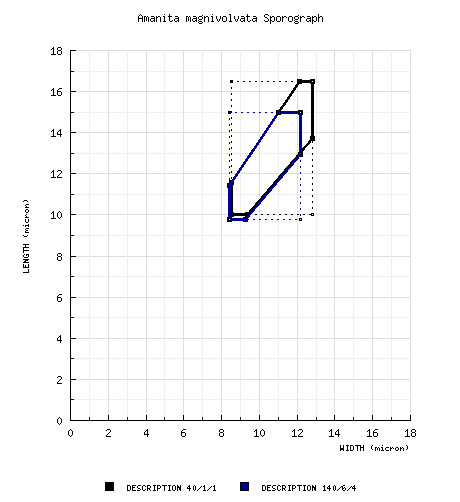
from type study of Tulloss (1994): [40/1/1] (9.0-) 10.0 - 16.5 (-17.5) × 8.5 - 12.8 (-14.5) μm, (L = 12.5 μm; W = 10.5 μm; Q = (1.03-) 1.07 - 1.36 (-1.50); Q = 1.19), hyaline, colorless, thin-walled, smooth, inamyloid, subglobose to broadly ellipsoid, occasionally ellipsoid to globose, often at least somewhat adaxially flattened, with giant spores sometimes adaxially indented; apiculus sublateral to (rarely) lateral, rather broad proportionately, cylindric; contents monoguttulate with additional small granules; white in deposit.
composite of all material examined: [140/6/4] (9.0-) 9.8 - 15.0 (-17.7) × (7.2-) 8.4 - 12.2 (-15.6) μm, (L = 10.8 - 12.5 μm; L' = 11.8 μm; W = 8.8 - 11.0 μm; W' = 10.0 μm; Q = (1.03-) 1.06 - 1.36 (-1.52); Q = (1.11-) 1.17 - 1.23; Q' = 1.18), hyaline, colorless, thin-walled, smooth, inamyloid, subglobose to broadly ellipsoid, occasionally ellipsoid to globose, often at least somewhat adaxially flattened, with giant spores sometimes adaxially indented; apiculus sublateral to (rarely) lateral, rather broad proportionately, cylindric; contents mono- to multiguttulate with or without additional small granules or entirely granular; white in deposit. |
| ecology |
Tulloss (1994): Finland: Subgregarious. In grass-herb forest in deep shade, developing in substrate of leaf and twig litter over clay in manner making "button" stage almost entirely above surface of soil, in forest dominated by Corylus avellana L. with Populus tremula L., Betula pubescens, B. verrucosa Ehrh., and Picea abies L., with shrub layer abundant and including Rhamnus frangula L., Salix spp., Alnus incana (L.) Moench., and Prunus padus L., with herb layer including Hepatica nobilis Schreber (=Anemone hepatica L.
non-type: Italy: At 100 m elev. Under Quercus ilex in humus-rich soil. |
| material examined |
Tulloss
(1994):
FINLAND:
VARSINAIS-SUOMI REGION—Karjalohja parish,
Puujärvi village, Herniemi, 1.x.1972 M. Aalto
1600 (holotype, H).
non-type material revised: ITALY:
LIGURIA—Genoa, municipal park on the
heights of Genoa, 30.v.1994 Mido Traverso s.n.
(RET 261-2; TRAVERSO).
NORWAY: VESTFOLD—Våle,
Våle church estate, 30.vi.1984 Per Marstad &
Steinar Aase s.n. (O, as "A. inaurata"). |
| discussion |
A sporograph comparison of the present species with
A.
pachyvolvata follows:
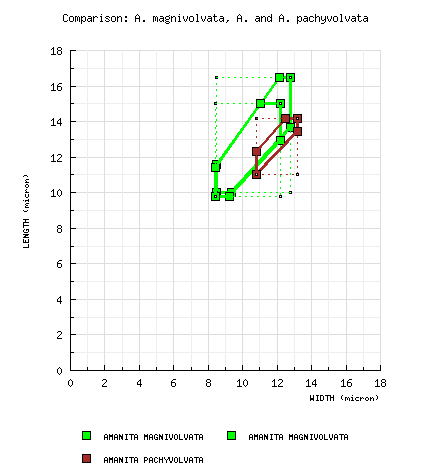
|
| citations |
—R. E. Tulloss |
| editors |
RET |
|


 Spore data sets and their composite