
| name | Amanita petersenii |
| name status | nomen provisorum |
| author | Tulloss & Kudzma |
| images |
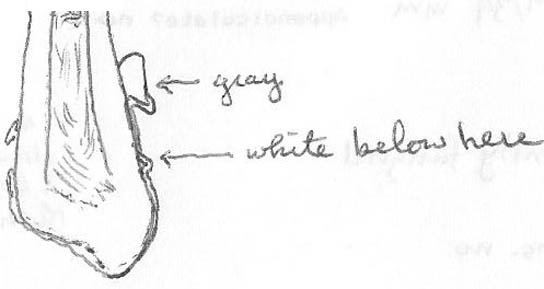  1. Amanita sp-S06, longitudinal section of stipe base and volva, Blue Valley, Macon Co., North Carolina, U.S.A. |
| intro | The following material is based on original research of R. E. Tulloss. |
| cap | The slightly flat, brownish gray cap is 78 mm wide and has a brown center with a broad rounded knob. The cap appears streaked with fine hair-like lines for most of its radius. The cap's flesh is white with a thin gray region below the cap's skin (10x lens required). The cap is 4.5 mm thick above the stem and thins evenly for most of its radius and then is reduced to a membrane the rest of the way to the grooved edge. The marginal grooving about half-way from the cap's edge toward its center. |
| gills | The free gills are 4.5 - 5.5 mm wide with a descending line on the upper stem. The edge of the gills bear what appear to be fine hair-like projections. The short gills are cut off squarely. |
| stem | The pale cylindric stem is 140 x 90 mm and is decorated with pale gray powder towards the flaring top, with darker fibers and narrow gray patches below. The stem is pale grayish-white and is unchanging when cut or bruised. No ring is present. The stem is stuffed with white cottony material that bruises yellowish in a central cylinder 3 mm wide. The flimsy, crumbly, sac-like volva is white in its lower half and is gray in its upper half. |
| odor/taste | The odor is reported to be "faintly fungoid." The taste was not recorded. |
| spores | The spores measure (9.1-) 9.5 - 10.8 (-11.0) × (8.0-) 8.5 - 10.0 (-10.5) µm and are inamyloid and subglobose to broadly ellipsoid. Clamps are probably lacking at bases of basidia. |
| discussion |
This species was found growing solitary in North
Carolina in a dry coarse mixed forest made up of
mainly Eastern White Pine (Pinus strobus),
Eastern Hemlock (Tsuga canadensis), Maple
(Acer sp.), and Rhododendron. This taxon has at least a superficial affinity to A. submembranacea of Europe or to the subarctic A. mortenii or to the North American A. sinicoflava.. Amanita petersenii was formerly called A. sp-S06 on this site.—R. E. Tulloss and N. Goldman |
| brief editors | RET |

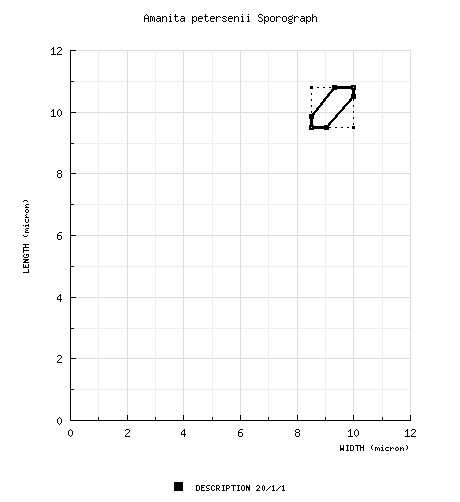
 Spore data sets and their composite