| name |
Amanita cinderellae |
| author |
Tulloss nom. prov. |
| name status |
nomen provisorum |
| english name |
"Cinderella's Amanita" |
| GenBank nos. |
Due to delays in data processing at GenBank, some accession numbers may lead to unreleased (pending) pages.
These pages will eventually be made live, so try again later.
|
| intro |
Olive text indicates a specimen that has not been
thoroughly examined (for example, for microscopic details) and marks other places in the text
where data is missing or uncertain.
The following is based on original research of R. E. Tulloss. |
| pileus |
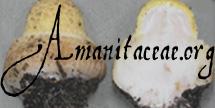
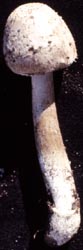
64 - 73 mm wide, pale umbrinous gray, not changing when bruised, virgate with pallid streaks, hemispheric with slight umbo, then campanulate to broadly campanulate, subviscid to tacky, subshiny; context white to off-white to pallid beige, sometimes gray in disk and under pileipellis, not changing when cut or bruised, 4 mm thick at stipe, thinning evenly for three-quarters to four-fifths of radius, then membranous to margin; margin striate (0.3 - 0.45R), appendiculate, incurved at first; universal veil absent. |
| lamellae |
free to narrowly adnate, subcrowded, dingy white to off-white in mass, pale cream to off-white in side view, unchanging when cut or bruised, up to 5.5 mm broad, with minutely flocculent concolorous edge, occasionally forking; lamellulae truncate, plentiful, of widely varying lengths, unevenly distributed, occasionally anastomosing to lamellae. |
| stipe |
94 - 99 × 9.5 - 12 mm, pale gray, becoming grayer with maturity, narrowing upward or thickest at center, flaring or not at apex, finely fibrillose (lens) below partial veil with gray or gray-brown fibrils darker than ground color, somewhat coarsely flocculent (lens) above; context pale gray to beige, darker toward apex and near stipe surface, unchanging when cut or bruised, larva tunnels concolorous, stuffed above, hollow below, with 3 mm wide central cylinder; partial veil subfelted-submembranous to subfelted-fibrillose, at first white above and gray below, becoming entirely gray, becoming radially lacerate, eventually lost, finely striate above (lens), smooth below; universal veil as weakly structured saccate volva tending to break up into smooth, up to 1.5 - 4.5 mm thick, somewhat rounded warts, then easily left in substrate, white at first, becoming gray, highest point of limb (when present) up to 30 mm from stipe base. |
| odor/taste |
Odor not distinctive. Taste not recorded. |
macrochemical
tests |
none recorded. |
| basidiospores |
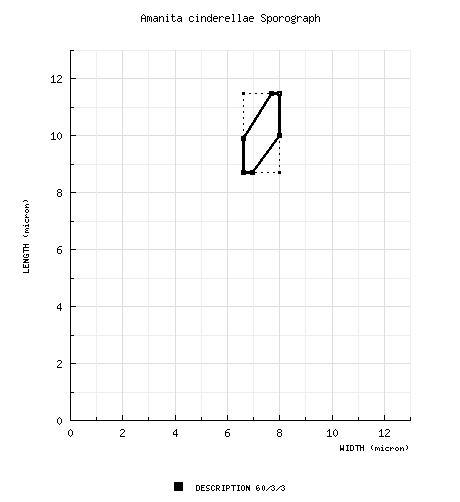
[60/3/3] (8.0-) 8.7 - 11.5 (-12.9) × (6.3-) 6.6 -
8.0 (-8.5) µm, (L = 9.4 - 10.4 µm;
L’ = 9.9 µm; W = 7.1 - 7.5 µm;
W’ = 7.3 µm; Q = (1.22-) 1.25 - 1.50
(-1.58);
Q = 1.33 - 1.39; Q’ = 1.36), hyaline,
smooth, thin-walled, inamyloid, broadly ellipsoid
to ellipsoid; apiculu sublateral, cylindric;
contents granular to multiguttulate to
monoguttulate with plentiful small granules; white in
deposit. |
| ecology |
New Jersey: Solitary under Quercus rubra or Q. alba. Connecticut: Solitary. |
| material examined |
U.S.A.:
CONNECTICUT—Fairfield Co. - Stamford,
20.ix.1984 S. S. Ristich s.n. [Tulloss
9-20-84-SSR-A] (RET 233-4, nrITS seq'd.),
22.ix.1984 S. S.
Ristich s.n. [Tulloss 9-22-84-SSR-A]
(RET 233-10). Unkn.
Co. - unkn. loc., ix.1993
participant in COMA foray s.n. (RET 106-4)
.
NEW JERSEY—Mercer Co. - Washington
Crossing St. Pk., arboretum area [40°18’00” N/
74°52’03” W, 32 m], 23.vi.1985 D. C. Tulloss
6-23-85-D (RET 053-5, nrITS seq'd.), 5.vii.1992
R. E. Tulloss 7-5-92-G (RET 061-7, nrITS seq'd.), 7.vii.1992 Bruce E. Vansant s.n.
[Tulloss 7-7-92-BEV2A] (RET 062-8, nrITS seq'd.). |
| discussion |
In the last few years RET and colleagues have
posted many sequences from section __Vaginatae__ to
GenBank. A recent nrITS sequence from the
present species yielded nBLAST results showing a closest
match (but not very close (e.g., grade over 91% with
over 84% similarity) to some of these recently posted
sequences from taxa of the Vaginatae.
The 5'-motif of the nrLSU locus
in the present species (TCTGACCTCAAATCA) is quite
unusual in the genus. It is shared only with
a small number
of taxa in the Vaginatae; for example,
A. minnesorora,
A. myrmeciae,
A. penetrans, and
A.
penetratrix. The current list of taxa
with the unusual motif can be found on the
technical tab of the last named taxon page.
It is important to re-evaluate
variation in the volva of this probable species. |
| citations |
—R. E. Tulloss |
| editors |
RET |
|


 Spore data sets and their composite