| name |
Amanita cistetorum |
| author |
Contu & Pacioni. 1998. Mycotaxon 69: 438, fig. 1(a-c). |
| name status |
nomen acceptum |
| english name |
"Cistus Loving Ringless Amanita" |
| etymology |
genetive plural of composite noun, Cistus, "genus of herbaceous plants and shrubs (Cistaceae)" |
| MycoBank nos. |
446913 |
| GenBank nos. |
Due to delays in data processing at GenBank, some accession numbers may lead to unreleased (pending) pages.
These pages will eventually be made live, so try again later.
|
| holotypes |
AQUI |
| selected illustrations |
Contu. 1999b. Boll. Ass. Micol. Ecol. Romana 46: 19, pl. unnumbered. |
| intro |
The following text may make multiple use of each data field.
The field may contain magenta text presenting data from a type study
and/or revision of other original material cited in the protolog of the present taxon.
Macroscopic descriptions in magenta are a combination of data from the protolog and
additional observations made on the exiccata during revision of the cited original
material.
The same field may also contain black text, which will data from a revision of the
species (including non-type material and/or material not cited in the protolog).
Paragraphs of black text will be labeled if further subdivision of
this text is appropriate.
Olive text indicates a specimen that has not been
thoroughly examined (for example, for microscopic details) and marks other places in the text
where data is missing or uncertain.
The following material not directly from the protolog of the present taxon is based upon
original research by R. E. Tulloss. |
| pileus |
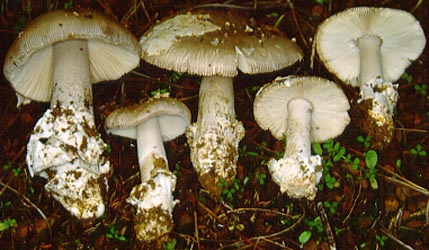
from protolog: 40 - 100 mm wide, lead-gray [a grayish brown] at first, then ash-gray, viscid at first; context white, unchanging; margin striate (up to 0.3R); universal veil as irregularly distributed warts or relatively large patch or patches, whitish, submembranous, fragile, with some ochraceous tint or spots [per image on this page]. [Note: Since the photograph on this page is Contu's, we have relied upon it to increase precision with regard to the color of the universal veil. The original text reads "ochraceous-whitish."—ed.] |
| lamellae |
from protolog: free, close to crowded, white sometimes with pinkish-ochraceous tint, often ash-grayish in age, proportionately rather broad and thick; lamellulae not described. |
| stipe |
from protolog: 50 - 80 × 8 - 15 mm, short in proportion to pileus width, white to lead-gray, cylindric or slightly narrowing upward, entirely pruinose and with pruinose covering being source of pigmentation?; context white, unchanging; exannulate; universal veil as saccate volve, white with ochraceous tint evident even in young material, submembranous, fragile, "scarcely sheathing" and tending to remain [at least in part] in substrate during collection of basidiome, with white basal mycelium. [Note: With regard to pruinose covering of the stipe we have provided an interpretation of the original text which reads, "entirely covered by a colours pruinosity."—ed.] |
| odor/taste |
from protolog: Odor and taste both week. Edible when cooked. |
macrochemical
tests |
none reported. |
| pileipellis |
from protolog: suprapellis "with thick layer of ixocutis composed of hyphae 1.2 - 7.2 μm wide; subpellis comprising filamentous hyphae 2.4 - 9.6 μm wide, with vacuolar pigment. [Note: It appears that there may be some confusion here over the terminology used to describe this tissue.—ed.] |
| pileus context |
from protolog: vascular hyphae present. |
| lamella trama |
from protolog: bilateral.
RET: bilateral; ??. |
| subhymenium |
from protolog: cellular. |
| basidia |
from protolog: 42 - 56 × 9.5 - 15.2 μm, rarely utriculate; 4-sterigmate; clamps lacking.
RET: 43 - 63 × 9.3 - 13.6 μm, ??. |
| universal veil |
from protolog: On pileus: apparently not described. On stipe base, exterior surface: not described. On stipe base, interior: filamentous hyphae 2.4 - 12.0 μm wide, as loose open lattice; inflated cells 12 - 55 μm wide, colorless to brown; vascular hyphae 9.2 - 26 μm wide. On stipe base, inner surface: not described. |
| stipe context |
from protolog: not described.
RET: longitudinally acrophysalidic; filamentous, undifferentiated hyphae 2.7 - 9.6 μm wide, branching, dominating near surface; acrophysalides up to 233 × 36 μm, plentiful except at exterior stipe surface, apparently absent at exterior surface, dominant in interior; vascular hyphae 5.1 - 15.9 μm wide, sinuous, infrequent, most frequent at exterior surface. |
| partial veil |
absent. |
| lamella edge tissue |
from protolog: inflated cells frequent, clavate to pyriform, 42 - 56 × 9.5 - 17 (-24) μm. |
| basidiospores |
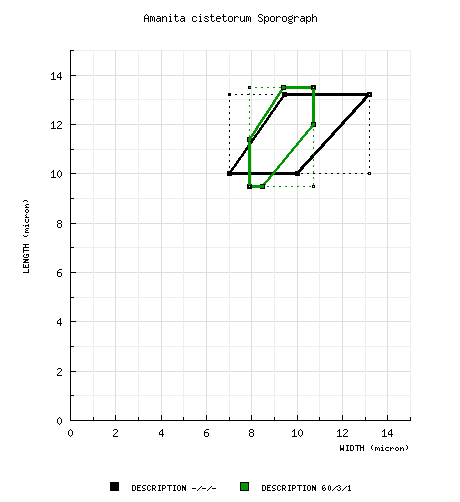
from protolog: [-/-/-] 10.0 - 13.2 × 7.0 - 13.2 μm, (Q = 1.0 - 1.4; Q' = 1.16), hyaline, inamyloid, globose (infrequently) to subglobose to broadly ellipsoid to ellipsoid, at least sometimes adaxially flattened (per figure); apiculus sublateral (per figure); contents monoguttulate (oil drop type); white in deposit. [Note: In this data, the Q value of the smallest recorded spore is the largest Q value and the Q value of the largest recorded spore is the smallest Q value. This is abnormal or at least unusual as is the sporograph which is quadrilateral rather than hexagonal. The latter suggests that the ranges of length, width, and Q are not based on the methods of this site.—ed.]
RET: [60/3/1] (8.9-) 9.5 - 13.5 (-15.5) × (6.2-) 7.9 - 10.7 (-12.5) μm, (L = 11.2 - 11.5 μm; L' = 11.3 μm; W = 9.0 - 9.2 μm; W' = 9.0 μm; Q = (1.09-) 1.12 - 1.44 (-1.56); Q = 1.26 - 1.27; Q' = 1.26), hyaline, colorless, smooth, thin-walled, inamyloid, subglobose to broadly ellipsoid to ellipsoid, adaxially flattened, sometimes expanded at one end; apiculus sublateral and cylindric to truncate-conic; contents dominately monoguttulate with additional small granules; white in deposit. |
| ecology |
from protolog: In small groups in the Mediterranean maquis, very common in Sardinia. Associated with Quercus suber and Cistus monspieliensis L. or with C. monspieliensis alone.
RET: With C. monspieliensis.
Cistus monspeliensis is a shrub of the Mediterranean region (southern Europe and northern Africa). In recent years southern European authors have reported amanitas that are proposed as ectomycorrhizal with Cistus. At least two species of Cistus have been established to be mycorrhizal—C. incanus and C. albidus. |
| material examined |
from protolog:
ITALY:
SARDINIA—Prov. Cagliari - Sette Fratelli,
1.xii.1981 G. Pacioni s.n. (paratype, AQUI).
Prov. Oristano - Marrubiu, Sant'Anna, 28.xi.1981 G.
Pacioni s.n. (paratype, AQUI). Prov. Sassari -
Luras, loc. Diga del Liscia, 26.xii.1995 M. Contu s.n.
(holotype, AQUI).
RET: ITALY:
SARDINIA—Prov. Sassari - Brandinchi,
11.xi.1997 M. Contu s.n. (original material, in
herb. Contu, authentic; RET 293-5, nrITS &
nrLSU seq'd.). |
| discussion |
The material examined by RET is authentic, original material that is not cited in the protolog.
The authors do not mention graying of the universal veil; however, they do report brown inflated cells in its tissue. This is similar to the submembranous universal veil of A. submembranacea to which they compare the present species. They state without further comment that Contu's A. submembranacea var. griseoargentata ia a "grayish variant" of the present taxon. The following figure provides sporograph comparison of the present species with A. submembranacea:
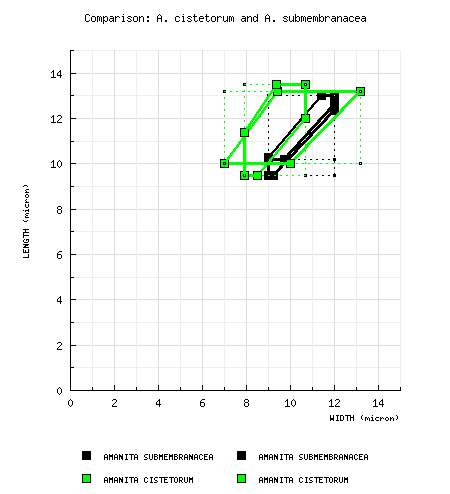
If we set aside the sporograph based on the data from the protolog of the present species and use only data from RET's studies, then the sporographs have minimal overlap, and the proportionately rounder spores of A. submembranacea are easily distinguishable from the spores of the present taxon.
The same can be shown to be true for other taxa with distinctly graying, submembranous universal veil and subglobose to broadly ellipsoid spores, e.g., A. constricta, A. reidiana, A. sinicoflava, etc.
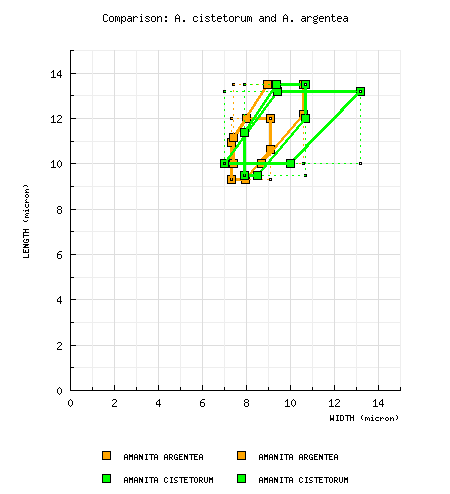
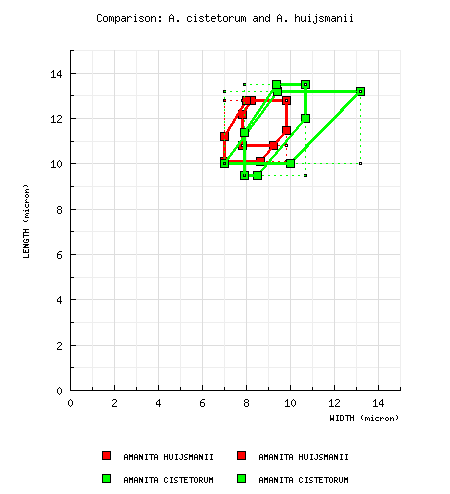
The authors expend some effort to distinguish the present taxon from three members of the group of European taxa in sect. Vaginatae with relatively narrow ellipsoid spores: A. argentea, A. huijsmanii, and A. mairei. The arguments rely on spore size and shape in large part; however, the difference in these characters is not always clear. Sporograph comparisons of the present species with these taxa are presented below:
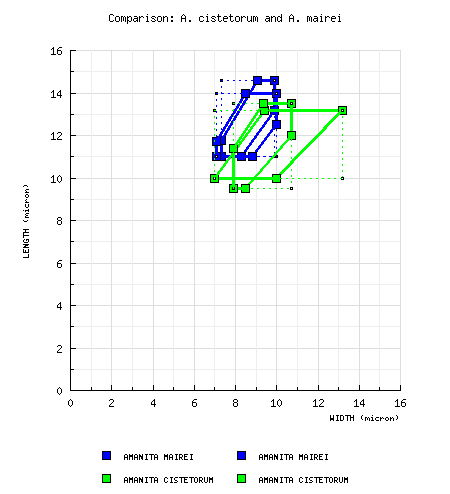
On the other hand, they fail to mention A. oblongispora the spores of which are at least as similar to those of the present species as are those of the taxa they list and was originally described from Sardinia.
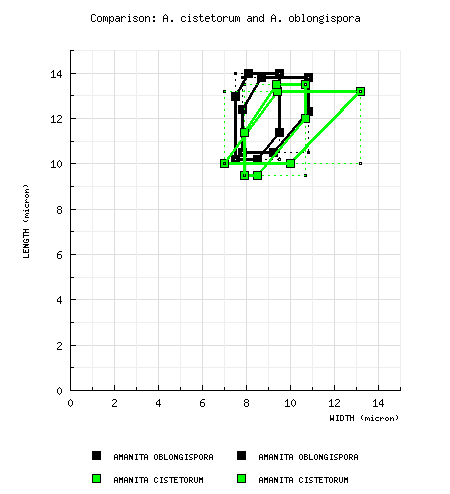
???more...give differentiation information for taxa where the difference is clear...examine universal veil of present taxon, etc.??? |
| citations |
—R. E. Tulloss |
| editors |
RET |
|



 Spore data sets and their composite