| name |
Amanita chiricahuana |
| author |
Tulloss nom. prov. |
| name status |
nomen provisorum |
| english name |
"Chiricahua Ringless Amanita" |
| etymology |
Chiricahua + -ana, suffix indicating
possession; hence, "of the Chiricahua"
For the Chiricahua Mountainsand the Chiricahua
Apaches for whom the mountains
were named and commemorating the
Chiricahua Mycoflora Project. |
| GenBank nos. |
Due to delays in data processing at GenBank, some accession numbers may lead to unreleased (pending) pages.
These pages will eventually be made live, so try again later.
|
| intro |
Olive text indicates a specimen that has not been
thoroughly examined (for example, for microscopic details) and marks other places in the text
where data is missing or uncertain.
The following is based on original research of R. E. Tulloss. |
| pileus |
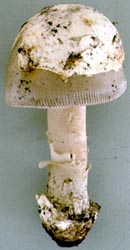
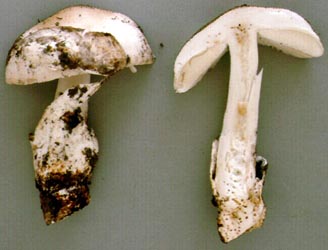
54 - 120 mm wide, gray with faint umbrinous tint to brownish-gray to pale brownish gray, sometimes white just at margin, unchanging when cut or bruised, irregular to subhemispheric at first, then convex, finally plano-convex with broad low umbo, sometimes developing concentric ridges (CMP1333), tacky to dry, shiny; context white to whitish to pale cream except for grayish region (up to 5 mm thick) in disc or mostly gray with whitish region above lamellae and near the stipe apex, with or without watery line above lamellae, unchanging when cut or bruised, 3.5 - 17 mm thick at stipe, thinning evenly to margin or to within 4 - 10 mm of margin and then membranous to margin; margin striate (0.1 - 0.25R), occasionally tuberculate in outermost 4 - 5 mm (CMP1333), nonappendiculate; universal veil as large patch or patches, white, occasionally with ochraceous or yellow-tan splotches and stains (CMP1333) or becoming pale grayish white (8-16-97-A[, CMP1818]) to brownish gray (CMP1346) in age, unchanging when cut or bruised, membranous and sometimes leathery or (in age) submembranous (CMP1346), soft and cottony at first, up to 1.5 mm thick, with subfelted surface (lens) in age (CMP1346), detersile. |
| lamellae |
receding to free to narrowly adnate, with faint (lens) to distinct (and then rather long) decurrent lines on stipe, crowded, off-white to cream to faintly orangish cream to sordid cream to very pale gray in mass, off-white to pale cream to sordid cream to very pale grayish white in side view, becoming more sordid at maturity and in areas damaged by insects, 4 - 8 mm broad, broadest about 0.75R from stipe to margin, sometimes with minute white flocculence (lens) on edge, with forking and reverse forking rather common in some specimens (8-16-97-A, CMP1333, CMP1346); lamellulae truncate to subattenuate, of diverse lengths, infrequent in some sectors, occasionally apparently absent (CMP1333) but then forking more common, often common to plentiful, originating at stipe occasionally, occasionally attached to neither stipe nor margin, occasionally almost all anastomosing with lamellae to form nearly poroid hymenium (CMP1333). |
| stipe |
44 - 114 × 12.5 - 20 mm, white to very pale grayish white with pulverulent to chalky surface, becoming brownish gray to gray when handled or in age, sometimes minutely fibrillose to fibrillose in lower portion (and then fibrils becoming brownish gray when touched or in age), sometimes with surface splitting into recurved scales (especially in lower third), subcylindric or narrowing upward or downward, flaring at apex or not, finely longitudinally striatulate (becoming more pronouncedly striate in age), sometimes with slight swelling at base (8-16-97-A, CMP1346); context white to off-white, unchanging when cut or bruised, concolorous to sordid ochraceous to watery tan in larva tunnels, firmly [occasionally in age somewhat loosely (CMP1818)] stuffed with white cottony fibrils, with central cylinder 5 - 12 mm wide; exannulate; universal veil as saccate volva, white on both exterior and interior surfaces, with some ochraceous stains on exterior of base, soft, cottony on exterior, membranous, sometimes graying in upper part of limb with age, up to 1.5 mm thick at midpoint between point of attachment to stipe and highest point on limb, distance from base of stipe to highest point of limb 26 - 37 mm, up to 34 mm wide, often breaking into uneven (sometimes subtriangular) limbs adnate to stipe base for one third to one half their lengths, with limbus internus small and placed near point of attachment (8-16-97-A, CMP1346), sometimes with upstanding fine fibrils on top, often becoming obliterated with age. |
| odor/taste |
Odor lacking or indistinct, occasionally sourish (CMP1333), sometimes unpleasant in age (CMP1346). Taste lacking. |
macrochemical
tests |
Syringaldazine spot test for laccase - positive within 2 min. in spots in context of stipe base and interior of universal veil, eventually positive throughout universal veil interior (including most pileal warts) and base of stipe in both immature and mature specimens and, in mature material, often on surface of lower stipe and on surfaces of lower half of central cylinder of stipe or in context of lower stipe. Paracresol spot test for tyrosinase - strongly positive in 1± min. in stipe base (then quicklly positive in entire stipe context), interior of volval limb, stipe surface, and pileipellis; eventually positive throughout basidiome except for pileus context under disc and some spots on lamellae. Chemical test voucher: CMP1818, Tulloss 8-16-97-A. |
| basidia |
43 - 61 × 13.8 - 17.5 µm, 4-sterigmate. |
| lamella edge tissue |
sterile. |
| anatomical figures |
|
| basidiospores |
[60/3/3] (9.5-) 10.2 - 13.2 (-14.0) × (8.5-) 9.0 - 11.8 (-13.0) µm, (L = 11.6 -11.8 µm; L’ = 11.7 µm; W = 10.3 - 10.8 µm; W’ = 10.5 µm; Q = (1.03-) 1.04 - 1.20 (-1.25); Q = 1.09 - 1.14; Q’ = 1.11), hyaline, colorless, ??-walled, smooth, inamyloid, globose to subglobose to broadly ellipsoid, ?? adaxially flattened, ?? expanded at one end; apiculus sublateral, short, sometimes rather broad, up to 1.0 × 1.2 µm, usually cylindric, occasionally truncate-conic; contents monoguttulate with or without additional small granules to multiguttulate; white in deposit. |
| ecology |
Arizona: Solitary to subgregarious, from 2130
to 2570 m elev. Under Pinus arizonica
in sand and rocks beside jeep trail or with
Pseudotsuga menziesii, Pinus discolor,
P. chihuahuana in rocks and sand of jeep trail
or under P. engelmannii or in mixed woods
with Quercus spp., P. arizonica, and
Ps. menziesii.
Colorado: Subgregarious, at 3200± m
elev. Under Picea engelmannii. |
| material examined |
U.S.A.:
ARIZONA—Cochise Co. - Coronado
National Forest, Chiricahua Mountains, Pinery Canyon
Camp, 4 km SE of Pine Canyon Rd (Chiricahua
Mycoflora Project site 10) [31.9331 N/ 109.2711 W,
2134 m], 30.viii.1993 J. Nam
Soo s.n. [CMP3514] (RET 676-10, nrITS seq'd.),
Rustler Park, Forest Service Station to 0.8 km S
on tr. to Long Park (Chiricahua Mycoflora Project
site 5) [31.9027° N/ 109.6270° W, 2558 m],
19.viii.1992 R. E. Tulloss 8-19-92-K [CMP1333]
(RET);
Rustler Park, on tr. to Long Park from Forest Service
Station 0.8 to 1.6 km S (CMP site 6) [31.9017° N/
109.2767° W, 2570 m], (CMP site #6), 19.viii.1992
R. E. Tulloss 8-19-92-W [CMP1341] (RET, nrITS seq'd.);
Barfoot Park, CMP site 46 [31.9157° N/ 109.2891° W,
2424 m], 15.viii.1991 F. H. Nishida s.n. [CMP0817]
(RET 702-1, nrITS-nrLSU seq'd.), 21.viii.1992 S. B.
Fleming s.n. [CMP1346; Tulloss 8-21-92-S]
(RET, nrITS seq'd.).
F. H. Nishida s.n. [CMP1818; Tulloss 8-21-92-X]
(RET, nrITS seq'd.),
W. J. Sundberg s.n. [CMP1835; Tulloss 8-21-92-ADa]
(RET, nrITS seq'd.);
22.viii.1994 S. B. Fleming s.n.
[CMP3302; Tulloss 8-22-94-A] (RET). |
| discussion |
t.b.d.
Material from the original collection site and date
has now been sequenced (nrITS and nrLSU sequences
derived).
This species was formerly called" Amanita sp.
AZ23 in manuscripts, checklists, and keys
circulated by RET. |
| citations |
—R. E. Tulloss |
| editors |
RET |
|




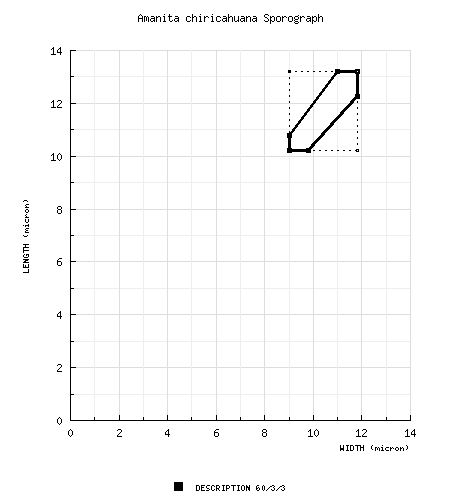
 Spore data sets and their composite