
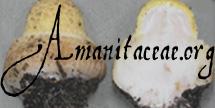
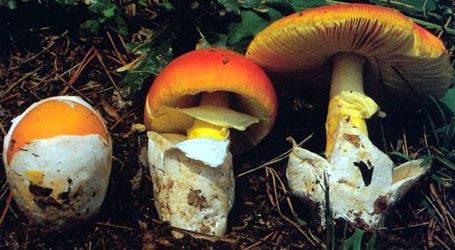
| name | Amanita sp-Arora-01-555 |
| name status | cryptonomen temporarium |
| english name | "Zambian Ringed Ringless Amanita" |
| GenBank nos. |
Due to delays in data processing at GenBank, some accession numbers may lead to unreleased (pending) pages.
These pages will eventually be made live, so try again later. |
| pileus | yellow-brown, umbonate; context ??; margin short striate, nonappendiculate; universal veil absent. |
| lamellae | ??; lamellulae truncate. |
| stipe | tall, with unknown amount of stipe base missing in sole exsiccatum; partial veil membranous, superior, persistent, proportionately narrow; universal veil as pallid membranous patch on lower stipe, ??. |
| odor/taste | neither recorded. |
| macrochemical tests |
none recorded. |
| universal veil | longitudinally acrophysalidic. |
| lamella edge tissue | sterile. |
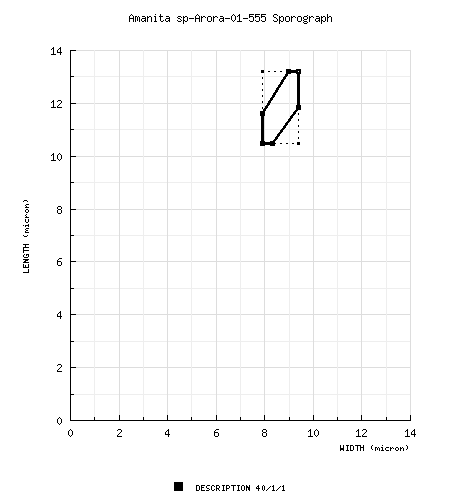
| basidiospores | [40/1/1] (10.2-) 10.5 - 13.2 (-15.0) × (7.3-) 7.9 - 9.4 (-10.5) μm, (L = 11.9 μm; W = 8.7 μm; Q = (1.21-) 1.26 - 1.47 (-1.60); Q = 1.36), hyaline, colorless, smooth, thin-walled, inamyloid, broadly ellipsoid to ellipsoid, usually adaxially flattened; apiculus sublateral, cylindric; contents mono- to multiguttulate (oil drop type); color in deposit unrecorded. |
| ecology | not recorded. |
| material examined | ZAMBIA: NORTHERN PROV.—Mpika Distr. - ca. Mpika, 22 km off Great North Hwy., Mutinondo Wilderness Area, 31.xii.2000-7.i.2001 David Arora 01-555 (RET 345-3, nrITS & nrLSU seq'd.). |
| discussion |
The most similar nrLSU sequence fragment in GenBank
is a fragment of less than 400 characters from
A.
madagascariensis, an annulate species of
sect. Vaginatae. The following figure provides a comparison of the sporographs of the present species and A. madagascariensis: |
| citations | —R. E. Tulloss, L. V. Kudzma, and D. Arora |
| editors | RET |
Information to support the viewer in reading the content of "technical" tabs can be found here.
 Spore data sets and their composite
Each spore data set is intended to comprise a set of measurements from a single specimen made by a single observer; and explanations prepared for this site talk about specimen-observer pairs associated with each data set. Combining more data into a single data set is non-optimal because it obscures observer differences (which may be valuable for instructional purposes, for example) and may obscure instances in which a single collection inadvertently contains a mixture of taxa.

Text and User-Generated Sporographs are published under the Creative Commons License.

In the case of a taxon page, image credits are on the 'image' tab.