
| name | Amanita verrucosivolva |
| name status | nomen acceptum |
| author | Zhu L. Yang |
| english name | "Asian Warted-Sack Ringless Amanita" |
| images |
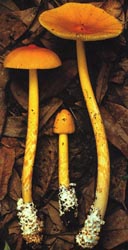 1. Amanita verrucosivolva, Yunnan Prov., China |
| intro | The following is based on the original description of A. verrucosivolva. |
| cap | The fruiting bodies of Amanita verrucosivolva are medium-sized to large. The cap is 70 - 140 mm wide, convex to applanate to concave, often distinctly umbonate, at first yellowish, becoming orange to yellow when mature, often yellowish towards margin, usually glabrous; the cap margin is tuberculate-striate (30% to 40% of radius), non-appendiculate; and the context is white. |
| gills |
The gills are free, crowded, and white to cream, with edges yellowish; the short gills are truncate. |
| stem | The exannulate stem of A. verrucosivolva is 100 - 220 × 10 - 20 mm, subcylindric or slightly tapering upwards, with a lower half that is white to ream and covered with yellow to orange, snakeskin-like squamules, while the upper half is yellowish to orange. The context is white and hollow; the stipe lacks a basal bulb; the volva on the stipe's base is saccate, 40 - 80 × 20 - 35 mm, 1 - 4 mm thick, with its outer surface white to dirty white and with brownish to ferruginous, conical to verrucose warts. The inner surface of the volva is white, and the volva's internal limb is yellow to yellowish. |
| odor/taste |
Odor of sauerkraut. Taste is mild. |
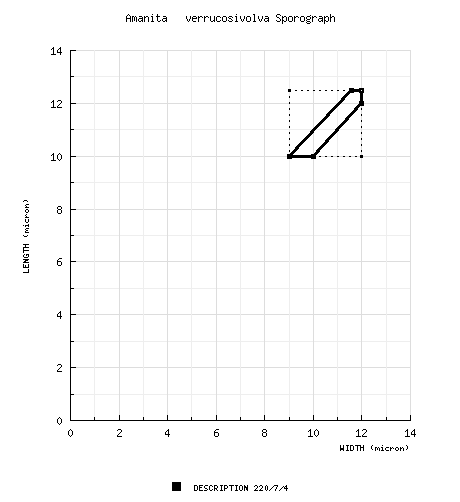
| spores | The spores of this species measure (9.0-) 10.0 - 12.5 (-14.0) × (8.5-) 9.0 - 12.0 (-14.0) µm, are globose to subglobose, and are inamyloid. Clamps are absent from the bases of the basidia. |
| discussion |
This species was originally
described from Yunnan Province, southwestern
China. It has also been found in Hubei
Province, central China.—Zhu L. Yang [Note: the reader may wish to compare this species with other species of section Vaginatae having a somewhat similarly decorated volva—A. strobilaceovolvata Beeli, A. strobilaceovolvata sensu Pegler & Shah-Smith, A. madagascariensis L. P. Tang et al., and A. tomentosivolva Zhu L. Yang. Note that several of these taxa have only recently been recognized as belong in the Vaginatae because they have annulate stems.—ed.] |
| brief editors | RET |

 Spore data sets and their composite