| name |
Amanita sp-N58 |
| author |
Tulloss & Rodríquez-Caycedo |
| name status |
cryptonomen temporarium |
| english name |
"Brown-orange Ringed Ringless Amanita" |
| GenBank nos. |
Due to delays in data processing at GenBank, some accession numbers may lead to unreleased (pending) pages.
These pages will eventually be made live, so try again later.
|
| intro |
Basidiomes are small to medium. |
| pileus |
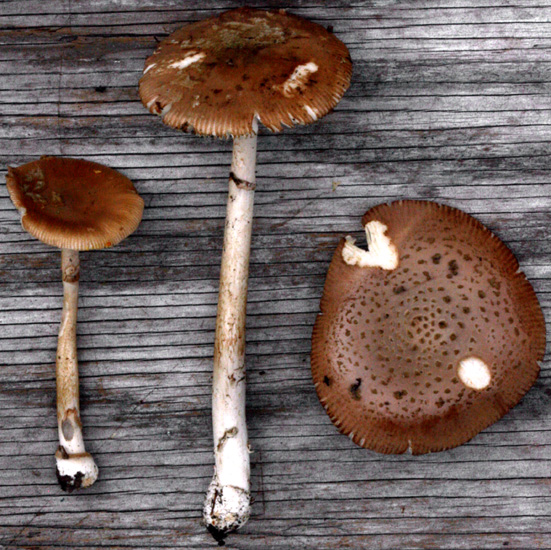
27 - 56 mm wide, brownish orange to orange-brown, plano-convex; context white or whitish, unchanging when cut or bruised, 4± mm thick over stipe; margin striate (0.15 - 0.35R), nonappendiculate; universal veil as felted-pulverulent patches or warts, pallid grayish to grayish, up to ca. 1 mm thick, detersile, when warts present then with warts (a) densely distributed locally or confluent and (b) having a flattened or irregular upper surface (not pyramidal) and (c) having polygonal bases and (d) at 50× having distinct layering with upper layer pulverulent and lower layer dominantly filamentous and (e) at 50× having fibrils extending radially from wart bases. |
| lamellae |
free, sometimes receding, ?, sordid cream in mass, pale creamy white in side view, 4.0 - 7.5 mm broad, rarely forking, rarely with reverse forking, with edges bearing little decoration; lamellulae sharply truncate, plentiful, of diverse lengths, unevenly distributed. |
| stipe |
50 - 100 × 3 - 8.5 mm, white, with raised fibrils becoming orange-brown from handling, chalky below fibrillose region and above bulb (taking finger prints), subcylindric or narrowing upward, barely flaring at apex, longitudinally striatulate; bulb subglobose to broadly ellipsoid, 5.5 - 13.5± mm × 6.5 - 15± mm; context off-white, unchanging, stuffed above, hollow below, with stuffing material comprising longitudinally oriented white fibrils, with similar material lining central cylinder in hollow part, with central cylinder 1.5 mm wide; larval tunnels not observed; partial veil superior (attached 10 - 24 mm from apex), membranous, faintly orangish white, narrow, with thickened grayish edge, soon collapsing and becoming reduced to grayish line, finally blackening with age or exposure; universal veil as membranous limb against stipe base or ocreate volva at base of stipe or as irregular patches on lower stipe, thin, pallid becoming distinctly gray, eventually dark gray in contrast with white of bulb, with patches variable in size and shape. |
| odor/taste |
Odor and taste not recorded. |
macrochemical
tests |
none recorded. |
| basidiospores |
[70/3/1] (8.5-) 9.0 - 12.2 (-15.0) × (5.5-) 5.9 - 7.2 (-8.8) μm, (L = 9.9 - 11.0 μm; L' = 10.5 μm; W = 6.2 - 6.9 μm; W' = 6.6 μm; Q = (1.32-) 1.43 - 1.77 (-1.88); Q = 1.54 - 1.61; Q' = 1.59), hyaline, colorless, thin-walled?, smooth, inamyloid, ellipsoid to elongate, adaxially flattened; apiculus sublateral, cylindric; contents monoguttulate with or without additional small granules; color in deposit not recorded. |
| ecology |
Solitary to scattered or in small group.
Connecticut:
At 150± m elev. In mixed deciduous
forest with Quercus alba, Q. rubra,
Acer, Betula, Fagus grandifoliva,
etc. |
| material examined |
U.S.A.:
CONNECTICUT—Middlesex Co. - E. Haddam,
Devil's Hopyard St. Pk. [41.4825° N/ 72.3147° W,
157 m], 4.ix.2011 Paula de Santo, Rhoda Roper et al.
s.n. [Tulloss 9-4-11-G] (RET 490-6, nrLSU
seq'd.). |
| discussion |
Among the three specimens in the original Connecticut
collection the coloring of the universal veil on
the pileus was variable with the upper parts of
some material paler than the basal parts and with
the reverse situation also seen. In most
cases, the volval remnants were patchy, but on the
largest cap, the volva had broken up into
polygonally-based warts with relative distinct
faces (facets) on the sides. In the warts,
apparent layering was visible (50×)—with the wart
base dominated by interwoven fibrils and the upper
part dominantly pulverulent.
Although we have not been able to obtain a complete
nrITS sequence for this species, we were able to
obtain three fragments of such a sequence. The
terminal fragment of ITS2 was connected with
a fragment
of the 5' end of an nrLSU sequence. The
combined length of these segments exceeds 200
characters. Despite poor quality, we were able to
find that the nrLSU sequence began with the 5' motif
known from Amanita subsection
Penetratrices.
This led to comparison with databases of nrLSU
sequences from section Vaginatae.
The four closest matches were species from subsection
Penetratrices.
The reader may
wish to compare the present species with
A.
sp-N49.
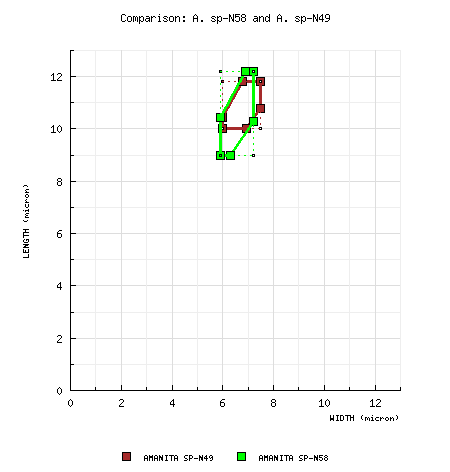
From sp-N49 we have the 64 initial characters
of nrLSU. Allowing for damage in the nrLSU 5'
motif of sp-N58. The two sequences share this
64 character substring.
The macroscopic description of the two taxa are
very similar, with one possible exception.
The known material of sp-N49 lacks a partial
veil. Genetic studies of the two species are
continuing.
more t.b.d. |
| citations |
—R. E. Tulloss and C. Rodríguez Caycedo |
| editors |
RET |
|


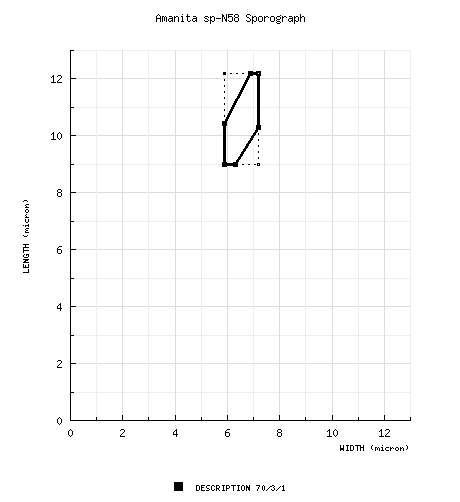
 Spore data sets and their composite