

| name | Amanita trygonion |
| name status | nomen provisorum |
| author | Tulloss, Pastorino & Kudzma |
| english name | "Little Dove Ringless Amanita" |
| images |
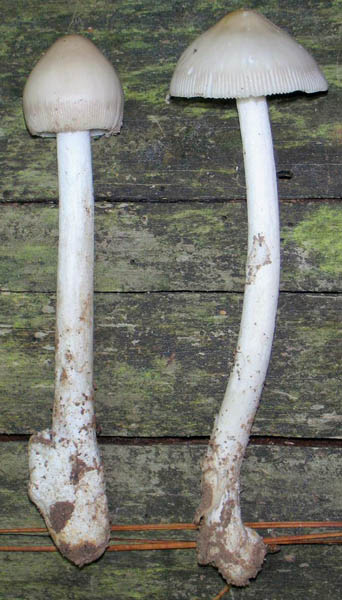 1. Amanita trygonion, Big Thicket Nat. Preserve, Hardin Co., Texas, U.S.A. (RET 622-5) |
| intro | The following description is based on original research by the authors of this page. |
| cap |
"sp-33": The cap of this species is about 53 mm wide,
pale grayish brown with notably darker gray-brown to
brown in the center and slightly darker gray brown over
the striate area, and umbonate. The cap's flesh
is off-white except under cap's skin in the umbo where
it is gray and elsewhere under the cap's skin paler
gray; the flesh is 4 mm thick above the stem.
The cap's margin is striate (45% of pileus radius); and
volval remnants are absent from the cap. "sp-T47": The cap of this specis is about 47 mm wide. At first the center of the cap is buff, while the remainder is pale grayish. As the mushroom ages the cap becomes grayer except for the center which becomes yellower. The cap is ovoid at first and becomes broadly bell-shaped with a distinct umbo. The cap's flesh is white. The margin of the cap is radially grooved with grooves occupying one-fifth to one-fourth of the cap's radius. There is no volval material remaning on the cap. |
| gills |
"sp-T33": The gills are free, crowded, off-white in
mass, white to pale grayish white in side view, and
about 3.5 mm broad. The short gills are truncate,
unevenly distributed, of diverse lengths, and
plentiful.
"sp-T47": The gills are narrowly connected to the stem in material viewed so far; they are close and cream to white. The short gills are squarely cut-off or nearly so and not very common. |
| stem |
"sp-T33":The stem is about 151 × 7 mm, off-white,
smooth in the upper three-quarters, and below area has
pale grayish fibrils forming upward pointing
squamules. There is no annulus on the
stem. At the stem's base, the volva is
sack-like, membranous, white on both inside and
outside surfaces, 42 × 12 mm. The volva has a
thin inner limb with very uneven free edge; it is
unusually long and attached to the outer volval limb
at the point of that limb's attachment to to the
stem. "sp-T47": The ringless stem of A. trygonion is 106 - 120 × 6 - 7.5 mm and white to off-white. The stem is inserted in a white, persistent, membranous, sack-like volva ranging up to 29 × 15.5 mm and attached to the stem's base. |
| odor/taste |
"sp-T33":
"sp-T47": The odor of this mushroom is slight or indistinct. Its taste has not been recorded. |
| spores |
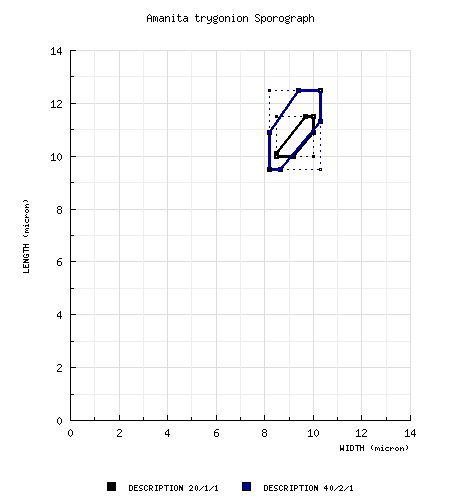
"sp-T33": Spore from this species measure (9.8-) 10.0 -
11.5 (-12.5) × (8.1-) 8.5 - 10.0 (-10.5) μm and are
inamyloid and subglobose to broadly ellipsoid.
Status of clamps on the basidia has not been
investigated, but they are probably absent.
"sp-T47": The spores of A. trygonion measure (7.9-) 9.5 - 12.5 (-13.0) × (7.1-) 8.2 - 10.3 (-11.5) μm and are dominantly broadly ellipsoid (sometimes subglobse or ellipsoid) and inamyloid. Clamps are absent from bases of basidia. |
| discussion |
"sp-T33": The long, thin inner limb of the volva is
somewhat reminiscent of the same structure in the
Atlantic coastal plain species
Amanita
longicuneus Tulloss nom. prov., but
the spores of the latter species are
larger and closer to being spherical. The
two species are also genetically separated as
indicated in part by the more common nrLSU 5' motif
(beginning with "TTT") in longicuneus and the
less common (beginning with "TCT") in the present
species. "sp-T47": Amanita trygonion is known only from pine-dominated mixed forest in sandy soils of eastern Texas. This species suggests Amanita sp-V01 to which the reader may wish to refer. This species was formerly called both Amanita sp-T33" and "Amanita sp-T47" on this site.—R. E. Tulloss and R. L. Pastorino |
| brief editors | RET |

 Spore data sets and their composite