
| name | Amanita hemibapha |
| name status | nomen acceptum |
| author | (Berk. & Broome) Sacc. |
| english name | "Half-Dyed Slender Caesar" |
| images |
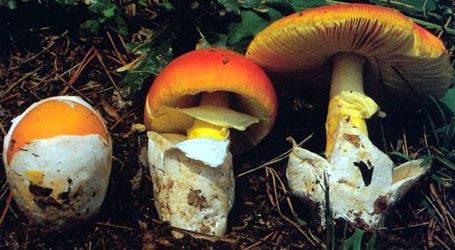
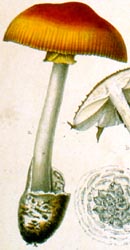 1. Amanita hemibapha, Sri Lanka, plate from original description. 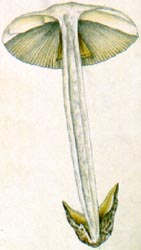 2. Amanita hemibapha, Sri Lanka, plate from original description. 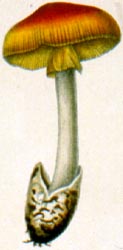 3. Amanita hemibapha, Sri Lanka, plate from original description. 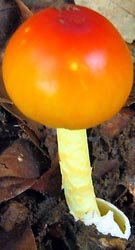 4. Amanita hemibapha, Kerala state, India. 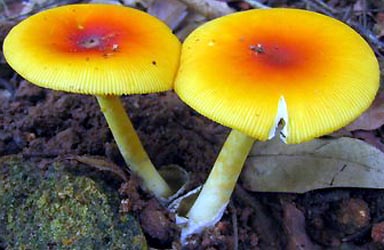  5. Amanita hemibapha, Kerala state, India. 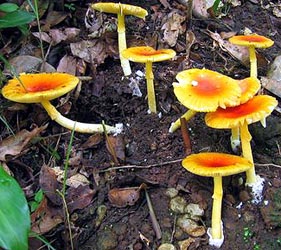 6. Amanita hemibapha, Kerala state, India. 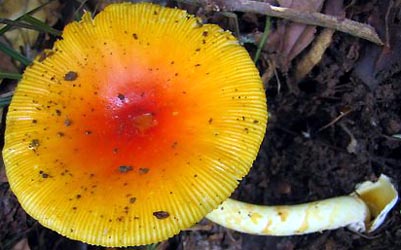 7. Amanita hemibapha, Kerala state, India. |
| intro | The following macroscopic description of Amanita hemibapha is based on (Vrinda et al., 2005). |
| cap | The cap of A. hemibapha is 80 - 100 mm wide, it is hemispheric at first and rarely develops an umbo, it becomes convex and then planar with or without a central depression; the margin may be flared upward in age. At first the color is tomato red or capsicum red. With age and exposure, the disc becomes deep orange and the margin distinctly more yellow. The striations on the margin extend inward for half the cap radius. The cap flesh is up to 6 mm thick, white with a yellow band below the cap''s skin, and doesn't bruise when injured. |
| gills | The gills are free, crowded, creamy white at first and pastel yellow to light yellow in mature specimens. They are up to 12 mm broad, unchanging when bruised and have an edge similar in color to the side surface. Infrequently, forked gills may be found. Short gills occur in at least three different lengths. |
| stem | The stem of A. hemibapha is 70 - 150 × 6 - 12 mm, maize yellow above and pastel yellow below, narrows upward, is connected to the volva only at its very base, and bears a superior skirt-like, maize yellow ring with a striate upper surface. The volva is saccate, fleshy, essentially white with two exceptions (the inner surface is yellow or yellowish; and the outer surface may bear brownish patches at first). The internal limb can be rather robust and be placed between 1/3 and 2/3 the distance from the volva''s upper rim to its base. As in many (most?) other taxa of stirpes Caesarea and Hemibapha, the fleshy part of the internal limb is connected to a colored subfelted to felted sheath covering the stem in the button stage. In the present species, this material breaks up and is left as patches or scraps (often with a horizontal orientation) on the stem. In A. hemibapha, these remnants are subfelted and maize yellow to sunflower yellow. |
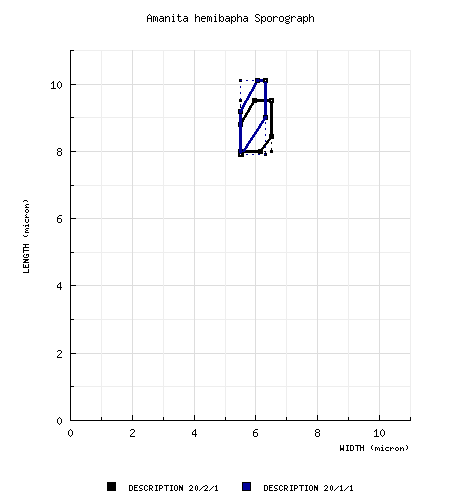
| spores | The spores measure (7.5-) 7.9 - 10.1 (-10.2) × (5.4-) 5.5 - 6.3 (-6.5) µm and are ellipsoid to elongate and inamyloid. Clamps are common at bases of basidia. Spore measurements reported by Vrinda et al. (2005) are: (7.5-) 8.3 - 10.5 (-12.0) × (4.5-) 5.3 - 6.0 (-6.8) µm. |
| discussion |
Amanita hemibapha was described from a botanical garden in Sri Lanka. We have examined a recent collection from Kerala State, India.
Associated plants reported by Vrinda et al. are the dipterocarps Hopea parviflora and Vateria indica and the Nutmeg, Myristica fragrans. This species is reported widely from southeast Asia and Oceania; however, at least some of the reports are incorrect and refer to other taxa such as A. caesareoides Lyu. N. Vassilieva (known from Japan to the Kamchatka Peninsula, Russia). The group of "Slender Caesars" in southern and eastern Asia is very complex; many are undescribed; and, for those that are described, the appropriate rank is sometimes problematic. The "Slender Caesars" are technically called Amanita stirps Hemibapha. For more about south and east Asian species in stirps Hemibapha see the following: Amanita chepangiana Tulloss & Bhandary, A. cinnamomescens Tulloss et al. nom. prov., A. esculenta Hongo & I. Matsuda, A. hemibapha var. ochracea Zhu L. Yang, A. hunanensis Y. B. Peng & L. H. Liu, A. incarnatifolia Zhu L. Yang, Amanita javanica (Corner & Bas ) T. Oda, C. Tanaka & Tsuda, Amanita longistriata (S. Imai) E.-J. Gilbert, A. princeps Corner & Bas, A. rubromarginata Har. Takahashi, A. similis Boedijn, and more to come.
Eastern North America and Central America are home to a number of other species of "Slender Caesars": Amanita arkansana H. R.Rosen, A. banningiana Tulloss nom. prov., A. cokeriana Singer, A. jacksonii Pomerl. (in the past incorrectly called both A. caesarea and A. hemibapha), A. garabitoana Tulloss, Halling & G. M. Muell. nom. prov., A. murrilliana Singer, and as many as a half-dozen other, undescribed taxa. For African taxa in stirps Hemibapha see the following: Amanita mafingensis Härk. & Saarim. in Härk. et al., A. masasiensis Härk. & Saarim. in Härk. et al., A. tanzanica Härk. & Saarim. in Härk. et al., A. loosii Beeli, and A. zambiana Pegler & Piearce. There are probably a number of undescribed taxa in addition to those listed.
For east Australian taxa in stirps Hemibapha see the following: Amanita egregia D. A. Reid, A. illudens Sacc., A. pallidofumosa A. E. Wood (? might belong here, but is said to lack clamps on basidia), and A. roseolamellata A. E. Wood. There several more known taxa that are undescribed. For a comparison between stirps Hemibapha and stirps Caesarea, see A. caesarea (Scop. : Fr.) Pers. The reader may also wish to follow up by referencing stirps Calyptroderma.—R. E. Tulloss and K. B. Vrinda |
| brief editors | RET |

 Spore data sets and their composite