
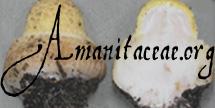

| name | Amanita esculenta |
| name status | nomen acceptum |
| author | Hongo & I. Matsuda |
| english name | "Esculent Slender Caesar" |
| images |
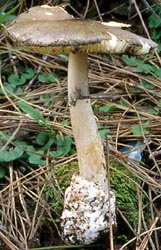 1. Amanita exculenta, Sichuan Prov., China. 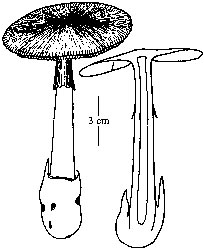 2. Amanita exculenta, Sichuan Prov., China. |
| intro | The following description is based on recently collected Chinese material: |
| cap | The cap is 50 - 100 mm wide, convex to applanate, and is only slightly umbonate; it is blackish brown to fuliginous when young, becoming dark brown, dark gray to gray when mature. The cap appears to have radially innate fibrils and usually lacks any remains of a volva. The cap''s margin is short-striate (occupying about 10% of the radius)). The cap flesh is white. |
| gills |
The gills of this species are free to subfree, white to cream-colored, and have dark gray edges; the short gills truncate. |
| stem | The stem is 90 - 120 × 8 - 20 mm, subcylindric or slightly narrowing upward, grayish above the ring and whitish to grayish below it, and hollow. A ring is placed high on the stem; the ring is membranous and has an upper surface that is gray to blackish and striate. The lower surface of the ring is grayish and fibrillose. The stem is attached just at its base to a membranous sac-like volva that is white and 30 - 50 × 20 - 30 mm and is 2 - 4 mm thick. |
| spores |
Spores of the Chinese collection measure (9.5) 10.0-12.0 × (7.0) 7.5-9.0 µm and are ellipsoid (occasionally broadly ellipsoid) and inamyloid; there are clamps at bases of basidia. |
| discussion |
The following description is based on the original description by Matsuda and Hongo (1955).
The cap of A. esculenta is 40 - 80 mm wide, dark red-brown ("bistre" to "snuff brown"), hemispheric at first, then convex, then plano-convex, sometimes with a slight depression in the center, viscid when moist, smooth, with a slightly striate margin. The volva is absent or present as a few sprinkled volval fragments. The flesh is white, rather thin, excepted above the stem. The gills are free, subcrowded, white, broadest at the center, narrow at the two ends, with a gray edge. The stem is 60 - 90 × 6 - 13 mm, narrowing upward, pale gray above the ring and striate, ash gray below and fibrillose-squamulose below the ring, hollow. The ring is ash-gray, membranous, placed well above the middle of the stem to near the top of the stem, striate above, floccose below, skirt-like, and persistent. The volva at the stem base is white, membranous, with a significant free limb, and attached to the stem on the sides as well as the base (according to illustration of young material). The spores measure 10.5 - 14 × 7 - 8.5 µm and are ellipsoid to elongate and inamyloid. Clamps are present at base of basidia. This species was originally described from pine woods in the prefecture of Niigata, Japan. It is also known from Sichuan Prov., China. ZLY has reviewed the collection of A. esculenta that is deposited in the National Science University herbarium in Tokyo; it is not the type, which may be lost. Amanita esculenta is assignable to stirps Hemibapha in which, it is rather closely related to A. hunanensis Y. B. Peng & L. H. Liu and A. yuaniana Zhu. L. Yang; however the latter pair have light-colored spots on their caps. The authors compare the present species to A. spreta (Peck) Sacc.; however, that North American species belongs in Amanita stirps Caesarea.—Z. L. Yang, R. E. Tulloss, and L. Possiel |
| brief editors | RET |

 Spore data sets and their composite