

| name | Amanita longistriata |
| name status | nomen acceptum |
| author | (S. Imai) E.-J. Gilbert |
| english name | "Imai's Slender Caesar" |
| intro |
On this page, each description is duplicated. The first of each pair of descriptions is based on recent collections from Japan by Bas, Yang, and Doi (1999). The second of each pair of desriptions is based on the description of Gilbert (1940) and the original description by Imai (1938). |
| cap |
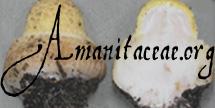
Bas, Yang, & Doi: The cap A. longistriata is 30 - 90 mm wide, grayish to grayish buff, sometimes with a slight pinkish tinge, sometimes grayish brown to brownish in the center, hemispherical at first, convex to plano-convex, with or without a small umbo, with a long-striate margin ((20-) 30 - 50% of the radius). The flesh is white. Gilbert & Imai: The cap of A. longistriata is 50 - 100 mm wide, smoky-umbrinous or clove-brown, darker in the center, convex at first, then plane, viscid when moist, smooth, with a long striate margin. Volval remnants are absent. The flesh is thin and white. |
| gills |
Ba, Yang, & Doi: The gills are free or even remote from the stem, rather distant, up to 11 mm broad, beautifully pale clear pink at first, later paler pink, with a minutely white, uneven, and floccose edge. The short gills are obliquely truncate. Gilbert & Imai: The gills are free, crowded, broad, and white becoming pale pinkish. |
| stem |
Bas, Yang, & Doi: The stem is 90 - 180 × 5 - 15 mm, close to cylindric or slightly tapering upward, pinkish-white at first, becoming white, with a proportionately broad central cylinder. The ring is in the upper part of the stem or almost at the midpoint, membranous, thin, and whitish. The volval sac is 20 - 30 (-40) × 10 - 20 mm, 0.5 - 1.5 mm thick, membranous, white or whitish on the exterior, with an internal limb placed above the point at which the stem is attached to the volva. Gilbert & Imai: The stem is 100 - 180 × 8 - 15 mm, narrowing upward, white, stuffed at first, then hollow, mostly undecorated, minutely floccose to minutely scaly below the ring, minutely powdery above the ring. The ring is membranous, placed high on the stem, skirt-like, rather broad, and white. The saccate volva is ample, 20 - 50 × 10 - 35 mm, for the most part free from the stem, connected only at the stem base, rather thick, persistent, proportionately large, and white on the outer surface, palely concolorous to the cap on the inner surface. |
| odor/taste | The odor is said to be indistinct. The taste is said to be mild. |
| spores |
Bas, Yang, & Doi: The spores (8.0-) 9.0 - 12.0 (-13.5) × (7.5-) 8.0 - 10.0 (-11.0) µm and are dominantly broadly ellipsoid, sometimes ellipsoid or subglobose and inamyloid. Clamps are often present at bases of basidia. Gilber & Imai: The spores measure 12.5 - 15 × 10 - 12.5 µm and are broadly ellipsoid and inamyloid. Clamps are almost certainly present at bases of the basidia. Spores measured from the Gilbert's drawings (1941) are: 10.5 - 12.6 × 8.8 - 10.5 µm. |
| discussion |
This species was originally described from Japan. It has also been reported from South Korea and China. It occurs solitarily or in groups in several forest types, sometimes with fir (Abies). ZLY points out that this species appears to be closely related to A. incarnatifolia Zhu L. Yang. Amanita longistriata can be placed in Amanita stirps Hemibapha.—Z. L. Yang, R. E. Tulloss, and L. Possiel |
| brief editors | RET |
| name | Amanita longistriata |
| author | S. Imai. 1938. J. Fac. Agric. Hokkaido Univ. 43(1): 11. |
| name status | nomen acceptum |
| english name | "Imai's Slender Caesar" |
| synonyms |
≡Amanitopsis longistriata (S. Imai) E.-J. Gilbert. 1940. Iconogr. Mycol. (Milan) 27, suppl. (1): 75, tab. 5 (fig. 6).
[Gilbert (1940. op. cit.: 90 (in caption of fig. 6); 1941. op. cit. 224) indicates that there was a collection that Imai called the type and that Gilbert had a part of it in his herbarium (now lost). Unfortunately, while in the majority of similar cases, Gilbert actually gave identifying information about such a collection in the caption of the figure showing drawings of spores, in the case of Amanita longistriata, he failed to do so.] The editors of this site owe a great debt to Dr. Cornelis Bas whose famous cigar box files of Amanita nomenclatural information gathered over three or more decades were made available to RET for computerization and make up the lion's share of the nomenclatural information presented on this site. |
| MycoBank nos. | 269761 |
| GenBank nos. |
Due to delays in data processing at GenBank, some accession numbers may lead to unreleased (pending) pages.
These pages will eventually be made live, so try again later. |
| lectotypes | in herb. S. Imai (SAP) |
| lectotypifications | Hongo. 1959. Mem. Fac. Liberal Arts Shiga Univ. 9: 70. |
| revisions | Yang and Doi. 1999. Bull. Natl. Sci. Mus. Tokyo B 25(3): 114-115, fig. 10. |
| selected illustrations | E.-J. Gilbert. 1941. Iconogr. Mycol. (Milan): 27, suppl.: 224, tab. 7. |
| intro |
The following text may make multiple use of each data field. The field may contain magenta text presenting data from a type study and/or revision of other original material cited in the protolog of the present taxon. Macroscopic descriptions in magenta are a combination of data from the protolog and additional observations made on the exiccata during revision of the cited original material. The same field may also contain black text, which is data from a revision of the present taxon (including non-type material and/or material not cited in the protolog). Paragraphs of black text will be labeled if further subdivision of this text is appropriate. Olive text indicates a specimen that has not been thoroughly examined (for example, for microscopic details) and marks other places in the text where data is missing or uncertain. The following material is derived from the protolog of the present taxon, (Yang 1997), and (Yang and Doi 1999). NOTE: Spore measurements from papers by Z. L. Yang use his "Times New Roman" face for "Q" and "Q'"—respectively, " |
| pileus | Yang and Doi (1999): 30 - 90 mm wide, slightly grayish buff, sometimes with very slightly pinkish tinge, grayish, sometimes grayish brown to slightly brownish over disc, at first hemispheric, then convex to plano-convex, with or without small umbo, subviscid, glabrous; context white; margin usually long-sulcate (0.3 - 0.5R), occasionally short-striate (0.2 - 0.25R), nonappendiculate; universal veil usually absent. |
| lamellae | Yang and Doi (1999): free or even remote, (sub)distant, when very young beautifully pale but clear pink, later paler pink, up to 11 mm broad, with edge minutely flocculose or subdenticulate; lamellulae obliquely truncate. |
| stipe | Yang and Doi (1999): 90 - 180 × 5 - 15 mm, at first pinkish white, later white, subcylindric to slightly narrowing upward; context with proportionately broad central cylinder; partial veil superior to almost median, membranous, thin, whitish; universal veil as saccate volva; membranous, white to whitish, 20 - 30 (-40) × 10 - 20 mm, with limb ca. 0.5 - 1.5 mm thick, with limbus internus placed slightly above point of juncture of stipe and limb. |
| odor/taste | Yang and Doi (1999): Odor indistinct. Taste mild. |
| macrochemical tests |
none recorded. |
| pileipellis | not described. |
| pileus context | not described. |
| lamella trama | not described. |
| subhymenium | Yang and Doi (1999): 30 - 40 μm thick; cellular; inflated cells in 2-3 layers, subglobose to ovoid to ellipsoid, 10 - 23 × 8 - 15 μm. |
| basidia | Yang and Doi (1999): 34 - 48 × 11 - 13 μm, 4-sterigmate, with sterigmata 3 - 5 μm long; clamps common. |
| universal veil | Yang and Doi (1999): On pileus: not seen. On stipe base, exterior surface layer: filamentous hyphae more or less irregularly arranged, 2 - 5 (-7) μm wide, hyaline, thin-walled; inflated cells rare. On stipe base, interior layer: with elements irregularly to somewhat longitudinally arranged; filamentous hyphae dominant, 2 - 7 (-12) μm wide, hyaline, thin-walled, branching, interwoven; inflated cells scarce to scattered to locally fairly abundant, subglobose to ovoid, 50 - 70 × 35 - 50 μm, sometimes ellipsoid to fusiform, 50 - 120 × 20 - 50 μm, colorless, hyaline, thin-walled; vascular hyphae rare; clamps present. On stipe base, inner surface layer: gelatinized, with filamentous hyphae 1 - 3 μm wide. |
| stipe context | not described. |
| partial veil | Yang and Doi (1999): filamentous hyphae, dominant, subradially to irregularly arranged, 2 - 6 μm wide; inflated cells usually rare, locally abundant, clavate to broadly clavate, 20 - 30 ×, colorless, hyaline, thin-walled; vascular hyphae rare; clamps very common. |
| lamella edge tissue | not described. |
| basidiospores |
type revision of Yang (1997): [100/1/1] (9.5-) 10.0 - 13.0 (-14.0) × (7.5-) 8.0 - 11.0 (-12.0) μm, ( non-type material, Yang (1997): [80/4/1] (9.5-) 10.0 - 12.5 (-13.5) × (8.0-) 8.5 - 10.0 (-11.0) μm, ( Yang and Doi (1999): [175/8/5] (8.0-) 9.0 - 12.0 (-13.5) × (7.5-) 8.0 - 10.0 (-11.0) μm, ( |
| ecology | Japan: Solitary to gregarious. Japan: In forest of (e.g.) Abies. |
| material examined |
Yang (1997): JAPAN: HOKKAIDO—??, 12.viii.1935 S. Imai s.n. (holotype, SAPA). HONSHU—Yamanashi-ken - Mt. Fuji, Yoshida-guchi, 6.ix.1983 C. Bas 9040 (L). Yang and Doi (1999): JAPAN: HONSHU—Tokyo Metropolis (Pref.) - Oume City, Kurosawa 3-Chôme, along left-side ridge of Kurosawa-gawa R., along hiking course, 16.vii.1997 Y. Doi & K. Miyazaki s.n. (TNS F-182475) s.n. (TNS F-182478), 5.x.1997 Y. Doi s.n. (TNS F-237593); Chiyoda-ku, garden of Fukiage-Gosho |
| discussion | Yang and Doi (1999): "The colour of the fruitbody is mainly based on the field notes of C. Bas 9040. ... Amanita longistriata is close to A. incarnatifolia Z. L. Yang (a new name for A. rhodophylla Imazeki & Toki (Yang 1997: 52). It differs from the latter in its somewhat larger basidiocarps, longer striations on the pileus margin, and wider basidiospores (Yang 1997). |
| citations | —Z. L. Yang |
| editors | RET |
Information to support the viewer in reading the content of "technical" tabs can be found here.
| name | Amanita longistriata |
| bottom links |
[ Keys & Checklists ] [ Draft description of, & key to, sect. Caesareae ] |
| name | Amanita longistriata |
| bottom links |
[ Keys & Checklists ] [ Draft description of, & key to, sect. Caesareae ] |
 Spore data sets and their composite
Each spore data set is intended to comprise a set of measurements from a single specimen made by a single observer; and explanations prepared for this site talk about specimen-observer pairs associated with each data set. Combining more data into a single data set is non-optimal because it obscures observer differences (which may be valuable for instructional purposes, for example) and may obscure instances in which a single collection inadvertently contains a mixture of taxa.

Text and User-Generated Sporographs are published under the Creative Commons License.

In the case of a taxon page, image credits are on the 'image' tab.