| name |
Amanita princeps |
| author |
Corner & Bas. 1962. Persoonia 2: 297, pl. 10, fig. 51. |
| name status |
nomen acceptum |
| english name |
"Head Man Slender Caesar" |
| etymology |
princeps "prominent" |
| MycoBank nos. |
326109 |
| GenBank nos. |
Due to delays in data processing at GenBank, some accession numbers may lead to unreleased (pending) pages.
These pages will eventually be made live, so try again later.
|
| holotypes |
L |
| intro |
The following text may make multiple use of each data field.
The field may contain magenta text presenting data from a type study
and/or revision of other original material cited in the protolog of the present taxon.
Macroscopic descriptions in magenta are a combination of data from the protolog and
additional observations made on the exiccata during revision of the cited original
material.
The same field may also contain black text, which is data from a revision of the present
taxon (including non-type material and/or material not cited in the protolog).
Paragraphs of black text will be labeled if further subdivision of
this text is appropriate.
Olive text indicates a specimen that has not been
thoroughly examined (for example, for microscopic details) and marks other places in the text
where data is missing or uncertain.
The following material not directly from the protolog of the present taxon and not cited as the work of Dr. Z. L. Yang or another researcher is based on original research by R. E. Tulloss.
NOTE: Spore measurements from papers by Z. L. Yang use his "Times New Roman" face for "Q"
and "Q'"—respectively, "Q" and "Q." |
| pileus |
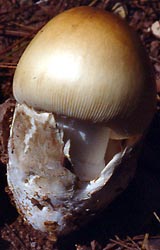
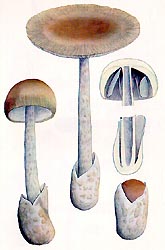
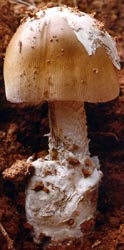
from protolog: 100 - 200 mm wide, light biscuit color or pale slightly grayish brownish ochraceous, slightly darker toward disk, paler toward white or pallid margin, ovoid to convex when young, plane or slightly concave to almost cyathiform with age, subumbonate, slightly viscid at first; context white, rather soft, very putrescent, 6 - 9 mm thick above stipe, about 1 mm thick at mid-radius; margin sulcate-striate (0.25R), already distinctly striate when emerging from volva; universal veil in mature material absent or occasionally as few thin white fugacious patches, in one "button" (about 35 mm high) up to 4 mm thick and still covering pileus. |
| lamellae |
from protolog: free (distant from stipe apex), crowded, white, then cream, with 134 - 150 primaries, 10 - 17 mm broad, thin, with flocculose-denticulate edge; lamellulae truncate, with 0 (-1) between each pair of otherwise adjancent lamellae. |
| stipe |
from protolog: 160 - 240 mm long × 11 - 20 mm, white or very pale buff, somewhat floccose below, pruinose-pulverulent above, stout, brittle, fibrous; context white, cream in stipe base, becoming hollow, still solid in 40 mm high bud, already hollow in specimen just emerging from volva; partial veil ample, pendulous, thin, floccose-membranous, easily torn, deciduous, usually dropping off in bits from underside of pileus on expansion, or splitting radially in strips, white or pale ochraceous buff, faintly striate above, subfloccose below, attached at very apex of stipe; universal veil as sheathing saccate volva, white, membranous, thick, fleshy, 50- 80 mm × 25 - 40 mm, attached only to the very base of stipe, with outer surface cracking and peeling in thin very pale buff patches, often with narrow 1 - 1.5 mm high limbus internus. |
| odor/taste |
from protolog: smell faintly like that of A. phalloides.... |
macrochemical
tests |
none recorded. |
| pileipellis |
from protolog: about 150 µm thick in young specimen; suprapellis hyaline gelatinized; subpellis present; filamentous hyphae very distant thin and nearly faded in suprapellis, in subpellis gradually becoming thicker and more crowded, 3 - 7 µm wide, in both layers interwoven over disc and radial over limb; vascular hyphae superficial and up to 12 µm wide in suprapellis, not described in subpellis; clamps abundant. |
| pileus context |
not described. |
| lamella trama |
from protolog: very distinctly bilateral, divergent; central stratum and subhymenial base filamentous hyphae 2 µm and more wide and inflated cells (ellipsoid and cylindric, up to 110 × 25 µm. |
| subhymenium |
not described. |
| basidia |
from protolog: 45 - 65 × 14 - 16 µm, perhaps dimorphic (not intermixed with pseudoparaphyses), 4-sterigmate. [Note: Clamps probably common because of their plenitude reported in other tissues.—ed.]. |
| universal veil |
from protolog: On stipe base, exterior surface layer: filamenous hyphae 2.5 - 5 µm wide, interwoven or sublongitudinally oriented; vascular hyphae scattered, up to 12 µm wide; clamps abundant. On stipe, inner surface layer: nearly similar to exterior, but with very scattered inflated cells up to 110 µm wide. On pileus (young fleshy volva of "button" specimen): filamentous hyphae thin; inflated cells numerous, large. |
| stipe context |
from protolog: longitudinally acrophysalidic. |
| partial veil |
not described. |
| lamella edge tissue |
from protolog: inflated cells very abundant in young specimen, forming broad margin along edge of gill, globose, mostly 20 - 30 µm wide, sometimes up to 40 µm wide. |
| basidiospores |
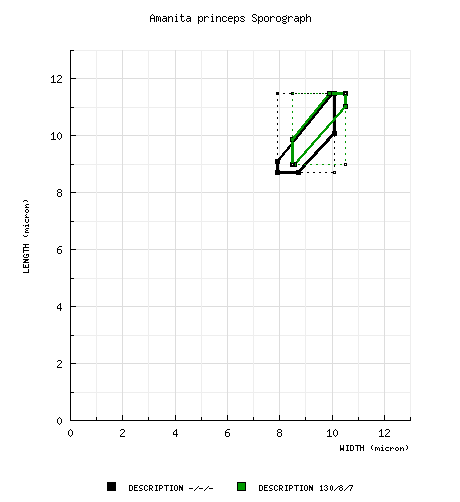
from protolog: [-/-/-] 8.7 - 11.5 × 7.9 - 10.1 μm, (Q = 1.0 - 1.15); Q = 1.10),
hyaline, colorless, densely and minutely verruculose, with walls very slightly thickened, inamyloid, globose to subglobose; apiculus proportionately large, prominent; contents mono- or multiguttulate; color in deposit not recorded. [Note: Fresh spores were reported to measure 10.0 - 13.0 × 9.0 - 12.0 μm.]
from Yang et al. (2001): [130/8/7] (8.5-) 9.0 - 11.5 (-12.0) × (7.5-) 8.5 - 10.5 (-11.0) μm, (Q = (1.0-) 1.05 - 1.16 (-1.21); Q = 1.09 ± 0.04), subglobose, sometimes broadly ellipsoid, rarely globose, thin-walled, colorless, hyaline, inamyloid, mostly smooth, occasionally finely verruculose; apiculus prominent, up to 2 μm long. |
| ecology |
In troops. China: On soil in forest. Singapore: Terrestrial, every rainy season, in "fern valley" "deep" in tropical forest. |
| material examined |
from protolog: SINGAPORE: Bukit Timah, ix.1930 E. J. H. Corner s.n. (paratype, L in liquid), iii.1931 E. J. H. Corner s.n. (holotype, L in liquid); Reservoir Jungle, 29.xi.1940 E. J. H. Corner s.n. (paratype, L, watercolor drawing only); unkn. loc. s.d. E. J. H. Corner s.n. (paratype, L, spore print only).
from Yang et al. (2001):
CHINA:
HAINAN—Changjiang Li Autonomous Co. - Bawangling, 17.viii.1988 G. Y. Zheng s.n. (HMIGD 14274, as "Amanita caesareae" in Bi et al. (2001)). Ledong Li Autonomous Co. - Jianfengling, 22.v.1981 M. Q. Gong 60058 (HKAS 22370), 16.viii.1999 M. S. Yuan 4295 (HKAS 34561), 4293 (HKAS 34562), 4291 (HKAS 34560), 3.ix.1999 X. L. Wu 16 (HKAS 34106). Unkn. Co. - Wuzhishan, 30.viii.1960 J. H. Yu and R. Liu 2227 (HMAS 31007, as "Amanitopsis vaginata" in Teng (1963, 1996), as "Amanita vaginata" in Tai (1979)). |
| discussion |
from protolog: "Monkeys refused to eat this species.
"Although the very finely and densely verruculose spores of A. princeps are unique within the genus Amanita, there is no doubt that the species should be classed in this genus.
"A remarkable feature of A. princeps is the fact that the part of the young volva covering the pileus mainly consists of sphaerocysts, while the limb of the volva is apparently entirely the result of hyphal growth, so that the originally rather crowded sphaerocysts become widely scattered." |
| citations |
—R. E. Tulloss |
| editors |
RET |
|



 Spore data sets and their composite