| name |
Amanita murrilliana |
| author |
Singer. 1951 ["1949"]. Lilloa 22: 385. |
| name status |
nomen acceptum |
| english name |
"Murrill's Slender Caesar" |
| synonyms |
≡ Venenarius gemmatus var. volvatus Murrill. 1941. Mycologia 33: 437. [This taxon was not combined in Amanita at the time of publication.]
The editors of this site owe a great debt to Dr. Cornelis Bas
whose famous cigar box files of Amanita nomenclatural information
gathered over three or more decades were made available to RET for computerization
and make up the lion's share of the nomenclatural information presented on this site.
|
| etymology |
Murrill + -ana, suffix indicating possession; hence, "of Murrill"
Honoring William Alphonso Murrill. |
| MycoBank nos. |
292455, 345948 |
| GenBank nos. |
Due to delays in data processing at GenBank, some accession numbers may lead to unreleased (pending) pages.
These pages will eventually be made live, so try again later.
|
| holotypes |
FLAS |
| type studies |
Jenkins. 1979. Mycotaxon 10: 180. |
| revisions |
Tulloss, here |
| intro |
The following text may make multiple use of each data field.
The field may contain magenta text presenting data from a type study
and/or revision of other original material cited in the protolog of the present taxon.
Macroscopic descriptions in magenta are a combination of data from the protolog and
additional observations made on the exiccata during revision of the cited original
material.
The same field may also contain black text, which is data from a revision of the present
taxon (including non-type material and/or material not cited in the protolog).
Paragraphs of black text will be labeled if further subdivision of
this text is appropriate.
Olive text indicates a specimen that has not been
thoroughly examined (for example, for microscopic details) and marks other places in the text
where data is missing or uncertain.
Except where indicated otherwise, the following description is based on the personal research of R. E. Tulloss. |
| pileus |
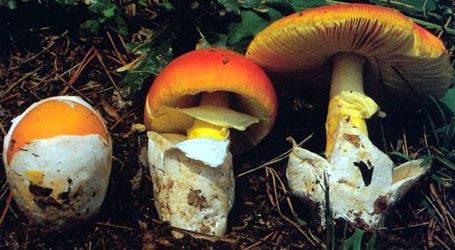
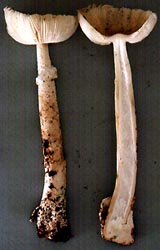
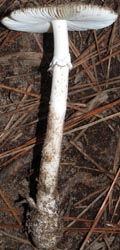
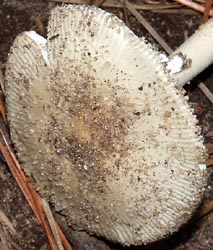
42 - 90 mm wide, cream (e.g., 92 y White) to pale pinkish buff to pale tan to cremeous to whitish near margin, pale watery tan to pinkish buff to pale straw color to pale tan with orangish tint to brown or sordid isabelline over disc (e.g., 76 l. y Br, 77 m. y Br), darkest at very center, occasionally faintly virgate, convex to planar with low umbo and then concave with umbo in age, glabrous, tacky; context white to pale yellowish white to pale cream, in wet weather with watery sordid line under pileipellis, unchanging when cut or bruised, 3 - 5 mm thick at stipe, thinning evenly for about two-thirds to three-quarters of radius, then membranous to margin; margin striate (0.25R - 0.55R), nonappendiculate; universal veil usually absent, occasionally as small white membranous detersile patch. |
| lamellae |
free, with faint decurrent line or tooth on stipe apex (lens), subdistant to close to subcrowded, white to pale cream (paler than 92 y White) in mass and in side view, 4 - 7 mm broad, broadest at about mid-radius, occasionally forking, with edge entire; lamellulae truncate to subtruncate to subattenuate, of diverse lengths, common to plentiful, unevenly distributed. |
| stipe |
89 - 177 × 5.5 - 16 mm, white to pale pinkish buff, not bruising from handling or becoming slightly brownish, often somewhat flattened, narrowing upward, very minimally flaring at apex or not flaring, pruinose to "floccose" (Murrill’s note with holotype) above partial veil, finely fibrillose to floccose to scaly below, with decoration concolorous to white, fibrils on stipe sometimes becoming brown from handling, sometimes with base rather deeply buried in substrate; context white to barely off-white, unchanging when cut or bruised, crisp, stuffed with white cottony material, becoming hollow, with 4± - 8 mm wide central cylinder; partial veil white, superior (in holotype, one sixth of stipe length from stipe apex), membranous, thin, 4 - 12 mm wide, finely striate above (lens), persistent, but often tearing and collapsing on stipe, sometimes becoming slightly sordid near edge; universal veil as saccate volva, white on exterior, whitish on interior, membranous to fleshy, lobed and flaring or collapsing, with soft or suede-like outer surface and smooth inner surface (with inner surface faintly but distinctly longitudinally striatulate in exsiccatum of holotype), ovoid to subovoid to subcylindric, with bottom sometimes flattened, often attached to part of base of stipe above very bottom (with several sections showing one side of stipe free except for very base and other side attached to volval limb in the stipe’s lower part for up to 10 mm), 20 - 90 × 17 - 27+ mm, 2 - 4 mm thick at midpoint between point of attachment and highest point of limb; limbus internus often lacking, when present, thin and up to 4 mm high and attached at very base of universal veil limb. |
| odor/taste |
Odorless. Taste not recorded. |
macrochemical
tests |
2% & 10% KOH - negative on pileipellis. Spot test for tyrosinase (paracresol) - positive throughout basidiome except for surfaces of lamellae. Spot test for laccase (syringaldazine) - positive in a narrow region of the lower portion of the volval sac which extends to neither surface of the sac and continues under the stipe base. Test vouchers: Tulloss 7-3-81-C and 7-10-90-C. |
| pileipellis |
35 - 40 µm thick, brownish orange to red-brown, becoming paler toward pileus context, gelatinized only slightly at surface; filamentous, undifferentiated hyphae 2.0 - 3.2 µm wide, branching, predominantly subradially arranged at midradius, but with rather frequent criss-crossing/interwoven hyphae; vascular hyphae 6.0 - 8.5 µm wide, subsinuous, occasionally loosely coiling, infrequent. |
| pileus context |
tissue somewhat collapsed in holotype; filamentous, undifferentiated hyphae 2.0 - 6.1 µm wide, branching, singly and in fascicles, common, forming an open lattice; acrophysalides clavate to subfusiform, up to approximately 110 × 25 µm and possibly larger; vascular hyphae not observed; clamps present. |
| lamella trama |
bilateral, otherwise not rehydratable in holotype; subhymenial base apparently containing elongate (narrowly fusiform or narrowly clavate) inflate cells; filamentous, undifferentiated hyphae branching. |
| subhymenium |
not rehydratable in holotype; pseudoparenchymatous (cellular), with (0-) 2± (-3) cells between base of longest basidia and subhymenial base, ?. |
| basidia |
badly damaged in holotype; 49 - 63 × 12.0 - 13.6 µm, 4-sterigmate, with sterigmata up to 6.5 × ? µm; clamps common, prominent. |
| universal veil |
On pileus: absent. On stipe base, exterior surface: filamentous, undifferentiated hyphae in interweaving and densely packed and often rather broad fascicles, partially gelatinized, often collapsed, leaving some gaps through which interior layer visible. On stipe base, interior: filamentous, undifferentiated hyphae 2.4 - 6.1 µm wide, branching, plentiful to locally dominating, singly and in fascicles, in open lattice; inflated cells common to plentiful, occasionally in small clusters, more common away from exterior surface, subpyriform to ellipsoid to broadly clavate to clavate, up to 95 × 58 µm, thin?-walled; vascular hyphae 16.8 - 20 µm wide, infrequent, loosely coiling, sinuous. On stipe base, inner surface: thin, gelatinized, with partially gelatinized filamentous, undifferentiated hyphae singly and in fascicles largely with sublongitudinal orientation, with criss-crossing, with pattern in gelatinized layer suggesting small inflated cells possibly originally at surface. |
| stipe context |
longitudinally acrophysalidic; filamentous, undifferentiated hyphae 2.5 - 6.4 (-14.6) µm wide, branching, plentiful in interior, dominating near surface; acrophysalides thin-walled, up to 229 × 48 µm, dominating in interior; vascular hyphae 8.8 - 15.2 (-22) µm wide, scattered to common, sinuous, sometimes loosely coiling. |
| partial veil |
extensively gelatinized and collapsed in holotype; filamentous, undifferentiated hyphae 2.5 - 8.0 µm wide, branching, gelatinized and collapsed, dominantly radially arranged, densely packed, predominantly colorless, occasionally with yellowish subrefractive walls; inflated cells not observed; vascular hyphae not observed; clamps observed. |
| lamella edge tissue |
not described. |
| basidiospores |
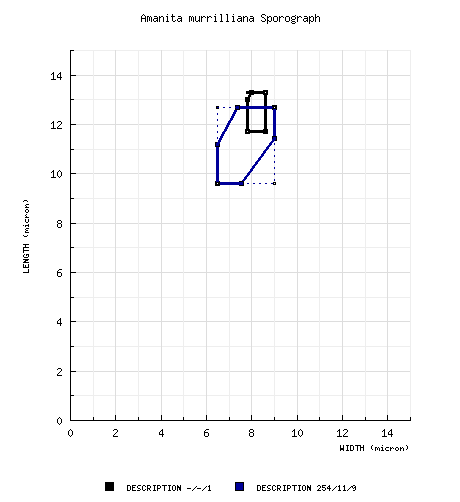
from type study of Jenkins (1979): [-/-/1] (10.9-) 11.7 - 13.3 (-14.1) × (7.0-) 7.8 - 8.6 (-9.4) μm, (Q = 1.33 - 1.67; Q' = 1.52),
hyaline, thin-walled, amyloid, globose; apiculus sublateral, cylindric; contents guttulate;
color in deposit not recorded.
composite from all material reviewed by RET: [254/11/9] (8.5-) 9.6 - 12.7 (-14.2) × (5.6-) 6.5 - 9.0 (-10.5) µm, (L = (10.4-) 10.5 - 11.9 µm; L’ = 11.3 µm; W = 6.6 - 7.9 (-9.8) µm; W’ = 7.6 µm; Q = (1.16-) 1.27 - 1.72 (-1.88); Q = (1.30-) 1.43 - 1.58; Q’ = 1.50), hyaline, colorless, thin-walled, smooth, inamyloid, ellipsoid to elongate, infrequently broadly ellipsoid, usually at least somewhat adaxially flattened, sometimes expanded at one end; apiculus sublateral, cylindric to truncate-conic; contents mono- (often dominating) to multiguttulate to granular; white in deposit. Possible crassospores noted in one collection (A. H. Smith 60771). |
| ecology |
Solitary to subgregarious; at up to 800 m elev. Québec. Canada: In sandy soil, at forest border under Acer, Fagus, Ostrya, and Tilia. Florida: Under evergreen Quercus. Maine: With Betula in glacial silt. Michigan: In deciduous forest with Quercus and Fagus. New Jersey: Clayey sand of road bank, in mixed deciduous woods with Quercus spp., Prunus sp., Liquidambar styraciflua, and diverse shrubs. New York: At ca. 500 m elev. In leaf litter of open, old growth forest including Acer, F. grandifolia, Betula, Prunus, and Tsuga canadensis. North Carolina: In loamy clay of road bank under Tsuga canadensis, Betula lutea f., and Rhododendron sp. or under Quercus rubra. Texas: In arid sandyland, Pinus-Quercus forest. |
| material examined |
from type study of Jenkins
(1979):
U. S. A.:
FLORIDA—Alachua Co. - Gainesville,
28.v.1938 W. A. Murrill F 16224 (holotype of V.
gemmatus var. volvatus,
FLAS).
RET: CANADA:
QUÉBEC—Région
Laval - Ville de Laval, 1.viii.1990 Yves
Lamoureux 1066 (CMMTL; RET 370-1), 28.viii.1994
Jean Després s.n. [Y. Lamoureux 2281] (CMMTL; RET
370-2). Chambly Co. -
Saint-Bruno-de-Montarville, 6.viii.1996 Yves
Lamoureux 2866 (CMMTL; RET 251-4).
U.S.A.:
FLORIDA—Alachua
Co. - Gainesville, 28.v.1938 W. A. Murrill F 16224
(holotype, FLAS), Gainesville [29.6780° N/
82.3312° W, 57 m], 10.xi.2015 Sarah Prentice s.n.
[mushroomobserver
#222502]
(RET 715-10, nrLSU seq'd.).
INDIANA—Monroe Co. - Se of Bloomington, Lake Monroe, Paynetown St. Recreation Area [39.0941° N/ 86.4476° W, 174 m], 1.ix.2012 Stephen Russell s.n. [mushroomobserver #108031] (RET 532-1), s.n. [mushroomobserver #108025] (RET 532-6).
MAINE—Franklin Co. - ca. Kingfield, 4.ix.1999 Y. Lamoureux s.n. [Tulloss 9-4-99-B] (RET ??-??).
MICHIGAN—Cheboygan Co. - Wildwood,
2.viii.1963 Dr. Cornelis Bas 3547 (L; RET 076-3,
nrITS seq'd., orig. "A. psammicolor").
Washtenaw Co. - Manchester,
Sharon Hollow, 25.ix.19[38? or
58?] A. H. Smith 60771 (MICH; RET 648-1,
gill fragments).
NEW JERSEY—Monmouth Co. - Assunpink
Wildlife Mgmt. Area, 3.vii.1981 Mary A. King &
R. E. Tulloss [Tulloss] 7-3-81-C
(RET 114-5).
NEW YORK—Franklin Co. - Floodwood Mtn.
Rd. [44.3476° N/ 74.4424° W, 501 m], 12.viii.2011
Pamela Cooley s.n. [Tulloss 8-12-11-C]
(RET 479-5). Oneida Co. -
unkn. loc. 29.viii.2010 Eric Smith s.n.
[www.mushroomobserver.org
#51715]
(RET 481-7), 18.ix.2010 Eric Smith s.n.
[mushroomobserver
#53150]
(RET 481-3).
NORTH CAROLINA—Iredell Co. - jct. St.
Hwys. 64 & 70 & Westminster Rd.,
6-10.vii.1987 Allein Stanley 758 (RET 278-1; UNCC,
mixed collection). Macon Co. - ca. Otto,
Coweeta Hydrological Stn., 10.vii.1990 R. H.
Petersen s.n. [Tulloss 7-10-90-C]
(RET 026-1).
TENNESSEE—Sevier Co. - ca. Gatlinburg,
GSMNP, Cherokee Orchard
[35.6811° N/ 83.4625° W, 945 m], 12.vii.2004
J. Carrera s.n. [Tulloss 7-12-04-J] (RET 374-2,
nrLSU seq'd.;
TENN); ca. Gatlinburg, GSMNP,
Grotto Falls trailhead
[35.6811° N/ 83.4625° W, 945 m], 12.vii.2004 S.
Tieken &
R. E. Tulloss [Tulloss 7-12-04-R] (RET
377-7).
TEXAS—Hardin Co. - Big Thicket Nat.
Pres., Turkey Creek Tr., 16.vi.2014 Ron Pastorino
6-16-15I [mushroomobserver
#169037 ]
(RET 632-9, nrITS & nrLSU seq'd.).
Newton Co. - Lewis Chapel
Community, Sandridge Cemetery Rd., Co. Rd. 4045,
3.vii.2007 David P. Lewis 8082 (RET 442-7). |
| discussion |
Sometimes, individual specimens of A. spreta can be very pale to white. A sporograph comparison of the present taxon to A. spreta is provided below. The spores of A. spreta can be seen to be, in general, more elongate.
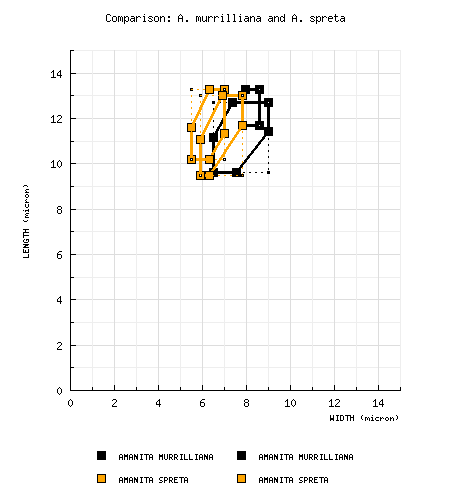
Amanita spreta is also a more robust species with a more fleshy cap that, consequently, has shorter marginal striations.
There is some reason to consider whether A. calyptrata var. albescens (a poorly known taxon originally described from Saratoga Co., New York, U. S. A.) could be a synonym of the present species. RET has not seen the type of the latter, but a broef type study was published by Jenkins (1979). A sporograph comparison of the present entity with Jenkins' spore measurements from Peck's A. calyptrata var. albescens is provided below:
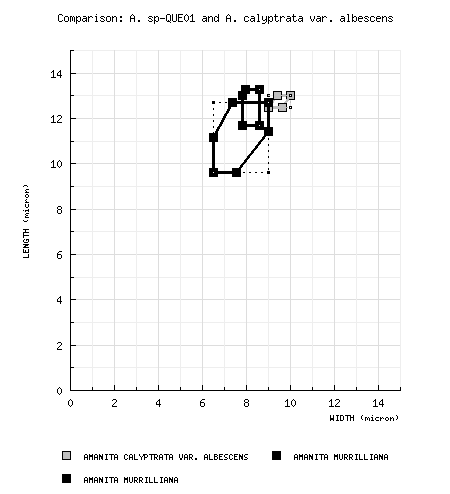
Specimens of the present species have been previously been provided with temporary code names including Amanita sp-QUE01, A. sp. S5, and A. sp-T41.
Need to check nrLSU sequences when they become available in GenBank because of this old note: A preliminary molecular study (unpublished) of the specimen on which Amanita sp-QUE01 is based shows that the specimen is phylogenetically closest to A. murrilliana in a sample of nearly 60 taxa of sect. Caesareae; however, due to the known morphological difference (spore width) and some phylogenetic differences (ca. 8 bp limited to ITS1 or 1.52% of the single nrITS sequence obtained), RET hesitates to place the present collection in A. murrilliana at present. |
| citations |
—R. E. Tulloss |
| editors |
RET |
|



 Spore data sets and their composite