| name |
Amanita caesareoides |
| author |
Lju. N. Vass. 1950. Bot. Mater. Otd. Sporov. Rast. Bot. Inst. Komarova Akad. Nauk S.S.S.R. 6(7-12): 199. |
| name status |
nomen acceptum |
| english name |
"Asian Vermilion Slender Caesar" |
| synonyms |
≡ Amanita caesarea var. caesareoides (Lju. N. Vass.) Wasser. 1988. Ukrayin'sk. Bot. Zhurn. 45(6): 76-78.
The editors of this site owe a great debt to Dr. Cornelis Bas
whose famous cigar box files of Amanita nomenclatural information
gathered over three or more decades were made available to RET for computerization
and make up the lion's share of the nomenclatural information presented on this site.
|
| MycoBank nos. |
292445 |
| GenBank nos. |
Due to delays in data processing at GenBank, some accession numbers may lead to unreleased (pending) pages.
These pages will eventually be made live, so try again later.
|
| lectotypes |
LE |
| lectotypifications |
Tulloss. 2005a. Mycotaxon 92: 475. |
| selected illustrations |
Imazeki and Hongo. 1987. Colored Illus. Mushr. Japan 1: pl. 29 (fig. 206).
Imazeki, Otani and Hongo. 1988. Fung. Japan: 3, 150-151. |
| intro |
The following text may make multiple use of each data field.
The field may contain magenta text presenting data from a type study
and/or revision of other original material cited in the protolog of the present taxon.
Macroscopic descriptions in magenta are a combination of data from the protolog and
additional observations made on the exiccata during revision of the cited original
material.
The same field may also contain black text, which is data from a revision of the present
taxon (including non-type material and/or material not cited in the protolog).
Paragraphs of black text will be labeled if further subdivision of
this text is appropriate.
Olive text indicates a specimen that has not been
thoroughly examined (for example, for microscopic details) and marks other places in the text
where data is missing or uncertain.
The following material not directly from the protolog of the present taxon and not cited as the work of another researcher is based on original research by R. E. Tulloss. |
| pileus |
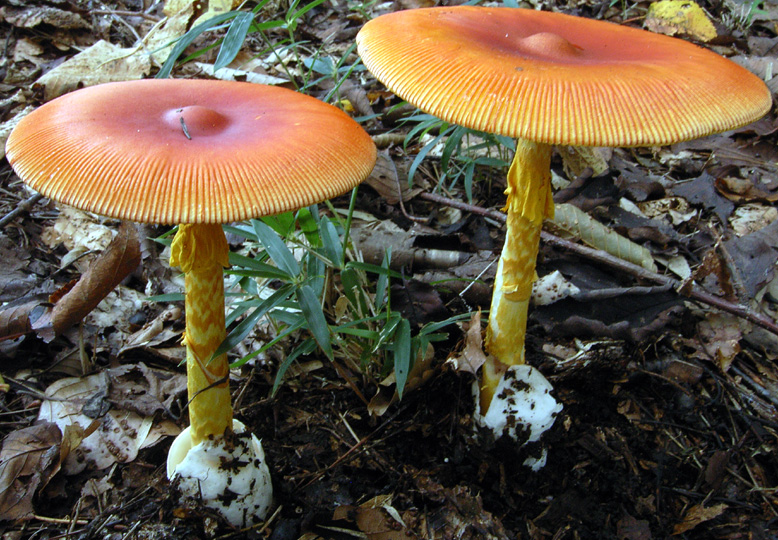
70 - 160 (-280) mm wide, red to orange-red to reddish orange (5-7A7, 7A8), ovate to convex when young, planar at maturity, with broad umbo, smooth, glabrous, with silky luster, moist to dry; context white to yellowish white, with yellow just below pileipellis, unchanging when cut or bruised, fleshy, thin, 3± mm thick; margin striate to striate-sulcate to costate-striate (0.2R - 0.4R), nonappendiculate, regular, decurved at first, becoming uplifted in mature specimens; universal veil almost always absent. |
| lamellae |
free to narrowly adnexed, with decurrent tooth on stipe apex?, close to crowded, pallid ochraceous yellow to yellow to yellowish orange (3-4A7, 4B7), thin to conspicuously thick, 10± mm broad, with edges dentate to entire; lamellulae truncate to subtruncate, of at least two lengths, unevenly distributed, scarce(?). |
| stipe |
100 - 190± (-260) × 15 - 40 mm, yellow to yellowish orange to ochraceous yellow (3A7, 4B7), narrowing upward, glabrous to finely fibrillose to decorated with ragged patches [orangish yellow in exsiccatum of Nagasawa 13916)]; context white to yellowish white, unchanging when cut or bruised, stuffed with soft cottony pith in youth, becoming hollow; partial veil concolorous with stipe (e.g., 4A8) to orange (5A7) [intensely yellow in exsiccatum of Nagasawa 13916)], sometimes becoming sordid with age, superior, thin, large, membranous, persistent, faintly striate above, sometimes only flaring from stipe near outer edge; universal veil as saccate volva, free, lobate (usually with three large lobes), fleshy and thick, sometimes leathery, up to 80 × 60 mm, with inner surface yellow, with outer surface white, attached only at stipe base; limbus internus present as shelf-like region. |
| odor/taste |
Odor not distinctive to mealy (Bhatt 1035). Taste mild to radish-like (Bhatt 1035). |
macrochemical
tests |
Aniline water - orange dissolves in excess reagent on pileipellis; negative on pileus context. Conc. HNO3 - negative on pileipellis; light yellow on pileus context. 40% aqueous NH4OH - yellow on pileipellis; negative on pileus context. 10% FeSO4 - brownish on pileipellis; negative on pileus context. 2% aqueous phenol - violet brown on pileipellis; violet brown on pileus context. Formaline - yellow in excess reagent on pileipellis; negative on pileus context. 30% KOH - yellow in excess reagent on pileipellis; negative on pileus context. EDIBLE and delicious to some, consumed in some parts of Himachal Pradesh, but not used for food by population in area of type locality (eastern Russia). |
| pileipellis |
255 - 260 µm thick, lacking strongly differentiated subpellis and suprapellis, gelatinized only at very surface, pale yellow near surface, gradually grading to pale orangish yellow near pileus context; filamentous, undifferentiated hyphae 1.9 - 7.6 µm wide, branching, sometimes constricted at septa, sometimes with slightly thickened walls, interwoven without dominant orientation (at point nearer to margin than midradius), densely packed vertically, lacking slightly inflated intercalary cells; vascular hyphae 1.4 - 7.6 µm wide, scattered, sinuous, more easily seen in scalp than in cross-section; clamps rather common.
[NOTE: Per C. Bas’ notes on syntype: with suprapellis an ixocutis 160 - 190 µm thick; filamentous, undifferentiated hyphae 1.2 - 2.3 µm wide in suprapellis, up to 3.5 µm wide in subpellis, interwoven, rather straight, subradially arranged.] |
| pileus context |
filamentous, undifferentiated hyphae 2.5 - 8.9 µm wide, branching, loosely interwoven in open lattice, occasionally in simple fascicles, thin-walled, with some narrowly fusiform intercalary cells up to 28 µm wide; acrophysalides narrowly ellipsoid to clavate to narrowly clavate, up to 117+ × 38 µm, thin-walled; vascular hyphae 4.4 - 10.2 µm wide, scattered, sordid yellow. |
| lamella trama |
bilateral, divergent; wcs = ?? µm; central stratum ??; subhymenial base comprising curving hyphae and/or very narrow and elongate inflated cells (mostly intercalary, narrowly fusiform to narrowly clavate to narrowly ellipsoid, mostly < 10.5 µm wide, up to 18.5 µm wide), occasionally with uninflated or slightly inflated intercalary branched element; filamentous, undifferentiated hyphae 2.5 - 8.0 µm wide, branching; divergent, terminal inflated cells similar in form to intercalary partially inflated elements of subhymenial base (narrowly fusiform to narrowly clavate) and mixed with them, up to 113 × 14.0 µm; vascular hyphae not observed; clamps common, prominent. |
| subhymenium |
wst-near = ?? µm; wst-far = ?? µm; [wst values are large compared to length of basidia, in possibly crushed mount wst-far seemed to be 125 - 130 µm]?; pseudoparenchymatous (cellular), with one to three cells (6.0 - 10.0 µm major diameter, spherical to ellipsoid) below bases of longest basidia, with basidia arising from inflated cells. |
| basidia |
34 -54 × 8.1 - 12.1 µm, dominantly 4-, occasionally 3-sterigmate, with sterigmata rather slender, up to 5.1 × 1.4 µm; clamps relatively common. |
| universal veil |
On pileus: absent. On stipe base, exterior surface: filamentous, undifferentiated hyphae partially gelatinized to gelatinized, yellow, fasciculate, rather densely packed, forming layer up to 55 - 60 µm thick. On stipe base, interior: filamentous, undifferentiated hyphae 0.9 - 10.4 µm wide, branching, plentiful to locally dominant, in fascicles, loosely interwoven, occasionally coiling, locally frequently septate, frequently with sublongitudinal orientation (especially near surfaces), sometimes with yellowish walls, occasionally with partially inflated in-tercalary segments (subfusiform to constricted); inflated cells scattered (sometimes in clusters locally, difficult to locate both in freehand section and when tissue teased out with needles), very infrequent near surfaces, thin-walled, ovoid to clavate to narrowly clavate to subfusiform, up to 169 × 44 [to 70 per Bas’ examination of syntype] µm (often less than 70 µm long, smaller when found near surfaces), with sublongitudinal orientation; vascular hyphae 2.5 - 10.0 µm wide, scattered away from surfaces, sinuous; clamps rather common, prominent. On stipe base, inner surface: with filamentous, undifferentiated hyphae much denser than in interior and inflated cells very infrequent, with more vascular hyphae (occasionally branched, locally in tangles, rather common locally) and with elements partially gelatinized. |
| stipe context |
longitudinally acrophysalidic, [“pale golden yellow (rather conspicuously!)” per Bas in his notes on syntype]; filamentous, undifferentiated hyphae 1.5 - 9.9 µm wide, branching; acrophysalides dominating in interior, up to 179 × 38 [to 48 per Bas in his notes on syntype] µm, thin-walled; vascular hyphae 10.2 - 17.5 µm wide, scattered, sinuous, occasionally branching. |
| partial veil |
filamentous, undifferentiated hyphae 1.4 - 6.0 µm wide, branching, singly or in fascicles, interwoven loosely in open lattice, with some fascicles having subradial orientation, often with nonrefractive yellow walls or with yellow granular contents (especially deposited on inner surface of cell walls), occasionally with subrefractive yellow walls; inflated cells terminal singly, narrowly clavate, thin-walled, with nonrefractive walls pigmented as in filamentous, undifferentiated hyphae, up to 39 × 10.0 µm [75 × 30 µm in Bhatt’s examination]; vascular hyphae 1.9 - 2.8 µm wide, scattered; clamps rather common, prominent. |
| basidiospores |
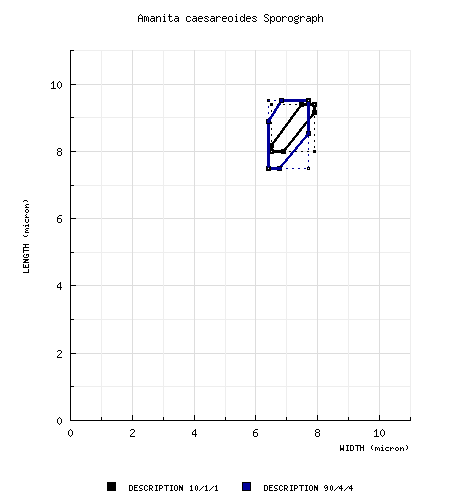
from proposed lectotype annotation by C. Bas (in type packet): [10/1/1] 8.0 - 9.4 × 6.5 - 7.9 μm, (L = 8.6 μm; W = 7.2 μm; Q = (1.01-) 1.16 - 1.26; Q = 1.20).
composite of data from all material reviewed by RET and C. Bas: [90/4/4] (7.0-) 7.5 - 9.5 (-12.0) × (6.2-) 6.4 - 7.7 (-8.5) μm, (L = 8.2 - 9.2 μm; L' = 8.5 μm; W = 6.9 - 7.2 μm; W' = 7.0 μm; Q = (1.01-) 1.11 - 1.39 (-1.52); Q = 1.17 - 1.33; Q' = 1.22), hyaline, colorless, smooth, thin-walled, inamyloid, subglobose to broadly ellipsoid to ellipsoid, rarely globose, usually at least somewhat adaxially flattened; apiculus ?sublateral, cylindric to truncate-conic; contents dominantly monoguttulate, granular to nearly entirely refractive in holotype; ?? in deposit. |
| ecology |
Solitary to gregarious. India: Tn soil in rich humus under Quercus leucotrichophora and Rhododendron arboreum, with scattered Pinus roxburghii. Japan: In woods dominated by Abies firma Sieb. & Zucc. and Castanopsis cuspidata. Russia: In young Quercus forest. |
| material examined |
CHINA:
YUNNAN—Chuxiong Yi Autonomous Prefecture - Lufeng Co., unkn. loc., in market, 7.viii.2002 market collector s.n. [D. Arora 02-107] (RET 356-10).
INDIA:
HIMACHAL PRADESH—Shimla Distr. - Taradevi, s.d. R. P. Bhatt 1035 (HPUB? as "A. hemibapha"; RET 149-3).
JAPAN:
HONSHU—Tottori-ken, Tottori-shi, Ochidani, 4.x.1990 E. Nagasawa s.n. (NY as “A. hemibapha”; TMI 13916 n.v.).
RUSSIA: PRIMORSKIY KRAI—Voroschilov Reg. - Gorno-Tayezhnaya Stn., 23.viii.1945 Lyu. N. Vassilieva s.n. [Тип. No. 3 Зак. No. 289 т. 4000] (LE, proposed lectotype of A. caesareoides). |
| discussion |
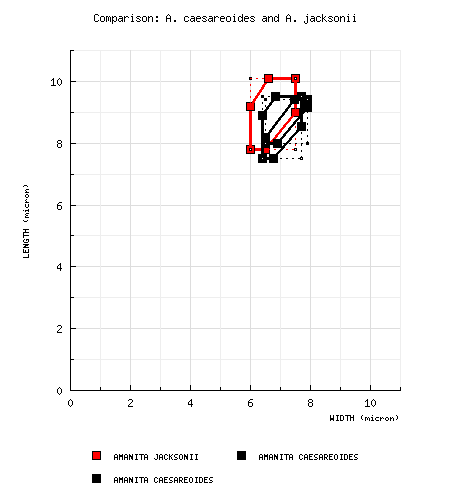
The following illustration provides comparison of spore shape and size by means of sporographs for the present species and the very similar A. jacksonii of eastern North America.
 |
| citations |
—R. E. Tulloss |
| editors |
RET |
|




 Spore data sets and their composite