| name |
Amanita arkansana |
| author |
H. R. Rosen. 1926. Mycologia 18: 97, pl. 9-11. |
| name status |
nomen acceptum |
| english name |
"Arkansas Slender Caesar" |
| etymology |
Arkansas + -ana, suffix indicating possession; hence, "of Arkansas" |
| MycoBank nos. |
203697 |
| GenBank nos. |
Due to delays in data processing at GenBank, some accession numbers may lead to unreleased (pending) pages.
These pages will eventually be made live, so try again later.
|
| lectotypes |
BPI (provisional per RET); isolectotype, TENN |
| lectotypifications |
proposed herein |
| type studies |
double click in markup mode to edit. |
| revisions |
Tulloss, here. |
| selected illustrations |
Justice, J. 1984. Arkansas Naturalist 2(5): cover, 2. |
| intro |
The following text may make multiple use of each data field.
The field may contain magenta text presenting data from a type study
and/or revision of other original material cited in the protolog of the present taxon.
Macroscopic descriptions in magenta are a combination of data from the protolog and
additional observations made on the exiccata during revision of the cited original
material.
The same field may also contain black text, which is data from a revision of the present
taxon (including non-type material and/or material not cited in the protolog).
Paragraphs of black text will be labeled if further subdivision of
this text is appropriate.
Olive text indicates a specimen
that has not been
thoroughly examined (for example, for microscopic
details) and marks other places in the text
where data is missing or uncertain.
The following material not directly from the
protolog of the present taxon is based upon
molecular studies of Santiago
Sanchez-Ramírez and a type study and orther
original research of R. E. Tulloss. |
| pileus |
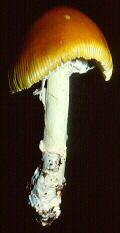
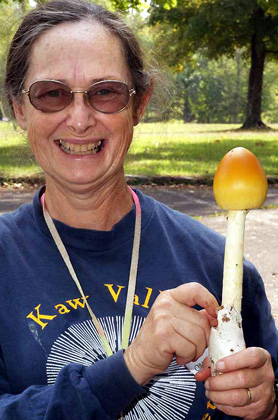
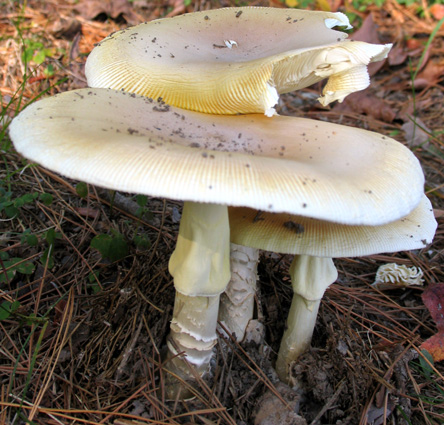
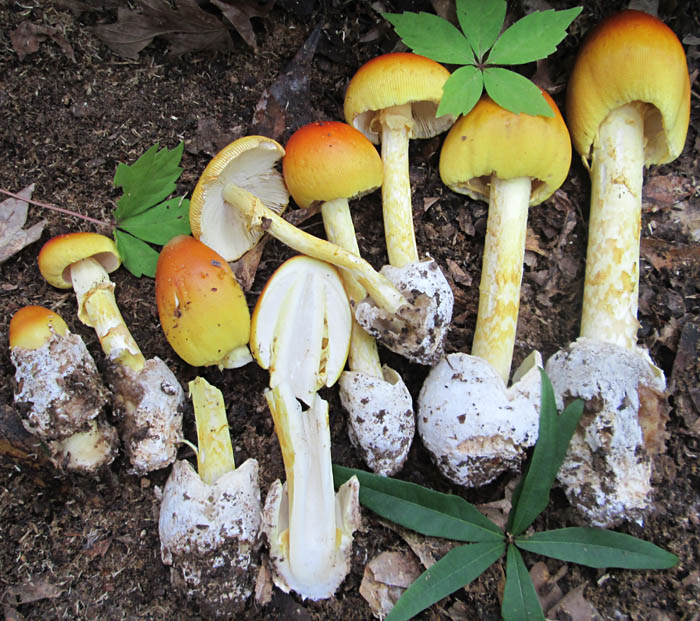
75 - 150+ mm wide, Orange-Buff (8.5YR 7.2/9.0) or
Baryta Yellow (5Y 8.4/6.0) or 10YR 6/10 or deep
orange or brownish red or
brownish yellow (e.g.,
approximately
6B-D7-8 or 8C8) over disc, pale yellow to Lemon
Yellow or yellow or
orange-yellow
(e.g., 4A5 or 4A8) or Light Cadmium
yellow (2.5Y 7.5/10) near margin, never red or
orange-red, sometimes virgate in central region,
fading extensively in direct sunlight, otherwise
unchanging when cut or bruised,
subovoid at first, then hemispheric to rounded
conic
(sometimes with broad umbo), becoming convex to
planoconvex to concave and (eventually) distinctly
umbonate, subshiny, tacky or barely viscid,
becoming dry; context
white to pale yellow (1A2) except near pileipellis
and near lamellae (in these regions always more
intensely yellow than elsewhere), unchanging when
cut or bruised, 4 - 9.5 mm thick, thinning evenly
for one third to one half radius, then membranous
to margin; margin conspicuously striate
(0.4 - 0.5R), nonappendiculate; universal
veil usually absent, rarely as one or two large
white membranous patches. |
| lamellae |
free or adnexed by decurrent line short or extending
10 - 20 mm down stipe apex, sometimes with decurrent
tooth, close to crowded,
yellow to cream in mass, in
side view yellow at first (especially near edge and
near context), then fading to very pale yellow (1A2)
and then to creamy white or off white to white,
unchanging when cut or bruised, 5 - 15 mm broad, with
broadest point nearer pileus margin than stipe,
sometimes
with fimbriate and yellow or yellowish edge;
lamellulae rounded truncate to subtruncate to
subattenuate, apparently not frequent. |
| stipe |
100 - 174 × 12.5 - 30 mm, whitish to pale yellow
(e.g., 3A3) to yellow, often more intensely colored
above partial veil, narrowing upward slightly, flaring
very slightly at apex, finely longitudinally
striatulate, usually with irregular
patches or fibrils in upper half, with patches and
fibrils concolorous at first and becoming deeper
yellow (e.g., 4A3-4) to tan to orange when handled;
context white to cream or pale yellow nearest
exterior surface fading to nearly white adjacent to
central cylinder, unchanging when cut or bruised,
with larva tunnels concolorous, stuffed with white
cottony material, becoming hollow, with central
cylinder 7 - 15± mm wide; partial
veil subapical to superior (e.g., attached
19± mm below apex), membranous,
yellow
(e.g., 3A3), often more intensely
colored on
underside, large (up to 40 mm long), pendent,
persistent, collapsing, sometimes tearing,
with striate upper surface,
with underside bearing patches
and fibrils similar
to those decorating stipe; universal veil as
ample saccate volva, soft-leathery (like kid leather),
grayish white to white on the exterior
, with inner
surface often pale yellow (orangish brown and
sometimes peeling or flaking off rather easily in
some exsiccata), membranous, rather
thick (1.5 - 10
mm at mid-height of limb), rounded
below, 30 - 60 (-110) × 32± - 80 mm,
only attached near
very base of stipe in mature specimens, with
limbus internus small,white to pale
yellow-orange, thin to rather thick,
attached less than one third of way from stipe base
to top of limb. |
| odor/taste |
Odor absent or faint to
mild or somewhat sweetish. Taste not recorded. |
macrochemical
tests |
Spot test for laccase (syringaldazine) - negative throughout basidiome. Spot test for tyrosinase (L-tyrosine) - scattered positive reactions—strong on surface of volva and spots in stipe base context after 3 - 4 min., strong reaction throughout volva after 9± min., faint in very limited region(s) on upper stipe context or surface after 8 - 20 min., faint on limited region(s) of pileus after 18 - 40 min. Test vouchers: Tulloss 10-26-85-A, Tulloss 7-16-87-C. |
| pileipellis |
(70-) 95 - 250 µm thick, with colorless and largely gelatinized suprapellis scant or up to 45 µm thick, with pale yellowish to yellow to orangish yellow to orange-yellow subpellis (70-) 95 - 230 µm thick, mostly ungelatinized; filamentous, undifferentiated hyphae 2.0 - 7.7 µm wide, in fascicles or singly, interwoven over disc, subradially arranged and more densely packed elsewhere; vascular hyphae 2.8 - 16.1 µm wide, occasionally branching, sinuous, scattered to locally common. |
| pileus context |
filamentous, undifferentiated hyphae 2.2 - 11.2 µm wide, branching, plentiful, in broad fascicles and singly, interwoven in moderately open lattice, occasionally with yellowish subrefractive walls; acrophysalides plentiful, thin-walled, ovate to clavate to narrowly clavate to subfusiform, sometimes subrostrate or rostrate, up to 200+ × 56 µm; vascular hyphae 10.5 - 21 µm wide, scattered, sinuous. |
| lamella trama |
bilateral, badly collapsed and only poorly rehydrating in isotype; wcs = 35 - 65 µm; subhymenial base of curved elongated cells, singly or in short chains, most or all intercalary, up to 56 × 21 µm, overlapping both subhymenium and central stratum, with admixture of occasional filamentous, undifferentiated hyphae; filamentous, undifferentiated hyphae 2.2 - 3.5 µm wide, with partially inflated intercalary segments up to 16.5 µm wide in central stratum; terminal, divergent inflated cells not observed; vascular hyphae not observed. |
| subhymenium |
collapsed in type material, with parameters not accurately measurable (wst-near probably > 75 µm; wst-far probably ≤ 85 µm) in isotype; from recent collections (wst-near = 75 - 110 µm; wst-far = 95 - 125 µm); mixture of inflated cells and partially inflated or uninflated short hyphal segments, pseudoparenchymatous in some regions, with one to three cells between subhymenial base and nearest bases of basidia/-oles, with basidia arising from cells of all types. |
| basidia |
In isotype: mostly collapsed, (up to 55±
× 12.2- - 13.5+ µm).
In non-type material: 39 - 57 × 9.0 - 13.8 µm,
thin-walled, dominantly 4-, but also 3-, 2-, and
1-sterigmate, with sterigmata up to 6.5 × 3.0 µm
(commonly quite slender); clamps occasional to rather
common (especially in region of lamella with no
mature basidia), prominent. |
| universal veil |
On pileus: absent. On stipe base, exterior surface: sometimes partially gelatinized, with interior visible through plentiful gaps; filamentous, undifferentiated hyphae 1.5 - 8.5 µm wide, branching, dominant, singly and in narrow and broad fascicles, interwoven loosely, without dominant orientation, with some partially to strongly gelatinized, sometimes making loose coil, occasionally with yellowish subrefractive walls; vascular hyphae not observed. On stipe base, interior: mostly colorless or pale yellowish, but with brownish orange zone parallel to and a little below the exterior surface (occupying region between 5% and 10% of distance from outer surface to inner surface in well-preserved limb fragment, with similar region seen in other mounts of older limbs not very well rehydratable), with outermost 30±% of thickness rehydrating most poorly; filamentous, undifferentiated hyphae 1.5 - 9.8 µm wide, branching, plentiful to locally dominant, in fascicles and singly, often coiling, interwoven in loose lattice, occasionally with yellowish subrefractive and slightly thickened walls; inflated cells plentiful to locally dominant (apparently in clusters) especially in region away from exterior surface, terminal, with walls thin or up to 0.5 µm thick, subglobose to pyriform to broadly ovoid to broadly ellipsoid (up to 85 × 65 µm) and ellipsoid to clavate to narrowly clavate (up to 78 × 46 µm); vascular hyphae not observed; clamps common. On stipe base, inner surface: elements like those of interior collapsed and strongly gelatinized in layer 10 - 35 µm thick, colorless to golden yellow (in isotype). |
| stipe context |
longitudinally acrophysalidic; filamentous, undifferentiated hyphae 3.8 - 11.9 µm wide, branching, plentiful to dominant (near surface), in fascicles and singly; acrophysalides dominant away from surface, thin-walled, often broad and rounded at base, up to 145 × 48 µm; vascular hyphae 2.8 - 21 µm wide, scattered, sinuous, infrequently coiled or twisted. |
| partial veil |
gelatinized somewhat on surfaces; filamentous, undifferentiated hyphae 1.5 - 7.4 µm wide, branching, dominating, singly and in fascicles, with numerous fascicles coparallel and subradial (with interweaving single hyphae and fascicles between them), closely packed, occasionally with yellowish subrefractive walls; inflated cells terminal, subfusiform to narrowly clavate to clavate to ellipsoid (up to 109 × 39 µm), thin-walled, relatively common; vascular hyphae 3.8 - 16.1 µm wide, sinuous, occasionally loosely tangled locally, scattered to locally rather common. |
| lamella edge tissue |
sterile. |
| basidiospores |
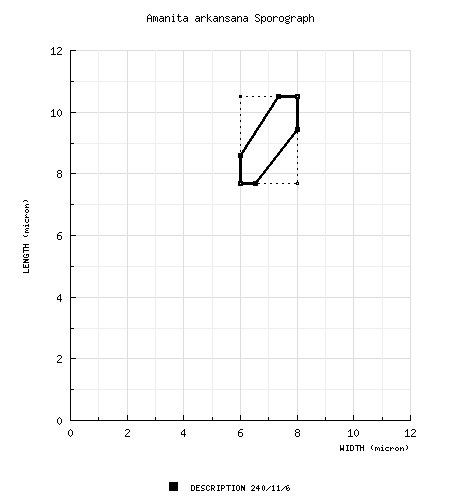
composite of data from all
material revised by RET & CRC: [240/11/6]
(7.0-) 7.7 - 10.5 (-15.0) × (5.6-) 6.0 - 8.0
(-10.2) µm, (L = (8.0-) 8.3 - 9.9 µm;
L’ = 8.9 µm; W = (6.3-) 6.5 -7.3
µm; W’ = 6.9 µm; Q = (1.10-) 1.18 - 1.43
(-1.69); Q = (1.22-) 1.24 - 1.38;
Q’ = 1.30), hyaline, colorless, smooth,
thin-walled, inamyloid, broadly ellipsoid to
ellipsoid, rarely subglobose, rarely elongate,
often at least somewhat adaxially flattened,
rarely as "giant spores";
apiculus sublateral, cylindric to
narrowly truncate-conic, usually relatively
small, sometimes proportionately broad;
contents granular to mono- or occasionally
multiguttulate with additional small granules;
white in deposit. |
| ecology |
Solitary to scattered or (occasionally) in
troops. Arkansas: In frondose woods or in
mixed woods (probably near Quercus).
Florida: In coarse sand under Pinus
clausa.
Mississippi: In damp, sandy loam of river bottom, in
forest of Quercus nigra, Q. phellos,
and P. echinata with Nyssa sylvatica,
Ilex sp., Carpinus caroliniana, and
Liquidambar styraciflua. Texas: In
mixed Pinus-hardwood forest. |
| material examined |
<U.S.A.:
ARKANSAS—Pulaski Co. - Little Rock,
Arkansas Dept. of Pollution Control & Ecology,
14.vi.1994 Jay Justice s.n.
(RET 136-6); unkn. loc.,
5.vii.1983 J. Justice s.n. [Tulloss 7-5-83-JJ2]
(RET 059-3). Saline Co. - 25 mi W of Little
Rock, 5.vi.1981 J. Justice s.n.
[Tulloss 6-5-81-JJ1] (RET 059-4).
Washington[?] Co. - E of
Fayetteville, E of Mt. Sequoia, 13.x.1925
[packet marked "13.x.1926" (sic)] H. R.
Rosen s.n. (holotype, BPI; isotypes TENN 21294
& 21299).
FLORIDA—Alachua Co. - Gainesville,
across from Fla. St. Mus., 11.viii.1985 A.
Norarevian s.n. [Tulloss 8-11-85-AN1]
(RET 137-5).
--Leon County, Tallahassee, property of H.L. and M.A. Hawkins 14.vii.2007 s.n. [Tulloss 7-14-07-A] (RET408-7) nrITS-LSU seq'd.).
GEORGIA— Gwinnett Co. - Berkeley
Lake [33.9829° N/ 84.1823° W, 300m], 24.vi.2013 J.
Craine s.n. (RET 543-8).
INDIANA—Montgomery
Co. - Waveland, Shades St. Pk. [39.9378° N/
87.0894° W, 223 m], 28.viii.2012 Stephen Russell
s.n. [mushroomobserver.org #107627]
(RET 532-4).
MISSISSIPPI—Jackson Co. - Pascagoula R. Wildlife Mgmt. Area, 16.vii.1987 D. C. & R. E. Tulloss 7-16-87-C (in herb. David T. Jenkins, Univ. Ala., Birmingham; RET 149-5).
TEXAS—Hardin or Tyler Co. - Big Thicket
Nat. Preserve, Turkey Crk. Unit, 26.x.1985 A.
Norarevian & J. Justice s.n. [Tulloss
10-26-85-A] (RET 139-10, nrITS & nrLSU &
tef1 & rpb2 seq'd.). Newton Co. -
1.6 km N of Bleakwood, off St.
Hwy. 87, 11.vii.2000 David P. Lewis 6333 (RET
354-6), 24.vi.2000 David P. Lewis 6321 (RET
354-9, nrITS & nrLSU & tef1 & rpb2
seq'd.); Bleakwood, Lewis prop., 24.ix.2000 David
P. Lewis 6358 (RET 354-10). Tyler Co.
- 8 km E of Spurger, Forest Lake Exp. For., off
rd. FM1013, ca. plots 39 & 41, 26.vi.1994 D. P.
Lewis 5302 (RET 283-5, nrITS & nrLSU &
tef1 & rpb2 seq'd.). |
| discussion |
Rosen had the opportunity to compare A. arkansana with a red-capped species (possibly A. jacksonii) in the field and found that the two taxa were never intermixed and that the colors of the pilei of the two taxa were constant from "button" to mature basidiome and that no intergrading of colors was to be found. He also notes that the volval sac is larger in A. arkansana than in the red-capped species and that the lamellae of A. arkansana becoming distinctly whiter than those of the red-capped species in mature basidiomes.
The isotype in BPI is composed of two specimens reduced to fragments: One specimen is mature, but very poorly dried or dried in senescence; the other is immature. The date on the BPI isotype packet results from an apparent slip of the pen. A handwritten label in the packet identifies the material as "ex type" and bears the year "1926"; however, the protolog clearly states that the holotype collection was made on 13 October 1925. The isotype in TENN comprises several stipe bases and a few pileal fragments. Annotation indicates that this is duplicate material extracted from the BPI isotype.
Rosen was a member of the faculty of the Department of Plant Pathology, University of Arkansas, Fayetteville. Therefore, an effort was made to find the holotype of A. arkansana in both UARK and the herbarium of the Plant Pathology Department. The holotype was not to be found in either institution, and apparently it is lost. Therefore, a lectotype should be designated.
Because of the more thorough and abundant representation of all parts of the basidiomes, I plan to designate the isotype in BPI as the lectotype of this species (ICBN §7.4). It is also noteworthy the material at BPI is the material that was reviewed by Gilbert (1941).
Dr. Jay Justice, Mr. David Lewis, and Mr. Aaron Norarevian have kindly given me several recent collections of A. arkansana from which additional data on this species has been extracted.
This species is assignable to Amanita stirps Hemibapha and can be distinguished from other taxa within that stirpes by key here [PDF].
The specimen with the largest value of Q was a specimen with rather common giant spores occurring on 1- and 2-sterigmate basidia.
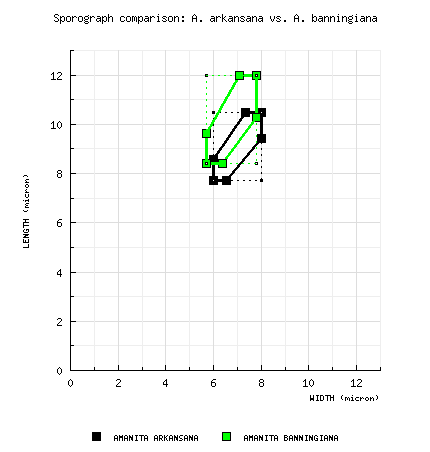
For purposes of comparison, spore data
(green figure) from
A.
banningiana are presented here:
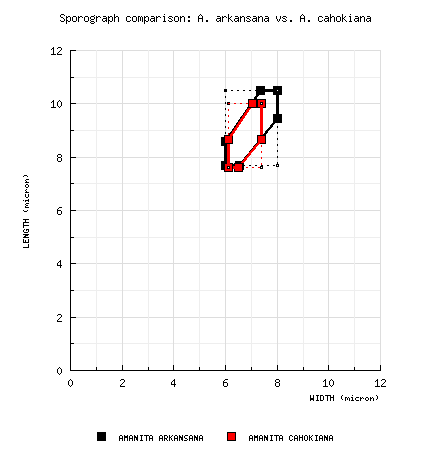
For purposes of comparison, spore data (red figure)
from A.
cahokiana are presented here:
|
| citations |
—R. E. Tulloss |
| editors |
RET |
|




 Spore data sets and their composite