| name |
Amanita illudens |
| author |
Sacc. 1891a. Syll. Fung. 9: 1. |
| name status |
nomen acceptum |
| english name |
"Mocking Ringless Amanita" |
| synonyms |
= Agaricus illudens Cooke & Massee nom. illeg. 1887. Grevillea 16 (fasc. 78): 30. [Posterior homonym. ICBN §53.1]
≡ Amanitopsis illudens (Cooke & Massee) McAlpine. 1895. Syst. Arrangem. Austral. Fungi: 4.
non Agaricus illudens Schwein. 1822. Schriften Naturf. Ges. Leipzig 1: 81. ≡ Omphalotus illudens (Schwein.) Bresinsky & Besl. 1979. Beih. Sydowia 8: 106.
The editors of this site owe a great debt to Dr. Cornelis Bas
whose famous cigar box files of Amanita nomenclatural information
gathered over three or more decades were made available to RET for computerization
and make up the lion's share of the nomenclatural information presented on this site.
|
| etymology |
illudens "mocking" |
| MycoBank nos. |
202816, 134908, 258910 |
| GenBank nos. |
Due to delays in data processing at GenBank, some accession numbers may lead to unreleased (pending) pages.
These pages will eventually be made live, so try again later.
|
| lectotypes |
K |
| lectotypifications |
Pegler. 1965. Austral. J. Bot. 13: 336. [implicit] |
| type studies |
Pegler. 1965. Austral. J. Bot. 13: 336, fig. 1/4.
Reid. 1980. Austral. J. Bot., Suppl. Ser. 8: 35, figs. 22(a-b), 71.
Tulloss, here |
| selected illustrations |
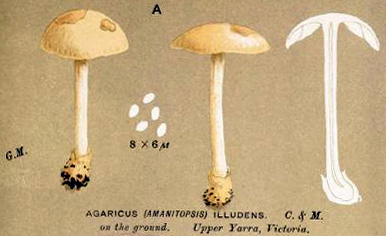
Cooke. 1890. Grevillea 18 (fasc. 88, following p. 360): pl. 2 (fig. A). |
| intro |
The following text may make multiple use of each data field.
The field may contain magenta text representing a type study
by Tulloss.
The same field may also contain black text, which will represent a revision of the
species by Tulloss. Paragraphs of black text will be labeled if further subdivision of
this text is appropriate.
Olive text indicates a specimen that has not been
thoroughly examined; for example, for microscopic details or other place in the text
where data is missing; for example, a place name or a measurement.
The original description is a brief Latin diagnosis as follows:
""Pileo convexo (1 unc.) ochraceo-flavido, verrucis inaequalibus, sparsis, latis, mox secedentibus, consperso, margine laevi; stipite gracili, fistuloso, aequali; annulo obsoleto; volva vaginali; lamellis liberis, postice attenuatis, candidis, acie serrulatis; sporis ovalibus 8 × 6 μ.
"On the ground. Upper Yarra, Victoria; Harkaway Ranges, Victoria. (C. French)
"Pileus scarcely exceeding 1 inch; stem 2 inches long, 2-3 lines thick."
[Communicated by Baron F. von Mueller, K.C.M.G.]
The partial microscopic description is based on orignal research of R. E. Tulloss. Using Cooke's illustrations to expand upon the macroscopic description is problematic. |
| pileus |
25± mm or more wide (28 mm wide in exsiccatum of lectotype), ochraceous yellow; context (as illustrated by Cooke) white and about 6% of stipe length, thinning evenly to margin; margin striate in exsicccatum, illustrated as nonappendiculate by Cooke; universal veil as broad unequal warts or patches (up to 6± mm wide and plentiful in exsiccatum of lectotype), scattered, detersile and soon lost, somewhat browner than pileus in Cooke’s plate. |
| lamellae |
free and attenuate towards stipe, with decurrent lines on stipe apex (visible in exsiccatum), close to crowded, white, with serrulate edge (brown to orange-brown in exsiccatum); lamellulae not described. |
| stipe |
50± × 4 - 6 mm or larger (41 × 3± mm in exsiccatum of lectotype), slender, cylindric, white and totally elongating per Cooke’s plate; context hollow and (as illustrated by Cooke), white, with width of central cylinder about 15% of stipe width; exannulate; universal veil as sheathing volva, membranous, externally buff and with uneven limb in Cooke’s plate, but with interior similar to white of stipe context in cross-section view of same plate. [Note: Because of the plenitude of colored cells in the interior of the universal veil (see microscopic anatomy), it is probable that a cross-section of the saccate volva would not be white.] |
| odor/taste |
not recorded |
macrochemical
tests |
none recorded |
| pileipellis |
(110-) 140 - 170 µm thick, gelatinizing only at surface, lacking distinct supra- and subpellis, yellow-orange, infested with mold in lectotype; filamentous, undifferentiated hyphae 1.2 - 3.4 µm wide, densely packed vertically, dominantly subradially arranged; vascular hyphae not observed. |
| pileus context |
tissue of lectotype penetrated by yellowish subrefractive hyphae of mold; filamentous, undifferentiated hyphae 2.3 - 6.9 µm wide, branching rather frequently, sometimes with yellowish walls, interwoven in open lattice structure, many collapsed in lectotype; acrophysalides collapsed in lectotype; vascular hyphae not observed.
|
| lamella trama |
bilateral, imperfectly rehydrating in lectotype; central stratum collapsed in lectotype; subhymenial tree including plentiful uninflated short hyphal segments, frequently branching; filamentous, undifferentiated hyphae 2.3 - 3.6± µm wide, branching, with many very short segments (some no more than 2.0 µm long); terminal, inflated cells not observed; vascular hyphae not observed. |
| subhymenium |
imperfectly rehydrating in lectotype; apparently dominated by frequently branching, short- or very short-segmented filamentous, undifferentiated hyphae; with basidia arising from short uninflated hyphal segments. |
| basidia |
40 - 56 × 10.1 - 13.3 µm, occasionally brownish yellow or sordid yellow in dilute KOH, thin-walled, dominantly 4-, also 2- and 1-sterigmate, with sterigmata rather short and stubby (up to 4.0 × 1.2 µm); clamps not observed. |
| universal veil |
In lectotype, penetrated by yellowish, subrefractive hyphae of mold (possible to confuse with vascular hyphae). On pileus, exterior surface: not observed, probably destroyed by mold. On pileus, interior: filamentous, undifferentiated hyphae 2.1 - 6.7 µm wide, branching, plentiful, locally dominating, sometimes with yellowish subrefractive walls; inflated cells grayish to brownish yellow to pale sordid yellow, often intensely pigmented, plentiful to locally dominant in clusters, terminal singly, globose to subglobose to ellipsoid to broadly clavate, up to 63 × 61 µm, with walls thin or slightly thickend (< 0.5 µm thick); vascular hyphae not observed with certainty, if present, not common. On pileus, lower surface: 2.8 - 11.4 µm (1 to 10 hyphal diameters) thick in lectotype; filamentous, undifferentiated hyphae 2.5 - 3.0 µm wide, apparently dominantly subradially arranged; collapsed inflated cells like those of interior; vascular hyphae not observed. On stipe base, exterior surface: filamentous, undifferentiated hyphae in thin layer, in lattice structure with lens-shaped openings, locally rather dense, partially gelatinized, collapsed, with sublongitudinal orientation predominating (but latter possibly due to poor rehydration of tissue); vascular hyphae not observed. On stipe base, interior: filamentous, undifferentiated hyphae 1.2 - 8.0 µm wide, branching, common to plentiful, often in narrow fascicles, sometimes constricted at septa, forming very open lattice structure around inflated cells; inflated cells dominating, thin-walled, up to 75 × 69 µm or larger, subglobose to subpyriform to ovoid to broadly clavate; vascular hyphae not observed. On stipe base, inner surface: thin gelatinized film comprising portions of inflated cells like those of interior, with filamentous, undifferentiated hyphae scant, appearing like closely fitted irregular polygonal tiles. |
| stipe context |
longitudinally acrophysalidic, collapsed and fragile in sole exsiccatum of lectotype; filamentous, undifferentiated hyphae 2.6 - 4.8 µm wide, branching; acrophysalides apparently thin-walled, collapsed and fragile in lectotype, up to 80 × 21 µm or larger; vascular hyphae not observed. |
| partial veil |
absent |
| lamella edge tissue |
no data recorded |
| basidiospores |
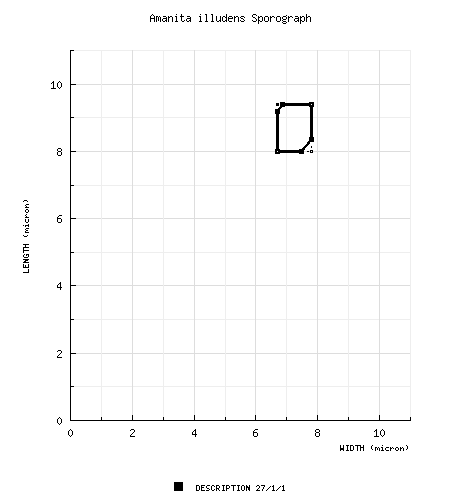
[27/1/1] (7.2-) 8.0 - 9.4 (-11.3) × (6.6-) 6.7 - 7.8 (-8.4) μm, (L = 8.9 μm; W = 7.0 μm; Q = (1.05-) 1.07 - 1.37 (-1.64); Q = 1.26), hyaline and colorless or (occasionally) brownish yellow to sordid yellow and subopaque in dilute KOH, thin-walled, smooth, inamyloid, subglobose to broadly ellipsoid to ellipsoid, often pip-shaped or sublachrimiform [“attenuated at...apiculus to appear pyriform” (Pegler, 1965: 336)], rarely elongate; apiculus subapical to sublateral, cylindric, sometimes obliquely truncate; contents granular to multiguttulate; color in deposit unknown. |
| ecology |
No data on associated plants. |
| material examined |
AUSTRALIA: VICTORIA—Unkn. - Harkaway Ranges, unkn. loc. [possibly in the mountains N & E of Harkaway], vi.1887 C. French s.n. (lectotype, K). |
| discussion |
The distinctly yellowish walls of some basidia and some spores is an uncommon character in Amanita. Large regions of the hymenium were devoid of mature basidia in several mounts. This, the wide variation in Q for the spores measured, and the fact that spore length was not distributed normally (skewed to shorter spores) suggest that the single specimen of the lectotype was just beginning sporulation when it was dried. More complete knowledge of the size and form of spores of A. illudens must await the collection and examination of new specimens.
Reid (1980) states, “Only [the Harkaway Ranges collection] is preserved at K and this was in effect selected as lectotype by Pegler (1965)....” Considering its age and provenance, the lectotype is well preserved. While there is mold on several portions of the basidiome (including on the hymenial surface), there are many regions in which little damage has been done. Most tissues have been penetrated by hyphae of a mold to some extent, and caution must be exercised in distinguishing the yellowish subrefractive hyphae of the mold from any vascular hyphae that may be observed. Whole spores are present in sufficent numbers to permit collection of data on their size and shape; and while rehydration of the lamella trama is imperfect, it was still possible to describe with some confidence the dominance of uninflated hyphal segments in the subhymenium. Bases of basidia are in good condition; and, if clamps had been at all common, some probably would have been noted.
While it may appear that Cooke (cited plate) illustrates marginal striation on the pileus of A. illudens, examination of figures of other taxa illustrated in the same work shows that the markings in question were often used as shading on portions of fruiting bodies that are not striate. |
| citations |
—R. E. Tulloss |
| editors |
RET |
|



 Spore data sets and their composite