

| name | Amanita subpallidorosea |
| name status | nomen acceptum |
| author | Hai J. Li |
| images |
 1. amanita= |
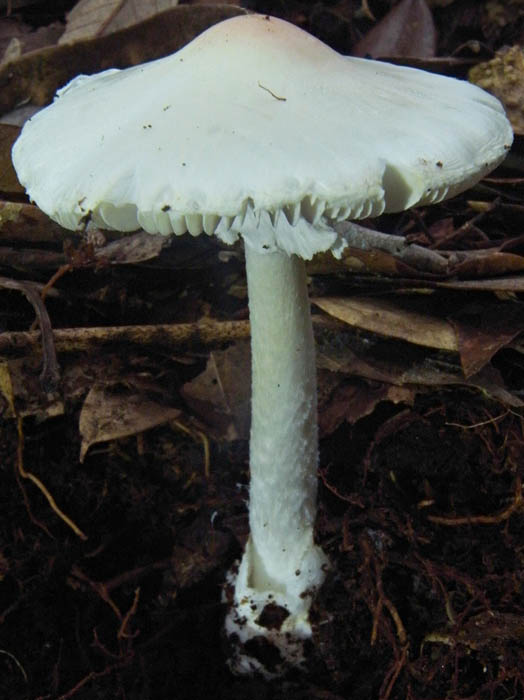
| intro | The following information is derived from the original description (Li et al., 2015) and a description provided by Yang (2015). The fruiting body of Amanita subpallidorosea is small to medium-sized. |
| cap | The cap is 30 - 80 mm wide, obtusely conic when young, then convex, becoming applanate at maturity, occasionally with a noticeable umbo. The cap is white to dirty at first; sometimes, it becomes pale rose in the center. The cap's margin is non-striate and non-appendiculate, and its flesh is white. No volva remains are present on the cap. |
| gills | The gills are free, white to whitish, crowded, and up to 4 mm broad. The short gills are attenuate, plentiful, and in at least two to three ranks. |
| stem | The stem is 70 - 120 mm long, nearly cylindric, slightly tapering upward, with an apex that is slightly expanded. The stem is 6 mm wide at the top and 14 mm wide near the base. It is white to whitish, solid, and is decorated with finely fibrillose squamules. Its flesh is white. The basal bulb of the stem is subglobose and 15 - 30 mm wide. The volva is limbate, membranous, rather firm, with free limb up to 15 mm high; both its surfaces are white. The stem's ring is near the top of the stem and is thin, skirt-like, and membranous. |
| odor/taste | The odor is indistinct. The species is deadly POISONOUS (Li et al. 2015). |
| spores | The spores measure (7.5-) 8 - 11 (-12) × (7-) 8 - 10 (-12) µm and are globose to subglobose and amyloid. The basidia are clampless. |
| discussion |
Amanita subpallidorosea grows in broad-leaved
forests dominated by Fagaceae [trees of the Beech-Oak
family]. It is only known from China (Guizhou
and Taiwan). It is characterized by its small to medium-sized basidioma often with a white pileal margin and pale rose center, a subapical annulus, and large, amyloid globose to subglobose basidiospores (8.5–11 × 8–10 μm). It differs from A. pallidorosea by its larger basidia and larger basidiospores. The reader may wish to compare this taxon with others that are genetically similar such as A. virosa, A. amerivirosa, A. ocreata, A. rimosa, and A. bisporigera. The fruiting body of A. subpallidorosea becomes yellow when wetted with 5% KOH (potassium hydroxide) solution.—Zhu L. Yang |
| brief editors | ZLY, RET |

 Spore data sets and their composite