

| name | Amanita pallidorosea |
| name status | nomen acceptum |
| author | P. Zhang & Zhu L. Yang |
| english name | "Pale-Rose Death Cap" |
| images |
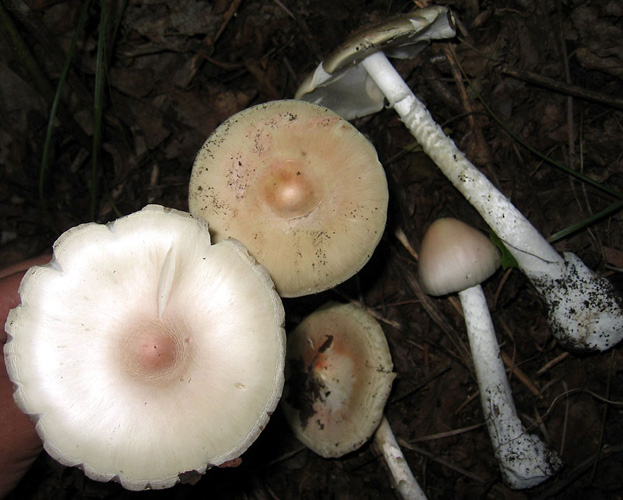  1. Amanita pallidorosea, Jilin Prov., China. 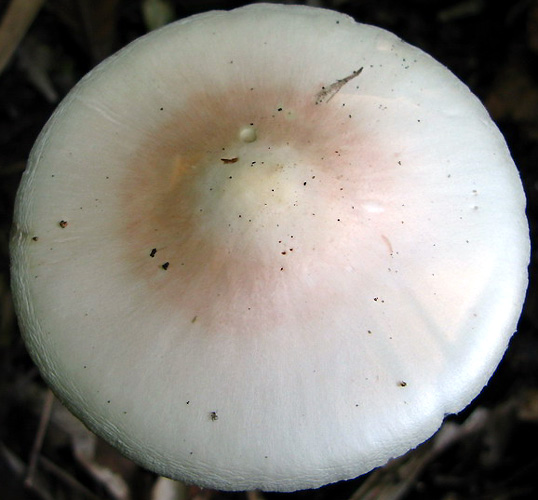 2. Amanita pallidorosea, holotype, Chongquing Municipality, China. |
| intro | The content herein is derived from the original description (Zhang et al., 2010). |
| cap | The fruiting body of Amanita pallidorosea is medium-sized. The cap is 50 - 80 mm wide, rounded conic when young, then convex, and finally becoming applanate and umbonate at maturity. It is undecorated, pallid rose in its center, and paler and becoming white to whitish toward margin. The cap also appears to have embedded, pinkish, radiating fibrils. |
| gills | The gills are free, white to whitish, crowded and up to 5 mm broad. The short gills are attenuate, plentiful, and in 2-3 ranks. |
| stem | The stem is 80 - 150 × 6 - 12 mm,close to cylindric, slightly tapering upward, white to pale buff, and solid, with finely fibrillose squamules. The stem's flesh is white. the basal bulb is subglobose and 12 - 22 mm wide. The volva is limbate, membranous, rather firm, wring is is placed near the top of the stem and is thin, membranous, white, skirt-like, and persistent. |
| odor/taste | The odor of this mushroom is indistinct. This species is deadly POISONOUS. |
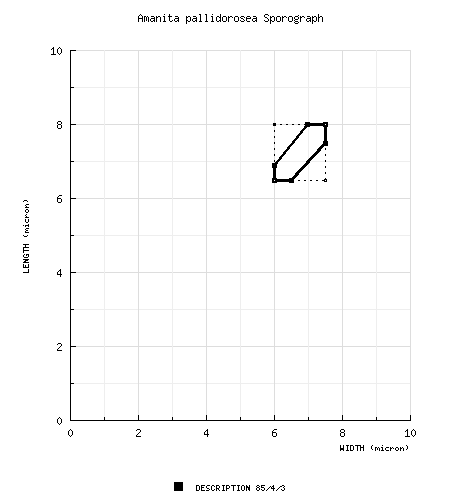
| spores | Spores of this species measure (6.0-) 6.5 - 8.0 (-10.0) × 6.0 - 7.5 (-9.5) µm and are globose to subglobose and amyloid. Basidia lack basal clamps. |
| discussion |
Amanita pallidorosea grows in forests dominated by Fagaceae [trees of the Beech-Oak family]. It is presently known from northeastern, central and southwestern parts of China. In August, 2007, a poisoning in Jilin Province, northeastern China was caused by eating this mushroom. Four persons in a family ate the mushroom, and two of them died. Although the pallid rose pileus is an important character for A. pallidorosea, a purely white variant may also exist in this species. More information and a key to the taxa of sect. Phalloideae in East Asia can be found in Zhang et al. (2010).—P. Zhang and Z.-L. Yang [A very similar pink tint over the center of the cap is known to occur occasionally in two North American species that are usually described as pure white—A. bisporigera and A. ocreata.—ed.] |
| brief editors | RET |

 Spore data sets and their composite