| name |
Amanita ocreata |
| author |
Peck. 1909. Bull. Torrey Bot. Club 36: 330. |
| name status |
nomen acceptum |
| english name |
"Western American Destroying Angel" |
| synonyms |
≡ Venenarius ocreatus (Peck) Murrill. 1912. Mycologia 4: 240.
≡Amanita ocreata (“ochreata”) Peck. in Sacc. 1912. Syll. Fung. 21: 5. [Orthographic error.]
= Amanita bivolvata Peck. 1909. Bull. Torrey Bot. Club 36: 329. ≡ Venenarius bivolvatus (Peck) Murrill. 1912. Mycologia 4: 241.
The editors of this site owe a great debt to Dr. Cornelis Bas
whose famous cigar box files of Amanita nomenclatural information
gathered over three or more decades were made available to RET for computerization
and make up the lion's share of the nomenclatural information presented on this site.
|
| MycoBank nos. |
451380, 208770 |
| GenBank nos. |
Due to delays in data processing at GenBank, some accession numbers may lead to unreleased (pending) pages.
These pages will eventually be made live, so try again later.
|
| holotypes |
A. bivolvata—NYS (implicit). A. ocreata—NYS (implicit). |
| type studies |
A. bivolvata—Jenkins. 1978a. Mycotaxon 7: 27. A. ocreata—Jenkins. 1978b. Mycotaxon 7: 371. |
| intro |
The following text may make multiple use of each data field.
The field may contain magenta text presenting data from a type study
and/or revision of other original material cited in the protolog of the present taxon.
Macroscopic descriptions in magenta are a combination of data from the protologs of A. ocreata and A. bivolvata and
additional observations made on the exiccata during revision of the cited original
material.
The same field may also contain black text, which is data from a revision of the present
taxon (including non-type material and/or material not cited in the protolog).
Paragraphs of black text will be labeled if further subdivision of
this text is appropriate.
Olive text indicates a specimen that has not been
thoroughly examined (for example, for microscopic details) and marks other places in the text
where data is missing or uncertain.
The following information not directly from the protologs cited above or from results of another researcher (cited in text) is based on original research by R. E. Tulloss. |
| pileus |
44 - 127 mm wide, hemispheric at first then plano-convex,
white sometimes with yellowish to pale ochre to brownish
stains toward disk, subviscid, shiny; context
white, sometimes with a thin water-logged line above
lamellae, 8 - 13 mm thick at disk, thinning evenly to
margin; margin not striate to shallowly striate,
slightly incurved at first then decurved and finally
slightly flaring, at times appendiculate with thin
membranous white fragments from the edge of the partial
veil; universal veil absent or as a very thin,
white, easily removed, browning, floccose-membranous
patch covering most of the pileus surface. |
| lamellae |
close to moderately crowded to crowded, free to narrowly adnate with faint decurrent line on stipe at times, white in mass, very pale cream in side view, 5 - 8 mm broad, with edge minutely fimbriate and white; lamellulae numerous, subtruncate to subattenuate to attenuate. |
| stipe |
50 - 150 × 11 - 29 mm, cylindric or narrowing downward, hollow, slightly fibrillose to flocculose below annulus, floccose/pulverulent above annulus, becoming glabrous toward base, white, not staining or bruising; context white throughout or with very pale cream in central part of stipe for much of its length or somewhat waterlogged in central part of stipe, unchanging, solid, larva tunnels concolorous; bulb ovoid to subfusiform to subnapiform to subradicating, to 27 - 42 × 21 - 46 mm; partial veil superior, white, thin, membranous, striate or not above, floccose/fibrillose below, edge often thickened, at times shredding and disappearing; universal veil white, thin, membranous, somewhat tough, soft surface, ocreate, in one or several limbs, often tearing raggedly, 30 - 62 mm from tip of limb to base of bulb, sometimes with low limbus internus encircling stipe or left on lower stipe or underside of annulus. |
| odor/taste |
Odor lacking or slightly of bleach or chlorine, of dead fish or of iodine (especially in bulb of stipe) in age. Taste "normal" per Baker’s field notes. |
macrochemical
tests |
KOH on the pileus: bright yellow.
Syringaldazine test for laccase - totally negative.
Paracresol test for tyrosinase - sometimes positive in
scattered spots on annulus, limb of universal veil, lower
part of central cylinder of stipe, or pileus context or on
cut edge of pileipellis. Results according to
Breckon (1968)—on exposed context of the lower stipe and
bulb unless otherwise noted: FeSO4 - Light Pinkish
Cinnamon; 3% KOH - negative; 15% KOH - negative or bright
yellow; conc. KOH - bright lemon yellow; Melzer’s
reagent - negative; phenol - negative or weakly and
slowly positive; phenolaniline - negative or weakly and
slowly positive; tincture of guaiac - negative or weakly
and slowly positive. DEADLY POISON: contains
amatoxins. Test vouchers: Tulloss ??, 2-20-98-D. |
| lamella trama |
bilateral, divergent; with shallow angle of divergence (about 20° or less than 30°) continuing to within one or two hyphal segments of base of basidia; dominated by nearly parallel interwoven undifferentiated filamentous hyphae 1.8 - 12.5 µm diam, moderately branched; inflated cells oblong ellipsoid to ventricose to clavate (to 82 × 38 µm), terminal or in short, terminal chains, occasionally subglobose to 21.5 × 20.5 µm; oleiferous hyphae present, 2.0 - 8.2 µm, locally in tangles; no clamps observed. |
| subhymenium |
ramose to subcellular, with basidia arising from short uninflated or partially inflated hyphal segments which may be irregular or branching and from small inflated cells (largest dimension less than 12 µm), with all such segments arranged in compact irregularly branching chains; no clamps observed. |
| basidia |
36 - 64 × (6.0-) 9.0 - 14.5 (-16.0) µm, 4-sterigmate, thin-walled; sterigmata up to 5.0 × 1.8 µm; clamps probably not present. |
| universal veil |
On pileus, external surface layer: ??. On pileus, interior: ??. On pileus, inner surface layer: ??. On stipe base, external surface layer: ??. On stipe base, interior: filamentous, undifferentiated hyphae 1.0 - 13.0 (-21?) µm wide, frequently branching, dominating, without dominant orientation, in fascicles and singly, occasionally looping, interwoven in moderately open lattice, sometimes constricted at septa, with walls thin or up to 0.5 µm thick, with some slightly inflated intercalary segments; inflated cells infrequent, narrowly clavate, up to 136 × 38 µm, with walls thin or slightly thickened as in filamentous, undifferentiated hyphae; vascular hyphae not observed; clamps not observed. On stipe base, inner surface layer: ??. |
| stipe context |
longitudinally acrophysalidic; ?? |
| lamella edge tissue |
not described. |
| basidiospores |
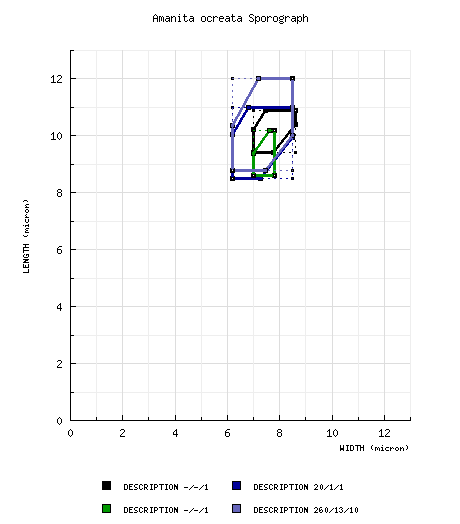
from type study of Jenkins (1978b): [-/-/1] 9.4 - 10.9 (-11.7) × 7.0 - 8.6 μm, (Q = 1.21 - 1.46; Q' = 1.28), hyaline, thin-walled amyloid, broadly ellipsoid to ellipsoid; apiculus sublateral, cylindric; contents guttulate;
color in deposit not recorded.
From RET type study: [20/1/1] (7.0-) 8.5 - 11.0 (-11.2) × (6.0-) 6.2 - 8.5 μm, (L = 10.0 μm; W
= 7.4 μm; Q = 1.17 - 1.62 (-1.72); Q = 1.36), smooth, thin-walled, amyloid, broadly ellipsoid to ellipsoid, occasionally elongate;
apiculus sublateral, cylindric, proportionately small; contents not recorded; color in deposit not recorded.
from Jenkins' type study of A. bivolvata (1978a): [-/-/1] 8.6 - 10.2 × 7.0 - 7.8 μm, (Q = 1.10 - 1.34; Q' = 1.25),
hyaline, thin-walled amyloid, subglobose to broadly ellipsoid to ellipsoid, often adaxially flattened; apiculus sublateral, cylindric; contents guttulate;
color in deposit not recorded.
from RET type study of A. bivolvata: material poorly dried, sample size too small, and spores too damaged [sampled on 18.i.1990—RET].
composite data for all specimens examined by RET & CRC: [260/13/10] (6.8-) 8.8 - 12.0 (-13.5) × (5.5-) 6.2 - 8.5 (-10.8) µm, (L = 9.4 - 11.1 (-11.2) µm; L’ = 10.3 µm; W = (6.6-) 6.9 - 7.9 µm; W’ = 7.4 µm; Q = (1.05-) 1.18 - 1.67 (-1.92); Q = 1.27 - 1.52 (-1.55); Q’ = 1.39), hyaline, smooth, amyloid to strongly amyloid, thin-walled, occasionally subglobose to broadly ellipsoid to ellipsoid to occasionally elongate, often adaxially flattened or even slightly depressed, sometimes expanded at one end; apiculus sublateral, small, cylindric; contents granular to guttulate; white in deposit. |
| ecology |
Solitary to subgregarious to gregarious in sand or sandy loam, in coastal counties, California to Washington. California: Under Quercus (especially, Q. agrifolia) or in mixed woods of Pinus and Quercus. Washington: Under Q. garryana, Corylus cornuta, and possibly under European spp. of Corylus. |
| material examined |
Jenkins' type study of A. ocreata
(1978b):
U.S.A.:
CALIFORNIA—Los Angeles Co. - Claremont,
i.1909 C. F. Baker 5136 (holotype, NYS).
Jenkins' type study of A. bivolvata
(1978a):
U.S.A.:
CALIFORNIA—Los Angeles Co. - Claremont,
i.1909 C. F. Baker 5084 (holotype of A.
bivolvata, NYS).
U.S.A.: CALIFORNIA—Los Angeles Co. - Claremont, i.1909
C. F. Baker 5084 (holotype of A. bivolvata, NYS),
5136 (holotype, NYS).
Monterey Co. - ca. Monterey, ii.1998 NAMA98
participant s.n. (RET 277-6, "02" nrITS & nrLSU
seq'd.).
Orange Co. - Laguna Beach, Laguna Coast Wilderness Pk.,
7.ii.2015 Kevin Lengtz s.n. [mushroomobserver #198270]
(RET 686-7, nrITS seq'd.); Trabuco Cyn., O'Neill
Regional Pk.,
24.ii.2015 Kevin Lentz s.n. [mushroomobserver #199719]
(RET 686-2, "02" nrITS & nrLSU seq'd.).
Riverside Co. - Cleveland Nat. For., Hwy. 74 [33.6524°
N/ 117.409° W, 800 m], 27.ii.2015 Kevin Lentz s.n.
[mushroomobserver #199976]
(RET 686-1, "01" nrLSU seq'd.).
San Francisco Co. - San Francisco, 17.ii.1963 W.
Sundberg s.n. (SFSU). Santa Barbara Co. - Rocky
Hook Pk., 3.iv.1939 P. M. Rea s.n. (L); Santa Barbara,
Oak Pk., 18.iii.1944 E. E. Morse s.n. (FH).
Santa Cruz
Co. - Aptos Hills, N. border of Watsonville, 2.iii.1989
J. Feci s.n. [Tulloss 3-2-89-J] (RET 041-2);
S. border of Aptos, 2.iii.1989 J. Feci & R. E.
Tulloss 3-2-89-D (RET 041-1). Sonoma Co. -
Shiloh Ranch Reg. Pk., 20.ii.1998 S. Davidson, P.
Peterson, M. Handler, D. C. & R. E. Tulloss
2-20-98-D (RET 0274-4).
WASHINGTON—Cowlitz Co. - Woodland,
Horseshoe Lk., 19.v.1991 Janet Lindgren s.n.
[Tulloss 5-19-91-JL1] (RET 010-8), [-JL2]
(RET 003-1).
[See also Thiers 27121
(SFSU).] |
| discussion |
From examination of the types, it is clear that A. bivolvata is synonymous with A. ocreata. I have chosen the latter epithet to maintain because it is in very common, correct usage today whereas the former epithet is either forgotten or considered to apply to a little-understood entity.
From notes in the herbarium packet containing the holotype of A. bivolvata it is clear that Peck considered the possibility of its identity with ocreata on the grounds of the similarity of the size and shape of spores in the two Baker collections. However, he fixed on the presence of a low limbus internus in the robust specimens of Baker 5084 as a distinguishing character state. Baker had called attention to the character with an excellent pen and ink drawing that is filed with the specimens. Baker’s drawing of his collection 5136 (filed with the specimen) shows a more slender, older specimen the universal veil of which has collapsed against the lower stipe obscuring the limbus internus—if a well-formed one had ever been present.
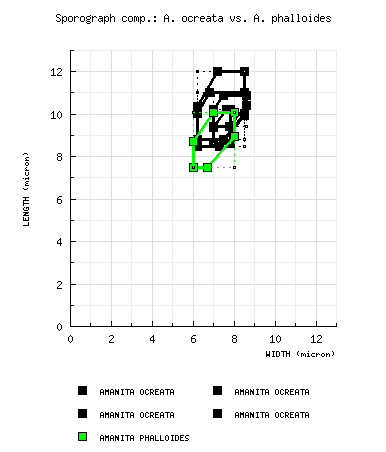
The impact of sample size on size and shape data of spores is illustrated by the comparison of the data from the Jenkins and RET type studis of A. ocreata. See the above sporograph.
For sporograph comparisons among white species of section Phalloideae that have a yellow to orange reaction to KOH spot testing, see the discussion of A. exitialis.
A sporograph comparison of the present species with A. phalloides is presented here because white specimens of the latter occur within the range of A. ocreata. Since the spore size and shape ranges of the two species clearly overlap, in the Pacific Coastal states of the U.S. and Mexico and (considering global warminng) also in British Columbia, it is worth testing white specimens of the Phalloideae with KOH when fresh and recording those results in notes deposited with the specimens in order to reduce determination problems with exsiccata.
Amatoxins have been demonstrated to be present in this species by Ammirati et al. (1977).
If the nrITS (or, separately, the nrLSU) sequences labeled 'A. ocreata' in GenBank are aligned, the result indicates that there may be two distinct taxa presently going under the present name. Tulloss' type study of the species may be useful in segregating the two possible taxa and selecting an epitype for A. ocreata. The types (in NYS) may be too old to yield DNA. |
| citations |
—R. E. Tulloss and C. Rodríguez Caycedo |
| editors |
RET |
|



 Spore data sets and their composite