

| name | Amanita virosa |
| name status | nomen acceptum |
| author | (Fr.) Bertill. |
| english name | "European Destroying Angel" |
| images |
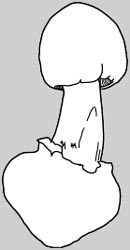 1. Amanita virosa, Brekke sluser, Halden, Ostfold, Norway. 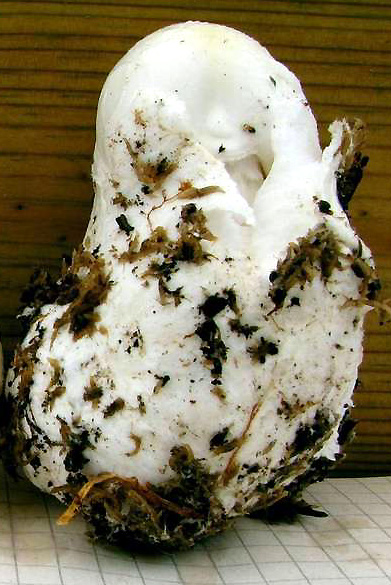 2. Amanita virosa, Degerberget, Hörnefors, Västerbotten, Sweden. 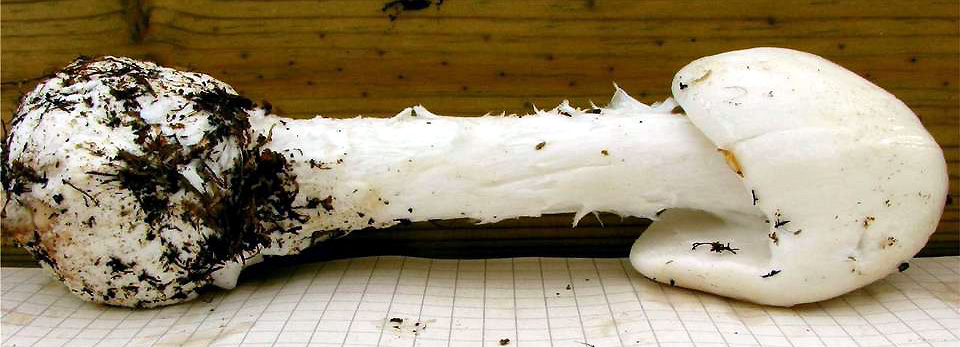  3. Amanita virosa, Degerberget, Hörnefors, Västerbotten, Sweden. |
| intro |
The following is largely based on the descriptions by Bresinsky and Besl (1990) and Neville and Poumarat (2004). |
| cap |
The cap of Amanita virosa is 29 - 123 mm wide, white, sometimes pale cream-colored, sometimes with yellowish or pale orangish tan tints in the center with age, hemispheric when young, soon conico-campanulate, with a broad umbo, smooth, viscid when moist, shiny when dry, not symmetric (with an irregular shape, not circular, often lobed), with a nonstriate and nonappendiculate margin. The volva is usually absent but rarely occurs as a few white membranous patches. The flesh is white, thick in the center of the cap, thin towards the margin. |
| gills |
The gills are quite close, pure white to cream, with a flocculose edge. The short gills are truncate. |
| stem |
The stem is 50 - 165 × 7 - 15 (-20) mm, cylindrical, white, solid to pithy-hollow, scaly below the ring (often illustrated with recurved pointed scales), arranged in concentric rings and somewhat overlapping each other; in some cases the scales are robust. The bulb is 16 - 48 mm wide. The ring is white to yellowish, skirt-like, membranous, fragile, collapsing rapidly on the stem, and in the upper quarter of the stem. The volva is membranous, white, sometimes taking on a pinkish tint at maturity, arising from the upper surface of the bulb, limbate, and usually collapsing against the stem base. The flesh is pure white and unchanging. |
| odor/taste | The odor is strongly of a old rose or honey, in age or drying. This species is deadly POISONOUS. |
| spores |
Bresinsky and Besl (1990) measured spores as follows: 8.2 - 11.3 × 6.7 - 9.7 µm and are subglobose to broadly ellipsoid and amyloid. Clamps are absent at bases of basidia. Neville and Poumarat (2004) measured spores as follows: 8 - 11 × 7.5 - 10 µm and are globose to subglobose to broadly ellipsoid and amyloid. RET measured spores from material collected from France, Norway, and Switzerland as follows: (6.6-) 8.2 - 10.5 (-13.0) × (6.1-) 6.9 - 9.5 (-12.6) µm. |
| discussion |
Amanita virosa is deadly poisonous. This species turns a beautiful and bright yellow on all surfaces when exposed to a 10% KOH solution. Amanita virosa was originally described from Sweden and is known from Europe and eastern Asia. Neville and Poumarat report this species under beech (Fagus sylvatica), chestnut (Castanea satiba), pine (Pinus), spruce (Picea abies), and fir (Abies alba). [Ed. Note: Although the present species has been reported from eastern Asia and has been confirmed genetically there (e.g., in Jilin Province, China), the name has apparently been misapplied to a number of different species. For example, see below.—Zhu L. Yang and RET] Very similar white "destroying angels" that stain yellow with KOH and have dominantly subglobose to broadly ellipsoid spores exist in much of the northern hemisphere: Amanita subjunquillea var. alba Zhu L. Yang and A. exitialis Zhu. L. Yang & T. H. Li (eastern Asia) and A. bisporigera G. F. Atk. and A. suballiacea (eastern North America).—R. E. Tulloss and L. Possiel |
| brief editors | RET |

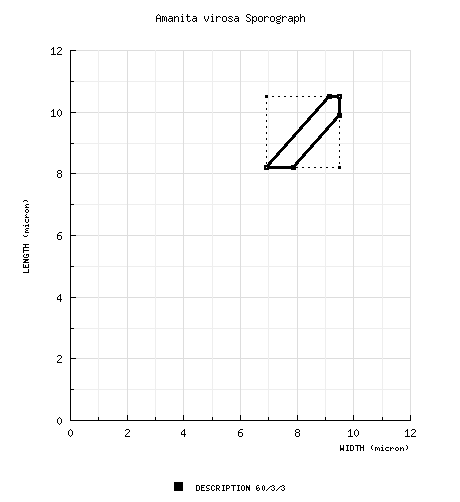
 Spore data sets and their composite