

| name | Amanita rimosa |
| name status | nomen acceptum |
| author | P. Zhang & Zhu L. Yang |
| english name | "Splitting Death Cap" |
| images |
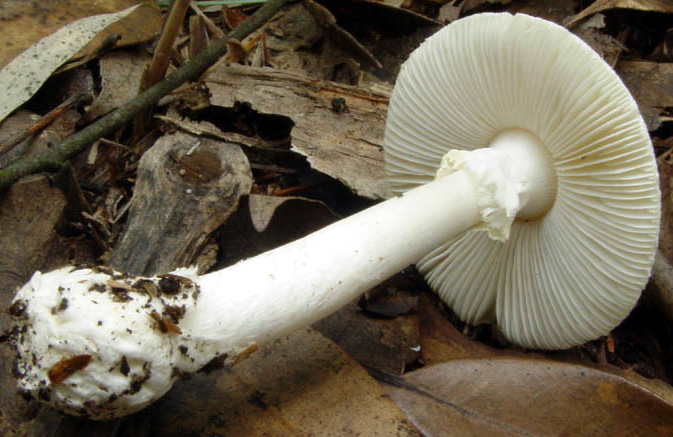  1. Amanita rimosa, holotype, Hunan Prov., China. 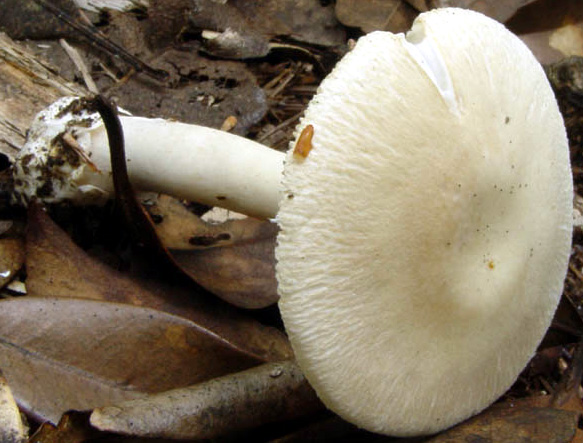 2. Amanita rimosa, holotype, Hunan Prov., China. |
| intro | The content herein is derived from the original description (Zhang et al., 2010). |
| cap | The fruiting body of Amanita rimosa is small to medium-sized. The cap is 48± mm wide, convex to flattened, undecorated, pale buff in the center, dirty white toward the margin, and raidally splitting around the margin (minutely or with flesh splitting for about half of the cap's radius). The cap's margin is non-striate and non-appendiculate, and its flesh is white. |
| gills | The gills are free, white to whitish, subcrowded, and up to 5 mm broad. The short gills are attenuate, plentiful, and in 2-3 ranks. |
| stem | The stem is 70 mm long, nearly cylindric, slightly tapering upward, with an apex that is slightly expanded. The stem is 7 mm wide at the top and 10 mm wide near the base. It is white to whitish, solid, and is decorated with with finely fibrillose squamules. Its flesh is white. The basal bulb of the stem is subglobose and 16 mm wide. The volva is limbate, membranous, rather firm, with free limb up to 8 mm high, and both its surfaces are white. The stem's ring is is placed near the top of the stem anid is thin, skirt-like, and membranous. |
| odor/taste | The odor is indistinct. This species is very probably deadly POISONOUS. |
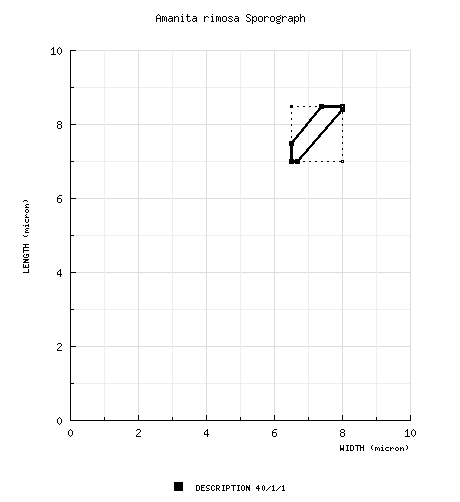
| spores | The spores measure 7.0 - 8.5 (-10.0) × 6.5 - 8.0 (-9.0) µm and are globose to subglobose and amyloid. The basidia are clampless. |
| discussion |
Amanita rimosa grows in a broad-leaved forest dominated by Fagaceae [trees of the Beech-Oak family]. This mushroom is only known from the type locality (China, Hunan Province, Yizhang County, Mangshan) at present. A remarkable feature of Amanita rimosa is its splitting cap surface, which is a result of the mushroom's having a slightly gelatinized upper layer of the cap's skin that includes abundant inflated cells. As a result, the structure of this skin is much weaker than is the case in nearly all known amanitas. The fruiting body becomes yellow when wetted with 5% KOH (potassium hydroxide) solution. Based on the close phylogenetic relationship with other lethal Amanita species, the present species must be deadly poisonous. More information and a key to the taxa of sect. Phalloideae in East Asia can be fund from Zhang et al. (2010).—P. Zhang and Z.-L. Yang |
| brief editors | RET |

 Spore data sets and their composite