
| name | Amanita dunicola |
| name status | nomen acceptum |
| author | Guzmán |
| english name | "Sand Dune Ringless Amanita" |
| cap |
The cap of A. dunicola is 15 - 40 mm wide, convex to subcampanulate or nearly plane, subviscid, with a smooth to short sulcate-striate margin; it is pale brownish to leather brown. The flesh is white. The volva is white, irregular, arranged in medium to small patches or warts over the center of the cap, and without much sand on the upper surface. |
| gills |
The gills are free to narrowly adnate, whitish rose to rose brown, drying yellow-brown to orange-brown, with a white fimbriate edge. Short gills are present and subtruncate to truncate. |
| stem |
The stem is 30 - 80 × 3 - 7 mm, cylindric to somewhat narrowing downward, smooth appearing, minutely flocculose, exannulate; the flesh is white. The membranous saccate volva is white, delicate, often encrusted with sand, more or less retained at maturity. |
| spores |
The spores measure (8.5-) 10.0 - 13.9 (-15.0) × (6.0-) 7.2 - 9.5 (-11.2) µm and are inamyloid and broadly ellipsoid to ellipsoid (occasionally elongate). Clamps are not uncommon at bases of basidia |
| discussion |
Amanita dunicola was originally described from the state of Yucatán, Mexico. It is associated with Coccoloba uvifera at the type locality and may be found in sandy areas with Coccoloba throughout the Caribbean region. Amanita dunicola bears similarities to a small group of tropical amanitas of section Vaginatae that have an upper layer to the cap's pellis which is in the form of a gelatinous matrix through which pass (apparently ungelatinized) pigmented hyphae. Other taxa in this group include A. flammeola Pegler & Piearce (of central Africa) and A. sampajensis A. V. Sathe & S. M. Kulk. (of southwestern India).—R. E. Tulloss |
| brief editors | RET |
| name | Amanita dunicola | ||||||||||||||||||||
| author | Guzmán. 1982. Mycotaxon 16: 256, figs. 24-28. | ||||||||||||||||||||
| name status | nomen acceptum | ||||||||||||||||||||
| english name | "Sand Dune Ringless Amanita" | ||||||||||||||||||||
| MycoBank nos. | 109590 | ||||||||||||||||||||
| GenBank nos. |
Due to delays in data processing at GenBank, some accession numbers may lead to unreleased (pending) pages.
These pages will eventually be made live, so try again later. Search:
Showing 0 to 0 of 0 entries | ||||||||||||||||||||
| holotypes | ENCB; isotype, NY; isotype, XAL | ||||||||||||||||||||
| type studies | Tulloss. 1994. Mycotaxon 52: 327, fig. 15. | ||||||||||||||||||||
| selected illustrations | Guzmán. 1983. Biótica 8: 91, fig. 5. | ||||||||||||||||||||
| intro |
The following text may make multiple use of each data field. The field may contain magenta text presenting data from a type study and/or revision of other original material cited in the protolog of the present taxon. Macroscopic descriptions in magenta are a combination of data from the protolog and additional observations made on the exiccata during revision of the cited original material. The same field may also contain black text, which is data from a revision of the present taxon (including non-type material and/or material not cited in the protolog). Paragraphs of black text will be labeled if further subdivision of this text is appropriate. Olive text indicates a specimen that has not been thoroughly examined (for example, for microscopic details) and marks other places in the text where data is missing or uncertain. For macroscopic details, the following is based on the protolog, notes found with the specimens, and observations on the exsiccata by R. E. Tulloss. The microscopic anatomical data in the following is based on original research by R. E. Tulloss. | ||||||||||||||||||||
| pileus | Tulloss (1994): 15 - 40 mm wide, convex to subcampanulate or somewhat plane, subviscid, pale brownish to leather brown; context white; margin smooth to short sulcate-striate; universal veil as white, irregular, medium to small patches or warts (often densely distributed) over disc and without much sand on upper surface. | ||||||||||||||||||||
| lamellae | Tulloss (1994): free to narrowly adnate, sometimes with decurrent line on upper stipe, whitish rose to rose brown, drying yellow-brown to orange-brown (more yellow than 5B5 or close to 10YR 7/8 to 7.5YR 5/8 to 7.5YR 7/8 near stipe and slightly redder than 7.5YR 5/8 near edge), with white fimbriate edge; lamellulae present, subtruncate to truncate. | ||||||||||||||||||||
| stipe | Tulloss (1994): 30 - 80 × 3 - 7 mm, cylindric to somewhat narrowing downward, smooth appearing, minutely flocculose (lens); context white; exannulate; universal veil as membranous saccate volva, white, delicate, often encrusted with sand, more or less retained at maturity. | ||||||||||||||||||||
| odor/taste | Tulloss (1994): Odor not distinctive (but, in exsiccata, very pleasant—like fresh bread). Taste pleasant. | ||||||||||||||||||||
| macrochemical tests |
none recorded. | ||||||||||||||||||||
| pileipellis | Tulloss (1994): 50 - 70 µm thick, colorless, comprising interweaving hyphae in gelatinous matrix, without distinguishable supra- or subpellis; filamentous, undifferentiated hyphae 1.5 - 10.0 µm wide, dominantly subradially oriented, but also criss-crossing, moderately closely packed, partially gelatinizing and then only at surface, occasionally with yellowish subrefractive walls; vascular hyphae 5.5 - 10.0 µm wide, branching, scattered. | ||||||||||||||||||||
| pileus context | Tulloss (1994): orange-brown pigment notable below pileipellis; filamentous, undifferentiated hyphae 4.0 - 8.8 µm wide, branching; acrophysalides thin-walled, clavate to broadly clavate to pyriform, up to 82 × 43 µm; refractive hyphae 1.8± µm wide, not common. | ||||||||||||||||||||
| lamella trama |
Tulloss (1994): obscurely (if at all) bilateral, imperfectly rehydrating, with wct = 80± - 90 µm; filamentous, undifferentiated hyphae 2.0 - 7.8 µm wide, interwoven, mostly subparallel to hymenial surface; with possibly terminal, inflated cells subventricose (concentrated toward center of trama) to ellipsoid (adjacent to and partially within subhymenium), with major axis subparallel to hymenial surface, thin-walled, up to 82 × 28 µm; vascular hyphae not observed. Note: This description [from (Tulloss 1994)] is based on poorly rehydrating tissue and may contain mistaken interpretations.—RET | ||||||||||||||||||||
| subhymenium |
Tulloss (1994): with wex-near = 0± µm and wex-far = 25± µm (poor rehydration), with hyphae subparallel to hymenial surface to be found immediately below basidia; basidia arise from small inflated cells and uninflated short hyphal segments that arise from hyphae of trama, with quantity of inflated cells variable from region to region. Note: This description [from (Tulloss 1994)] is based on poorly rehydrating tissue and may contain mistaken interpretations.—RET | ||||||||||||||||||||
| basidia | Tulloss (1994): 36 - 60 × 11.0 - 17.2 µm, dominantly 4-, occasionally 2-sterigmate, thin-walled; clamps not uncommon. | ||||||||||||||||||||
| universal veil | Tulloss (1994): On pileus: filamentous, undifferentiated hyphae 5.5 - 9.5 µm wide, dominating, partially gelatinizing near surfaces, frequently branching, somewhat loosely interwoven; inflated cells thin-walled, broadly clavate to subovoid to broadly ellipsoid, up to 40 × 33 µm, collapsing. At stipe base: heavily encrusted with sand and difficult to examine; almost entirely composed of filamentous, undifferentiated hyphae rather loosely interwoven, frequently branching; inflated cells amidst ungelatinized (interior) hyphae are scarce or absent; vascular hyphae not observed; exterior and interior surfaces gelatinizing(?); mounts sparsely populated by extensively gelatinized, subglobose, inflated cells apparently associated with extensively gelatinized layer dominated by inflated cells and separating from volval limb in mounting—possibly remnants of limbus internus. | ||||||||||||||||||||
| stipe context | Tulloss (1994): longitudinally acrophysalidic; filamentous, undifferentiated hyphae 1.2 - 9.0 µm wide, branching; acrophysalides thin-walled, slender, up to 188 × 33 µm, one seen arising from subglobose intercalary cell; vascular hyphae 1.5 - 12.5 µm wide, common, locally branching and in tangles, serpentine; clamps present. | ||||||||||||||||||||
| partial veil | Tulloss (1994): absent. | ||||||||||||||||||||
| lamella edge tissue | sterile. | ||||||||||||||||||||
| basidiospores |
Tulloss (1994): [60/3/1] (8.5-) 10.0 - 13.9 (-15.0) × (6.0-) 7.2 - 9.5 (-11.2) μm, (L = 11.0 - 12.8 μm; L' = 11,8 μm; W = 8.0 9.1 μm; W' = 8.6 μm; Q = (1.17-) 1.25 - 1.56 (-1.67); Q = 1.35 - 1.41; Q' = 1.38). composite of data from all material revised by RET: [100/5/1] (8.5-) 10.2 - 14.2 (-16.5) × (6.0-) 7.2 - 9.6 (-11.2) µm, (L = 11.0 - 13.1 µm; L’ = 12.2 µm; W = 8.0 - 9.1 µm; W’ = 8.5 µm; Q = (1.17-) 1.27 - 1.73 (-1.89); Q = 1.35 - 1.60; Q’ = 1.45), hyaline, colorless, thin-walled, smooth, inamyloid, broadly ellipsoid to ellipsoid, occasionally elongate, often adaxially flattened, sometimes adaxially depressed, infrequently pyriform, often expanded at one end, infrequently expanded in middle; apiculus sublateral to subapical, cylindric; contents monoguttulate; color in deposit not recorded. | ||||||||||||||||||||
| ecology | Gregarious to solitary. In sand below Coccoloba uvifera L., in dunes close to sea. Probably ectomycorrhizal (fide Guzmán). | ||||||||||||||||||||
| material examined | MÉXICO: YUCATAN—Mpio. Ixil - Progreso to Telchac rd., 18.xi.1981 G. Guzmán 21235 (holotype, ENCB, n.v.; isotype, NY; isotype, XAL). | ||||||||||||||||||||
| discussion |
Structure of the volva is very difficult to ascertain because of sand encrusting it in two of the specimens examined. It is interesting to note there is no encrusting sand on patches and warts on the pilei of the exsiccata. It appears that the outer part of the universal veil with its covering of sand particles is sufficiently tough so that it often takes the form of a saccate volva while leaving an inner portion with a slightly greater(?) proportion of inflated cells as sand-free patches and warts on the pileus. Everything observed in the limb of the universal veil on the stipe base in A. dunicola is consistent with the material on the pileus—except a thin, bent, or curved membrane dominated by extensively gelatinized hyphae and including relatively common, inflated cells. This membrane was observed in a crush mount; the same mount was littered with extensively gelatinized, subglobose, inflated cells that were much like those in the gelatinized membrane. This structure is consistent with that of a limbus internus that is more friable than the outer limb of the universal veil. It would be valuable to confirm this morphology in fresh material. Species of Amanita treated in [(Tulloss 1994)] having spore size and shape and universal veil similar to those of A. dunicola are A. argentea, A. huijsmanii, A. supravolvata, and A. yucatanensis. Amanita argentea, A. huijsmanii, and A. supravolvata have subhymenia including ramifying elements that are not subparallel to the hymenial surface and, indeed, may be perpendicular to it. In addition, in these European species Amanita yucatanensis was described from tropical forest, apparently (rehydration was imperfect in both holotype and isotype) has a lamella trama of about half the width of the lamella trama of the present taxon, and, additionally, differs from A. dunicola in the following: The present species is somewhat similar to A. arenicola O. K. Miller and D. J. Lodge (2000) recently described from Puerto Rica and the British Virgin Islands. Unfortunately, protologs of both taxa are inadequate for thorough comparison of macroscopic characters. I have not had the opportunity to thoroughly examine the holotype of A. arenicola. Note: Comparison is also required with A. mairei Foley (t.b.d.). | ||||||||||||||||||||
| citations | —R. E. Tulloss | ||||||||||||||||||||
| editors | RET | ||||||||||||||||||||
Information to support the viewer in reading the content of "technical" tabs can be found here.
| name | Amanita dunicola |
| bottom links | [ Keys & Checklists ] |
| name | Amanita dunicola |
| bottom links | [ Keys & Checklists ] |
 Spore data sets and their composite
Each spore data set is intended to comprise a set of measurements from a single specimen made by a single observer; and explanations prepared for this site talk about specimen-observer pairs associated with each data set. Combining more data into a single data set is non-optimal because it obscures observer differences (which may be valuable for instructional purposes, for example) and may obscure instances in which a single collection inadvertently contains a mixture of taxa.
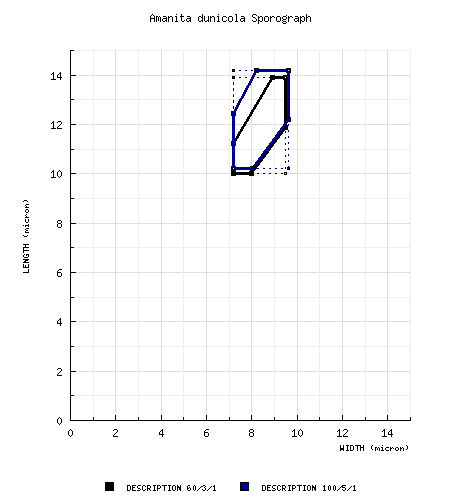

Text and User-Generated Sporographs are published under the Creative Commons License.

In the case of a taxon page, image credits are on the 'image' tab.