| name |
Amanita flammeola |
| author |
Pegler & Piearce. 1980. Kew Bull. 35(3): 482, fig. 3(A-D). |
| name status |
nomen acceptum |
| english name |
"Flame-Colored Ringless Amanita" |
| MycoBank nos. |
112739 |
| GenBank nos. |
Due to delays in data processing at GenBank, some accession numbers may lead to unreleased (pending) pages.
These pages will eventually be made live, so try again later.
|
| holotypes |
K |
| type studies |
Tulloss, here |
| intro |
The following text may makes multiple use of each data field.
The field may contain magenta text representing a type study
by Tulloss.
The same field may also contain black text, which will represent a revision of the
species by Tulloss. Paragraphs of black text will be labeled if further subdivision of
this text is appropriate.
Olive text indicates a specimen that has not been
thoroughly examined (for example, for microscopic details) and marks other places in the text
where data is missing or uncertain.
The following is based on the protolog (for most macroscopic data) and on original research of R. E. Tulloss. |
| pileus |
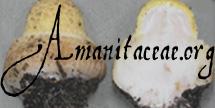
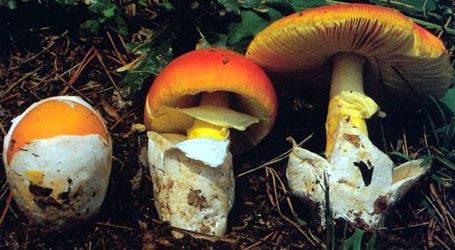
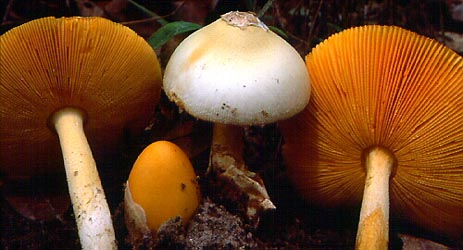
from type study of Tulloss: 60 - 90 mm wide, saffron yellow, straw yellow at margin, becoming paler at maturity, narrowly rounded-conic at first, expanding to applanate with decurved margin, umbonate; context fairly thick [although very thin in exsiccata], firm, white; margin striate (0.1 - 0.15R), nonappendiculate; universal veil absent. |
| lamellae |
from type study of Tulloss: free, crowded, saffron yellow or paler, presently somewhat pinkish brown in exsiccata, ventricose, with edge floccose-denticulate; lamellulae truncate, common, unevenly distributed, of three lengths. |
| stipe |
from type study of Tulloss: 60 - 150 × 5 - 20 mm, concolorous with pileus, cylindric or narrowing upward, pruinose to farinose; context solid to stuffed (hollow in exsiccatum); exannulate; universal veil as cylindro-saccate volva, up to 60 mm tall, white, membranous, with thin exterior surface layer appearing to be delaminated from thicker and somewhat spongy interior in exsiccata, completely buried in substrate (despite its length), having longitudinally fibrillose pallid membranous limbus internus (1± cm high in exsiccatum, probably originally pale yellow to yellow) attached to volval limb about one-third of distance from base of stipe to uppermost point on limb. |
| odor/taste |
from type study of Tulloss: Odor pleasant; taste mild. |
macrochemical
tests |
from type study of Tulloss: none recorded. EDIBLE. |
| pileipellis |
from type study of Tulloss: suprapellis comprising sinuous, narrow, filamentous, undifferentiated hyphae in gelatinous matrix, 45 - 80 µm thick; subpellis comprising densely packed, ungelatinized hyphae, very faintly yellow, 55 - 185 µm thick; filamentous, undifferentiated hyphae in suprapellis 1.2 - 3.4 µm wide, branching; filamentous, undifferentiated hyphae in subpellis 2.0 - 8.4 µm wide, branching, subradially oriented, with intercalary inflated segments (up to 70 × 15.4 µm or larger), often slightly constricted at septa; vascular hyphae 1.5 - 6.3 µm wide, branching, apparently restricted to subpellis. |
| pileus context |
from type study of Tulloss: filamentous, undifferentiated hyphae 2.8 - 11.3 µm wide, dominating, branching, interwoven in loose lattice, with those of smaller diameter often in fascicles, with those of larger diameter often constricted at septa, with plentiful partially inflated intercalary segments up to 18.9 µm wide; acrophysalides not observed; vascular hyphae 4.2 - 7.7 µm wide, scattered, infrequent. |
| lamella trama |
from type study of Tulloss: bilateral, very poorly rehydrating in holotype; wcs = 35 - 40 µm; subhymenial base comprising branching short-segmented hyphae and subfusiform to narrowly ellipsoid inflated intercalary thin-walled cells (up to 50 × 16.8 µm) in chains or with single cell reaching from central stratum into subhymenium, with such cells or chains diverging from central stratum at at shallow angle (under 30°); filamentous, undifferentiated hyphae 2.1 - 5.6 µm wide, branching, occasionally with yellowish subrefractive walls, with intercalary segments in central stratum often partially inflated (up to 11.2 µm wide); terminal, inflated cells not observed; vascular hyphae not observed. |
| subhymenium |
from type study of Tulloss: wst-near = 40 - 55 µm; wst-far = 65 - 70 µm; pseudoparenchymatous in many regions of most mature basidia, with 1 - 4 cells (hyphal segments or globose to subglobose to clavate inflated cells, 9.4 - 13.3 × 9.1 - 11.9 µm, thin-walled, with major axes perpendicular to central stratum) between bases of basidia/-oles and subhymenial base, with 2 - 3 cells between bases of longest and shortest basidia/-oles in selected regions of hymenium, with basidia arising (sometimes multiply) from inflated cells and (at least in less mature regions of hymenium) from partially inflated short hyphal segments. |
| basidia |
from type study of Tulloss: (26-) 30 - 65 × (7.8-) 9.8 - 12.9 µm, 4-sterigmate, with walls 0.7± µm thick in apical portion, with sterigmata up to 5.7 × 1.7 µm; clamps not observed. |
| universal veil |
from type study of Tulloss: On pileus: occasional pale yellow gelatinized patches of co-parallel hyphae in layer one or two hyphal diameters thick. On stipe base, exterior surface: filamentous, undifferentiated hyphae 2.1 - 7.7 µm wide, branching, with those of larger diameter constricted at septa, colorless, in very broad fascicles with diverse orientations (although many sublongitudinally oriented), often partially gelatinized [and then often encrusted with yellow material (from substrate?)] and/or partially collapsed; inflated cells and vascular hyphae not observed. On stipe base, interior: filamentous, undifferentiated hyphae 2.0 - 10.5 µm wide, branching, dominating, in fascicles and singly, occasionally with pale yellow walls, more commonly pigmented near inner surface, more likely to be sublongitudinally oriented near surfaces, otherwise without dominant orientation and interwoven in open lattice; inflated cells not observed; vascular hyphae 2.1 - 10.8 µm wide, occasional, observed only near inner surface. On stipe base, inner surface: partially to strongly gelatinized, otherwise as described under interior. On stipe base, limbus internus: longitudinally acrophysalidic, completely ungelatinized; filamentous, undifferentiated hyphae 1.4 - 8.4 µm wide, branching, frequently having yellow walls, with those of larger diameter often constricted at septa, with infrequent inflated intercalary segments (up to 12.6 µm wide), with plentiful tip cells; acrophysalides unevenly distributed, most frequent in uppermost portion of tissue, up to 115 × 28 µm, thin-walled, clavate, occasionally with yellow walls; vascular hyphae not observed after extensive search. |
| stipe context |
from type study of Tulloss: longitudinally acrophysalidic; filamentous, undifferentiated hyphae 1.8 - 7.1 µm wide, branching, plentiful, dominant at surface; acrophysalides plentiful to dominant away from surface, thin-walled, up to 176 × 22 µm; vascular hyphae 2.0 - 8.3 µm wide, branching, scarce in interior, scattered (but locally rather frequent) at surface. |
| lamella edge tissue |
not described |
| basidiospores |
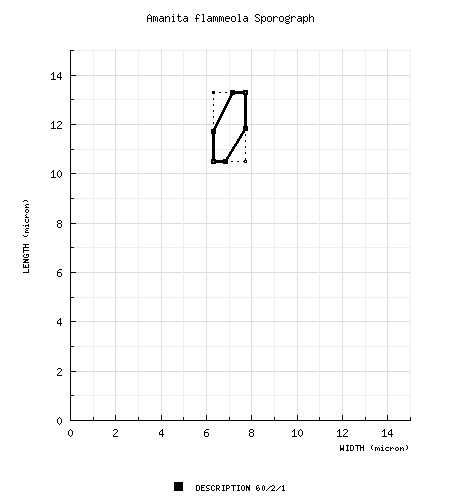
from type study of Tulloss: [60/2/1] (8.6-) 10.5 - 13.3 (-15.4) × (5.7-) 6.3 - 7.7 (-9.0) µm, (L = 11.5 - 11.6 µm; L’ = 11.5 µm; W = 6.8 - 6.9 µm; W’ = 6.9 µm; Q = (1.39-) 1.54 - 1.86 (-2.05); Q = 1.68 - 1.69; Q’ = 1.69), hyaline, colorless, thin-walled, smooth, inamyloid, ellipsoid to elongate, infrequently cylindric, often adaxially flattened, sometimes expanded at one end; apiculus sublateral, subcylindric to truncate-conic, short and relatively broad; contents dominantly monoguttulate, occasionally multiguttulate; very pale salmon pink in deposit. |
| ecology |
from type study of Tulloss: Solitary in miombo woodland, in December and from late March to early April.
RET: In mixture of Uapaca and Brachystegia. |
| material examined |
RET: ZAMBIA: COPPERBELT
PROV.—ca. Kitwe, Garneton,
14-24.xii.2000 David Arora 00-326 (RET 346-5,
nrLSU seq'd.);
btwn. Kitwe and Ndola,
purchased by roadside, 22.xii.1978 G. D.
Piearce FP 602/2 (paratype, K);
off Kitwe-Ndola Road, Greystone
Farm, 28.xii.2000 David Arora 00-465 (RET 348-4;
SFSU);
Misaka Nat. For.,
28.xii.1978 H. Munthali s.n. [Piearce FP 605]
(holotype, K). |
| discussion |
type study of Tulloss: The pileipellis of A. flammeola is of a form very uncommon in the taxa of section Vaginatae that I have reviewed to date. The only somewhat similar pileipellis was seen in A. dunicola Guzmán (Tulloss 1994: 310) and A. sampajensis (this site). The suprapellis may fit the description by Shaffer (1966) of a pellis in which a gel is secreted by hyphae that themselves are not gelatinized—rather than produced by the swelling and breakdown of hyphal walls, which is the usual case in Amanita.
The thin, membranous limbus internus of the present species is identified as such as follows: It cannot represent the inner surface of the universal veil limb because this surface is partially gelatinized, lacks inflated cells, includes vascular hyphae, and does not have frequent hyphal tip cells in evidence. It cannot represent the stipe surface because the latter surface is composed of somewhat collapsed elements, does not have hyphal tip cells in evidence, and includes vascular hyphae. The structure is rather like that of some partial veils in Amanita except for its good state of preservation, the frequent occurrence of hyphal tip cells, and its relatively infrequent hyphae having an orientation other than sublongitudinal. [One might wish to compare this structure to that of the felted material left on the stipe in species of sect. Caesareae such as A. jacksonii, etc.]
The paratype collection (Piearce FP 602/2) is immature. Its lamellae bear very few mature spores. However, the unusual pileipellis, thickened apices of basidia, macroscopic similarity, etc. are convincing evidence for conspecificity. Sterigmata and apophyses were beginning to form on numerous basidia when the basidiocarp was dried. The subhymenium illustrated (Fig. ??) is probably underinflated compared with what would be expected in a mature specimen.
I examined spores from lamellae of the two mature basidiocarps of the holotype and from the spore print associated with the smaller of the two. In no case did I obtain data yielding a Q as high as that reported in the protolog (1.95). The data from the spore print was almost identical with the data from the lamellae.
Pegler and Piearce (1980) recorded a name for this species among an indigenous people (Bemba) in Zambia—musholomwa. |
| citations |
—R. E. Tulloss |
| editors |
RET |
|



 Spore data sets and their composite