
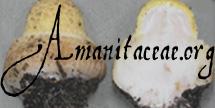
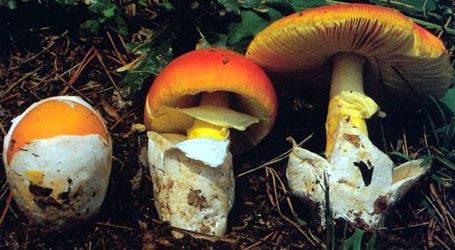
| name | Amanita sampajensis |
| name status | nomen acceptum |
| author | A. V. Sathe & S. M. Kulk. |
| english name | "Sampaja Ringless Amanita" |
| cap |
The cap of A. sampajensis is 62 - 90 mm wide, ovate when young, becoming planar, smooth, moist, fleshy, nonappendiculate, with a sulcate margin. The cap is isabelline to hazel and fades on drying. The volva is present as a thin indistinct layer of hyaline fragments. |
| gills |
The gills are free (remote), close, white, becoming off-white, lanceolate. Short gills are present. |
| stem |
The stem is 180 - 210 × 16 - 18 mm, dark olivaceous brown, narrowing upward, lacking surface decoration, and exannulate. The flesh is hollow. The saccate volva is membranous and formed two lobes in the type material.. |
| spores |
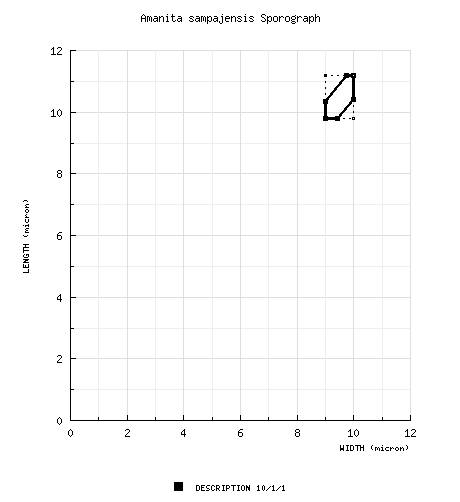
The spores measure (9.4-) 9.8 - 11.2 (-12.0) × 10.0 - 7.4 (-10.8) µm and are globose to subglobose and inamyloid. Clamps are absent at bases of basidia. |
| discussion |
This species is only known from the type, a collection made in western India (Karnataka state). Amanita sampajensis is a member of a small group of tropical amanitas that have an upper layer of the cap skin comprising a gelatinous matrix in which are to be found ungelatinized, pigmented hyphae. Other members of this group are A. dunicola Guzmán and A. flammeola Pegler & Pierce.—R. E. Tulloss |
| brief editors | RET |
| name | Amanita sampajensis | ||||||||||||||||||||
| author | A. V. Sathe & S. M. Kulk. 1981 ["1980"]. Agaricales (Mushr.) S. W. India 1: 44-46, 69, fig. 2. | ||||||||||||||||||||
| name status | nomen acceptum | ||||||||||||||||||||
| english name | "Sampaja Ringless Amanita" | ||||||||||||||||||||
| MycoBank nos. | 115562 | ||||||||||||||||||||
| GenBank nos. |
Due to delays in data processing at GenBank, some accession numbers may lead to unreleased (pending) pages.
These pages will eventually be made live, so try again later. Search:
Showing 0 to 0 of 0 entries | ||||||||||||||||||||
| holotypes | AMH 4550; isotype, NY 47701 | ||||||||||||||||||||
| type studies | Tulloss, here | ||||||||||||||||||||
| intro |
The following text may make multiple use of each data field. The field may contain magenta text presenting data from a type study and/or revision of other original material cited in the protolog of the present taxon. Macroscopic descriptions in magenta are a combination of data from the protolog and additional observations made on the exiccata during revision of the cited original material. The same field may also contain black text, which is data from a revision of the present taxon (including non-type material and/or material not cited in the protolog). Paragraphs of black text will be labeled if further subdivision of this text is appropriate. Olive text indicates a specimen that has not been thoroughly examined (for example, for microscopic details) and marks other places in the text where data is missing or uncertain. The following material not directly from the protolog of the present taxon and not cited as the work of another author is derived from the original research of R. E. Tulloss. | ||||||||||||||||||||
| pileus | from type study of Tulloss: 62 - 90 mm wide, isabelline to hazel, fading on drying, ovate when young, becoming planar, smooth, moist; context fleshy; margin sulcate, nonappendiculate; universal veil as thin indistinct layer of hyaline fragments (e.g, thin-walled, obpyriform to subglobose inflated cells per protolog). | ||||||||||||||||||||
| lamellae | from type study of Tulloss: free (remote), close, white, becoming off-white, lanceolate, up to 7 mm broad, with entire margin; lamellulae present. | ||||||||||||||||||||
| stipe | from type study of Tulloss: 180 - 210 × 16 - 18 mm, dark olivaceous brown, narrowing upward, lacking surface decoration; context fleshy, hollow; exannulate; universal veil as saccate volva, membranous, bilobate, 50 - 62 × 20 - 24 mm. | ||||||||||||||||||||
| odor/taste | not recorded. | ||||||||||||||||||||
| macrochemical tests |
none recorded. | ||||||||||||||||||||
| pileipellis | from type study of Tulloss: 85 - 90 µm thick overall; suprapellis often apparently eliminated by action of molds, but occasionally found as colorless gelatinous matrix 10 - 40 µm thick (35 - 75 µm thick per protolog) including sinuous, filamentous, undifferentiated hyphae 1.5 - 3.0 µm wide, sordid yellowish with subrefractive walls (having olivaceous contents per protolog); subpellis 45 - 75 µm thick, brown-orange to orange-brown to red-brown, with elements densely packed vertically; filamentous, undifferentiated hyphae 1.5 - 5.1 µm wide, without dominant orientation when viewed from above, singly and in fascicles; vascular hyphae not observed. | ||||||||||||||||||||
| pileus context | from type study of Tulloss: tissue collapsed in part; filamentous, undifferentiated hyphae 2.0 - 5.6+ µm wide (per protolog, 7.5+ µm wide), branching, plentiful, thin-walled, singly and in fascicles, interwoven in open lattice; acrophysalides plentiful, broadly ellipsoid to clavate, up to 65 × 29 µm or larger (per protolog, up to 36 µm wide); vascular hyphae not observed. | ||||||||||||||||||||
| lamella trama | from type study of Tulloss: largely destroyed by mold; per protolog, bilateral, ...with filamentous, undifferentiated hyphae 6 - 45 µm wide, thin-walled. [Note: The remark that the gill edge was fertile (from the protolog) has been removed. It probably resulted from a misinterpretation of the cells of the lamella margin.—ed.] | ||||||||||||||||||||
| subhymenium | from type study of Tulloss: largely destroyed by mold; per protolog, cellular and 27 - 33 µm wide. | ||||||||||||||||||||
| basidia | From type study of Tulloss: largely destroyed by mold, 4-sterigmate; per protolog 45 - 58 × 12 - 21 µm, with sterigmata up to 8 × 3 µm, and without clamps. | ||||||||||||||||||||
| universal veil | from type study of Tulloss: On pileus: scattered inflated cells partially gelatinized, up to 49 × 46 µm (obpyriform to subglobose and up to 55 µm wide per protolog). On stipe base, exterior surface layer: mold present, locally obscuring tissue; filamentous, undifferentiated hyphae 1.3 - 5.1 µm wide, branching, dominating, mostly collapsed, locally gelatinized, predominantly sublongitudinally oriented, in fascicles and singly, interweaving with some gaps allowing view of interior; vascular hyphae not observed. On stipe base, interior layer: filamentous, undifferentiated hyphae 2.8 - 8.6 µm wide, rather frequently branching, in fascicles and singly, loosely interwoven in open lattice, with openings in lattice of the size and form of inflated cells even when not clearly containing such; inflated cells at least plentiful, probably at least locally dominant, subglobose to pyriform to ellipsoid to broadly clavate to clavate, up to 75 × 57 µm or larger, thin(?)-walled; vascular hyphae not observed. On stipe base, inner surface layer: like interior, but gelatinized and brownish yellow, suggesting honey comb possibly due to gelatinization and/or due to cells left on pileus surface. | ||||||||||||||||||||
| stipe context | from type study of Tulloss: tissue largely collapsed and partially gelatinized; longitudinally acrophysalidic; filamentous, undifferentiated hyphae 2.5 - 14.0 µm wide, branching, thin(?)-walled, common; acrophysalides (e.g., 121 × 24 µm) dominating away from surfaces, thin(?)-walled, often somewhat rounded at base; vascular hyphae not observed. | ||||||||||||||||||||
| partial veil | absent. | ||||||||||||||||||||
| lamella edge tissue | from protolog: "fertile." [Note: Amanita lamella edges are sterile of necessity because of the mode of development of the basidiome. The protolog's statement to the contrary probably results from a misinterpretation of the lamella edge cells; see above.—ed.] | ||||||||||||||||||||
| basidiospores |
from type study of Tulloss: [10/1/1] (9.4-) 9.8 - 11.2 (-12.0±) × 9.0 - 10.0 (-10.8±) μm, (L = 10.4 μm; W = 9.5 μm; Q = 1.04 - 1.15 (-1.17); Q = 1.09), colorless, hyaline, smooth, thin-walled, inamyloid, globose to subglobose, infrequently broadly ellipsoid, often adaxially flattened; apiculus sublateral, cylindric; contents monoguttulate or granular; white in deposit. from protolog: [-/-/-] 10.5 - 13.5 × 9.5 - 12.0 μm, (est. Q = 1.12). | ||||||||||||||||||||
| ecology | from type study of Tulloss: Solitary or subgregarious. Between 900 and 1800 m elev. In forest. | ||||||||||||||||||||
| material examined | from type study of Tulloss: INDIA: KARNATAKA—S. Capara Distr. - Sampaja [900 - 1800 m], 18.vi.1980 S. M. Kulkarni s.n. (holotype, AMH 4550, n.v.; isotype, NY 47701, badly damaged by mold). | ||||||||||||||||||||
| discussion |
from type study of Tulloss: Most of the isotype was enshrouded by multiple molds and bacteria. It is quite possible that spores from undamaged material would be larger; only one or two spores in several sections appeared to be completely undamaged. With the lamella trama, subhymenium, and spores very incompletely characterized, understanding of this taxon must (for the moment) be considered incomplete. It is encouraging that, for several tissues (particularly, the interesting pileipellis), their characters as reported in the protolog were confirmable. That the spores of A. sampajensis are acyanophilic and inamyloid demonstrates that the reported mutually exclusive nature of amyloidity and cyanophily in tissues of agarics (Watling, 1971) is not complemented by mutual exclusion of the absence of the reactions in spores. This species seems to belong to a group of tropical species that have a similar, unusual pileipellis with a uniquely structured suprapellis. (See also A. dunicola and A. flammeola. | ||||||||||||||||||||
| citations | —R. E. Tulloss | ||||||||||||||||||||
| editors | RET | ||||||||||||||||||||
Information to support the viewer in reading the content of "technical" tabs can be found here.
| name | Amanita sampajensis |
| bottom links | [ Keys & Checklists ] |
| name | Amanita sampajensis |
| bottom links | [ Keys & Checklists ] |
 Spore data sets and their composite
Each spore data set is intended to comprise a set of measurements from a single specimen made by a single observer; and explanations prepared for this site talk about specimen-observer pairs associated with each data set. Combining more data into a single data set is non-optimal because it obscures observer differences (which may be valuable for instructional purposes, for example) and may obscure instances in which a single collection inadvertently contains a mixture of taxa.

Text and User-Generated Sporographs are published under the Creative Commons License.

In the case of a taxon page, image credits are on the 'image' tab.