
| name | Amanita mairei |
| name status | nomen acceptum |
| author | Foley |
| english name | "René Maire's Ringless Amanita" |
| synonyms |
=Amanita crassipes Coccia & Migl.
=Amanita griseocastanea Coccia & Migl. |
| images |
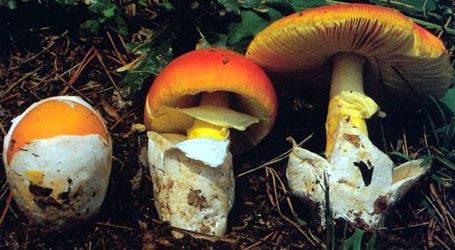
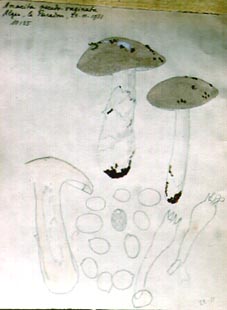 1. Amanita mairei, one of Foley's watercolors of original material, Morocco. 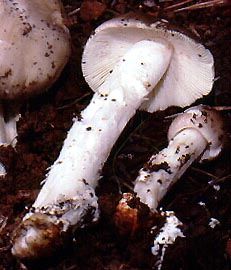 2. Amanita mairei, pine plantation, Canary Islands, Spain. 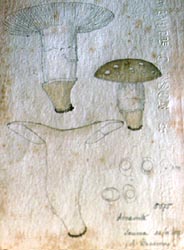 3. Amanita mairei, watercolor of early 20th Cent. collection by R. Maire, Egypt |
| cap |
Amanita mairei is an exannulate species with a 50 - 90 mm wide cap having predominantly brownish and grayish tints, but also sometimes with an olivaceous tint or with violaceous tint at maturity (according to Foley), is never a pure gray and never appears metallic. The marginal striations of the cap are rather short. The volval sac is often left in significant part on the cap. |
| gills |
The gills are free to very narrowly adnate, close, white at first, sometimes taking on a pale pink tint, finally becoming somewhat grayish, 6 - 9 mm broad, rarely forking; the short gills are infrequent and irregularly distributed, truncate to excavate-truncate to subattenuate. |
| stem |
The white stem is 50 - 90 × 10 -15 mm and rounded at the base; it bears the remains of a membranous-submembranous, white, saccate volva. Watercolors by R. Maire and Foley in the Institute de Botanique, Montpellier (MPU) sometimes show the entire free limb of the volva ripped away by the expansion of the fruiting body. |
| spores |
The spores measure (9.5-) 11.0 - 14.0 (-17.5) × (6.6-) 7.1 - 10.0 (-11.5) µm and are broadly ellipsoid to ellipsoid to elongate and inamyloid. Clamps may occasionally be found at bases of basidia. |
| discussion |
The species is associated with pine around the Mediterranean basin and occurs with exported pine at least in the Canary Islands. An early collection by R. Maire in Egypt (represented in the herbarium of the University of Montpélier at least by a watercolor) is annotated as occurring with Eucalyptus. The species can have a stipe that is quite robust as clearly illustrated in one of Maire's
watercolors (above, lower row)] as well as taking on the more common, gracile forms illustrated on this page. The
present species is clearly distinct from A. argentea Huijsman,
although the names are often mistakenly considered taxonomic synonyms in the literature of the
last half century. Other taxa with which to compare A. mairei are
A. huijsmanii F. Massart & Rouzeau and
A. supravolvata Lanne. |
| brief editors | RET |
| name | Amanita mairei | ||||||||||||||||||||||||||||||||||||
| author | Foley. 1949. Mém. Soc. Hist. Nat. Afrique N., Hors Sér. 2: 117, fig. 1, pl. IV. | ||||||||||||||||||||||||||||||||||||
| name status | nomen acceptum | ||||||||||||||||||||||||||||||||||||
| english name | "René Maire's Ringless Amanita" | ||||||||||||||||||||||||||||||||||||
| synonyms |
=Amanita pseudospissa Maire ined. [Cited by Foley in protolog and found on drawings and herbarium packets of syntypes, etc. in MPU.]
=Amanita pseudospissa var. pseudovaginata Maire ined. [Cited by Foley in protolog and to be found on drawings and herbarium packets of syntypes, etc. in MPU.]
=Amanita pseudovaginata Maire ined. [To be found on drawings and herbarium packets of syntypes, etc. in MPU.]
=Amanita crassipes Coccia & Migl. 2000. Micol. Ital. 29(1): 77.
=Amanita griseocastanea Coccia & Migl. 2000. Micol. Ital. 29(1): 78.
=Amanita luteovergens Coccia & Migl. 2000. Micol. Ital. 29(1): 80. The editors of this site owe a great debt to Dr. Cornelis Bas whose famous cigar box files of Amanita nomenclatural information gathered over three or more decades were made available to RET for computerization and make up the lion's share of the nomenclatural information presented on this site. | ||||||||||||||||||||||||||||||||||||
| etymology | genitive of a Latinized name; hence, "Maire's" or "of Maire" | ||||||||||||||||||||||||||||||||||||
| MycoBank nos. | 284061, 464665, 464666, 464667 | ||||||||||||||||||||||||||||||||||||
| GenBank nos. |
Due to delays in data processing at GenBank, some accession numbers may lead to unreleased (pending) pages.
These pages will eventually be made live, so try again later. Search:
Showing 1 to 5 of 5 entries | ||||||||||||||||||||||||||||||||||||
| holotypes |
A. crassipes—in herb. Coccia; isotype, in herb. Migliozzi A. griseocastanea—in herb. Coccia; isotype, in herb. Migliozzi A. luteovergens—in herb. Coccia; isotype, in herb. Migliozzi | ||||||||||||||||||||||||||||||||||||
| lectotypes | A. mairei—MPU | ||||||||||||||||||||||||||||||||||||
| type studies | Tulloss, here. | ||||||||||||||||||||||||||||||||||||
| revisions |
Tulloss, here. Hanss & Moreau (2020 [2017]) provide molecular and phylogenetic information. | ||||||||||||||||||||||||||||||||||||
| selected illustrations |
A. crassipes—Coccia and Migliozzi. 2000b. Boll. Gruppo Micol. G. Bresadola 43(2): 191, 192, 193. A. griseocastanea—Coccia and Migliozzi. 2000b. Boll. Gruppo Micol. G. Bresadola 43(2): 194, 195, 196, 198. A. luteovergens—Coccia and Migliozzi. 2000b. Boll. Gruppo Micol. G. Bresadola 43(2): 200, 201, 202. | ||||||||||||||||||||||||||||||||||||
| intro |
The following text may make multiple use of each data field. The field may contain magenta text presenting data from a type study and/or revision of other original material cited in the protolog of the present taxon. Macroscopic descriptions in magenta are a combination of data from the protolog and additional observations made on the exiccata during revision of the cited original material. The same field may also contain black text, which is data from a revision of the present taxon (including non-type material and/or material not cited in the protolog). Paragraphs of black text will be labeled if further subdivision of this text is appropriate. Olive text indicates a specimen that has not been thoroughly examined (for example, for microscopic details) and marks other places in the text where data is missing or uncertain. The following material not directly from the protolog of the present taxon or the protolog of one of its synonyms is based upon original research by R. E. Tulloss. | ||||||||||||||||||||||||||||||||||||
| pileus |
from a study of original material of A. mairei by RET: 50 - 90 mm wide, pale gray to brownish gray to light brown to dark smoke gray, at times with yellowish or bister tint when young, having paler version of same colors or often with additional pale violaceous tint at maturity [Drab-Gray (10YR 6.6/2.0) to Light Drab (10YR 5.8/2.0) to Light Grayish Olive (5Y 5.8/2.0) to Smoke Gray (5Y 6.8/2.0) to Pallid Vinaceous-Drab (7.5RP 8.0/1.5)], spherical at first, then broadly convex, eventually planar or even with raised margin, not umbonate, moist at first, but not viscid, not hygrophanous; context white, grayish ochraceous under pileipellis, firm, rather thick in disk, thinning evenly to margin; margin striate (0.1±R) from outset, nonappendiculate; universal veil white, as one or more membranous patches of variable size, rather firmly attached to pileipellis at their edges; pileipellis more or less separable. non-type: brown with short striations on the margin. | ||||||||||||||||||||||||||||||||||||
| lamellae |
from a study of original material of A. mairei by RET: free to narrowly adnate, with decurrent line on stipe apex, close, white at first, then taking on pale pink tint, finally becoming somewhat grayish, more or less rounded-attenuate at both ends, 6 - 9 mm broad, slightly ventricose or having straight lower edge, edge slightly pruinose or very slightly flocculose, rarely forking; lamellulae infrequent, irregularly distributed, truncate to excavate-truncate to subattenuate. | ||||||||||||||||||||||||||||||||||||
| stipe |
from a study of original material of A. mairei by RET: 50 - 90 × 10 - 15 mm, white, narrowing upward, separable from pileus relatively easily, surface somewhat flocculose near apex, striate-fibrillose below, with some fibrils somewhat raised, sometimes festooned with portions of what appears to be white limbus internus; context fibrous-fleshy, stuffed then hollow; exannulate; universal veil as saccate to cupulate volva, white, unitangent, rather thick, but often breaking rather easily, somewhat constricted and at times becoming appressed to stipe, sometimes in several irregular limbs, sometimes leaving detersile patch on lower stipe, sometimes reduced to minimal limb, with limbus internus 2± mm long (e.g., in button specimen of R. Maire 11358) and apparently commonly disappearing by maturity (Foley, 1949: fig. 1, sectioned basidiome, lower left) or becoming distributed in festoons on stipe. non-type: decorated with fragments of what appears to be limbus internus of universal veil in descending spiral. | ||||||||||||||||||||||||||||||||||||
| odor/taste | from a study of original material of A. mairei by RET: Odor very slight or absent. Taste sweetly mushroom-like. | ||||||||||||||||||||||||||||||||||||
| macrochemical tests |
from a study of original material of A. mairei by RET: KOH - negative on pileipellis, flesh, and lamellae. NH4OH - very palely brownish red on pileipellis and flesh; negative on lamellae. FeSO4, H2SO4, HNO3, - negative. Phenol - pink becoming reddish brown. Guaiac - rapidly mineral blue on flesh, universal veil, and surface of stipe; more slowly and less intensely bluish on pileipellis; negative on lamellae. | ||||||||||||||||||||||||||||||||||||
| pileipellis | from a study of original material of A. mairei by RET: lacking distinct gelatinized suprapellis, slightly gelatinized near surface, 50 - 60+ µm thick, with upper 15 - 20 µm colorless, with remainder yellow-brown to orange-brown to brownish orange, probably not fully reinflating, with network of narrow yellow refractive hyphae at or near surface; filamentous, undifferentiated hyphae 2.4 - 10.1 µm wide, branching; vascular hyphae not observed. | ||||||||||||||||||||||||||||||||||||
| pileus context | from a study of original material of A. mairei by RET: filamentous, undifferentiated hyphae 2.4 - 10.9 µm wide, branching, thin-walled, often in small fascicles, forming open lattice enclosing inflated cells and (apparently) empty spaces; inflated cells thin-walled, usually terminal, occasionally in short chains, ovoid (to 89 × 60 µm) or clavate to narrowly fusiform (120 × 39 µm and possibly larger), thin-walled; refractive hyphae (possibly some are vascular) 3.6 - 9.5 µm wide, scattered to locally common, yellow to brownish yellow, usually clearly septate and comprising series of intercalary segments. | ||||||||||||||||||||||||||||||||||||
| lamella trama |
from a study of original material of A. mairei by RET: bilateral; largely unrehydratable, with central stratum including filamentous, undifferentiated hyphae 1.8 - 7.4 µm wide, with slightly inflated intercalary subfusiform segments up to 26 × 10.3 µm and possibly sometimes in chains; vascular hyphae not observed. non-type: wcs = 30± µm (rehydration inadequate). | ||||||||||||||||||||||||||||||||||||
| subhymenium |
from a study of original material of A. mairei by RET: often not rehydrating except for uninflated short hyphal segments below short basidioles and, hence, embedded in hymenium; basidia arising from uninflated hyphal segments and (possibly) from small inflated or partially inflated cells; as much as could be told, having form similar to subhymenium of A. argentea (Tulloss, 1994: fig. 7). non-type: lacking inflated cells and comprising densely interwoven, short-segmented, filamentous, undifferentiated hyphae with occasional narrowly clavate, intercalary segments. | ||||||||||||||||||||||||||||||||||||
| basidia |
from a study of original material of A. mairei by RET: badly damaged, many collapsed and very frequently with tops digested by mold, 40 - 66 × 8.0+ - 14.6 µm, thin walled, 4-sterigmate when sterigmata could be found, with sterigmata up to 6+ µm long [per protolog]; clamps rather common where basidial bases preserved. non-type: clamps common at bases of basidia. | ||||||||||||||||||||||||||||||||||||
| universal veil | from a study of original material of A. mairei by RET: On pileus, exterior surface: fragmented, chaotic, stretched and broken hyphal layer. On pileus, interior: similar to interior on stipe base, but more compacted by expansion of pileus, with filamentous, undifferentiated hyphae up to 17.8 µm wide. On pileus, inner surface: comprising densely interwoven, criss-crossing, filamentous, undifferentiated hyphae, less gelatinized than on same surface of volval limb on stipe base, rather easily separating from pileipellis and somewhat tinted by the same pigment as in pileipellis, with many criss-crossing narrow yellowish hyphae near or in gelatinizing region permitting separation of volva and pileipellis. On stipe base, exterior surface: filamentous, undifferentiated hyphae 3.6 - 12.5 µm wide, branching, often in fascicles and these interwoven with single hyphae, with occasional gaps between fascicles, extensively to partially gelatinized and "glued" together forming distinct layer 10 - 15 hyphal diameters thick; refractive hyphae 2.4 - 6.0 µm wide, yellowish, as scattered fragments. On stipe base, interior: filamentous, undifferentiated hyphae 2.2 - 17.3 µm wide, branching, commonly in fascicles, interwoven in open lattice, dominating; inflated cells narrowly ellipsoid to clavate (rarely ellipsoid), up to 90 × 26 µm, thin-walled; refractive hyphae 4.8 - 6.0 µm wide, scarce. On stipe base, inner surface: filamentous hyphae 2.4 - 9.5 µm wide, branching, in predominantly longitudinally oriented fascicles (under dissecting scope exhibiting clearly longitudinal stripes of partially gelatinized surface hyphae, probably separated by force of pileus expansion), with some fascicles curving and crossing others; refractive hyphae 3.6 - 4.4 µm wide, as scattered fragments on surface. | ||||||||||||||||||||||||||||||||||||
| stipe context | from a study of original material of A. mairei by RET: longitudinally acrophysalidic; filamentous, undifferentiated hyphae 2.4 - 6.0 µm wide, branching, most densely packed near and at stipe surface; acrophysalides up to 202 × 51 µm or larger (tissue condition not good); refractive hyphae 6.0 - 11.9 µm wide, scattered to locally common, occasionally sinuous, but with regular outline and septate. | ||||||||||||||||||||||||||||||||||||
| partial veil | from a study of original material of A. mairei by RET: absent. | ||||||||||||||||||||||||||||||||||||
| lamella edge tissue | sterile. | ||||||||||||||||||||||||||||||||||||
| basidiospores |
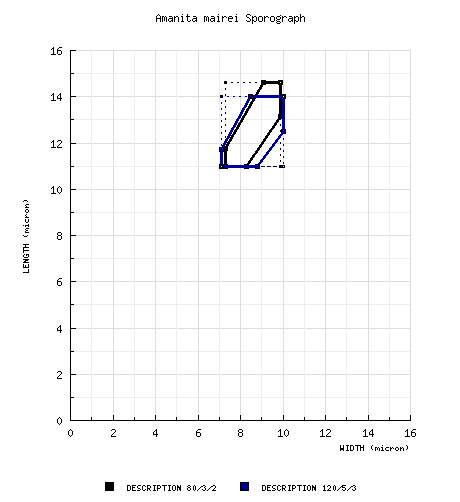
from a study of original material of A. mairei by RET: [80/3/2] (9.5-) 11.0 - 14.6 (-15.3) × (6.6-) 7.3 - 9.9 (-10.6) µm, (L = 11.6 - 13.8 µm; L’ = 12.6 µm; W = 7.7 - 9.1 µm; W’ = 8.6 µm; Q = (1.21-) 1.33 - 1.61 (-1.91); Q = 1.42 - 1.53; Q’ = 1.47), hyaline, colorless, smooth, thin-walled, inamyloid, ellipsoid, occasionally elongate, infrequently broadly ellipsoid, often at least somewhat adaxially flattened, sometimes expanded at one end; apiculus sublateral, cylindric, rather small (proportionately); contents predominately mono-, occasionally multiguttulate, with or without small additional granules; white in deposit. composite of all material examined: [120/5/3] (9.5-) 11.0 - 14.0 (-17.5) × (6.6-) 7.1 - 10.0 (-11.5) µm, (L = 11.6 - 13.8 µm; L’ = 12.5 µm; W = 7.7 - 9.4 µm; W’ = 8.6 µm; Q = (1.20-) 1.25 - 1.65 (-1.91); Q = (1.33-) 1.42 - 1.53; Q’ = 1.45). | ||||||||||||||||||||||||||||||||||||
| ecology |
from protologs of A. crassipes, A. griseocastanea, and A. luteovergens: Italy: In small numbers or gregarious. In sandy soil under Pinus pinea. from a study of original material of A. mairei by RET: Algeria: Solitary to subgregarious. In sandy clay under P. halepensis L. non-type: Spain: Under Pinus and Cistus monspielensis L. | ||||||||||||||||||||||||||||||||||||
| material examined |
from protolog of A. crassipes:
ITALY:
LAZIO—Roma - Capocotta from protolog of A. griseocastanea: ITALY: LAZIO—Roma - Castel Fusano, from protolog of A. luteovergens: ITALY: LAZIO—Roma - Pomezia, Campo Ascolano, RET: ALGERIA: ca. Algiers, Birmandreis, le Paradou, 11.xi.1931 H. Foley s.n. [R. Maire 10095] (syntype, MPU, watercolor only), 15.xi.1931 H. Foley s.n. [R. Maire 10094] (syntype, MPU), 18.xi.1931 H. Foley s.n. [R. Maire 10096] (syntype, MPU, with watercolor), 22.xi.1931 H. Foley s.n. [R. Maire 10125] (syntype, MPU, watercolor only), 16.xi.1941 H. Foley s.n. [R. Maire 11358] (syntype, MPU), 20.iv.1946 H. Foley s.n. [R. Maire 12218] (syntype, MPU). PORTUGAL: LISBON 15.xii.2018 Zacarias Lepista s.n. [mushroomobserver #351620 (RET 860-8, nrITS-LSU seq'd.). SPAIN: CANARY ISLANDS—La Palma - Montaña de Tagoja, 24.xii.1997 Bill Roody s.n. (RET 278-6). UNKN. PROV.—unkn. loc., 3.ix.2019 P. Villalonga PV19090301 (RET 883-4, nrITS-LSU seq'd.), 16.ix.2019 Paco Villalonga PV19091602 (RET 882-10, nrITS-LSU seq'd.), 28.ix.2019 Paco Villalonga PV19092802 (RET 884-2, nrITS-LSU seq'd.), s.d. T. Illescas Ferrezuelo 4370 (RET 889-8, nrITS-LSU seq'd.). | ||||||||||||||||||||||||||||||||||||
| discussion |
from a study of original material of A. mairei by RET: Four syntypes of Amanita mairei have been located in R. Maire’s herbarium (MPU). One is accompanied by a watercolor painted by the collector, Dr. Foley. Two additional Foley water colors were located representing two collections that are not in Maire’s herbarium. None of the collections is currently in sufficiently good condition that all microscopic characters can be described from it. However, on all available evidence, I believe that the collections are contaxic. I have had to use all of them in order to create the partial anatomical description given above. With regard to the watercolors, it is noteworthy that the figures in the protolog of A. mairei came in part from the watercolor of Maire 10125—namely, the top right fruiting body and the lower left fruiting body as published. The other basidiome representations and the representations of spores, basidiole, and basidia in the published figures do not correspond to any of the drawings I examined. Therefore, we may assume that Foley had other drawings than those now in MPU from which he selected portions for publication. The location of such drawings is unknown to me. Based on a previous type study of the species (Tulloss, 1994), there is a striking similarity of many characters of A. argentea Huijsman to those recorded for the present species. Indeed the two taxa have been proposed as taxonomic synonyms by many authors—perhaps beginning with Malençon and Bertault (1970; 1972). However, there are differences that are noteworthy and that, for the moment, suggest to me that the two taxa might be distinct at specific rank and that it is best to seek more evidence before forming a final opinion. Unfortunately, because of the condition of the syntypes of A. mairei, the very important characters of the lamella tramas of the two taxa cannot be compared. As for the other characters, the following is the list of character differences noted: Amanita argentea was described from deciduous forest while A. mairei was described as associated with Pinus. However, the possible habitat difference may not hold up; for I have received a collection of A. argentea collected under Pinus, Arbutus, and Juniperus in Italy. In addition, R. Maire 5075, cited above, was collected under Eucalyptus according to Maire’s notes from 22 November 1917 (MPU). Therefore, both taxa may be capable of symbiosis with multiple hosts. In the same manner as does A. argentea, A. huijsmanii differs from A. mairei in regard to pileus color, spore size and shape, and relative length of pileus striations. Since the limbus internus is often lacking in examined material of A. huijsmanii, it is most conservative to assume that the latter species doesn’t differ from A. mairei with regard to the limbus internus. Examination of the type of A. huijsmanii (Tulloss, 1994) revealed that the volval sac was extensively gelatinized; if this is a constant character, it would play a significant role in separating A. huijsmanii and A. mairei. Also, from existing evidence, it would appear that A. huijsmanii basidiomes tend to be smaller than those of A. mairei. With regard to comparison with A. supravolvata Lanne, it appears that we can say with some confidence that it is not conspecific with A. mairei. Among other differences are: Amanita bertaultii Contu (1985a) was synonymized with A. mairei after additional study by Contu (1989b). However, the protolog rather strongly suggests A. supravolvata. I have not yet been able to review the holotype of A. bertaultii. It is possible that a number of authors have mixed data from A. supravolvata and A. mairei when describing several characters including spore size and shape. This has added to the confusion concerning the taxa of Amanita section Vaginatae in the Mediterranean region having broadly ellipsoid to ellipsoid spores. For example, among the items related to A. mairei in the dossiers of Malençon (MPU) there are notes on a collection determined as A. mairei that, based on the excellent drawings of fresh material included, appears to have included a superb, mature specimen of A. supravolvata with typical bitangent volva. If data from A. huijsmanii s. str. and A. argentea s. str. are also merged with data from A. mairei, the range of Q (for example) that results is nearly tripled (based on current limited data). Reid (1987: 508-509) gives a very wide range of spore shape for material he placed in A. mairei. I have examined the three principal U.K. collections he cites. While two of the specimens exhibit giant spores (indicating probable drying during early sporulation), the third specimen (undoubtedly contaxic with the other two) is a good match to continental material of A. argentea. His comments about the spore measurements of A. mairei from earlier work underline my belief that these measurements were taken from spores of more than one taxon. Comments copied from formerly existing taxon page of A. luteovergens: This species was originally described from Rome (Italy) under pine (Pinus pinea) in soil that is mostly composed of sand. The authors produced a beautifully illustrated version of the original description which was published in the special Amanita issue of the Bollettino del Gruppo Micologico G. Bresadola - nuova serie (2000). Based on the illustrations and descriptions in this paper, it would appear that the authors recognize that Amanita mairei Foley (= A. griseocastanea Coccia & Migl.) can produce very pallid, or albino, fruiting bodies. These appear to differ from A. luteovergens only in the fact that the latter has yellow staining flesh. We are familiar with the present species only from the original description and the additional illustrations just mentioned. However, we think it is worth exploring the question of whether the staining which is the fundamental reason for the segregation and naming of A. luteovergens might not be a case of the yellowing syndrome which we have discussed other places on this site. Yellow bruising reactions have rarely, if ever, been reported previously in section Vaginatae. If the holotype of the present species were a "victim" of the yellowing syndrome, A. luteovergens could be a further synonym of A. mairei. We would be extremely interested in hearing from our readers with regard to the present species and our comments on it. | ||||||||||||||||||||||||||||||||||||
| editors | RET | ||||||||||||||||||||||||||||||||||||
Information to support the viewer in reading the content of "technical" tabs can be found here.
| name | Amanita mairei |
| name status | nomen acceptum |
| author | Foley |
| english name | "René Maire's Ringless Amanita" |
| images |
1. Amanita mairei, one of Foley's watercolors of original material, Morocco. 2. Amanita mairei, pine plantation, Canary Islands, Spain. 3. Amanita mairei, watercolor of early 20th Cent. collection by R. Maire, Egypt |
| photo |
Bill Roody - (2) in pine forest on one of the Canary Islands, Spain.
zaca- (4-5) Parque de Monsanto, Lisboa, Portugal(RET 860-6) [Note: Untrimmed and unedited images may be found at mushroomobserver.org/351620] |
| drawing | double click in markup mode to edit. |
| watercolor | Foley - (1) illustration of original material of Amanita mairei (deposited in the herbarium of the University of Montpéllier, France), Morocco. R. Maire - (3) illustration of material collected by Maire in Egypt (deposited in the herbarium of the University of Montpéllier, France). Maire's material came from Egypt. |
 Spore data sets and their composite
Each spore data set is intended to comprise a set of measurements from a single specimen made by a single observer; and explanations prepared for this site talk about specimen-observer pairs associated with each data set. Combining more data into a single data set is non-optimal because it obscures observer differences (which may be valuable for instructional purposes, for example) and may obscure instances in which a single collection inadvertently contains a mixture of taxa.

Text and User-Generated Sporographs are published under the Creative Commons License.

In the case of a taxon page, image credits are on the 'image' tab.