| name |
Amanita supravolvata |
| author |
Lanne. 1979 ["1978"]. Doc. Mycol. 9(34): 24. |
| name status |
nomen acceptum |
| english name |
"High Sack Ringless Amanita" |
| synonyms |
≡ Amanita supravolvata Lanne nom. inval. 1978. Vie Bordeaux. 20 mai 1978: 7. [ICBN §29.4.]
≡ Amanita supravolvata Lanne nom. inval. 1978a. Bull. Trimestriel Sect. Mycol. Soc. Linn. Bordeaux 1978(1): 10-16. [ICBN §35.1, §36.1, and §37.1. [Lanne published a provisional description and explicitly assigned no rank.]
≡ Amanita argentea var. supravolvata (Lanne) Contu. 1985a ["1984"]. Doc. Mycol. 14(56): 26.
≡ Amanita mairei f. supravolvata (Lanne) Romagn. nom. inval. 1992. Bull. Trimestriel Soc. Mycol. France 108(2): 76. [Lacking full and direct reference to basionym. ICBN §33.2]
≡ Amanita mairei f. supravolvata (Lanne) Romagn. ex Lanne. 1993a. Doc. Mycol. 23(91): 21.
non Amanita fulva f. supravolvata A. G. Parrot nom. inval. 1980. Bull. Centr. Études Rech. Sci. 13(1): 114.
[Lacking Latin diagnosis and specification of holotype. ICBN §36.1, §37.1]
The editors of this site owe a great debt to Dr. Cornelis Bas
whose famous cigar box files of Amanita nomenclatural information
gathered over three or more decades were made available to RET for computerization
and make up the lion's share of the nomenclatural information presented on this site.
|
| MycoBank nos. |
308596 |
| GenBank nos. |
Due to delays in data processing at GenBank, some accession numbers may lead to unreleased (pending) pages.
These pages will eventually be made live, so try again later.
|
| revisions |
Hanss & Moreau (2020 [2017]) provide molecular and
phylogenetic information. |
| intro |
The following text may make multiple use of each data field.
The field may contain magenta text presenting data from a type study and/or revision of other original material cited in the protolog of the present taxon. Macroscopic descriptions in magenta are a combination of data from the protolog and additional observations made on the exiccata during revision of the cited original material.
The same field may also contain black text, which is data from a revision of the present taxon (including non-type material and/or material not cited in the protolog). Paragraphs of black text will be labeled if further subdivision of this text is appropriate.
Olive text indicates a specimen that has not been thoroughly examined (for example, for microscopic details) and marks other places in the text where data is missing or uncertain.
The following material is derived from the protolog, Tulloss (1994), and additional orignal research by R. E. Tulloss. |
| pileus |
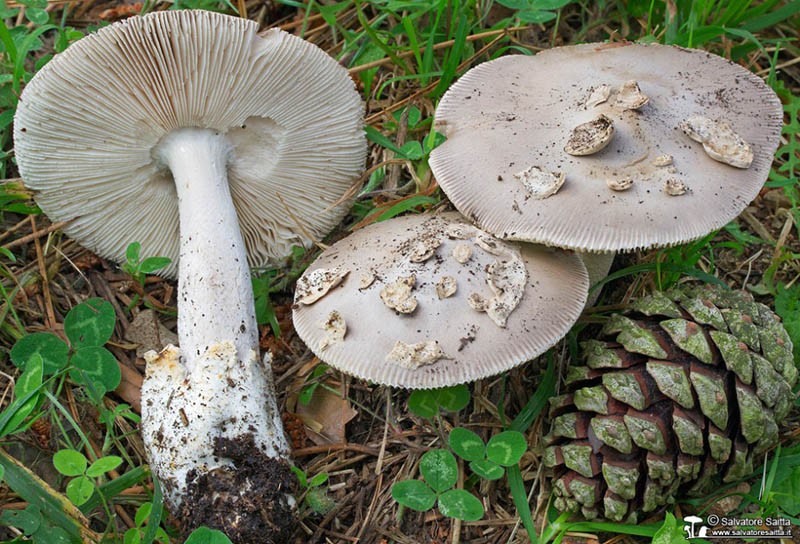
protolog (1979) and Tulloss (1994): 25 - 85 (-90) mm wide, pale gray, Séguy 233 (approximately between 75YR 8/2 and 7.5YR 7/2, moderate brownish gray with slightly yellow tint) with slight tinge of Séguy 200 (rather pallid peach, close to 5YR 8/4), paler at first, hemispheric, then pulvinate to plano-convex, rarely bluntly umbonate; context white, pearly, contrasting to color of lamellae, thinning evenly and rapidly toward margin; margin decurved, short striate or short sulcate (0.1±R); universal veil absent or more often as a small to large white cottony membranous patch over disc; pileipellis completely separable. |
| lamellae |
protolog (1979) and Tulloss (1994): free, rather close, whitish cream, with some flesh tones at first, up to 8 mm wide, rather thick, rarely forking; lamellulae scattered, squarely truncate. |
| stipe |
protolog (1979) and Tulloss (1994): 90 - 185 × 6 - 17 mm, very white, very slender, narrowing upward, expanding at apex, with surface rarely pilose, lacking any obvious pseudorhizae at base, often roughly obconic at base; context white, pearly, easily separable from pileus context, stuffed, then hollow; exannulate; universal veil as cylindric saccate volva with highest point of limb 35 - 67 mm from stipe base, stainding out evenly from stipe for upper 15 - 35 mm, abruptly becoming adnate with stipe below this portion, often with small limbus internus at point of separation from stipe. |
| odor/taste |
protolog (1979) and Tulloss (1994): Odor absent. Taste absolutely absent, "certainly not radish-like." |
macrochemical
tests |
protolog (1979): NH4OH, NaOH, H2SO4, FeCL2, and aniline - all negative. Guaiac - positive (blue black) only in and stipe base, in central cylinder of stipe, and on interior and exterior of volval sac. Phenol - slowly vinaceous rose on pileipellis, volval sac, and in context of pileus and stipe. Fe2(SO4)3. Test voucher: not recorded. |
| pileipellis |
protolog (1979) and Tulloss (1994): 75± μm thick, gelatinizing at surface, with surface damaged by mold in some areas; filamentous undifferentiated hyphae 0.7 - 8.0 μm wide, tightly interwoven, subradially arranged; vascular hyphae not observed.
composite from all material revised by RET: subpellis ungelatinized, yellow-orange or brownish yellow-orange, 72 - 75 ± μm thick, suprapellis colorless, minimal, partially gelatnized to genlatinized 0 - 5 ± μm thick. |
| pileus context |
protolog (1979) and Tulloss (1994): filamentous undifferentiated hyphae 1.5 - 17.0 μm wide, branching, loosely interwoven, in fascicles or not, plentiful; acrophysalides dominant except close to pileipellis, thin-walled, subglobose to broadly ellipsoid to ellipsoid to subovoid to broadly clavate to clavate, up to 79 × 48 μm, narrowest closest to pileipellis; vascular hyphae 1.4 - 8.4 μm wide, branching, infrequent to locally common and loosely tangled. |
| lamella trama |
protolog (1979) and Tulloss (1994): obscurely bilateral; wcs = 55± - 65± μm; with angel of divergence shallow to 90° filamentous undifferentiated hyphae 2.2 - 7.0 μm, branching, apparently with occasional intercalary inflated segments (e.g., 31+ × 15.0 μm); divergent terminal inflated cells not observed; vascular hyphae 2.5 - 8.2 μm wide, infrequent to common, branching, sometimes in tangles. [Note: See supplementary decription immediately below. : The type was damaged by mold and tissues of the lamellae proved difficult to rehydrate. The non-type material was an authentic topotype deposited in L by Lanne.—ed.]
non-type material (1994): bilateral; wcs = 40 - 60 μmm wutg abgke if divergence rather shallow, with elements of subhymenial tree curving away from central stratum and becoming perpendicular to it; filamentous undifferentiated hyphae 1.2 - 6.8 μm wide; terminal inflated cells absent or obsecured by intercalary inflated cells of central stratum; vascular hyphae 1.8 - 3.5 μm wide, very scarce;...[Note: The report of the presence of clamps in the original text is undoubtedly in error.—ed.] |
| subhymenium |
protolog (1979) and Tulloss (1994): wst-near = ca. 0 μm; wst-far = 25± μm; as sparesely branching structure comprising (dominantly) short uninflated hyphal segments and occasional small ellipsoid or clavate cells, with basidia arising from uninflated elements, with hyphae apparently running parallel to central stratum.... [Note: The holotype material was problematic as noted above. The report of clamps is likely to have been a misinterpretation of tissues that were not rehydrated. See below.]
non-type material (1994): wst-near = 15 - 35 μm; wst-far = 45 -65 μm; with small inflated cells and uninflated and partially inflated hyphal segments in a branching structure, with basidia arising from cells of all types, without hyphae parallel to central stratum below bases of basidia. |
| basidia |
protolog (1979) and Tulloss (1994): 45 - 57 × 10.2 - 14.5 μm, 4-sterigmate, almost all in holotype damaged by mold and collapsed. [Note: Clamps probably absent. See previous notes.—ed.] |
| universal veil |
protolog (1979) and Tulloss (1994): On pileus badly damaged by mold, possibly with inflated cells more plentiful than in volval limb on stipe base. On stipe base, exterior surface layer: as loosely interwoven network of of fascicles of partially gelatinized filamentous undifferentiated hyphae, occasionally co-parallel and more densely arranged [possible remnants of outermost surface layer]. At stipe base, interior: filamentous undifferentiated hyphae 1.4 - 11.9 μm wide, rather densely interwoven, in fascicles or not, branching, dominating to plentiful; terminal inflated cells thin-walled, narrowly clavate to clavate to narrowly ellipsoid, common to locally plentiful, up to 112 × 39 μm; vascular hyphae 4.5 - 7.7 μm wide, scarce to locally common. At stipe base, inner surface: covered with particles of sand and unobservable.
|
| stipe context |
protolog (1979) and Tulloss (1994): longitudinally acrophysalidic; filamentous undifferentiated hyphae 2.0 - 15.2 μm wide, branching; acrophysalides thin-walled, up to 173 × 37 μm; vascular hyphae 6.0 - 8.5 μm wide, scarce. |
| partial veil |
absent. |
| lamella edge tissue |
protolog (1979) and Tulloss (1994): not described.
non-type material (1994): sterile. |
| basidiospores |
Tulloss from type material
(1994):
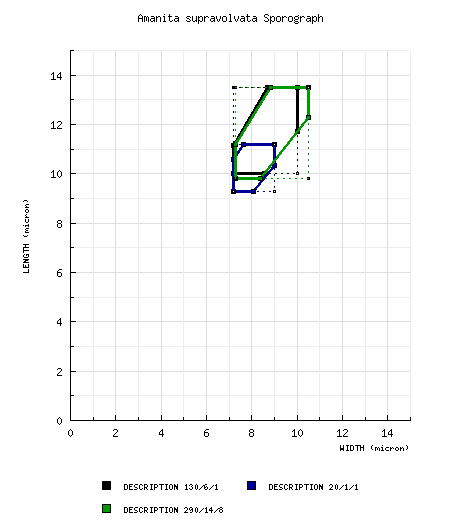
[130/6/1] (8.8-) 10.0 - 13.5
(-15.2) × (6.5-) 7.2 - 10.0 (-14.0) μm, (L =
10.5 - 12.3 μm; L' = 11.5; W = 8.0 -
9.3 μm; W' = 8.7 μm; Q = (1.07-) 1.17 - 1.55
(-1.82); Q = 1.24 - 1.43; Q' = 1.33),
hyaline, colorless, smooth, thin-walled, inamyloid,
broadly ellipsoid to ellipsoid, infrequently
subglobose or elongate, sometimes adaxially
flattened; apiculus sublateral, cyindric,
rather small to prominent; contents
monoguttulate; cream in deposit.
non-type material Tulloss
(1994):
[20/1/1] (8.4-) 9.3 - 11.2 (-14.6) × (6.4-) 7.2 -
9.0 (-9.1) μm, (L = 10.3 μm; W =
7.8 μm; Q = (1.11-) 1.15 - 1.47 (-1.60); Q =
1.32).
summary of all data from material revised by RET:
[290/14/8] (8.9-) 9.8 - 13.5 (-16/5) × (6.4-) 7.3 -
10.5 (-14.0), (L = (10.3-) 10.5 - 12.3
(-1.43) μm; L = 11.5 μm; W = (7.8-)
8.0 - 9.3 (-9.6) μm; W' = 8.7 μm; Q = (1.07-)
1.17 - 1.53 (-1.82); Q = (1.24-) 1.25 - 1.39
(-1.43); Q' = 1.32), ...more... |
| ecology |
Tulloss
(1994):
France: Solitary to
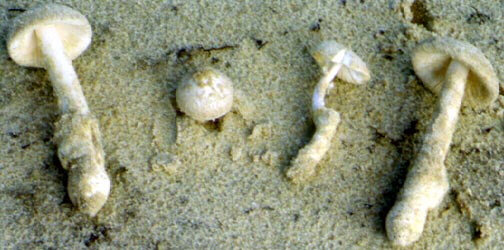
scattered. In sand on forest side of dunes along
Atlantic coast of France, always near edge of maritime
pine (Pinus pinaster) forest or near isolated
thickets of stunted pines. Most of basidiome
commonly covered with sand. Lanne
(1979a)
provided an extensive survey of vascular plants in
areas surrounding his collecting
sites.
RET: France: In sand soil with Pinus
maritima or in sandy soil of 14-year-old
plantation of P. pinaster. Germany:
Roadside in sandy Pinus forest. Italy: In
a meadow under Pinus.
Poland: In sandy soil under Pinus sylvestrix with Corynophorus canescens and Thymus serpyllum. |
| material examined |
Tulloss (1994): FRANCE: GIRONDE—Lacanau-Océan, 18.x.1978 Claude Lanne 1 (holotype; herb. Soc. Linn. Bordeaux; isotype, RET 085-2; isotype, RET 103-7, nrITS seq'd.).
non-type material Tulloss
(1994):
FRANCE:
GIRONDE—Lacanau-Océan,
x.1977 C. Lanne s.n. (L, original
material uncited in protolog).
RET (additional): FRANCE:
GIRONDE—Bombannes, 14.xi.1998 Francis
Massart s.n. (RET 291-8, nrITS-LSU seq'd.);
ca. Bordeaux, le Pond-de-la-Maye,
Station de Recherches Sur les Champignons, Inst.
Nat. de la Recherche Agronomique, 21.x.1994 Jacques
Guinberteau 94 11 021 (RET 140-2); La Brède,
21.v.1993 Francis Massart s.n. (RET 091-8),
29.v.1993 F. Massart b/29593 (RET 091-9),
93051 (RET 262-4, nrITS-LSU seq'd.); La Porge,
7.xii.1993 F. Massart 93101 (RET 261-9), 8.xii.1996
F. Massart 96047 (RET 262-7, nrITS-LSU seq'd.).
LES LANDES—Contis,
29.xi.1997 F. Massart 970071
(RET 273-4).
GERMANY:
BRANDENBURG—ca. Potsdam, Fresdorf,
26.viii.1970 D. Benkert s.n. (L).
UNKNOWN STATE—unkn.
loc., 2.x.2009 René K. Schumacher s.n.
(RET 522-10).
ITALY:
COSENZA—Celico - Colamauci,
30.ix.2008 Carmine Lavorato 080930-05 (RET 427-8,
nrITS & nrLSU seq'd.).
SICILY—Messina, Peloritani Mtns.
[38.1849° N/ 15.4914° E, 416 m], 6.vi.2018
Salvatore Saitta 7182 (RET 822-6, nrITS & nrLSU
seq'd.), 5.vii.2018 S. Saitta s.n. (RET 859-4, nrITS &
nrLSU seq'd.).
POLAND: KRAKÓW—Kraków,
ca. Tyniec, 20.viii.1967 Hanns Kreisel & M.
Lisiewska s.n. (L).
RUSSIA:
KHMAO-Yugra—Khanty-Mansiyskiy
Distr. - Mukhrino Filed Stn. of UgraSU UNESCO chair,
[60.9105° N/ 68.7168° E, 33 m elev.],
7.ix.2014 Tatiana Bulyonkova 2899 (in herb.
Bulyonkova;RET 877-5, nrITS seq'd.).
SPAIN:
UNKN. PROV.—unkn. loc., 28.ix.2019
Paco Villalonga PV19092801 (RET 883-8, nrITS-LSU
seq'd.), 24.x.2019 P. Villalonga PV19102401 (RET
883-9, nrITS-LSU seq'd.), 2.xi.2019 P. Villalonga
PV19110201 (RET 884-3). |
| discussion |
Tulloss (1994): "Mold on the hymenial surfaces of the holotype has partially destroyed the basidia; and the tissues of the lamella trama and subhymenium are difficult to rehydrate. Mold also is to be found on the stipe surface, the surfaces of the universal veil, and on the surfaces of fractures through the pileus context that must have occurred after drying.
"Fortunately, I was able to locate an authentic topotype in L (dated "?.x.1977"). This collection is in good condition with a lamella trama that rehydrates well; and I believe it to be conspecific with the holotype material [based on morphology]. The basidia are predominantly immature, but even in that state, the subhymenium clearly contains many small, inflated cells. [Microanatomical information from the topotype is to be found above, interspersed with data from the type study.—ed.]
... When I examined the above-mentioned topotype in Dr. Bas' laboratory (L), he also showed me additional collections [of the present species] from Germany (near Potsdam, Fresdorf, 26.viii.1970 D. Benkert s.n.) and Poland (Cracow, near Tyniec, 20.viii.1967 Hanns Kreisel & M. LLisiewska s.n.) that he considered possibly assignable to A. supravolvata. I examined the Polish collection and reviewed Dr. Bas' notes on the German collection. I agree with his determinations. The Polish specimen is well-preserved and more mature than the topotype discussed above; it is worth noting that the cells of the subhymenial tree are even more predominantly inflated than those illustrated for the topotype (see Fig.). These two collections considerably extend the previously known range of the present species. Both collections are said to have been made in sandy soil under Pinus. ..."
There follow sporograph comparisons to the other known European taxa (A. argentea, A. huijsmanii, and A. mairei) with spores that are ellipsoid on average.
Amanita argentea and Amanita supravolvata cannot be segregated on the basis of spore size and shape:
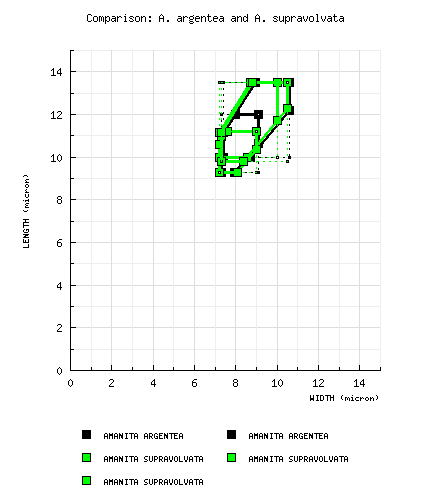
The same seems true of the utility of spores in separating A. huijsmanii from the present species. Note that the sample size of A. huijsmanii spores is the smallest of the other taxa treated here.
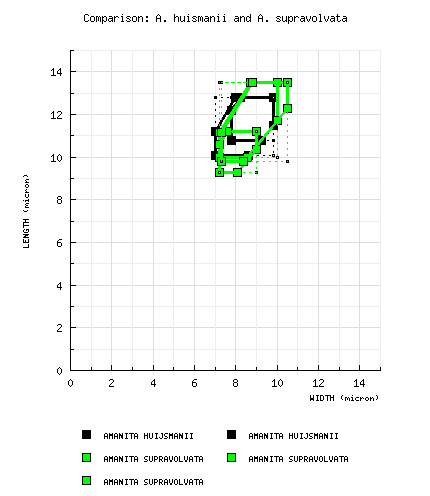
On average, the spores of A. mairei are the narrowest and longest of all the taxa compared here:
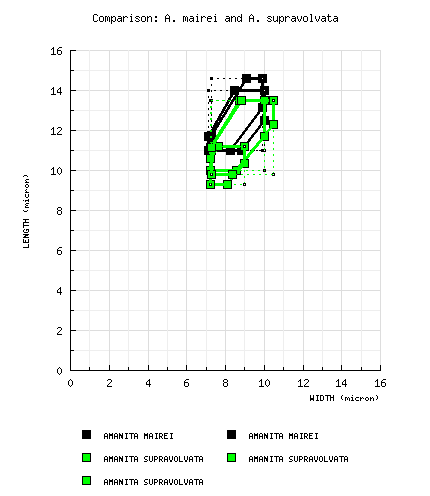
|
| citations |
—R. E. Tulloss |
| editors |
RET |
|

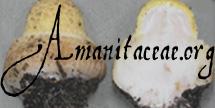


 Spore data sets and their composite