| name |
Amanita huijsmanii |
| author |
F. Massart & Rouzeau. 1990 ["1989"]. Bull. Soc. Linn. Bordeaux 17(3): 159, pl. 1. |
| name status |
nomen acceptum |
| english name |
"Huijsman's Ringless Amanita" |
| synonyms |
≡ Amanita argentea f. huijsmanii (F.
Massart & Rouzeau) Contu 1999. 1999. Boll. Acc. Gioen. Sci. Nat. 32: 20.
The editors of this site owe a great debt to Dr. Cornelis Bas
whose famous cigar box files of Amanita nomenclatural information
gathered over three or more decades were made available to RET for computerization
and make up the lion's share of the nomenclatural information presented on this site.
|
| etymology |
genitive of a Latinized name; hence "Huijsman's" or "of Huijsman" |
| MycoBank nos. |
129514 |
| GenBank nos. |
Due to delays in data processing at GenBank, some accession numbers may lead to unreleased (pending) pages.
These pages will eventually be made live, so try again later.
|
| holotypes |
LIP; isotype (fragments) in RET |
| type studies |
Tulloss. 1994. Mycotaxon 52: 334, fig. 19. |
| revisions |
Hanss, J.-M. and P.-A. Moreau.
2020 [2017]. Bull. Soc. Mycol.
France 133 (1-2): 67-141. |
| selected illustrations |
F. Massart. 2000. Boll. Gruppo Micol. G. Bresadola 43(2): 256. |
| intro |
The following text may make multiple use of each data field.
The field may contain magenta text representing a type study
by Tulloss.
The same field may also contain black text, which will represent a revision of the
species by Tulloss. Paragraphs of black text will be labeled if further subdivision of
this text is appropriate.
Olive text indicates a specimen that has not been
thoroughly examined (for example, for microscopic details) and marks other places in the text
where data is missing or uncertain.
The following is based on the cited literature,
molecular study of Der. Linas
V. Kudzma, and other original research by R. E.
Tulloss. |
| lamella edge tissue |
sterile. |
| basidiospores |
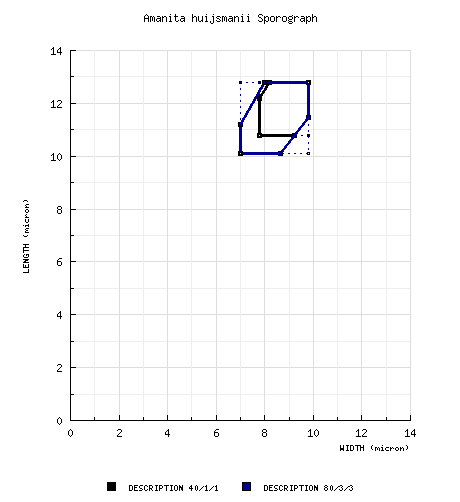
Tulloss (1994): [40/1/1] (8.5-) 10.8 - 12.8 (-15.0) × (6.8-) 7.8 - 9.8 (-10.5) μm,
(L = 11.5 μm; W
= 8.7 μm; Q = (1.10-) 1.17 - 1.56 (-1.65); Q = 1.30), hyaline, colorless, thin-walled, smooth, inamyloid, broadly ellipsoid to ellipsoid, occasionally subglobose, infrequently elongate, ocasionally adaxially flattened, occasionally expanded at one end; apiculus sublateral, cylindric; contents guttulate; white in deposit.
composite of data from all material revised by RET: [80/3/3] (8.5-) 10.1 - 12.8 (-15.0) × (6.5-) 7.0 - 9.8 (-10.9) μm, (L = 11.3 - 11.5 μm; L' = 11.4 μm; W = 7.8 - 8.7 μm; W' = 8.4 μm; Q = (1.10-) 1.17 - 1.60 (-2.13); Q = 1.30 - 1.46; Q' = 1.36), hyaline, colorless, thin-walled, smooth, inamyloid, broadly ellipsoid to ellipsoid, occasionally subglobose, infrequently elongate, ocasionally adaxially flattened, occasionally expanded at one end; apiculus sublateral, cylindric; contents guttulate; white in deposit. |
| ecology |
Solitary or in small groups or scattered.
Croatia: In forest with Quercus
robur, Pinus sylvestris, Carpinus
betulus and (locally common) Tilia
sp.
Czechia: With Quercus, Fagus, &
Betula.
France: In
deciduous or mixed woods on clayey-calcareous
soil or under Quercus.
Italy: With Quercus sp. or with
Quercus cerris.
Portugal: At 309 m elev. Under
Castanea.
Spain: With Quercus suber and Cistus
albida or Q. suber,Q. rotundifolia,
Ulex parviflora, Cistus, etc. |
| material examined |
CROATIA: MEDIMURJE—
Nedelišće - Macinec
[46.3990° N/ 16.3003° E, 185 m], 6.vii.2019 Neven
Ferenčak "new2" (RET 867-4, nrITS-LSU seq'd.).
CZECHIA:
CENTRAL BOHEMIA—Český Šternberk,
Vrábov Hill, 15.vii.2006 Dr. Jan Borovička 10
(RET 403-5, nrITS & nrLSU seq'd.).
FRANCE:
DORDOGNE—Payzac, 17.x.1997 Christian
Rouzeau s.n. [Massart 97058] (in herb. Massart;
RET 272-7).
GIRONDE—La Brède, Château La Sauque,
24.viii.1997 Francis Massart 97051 (in herb. Massart;
RET 272-5, nrITS and nrLSU seq'd.).
St-Vivien-de-Monségur,
25.viii.1989 Francis
Massart 89A1
(holotype, LIP, nrITS seq'd.; isotype, RET 011-1(a),
fragments), 89A2 (paratype, RET 011-1(b)),
17.vii.1997 Francis Massart 97043
(in herb. Massart; RET 272-8).
GERMANY:
BADEN-WÜRTTEMBERG—Bebenhausen, below
"Sulzplatte" at the "Kirnberg" [MTB 7420/1.4234
(“Grenze zu .4242”)], 16.vii.1994 A. Müller s.n.
[Gminder 94/451] (in herb. Gminder; RET 306-1,
nrITS-nrLSU seq'd.), 1.viii.1996 A. Bollman &
Andreas Gminder [Gminder 96/198] (in herb. Gminder
as "A. lactea";
in herb V. Migliozzi; RET 273-5); Dettenhausen,
"Betzenberg," bei der Keltischen Schanze,
15.viii.1996 Andreas Gminder 96/230 (in herb. A.
Gminder; RET 307-10, nrITS seq'd.).
ITALY:
LIGURIA—Genova, municipal park on the
heights of Genova, 31.v.1994 Mido Traverso s.n.
(RET 261-2, nrLSU seq'd.).
TOSCANO—Pistoia - [43.9919° N /
10.9121° E, 527 m], 29.vii.2014 Luca Pasquali s.n.
[mushroomobserver
#171619]
(RET 658-5, nrLSU seq'd.);
[44.0073° N / 10.935° E, 725 m],
2.viii.2014 L. Pasquali s.n. [mushroomobserver
#172162]
(RET 658-9, nrLSU seq'd.).
UMBRIA—Terni - unkn. loc., 5.viii.2018
Loredana Fer s.n. (RET 847-1, nrLSU seq'd.).
PORTUGAL:
CADAVAL—Serra de Montejunto
[39.2035° N/ 9.05° W, 309 m], 4.x.2014
Zacarias Lepista s.n. [mushroomobserver
#181567]]
(RET 650-10, nrITS & nrLSU seq'd.).
SPAIN:
CASTELLÓN—Mpio. Alcudia
de Veo - Parque Natural de la Sierra de Espadán,
18.ix.2019 Jorge Juan Martín Calvo 4 (RET 878-9;
ITS2-nrLSU fragm. seq'd.),
J. J. Martín Calvo 6 (RET 878-10,
nrLSU seq'd.).
UNKN. PROV.—J. J.
Martín Calvo 1 (RET 876-5, nrLSU seq'd.);
J. J. Martín Calvo 2 (RET 876-9, nrLSU seq'd.);
J. J. Martín Calvo 3 (RET 876-10, nrLSU seq'd.);
16.ix.2019 Paco Villalonga PV19091601 (RET 882-9,
nrITS-LSU seq'd.). |
| discussion |
The nrITS 5' motif for this species is of the common
form for Amanita sect.
Vaginatae—"TTTGACCTCAAATCA."
Individual specimens of this species has appeared on
this site with the temporary codes
A. sp-CROAT02,
A. sp-FRAN01, A. sp-ITAL03,
A. sp-ITAL04, and A. sp-PORT02. |
| citations |
—R. E. Tulloss |
| editors |
RET |
|



 Spore data sets and their composite