| name |
Amanita aurantiovelata |
| author |
Schalkw. & G. M. Jansen. 1982. Persoonia 11: 515, fig. 1(a-f). |
| name status |
nomen acceptum |
| english name |
"Chilean Orange Dust Amanita" |
| synonyms |
= Amanita gayana sensu Singer. 1969. Beih. Nova Hedwigia 29: 151. non Amanita gayana (Mont.) Mont. in Gay nom. dub.
The editors of this site owe a great debt to Dr. Cornelis Bas
whose famous cigar box files of Amanita nomenclatural information
gathered over three or more decades were made available to RET for computerization
and make up the lion's share of the nomenclatural information presented on this site.
|
| etymology |
aurantius, orange + velatus, veiled;
hence referencing the orange universal veil. |
| MycoBank nos. |
110464 |
| GenBank nos. |
Due to delays in data processing at GenBank, some accession numbers may lead to unreleased (pending) pages.
These pages will eventually be made live, so try again later.
|
| holotypes |
L |
| intro |
The following text may make multiple use of each data field.
The field may contain magenta text presenting data from a type study
and/or revision of other original material cited in the protolog of the present taxon.
Macroscopic descriptions in magenta are a combination of data from the protolog and
additional observations made on the exiccata during revision of the cited original
material.
The same field may also contain black text, which is data from a revision of the present
taxon (including non-type material and/or material not cited in the protolog).
Paragraphs of black text will be labeled if further subdivision of
this text is appropriate.
Olive text indicates a specimen that has not been
thoroughly examined (for example, for microscopic details) and marks other places in the text
where data is missing or uncertain.
The following material not directly from the
protolog of the present taxon and related materials
such as unpublished photographs or from another
cited source is based on
collections, photographs and field notes of Dr.
Egon Horak and other original research of R. E.
Tulloss.
protolog: Basidiome
medium-sized. |
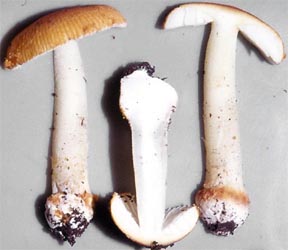
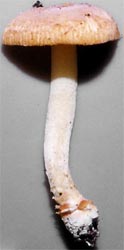
| pileus |
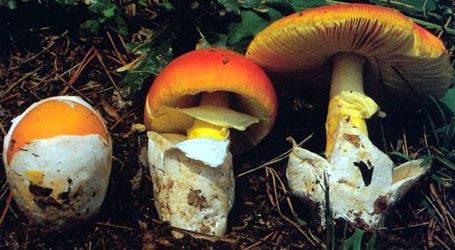
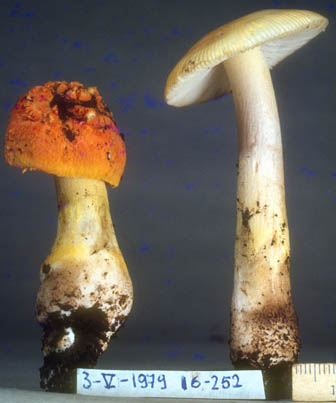
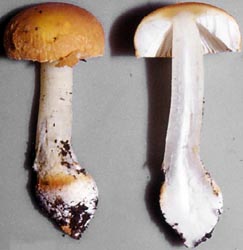
protolog: up to 45 mm wide,
semiglobose when young, convex when older, deep
orange to red-orange when young, fading to orange
or orange-yellow (4-5A6), pale yellow at margin,
not umbonate, at first appearing felted,
eventually shiny; context pale yellow below
pileipellis, otherwise, white;
margin at first
slightly sulcate, later strongly sulcate-striate,
nonappendiculate; universal veil as up to 2 mm
high warts, fragile, deep orange (6A8), slenderly
conic, pulverulent, with pallescent tips,
detersile; pileipellis easily peeling for
two-thirds of radius. |
| lamellae |
protolog: free, moderately
crowded, white, with some edges
fimbriate especially near stipe; lamellulae
scarce.
RET: free, moderately crowded, white, with some edges
fimbriate especially near stipe; lamellulae
scarce (not observedyet??
in material examined). |
| stipe |
protolog: up to 75 × 12+ mm, pale yellow (2A4), at first
narrowing upward, later nearly cylindric, somewhat
pulverulent (sometimes with superior
pulverulent zone); bulb up to 22 mm wide, with or
without slightly rooting pointed base,
proportionately broadest when young; context
white, solid; exannulate; universal veil friable,
floccose, deep orange, on base of stipe or bulb.
RET: up to 75 × 12+ mm, pale yellow (2A4), at first
narrowing upward, later nearly cylindric, somewhat
pulverulent (sometimes with superior
pulverulent zone); bulb up to 22 mm wide, with or
without slightly rooting pointed base,
proportionately broadest when young; context
white, solid; exannulate; universal veil friable,
floccose, deep orange, predominantly remaining on
bottom 1–2 cm of stipe base and on bulb above its
broadest part. |
| odor/taste |
protolog: Odor
indistinct. Taste mild.
Inedible according to Garrido-G.
(1985). |
macrochemical
tests |
none recorded. |
| pileipellis |
protolog: "ixocutis" of colorless,
gelatinized hyphae. [Note: It is not
clear if this is a suprapellis with an undescribed
ungelatinized subpellis or a single-layered and
totally gelatinized
pileipellis. The latter would be unusual in
Amanita.—ed.] |
| pileus context |
not described. |
| lamella trama |
protolog: "approximately
bilateral." |
| subhymenium |
protolog: "inflated."
[Note: In an accompanying figure, a basidium appears
to arise from an uninflated hyphal segment.
Hence, "inflated" may mean that there were inflated
cells in the subhymenium rather than that the tissue
was composed entirely of inflated cells.—ed.] |
| basidia |
protolog: 35 - 65 × 7.0 - 14.0
µm, 4-sterigmate; clamps present.
RET: 35 - 65 × 7.0 - 14.0 µm, dominantly 4-, also
5- and 3-sterigmate, with sterigmata up to
?? × ?? µm; clamps frequent. |
| universal veil |
protolog: On pileus:
with all elements near disc arranged anticlinally;
filamentous hyphae 5.0 - 12.0 μm wide, branching;
inflated cells subglobose to ellipsoid to pyriform,
yellowish, thin-walled, 20 - 65 × 18.0 - 37
μm, in terminal in chains of 4 - 6 cells
(without exception).
On stipe base: filamentous hyphae 2.5 - 6.0
μm wide, branching, very abundant, "somewhat
encrusted"; inflated cells often large
(up to 175 × 80 μm), terminal, singly or in
short chains. |
| stipe context |
protolog: longitudinally
acrophysalidic; filamentous hyphae 2.5 - 6.0 μm
wide, sparsely branching; acrophysalides up to 200
× 35 μm. |
| partial veil |
absent |
| lamella edge tissue |
protolog: filamentous hyphae
present as relatively short and sometimes branching
segments; inflated cells terminal singly or in chains,
globose to ellipsoid to elongate or irregular
9.0 - 45 × 10.0 - 25 μm.
RET: sterile. |
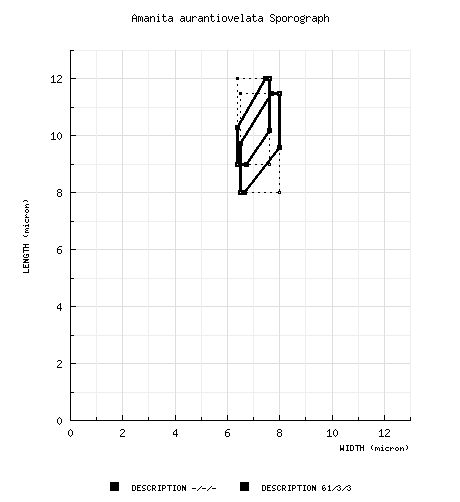
| basidiospores |
protolog: [-/-/-] 8.0 - 11.5
× 6.5 - 8.0 μm, (Q = 1.20 - 1.50 (-1.65); est. Q' = 1.35),
hyaline, colorless, smooth, thin-walled, inamyloid,
broadly ellipsoid to ellipsoid, rarely elongate,
adaxially flattened (per illustrations);
apiculus sublateral (per illustrations),
"sometimes truncate,"
"broad"; contents not recorded;
white in deposit.
RET: [61/3/3] (8.8–) 9.0–12.0 (–12.6) × (6.0–) 6.4–7.6
(–9.0) µm, (L = 9.6–11.0 µm; L' =
10.2 µm; W = 6.8–7.4 µm; W' = 7.0 µm;
Q = (1.28–) 1.34–1.61 (–1.69); Q = 1.40–1.50;
Q' = 1.46), hyaline, colorless, thin-walled,
smooth, inamyloid, adaxially flattened, ellipsoid to
occasionally elongate; apiculus sublateral,
proprotionately large and markedly projecting,
cylindric to truncate-conic; contents dominantly
monoguttulate with additional small granules;
white in deposit. |
| ecology |
protolog: Chile: Solitary. Under
Nothofagus obliqua.
With regard to additional research in Chile,
Valenzuela et al. (1999)
report that this species was not present in the
Nothofagus forests studied in the Cordillera
de la Costa and the Cordillera de los Andes; however,
it was a common species in forest of the Depresión
Intermedia—occurring there with N. dombeyi,
N. obliqua, and other unidentified
Nothofagus species. |
| material examined |
protolog: CHILE:
LOS LAGOS—30 km W of Osorno, Cuinco
[40.6417° S/ 73.4417° W], 3.vi.1979
Jansen & Schalkwijk XVI-251 (holotype,
L).
RET: CHILE: BÍO BÍO—Curanilahue, Trongol
Bajo, 32.v.1982 N. Garrido-G. 519 (M n.v., ZT
(Horak)).
LOS LAGOS—Valdivia, Elvira, Cuesta Sta.,
14.v.1967 R. Singer M6889
(SGO n.v.), 15.v.1967 R. Singer M6912
(SGO n.v.), 8.iv.1975 E. Horak 75/280 (ZT
(Horak)); Rebellín, 18.v.1990 E. Valenzuela &
J. Grinsbergs s.n. (AH 13911 n.v., ZT (Horak)
5161). |
| discussion |
In the protolog, the authors compared the present
species to others of section Amanita with an
exannulate stipe, colored
universal veil, and spores of comparable size and
shape. In the process, they pointed out
siginificant differences segregating their new
species from A.
mira, A. rubrovolvata,
and A. wellsii.
The reader may also wish to compare the present
species with A.
cruzii and A.
roseitincta. |
| citations |
—R. E. Tulloss, G. M. Jansen, and E. Horak |
| editors |
RET |
|



 Spore data sets and their composite