| name |
Amanita
cruzii |
| author |
O.K. Mill. & Lodge. 2001. Mycotaxon 79: 297, figs. 6-9, 13-14, 17-18. |
| name status |
nomen acceptum |
| english name |
"José Cruz's Amanita" |
| etymology |
genitive of a Latinized name; hence, "of Cruz" or "Cruz's"
Named in honor of the experimental agriculturalist, José Cruz, on whose experimental coffee plantation, some of the first collections of this species were found. |
| MycoBank nos. |
474290 |
| GenBank nos. |
Due to delays in data processing at GenBank, some accession numbers may lead to unreleased (pending) pages.
These pages will eventually be made live, so try again later.
|
| holotypes |
JBSD [located at VPI, will be sent to JBSD in conformance with place of deposit stated in protolog] |
| intro |
The following text may make multiple use of each data field.
The field may contain magenta text presenting data from a type study
and/or revision of other original material cited in the protolog of the present taxon.
Macroscopic descriptions in magenta are a combination of data from the protolog and
additional observations made on the exiccata during revision of the cited original
material.
The same field may also contain black text, which is data from a revision of the present
taxon (including non-type material and/or material not cited in the protolog).
Paragraphs of black text will be labeled if further subdivision of
this text is appropriate.
Olive text indicates a specimen that has not been
thoroughly examined (for example, for microscopic details) and marks other places in the text
where data is missing or uncertain.
The following material not directly from the protolog of the present taxon and not cited as the work of another researcher is based upon original research by C. Rodríguez Caycedo and R. E. Tulloss. |
| pileus |
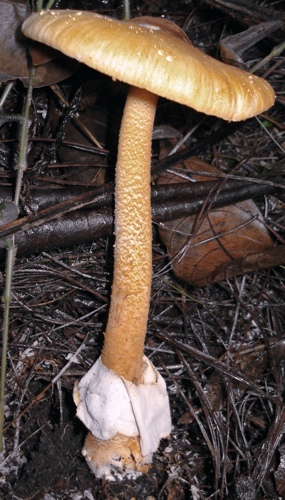
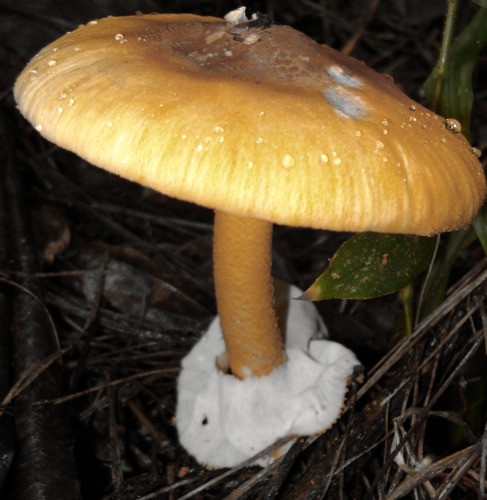
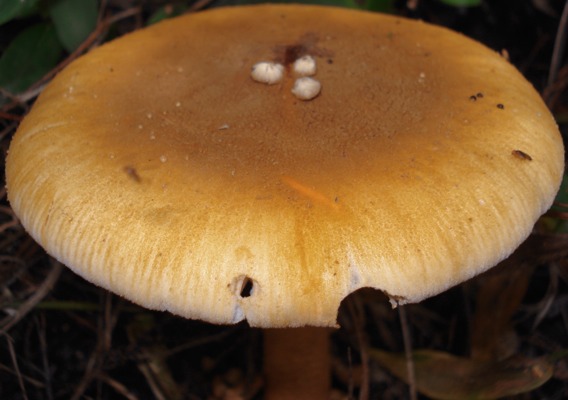
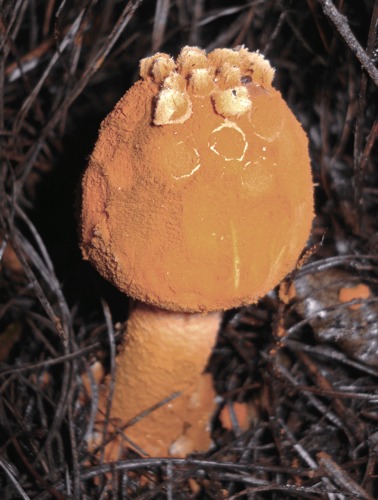
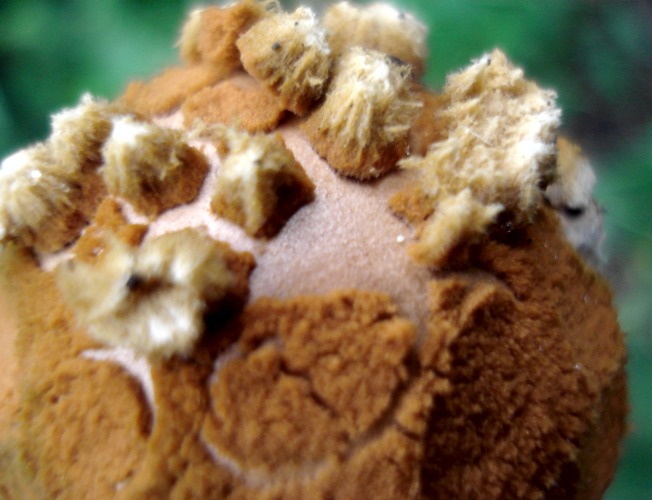
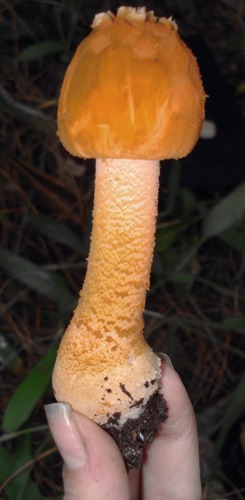
from protolog: (30-) 40 - 80 mm wide, light orange (6A2) when exposed in age, convex to broadly convex, dry; context firm, white; margin at first scantily appendiculate; universal veil duplex, with outer layer whitish (thin and appearing "membranous" in "buttons") and eventually comprising pyramidal warts (densest over disc, each centered in shallow depression of inner layer), with inner layer at first forming complete pulverulent and rusty brown (6C-D7 to 7D6-7) covering (disappearing with age). |
| lamellae |
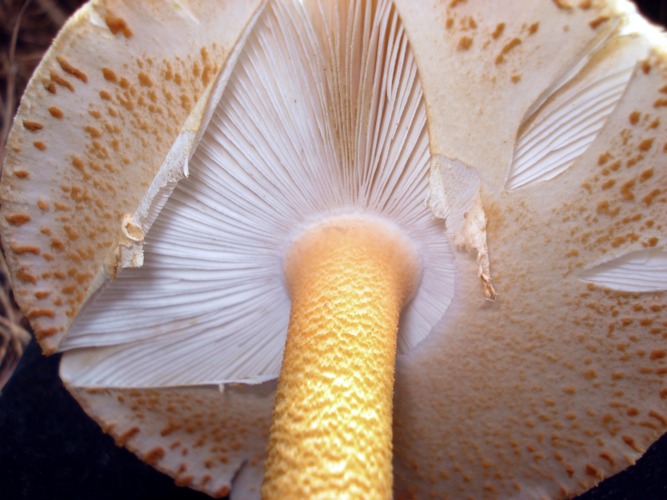
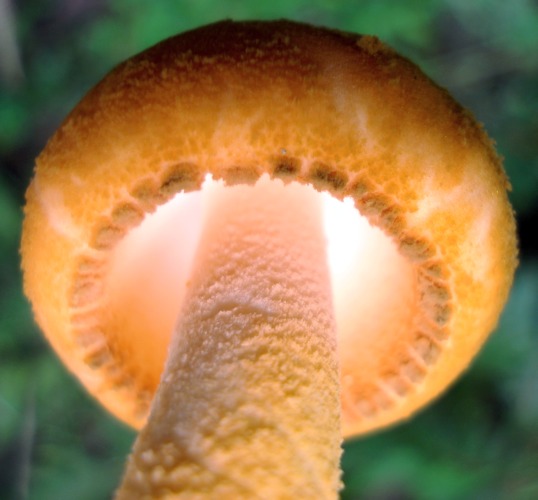
from protolog: free, subdistant, white, broad, with edge minutely fimbriate; lamellulae of two lengths. |
| stipe |
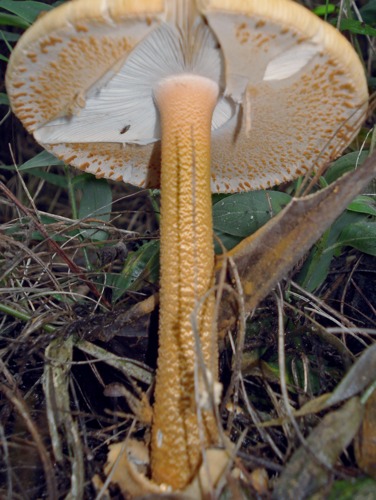
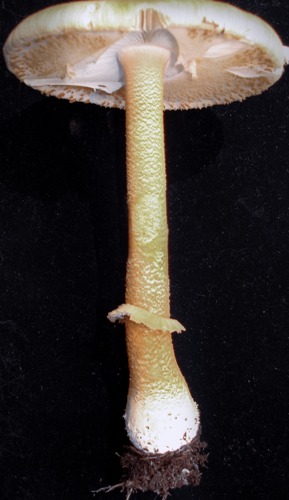
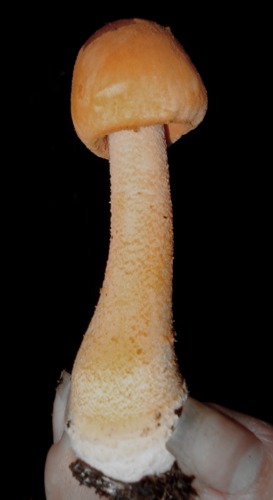
from protolog: 55 - 90 × 4 - 13 (-20) mm, narrowing upward; bulb 17 - 28 mm wide, white; context white, firm above, below having central cylinder with "pithy" contents; partial veil apical, often evanescent, apparently "duplex," with apparent lower layer of rusty brown pulverulent material from the limbus internus of the unviersal veil, with apparent upper layer (partial veil proper) white, striate above [apparently membranous—ed.]; universal veil in raised rings above bulb and as evenly distributed to patchy rusty brown pulverulence similar to lower level of universal veil on pileus. |
| odor/taste |
from protolog: "indisctinct, faint, resembling radish or potato." Taste not recorded. |
macrochemical
tests |
none recorded. |
| pileipellis |
from protolog: as cutis of filamentous hyphae 3.4 - 11.0 μm wide, hyaline, thin-walled. [Note: remainder of description appears to describe basal elements of universal veil from pileus (see below)—ed.] |
| pileus context |
from protolog: hyphae 3.4 - 10.0 (-24) μm wide, loosely interwoven, thin-walled, hyaline; acrophysalides not described; clamps lacking. |
| lamella trama |
from protolog: diverent; hyphae 3.4 - 11.0 μm wide, thin-walled, hyaline; clamps lacking. |
| subhymenium |
not described in protolog. |
| basidia |
from protolog: 43 - 45 × 10 - 12 μm, 4-sterigmate, clavate, thin-walled, hyaline in 3% KOH; clamps lacking. |
| universal veil |
from protolog: On pileus, pyramidal warts: filamentous hyphae scattered, thin-walled; inflated cells 16 - 68 × 13 - 33 μm, (length/width = 1.06 - 3.47; mean length/width = 1.58), subglobose to broadly ellipsoid to ovoid to ellipsoid to pyriform to elongate to cylindric to bacilliform; clamps lacking. On pileus, powdering layer: filamentous hyphae 1.7 - 4.0 μm wide, hyaline, common ("about 20%"); inflated cells 19 - 49 × 10 - 26 μm, (length/wide = 1.0 - 3.1; mean length/width = 1.76), rarely globose to subglobose to broadly ellipsoid to ellipsoid to elongate to cylindric to bacilliform cells, with narrower cells often constricted; clamps lacking. [On pileus, apprently from basal layer:] as "loose trichodermium"; filamentous hyphae not described; inflated cells 21 - 52 × 7 - 21 μm, clavate, capitate, globose to irregular, terminal; clamps lacking. |
| stipe context |
not described in protolog. |
| partial veil |
from protolog: filamentous hyphae 2.0 - 3.5 μm, thin-walled, hyaline, branched, plentiful ("45%"); inflated cells: 19 - 49 × 10 - 26 μm (length/width ratio = 1.9 - 3.1; mean length/width ratio = 1.76), globose to subglobose to broadly ellipsoid to ellipsoid to ovoid to elongate to cylindric to bacilliform, often constricted, thin-walled, plentiful to dominant; clamps lacking. [Note: Miller calls the partial veil "duplex," but doesn't say whether the above observations apply to the partial veil proper or the limbus internus of the universal veil that covers the underside of the partial veil.—ed.] |
| lamella edge tissue |
from protolog: inflated cells 15 - 31 × 7.5 - 20 μm, pyriform to clavate to globose, thin-walled, hyaline in 3% KOH; clamps lacking. [Note: originally misdescribed as "cheilocystidia" by Miller.—ed.] |
| basidiospores |
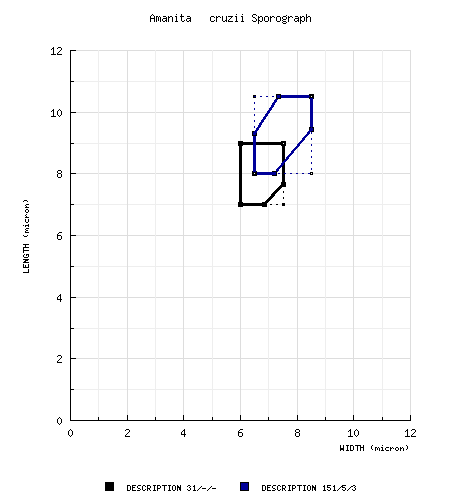
from protolog: [31/-/-] 7.0 - 9.0 × 6.0 - 7.5 μm, (Q = 1.02 - 1.50; Q = 1.26), hyaline, colorless to light yellow in 3% KOH, thin-walled, inamyloid, globose to subglobose to broadly ellipsoid to ellipsoid; apiculus sublateral (per figure); contents with "large central oil body"; color in deposit not recorded.
CRC: [151/5/3] (6.5-) 8.0 - 10.5 (-11.8) × (5.5-) 6.5 - 8.5 (-9.0) μm, (L = 8.7 - 9.7 μm; L' = 9.2 μm; W = 7.4 - 7.8 μm; W' = 7.5 μm; Q = (1.04-) 1.11 - 1.43 (-1.56); Q = 1.19 - 1.30; Q' = 1.24), hyaline, colorless, smooth, thin-walled, inamyloid, subglobose to broadly ellipsoid to ellipsoid, infrequently globose; apiculus sublateral, cylindric; contents predominantly monoguttulate, rarely multiguttulate or granular; color in deposit not recorded. |
| ecology |
from protolog: Dominican Republic: Solitary or in small groups. At 950 - 1250 m elev. Under Pinus occidentalis in mixed woods or in plantations.
CRC et al.: Colombia: In small groups. At 2226± m elev. In plantation of Pinus patula (alien). |
| material examined |
from protolog: DOMINICAN REPUBLIC: PROV. LA VEGA—Cordillera Central above Manabao, José Cruz's farm [19°04'46" N/ 70°48'11" W, 1197 m], 14.i.1997 H. H. Miller & D. J. Lodge s.n. [O. K. Miller 26806, CFMR-DR-2150] (paratype, JBSD; paratype, VPI). PROV. SANTIAGO—La Celestina, Community Forest, 25.xi.1999 O. K. & H. H. Miller [O. K. Miller 27706, CFMR-DR-1411] (holotype, JBSD), T. Armstrong & T. J. Baroni s.n. [Baroni 8998, CFMR-DR-1121] (paratype, CORT; paratype, JBSD 94018; paratype, NY), D. J. Lodge, O. K. & H. H. Miller [O. K. Miller 27710, CFMR-DR-1413] (paratype, CFMR; paratype, JBSD); Parque Bermúdez, Anton Sape Bueno entrance [19°12'07" N/ 70°59'00" W, 950 m], 24.xi.1999 J. G. Torrez & T. J. Baroni s.n. [O. K. Miller 27695, CFMR-DR-1402] (??).
CRC et al.: COLOMBIA: DPTO.
SANTANDER—Mpio. Floridablanca - Centro de
Educación Ambiental El Diviso, km 17 en route to
Cúcuta [7º06′44″ N/ 73º01′48″ W, 2226 m], 19.xi.2006
C. Rodríguez Caycedo 191106-12 (HUA).
DOMINICAN REPUBLIC: PROV.
LA VEGA—Los Dajaos, finca de José Cruz
[19º04′46″ N/ 70º48′11″ W, 1291 m], 29.i.1998
D. J. Lodge, G. Dobler, M. Castellano & J.
Trappe s.n. [Lodge DR-61, CFMR-DR-606] (CFMR,
uncited original material, immature); Jarabacoa,
26.iv.2014 Claudio Angelini ANGE340 (RET 692-10);
Jarabacoa
Golf Course, 13.xi.2003 H. & O. K. Miller
& T. J. Baroni s.n. [Baroni 9791, CFMR-DR-2863]
(JBSD; CORT).
PROV. SANTIAGO—La
Celestina, Plan Sierra Project 4+, 4.5 km from La
Celestina, 25.xi.1999 T. Armstrong & T. J.
Baroni 35 [Baroni 8998, CFMR-DR-1121] (paratype,
CORT; paratype, JBSD 94018). |
| discussion |
t.b.d.
The numbers beginning "CFMR-DR-" are unique identifiers for individual collections in the database of the Basidiomycetes of the Greater Antilles project. These identifiers have been verified by Dr. D. Jean Lodge.
The original description includes many typographical and syntactic errors. The editors are very appreciative of the assistance afforded to us by Drs. S. Redhead, D. J. Lodge, and T. Weibold in sorting out the sites of deposit of collections, collections numbers, database identifiers, related nomenclatural, and other matters.
Collections cited neither in the protolog, nor in the study of CRC et al. [per database of Basidiomycetes of the Greater Antilles project (CFMR)]: DOMINICAN REPUBLIC: UNKN. PROV.—unkn. loc., 23.xi.1999 unkn. coll. s.n. [CFMR-DR-1382] (??), 16.xi.2003 O. K. Miller 28511 [CFMR-DR-2964] (??; JBSD), O. K. Miller 28512 [CFMR-DR-2965] (??; JBSD), 23.xi.2003 O. K. Miller 28481 [CFMR-DR-2936] (??; JBSD). |
| citations |
—C. Rodríguez Caycedo and R. E. Tulloss |
| editors |
RET |
|



 Spore data sets and their composite