| name |
Amanita wellsii |
| author |
(Murrill) Murrill. 1920. Mycologia 12: 292. |
| name status |
nomen acceptum |
| english name |
"Salmon Amanita" |
| synonyms |
≡ Venenarius wellsii Murrill. 1920. Mycologia 12: 291.
≡ Amanita wellsii (Murrill) Sacc. & Trotter 1925. Syll. Fung. 23: 3. [Superfluous combination]
The editors of this site owe a great debt to Dr. Cornelis Bas
whose famous cigar box files of Amanita nomenclatural information
gathered over three or more decades were made available to RET for computerization
and make up the lion's share of the nomenclatural information presented on this site.
|
| etymology |
genitive of Latinized name, "Wells'" or "of Wells" |
| MycoBank nos. |
174316, 199888 |
| GenBank nos. |
Due to delays in data processing at GenBank, some accession numbers may lead to unreleased (pending) pages.
These pages will eventually be made live, so try again later.
|
| holotypes |
NY |
| type studies |
Jenkins. 1977. Biblioth. Mycol. 57: 99.
Jenkins. 1979. Mycotaxon 10: 198. |
| revisions |
Jenkins. 1977. Biblioth. Mycol. 57: 78.
Wartchow, Tulloss and Cavalcanti. 2009. Mycologia 101: 867. [partial]
Tulloss, here |
| intro |
The following text may make multiple use of each data field.
The field may contain magenta text presenting data from a type study
and/or revision of other original material cited in the protolog of the present taxon.
Macroscopic descriptions in magenta are a combination of data from the protolog and
additional observations made on the exiccata during revision of the cited original
material.
The same field may also contain black text, which is data from a revision of the present
taxon (including non-type material and/or material not cited in the protolog).
Paragraphs of black text will be labeled if further subdivision of
this text is appropriate.
Olive text indicates a specimen that has not been
thoroughly examined (for example, for microscopic details) and marks other places in the text
where data is missing or uncertain.
The data presented below is based on original research of R. E. Tulloss. |
| pileus |
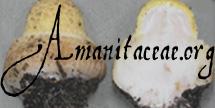
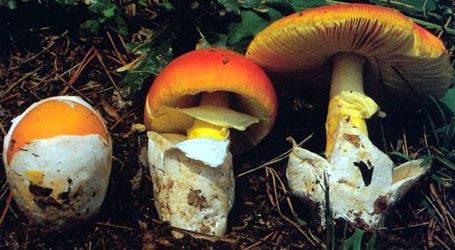
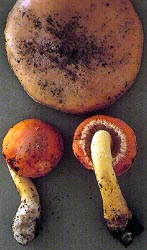
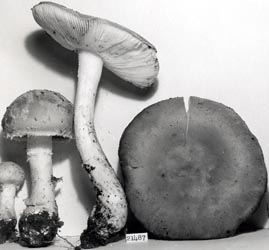
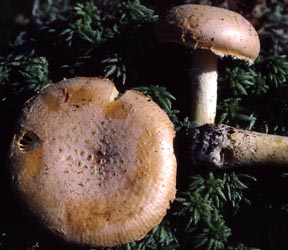
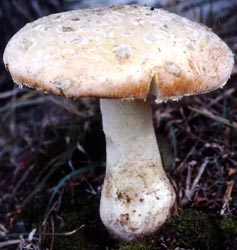
83 - 130 mm wide, salmon to orange to yellow-orange to red-orange, sometimes unevenly pigmented, sometimes becoming more evenly pigmented (and very slightly browner) by maturity, hemispheric at first, then convex to broadly convex, sometimes uneven, tacky to subviscid to viscid when moist, rather dull when tacky, becoming subshiny when dry; context white except for yellow band 2 - 3 mm thick just below pileipellis, unchanging when cut or bruised, 5.5 - 10 mm thick, thinning evenly for 85 - 95% of radius, then membranous to margin; margin sometimes nonstriate at first, eventually short striate (0.05R - 0.2R), incurved at first, decurved at maturity, sterile; universal veil as friable warts or powdery layer (sometimes suggesting universal veil of A. flavoconia), bright yellow, becoming sordid pale cream or sordid very pale tan upon exposure and drying in situ, detersile. |
| lamellae |
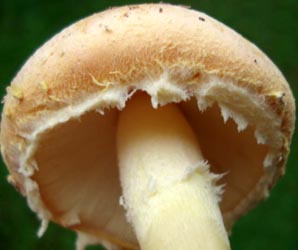
free without decurrent line on stipe apex, crowded, cream in mass, white in side view, 7 - 14 mm broad, broadest near midpoint; lamellulae truncate, of diverse lengths, unevenly distributed, plentiful. |
| stipe |
79 - 90 × 11.5 - 15 mm, white to pale yellow, becoming brown to nearly black from handling (especially on raised fibrils), finely pulverulent above parital veil, fibrillose below it, longitudinally striatulate, slightly narrowing upward or cylindric, flaring just at apex; bulb white, ellipsoid to broadly clavate, 21 - 29 × 19 - 27 mm; context white at first, becoming brownish where nearby surface has bruised, with larva tunnels concolorous or with brownish tint, firmly stuffed with dense white material, with central cylinder 3 - 9 µm wide; partial veil subapical to superior, white to yellowish white to pale yellow, sometimes more strongly pigmented below, nonstriate above and below, subpulverulent below, submembranous, weakly structured, sometimes with yellow bits of universal veil attached to underside at edge; universal veil as scattered to confluent warts or small patches, bright yellow, fading as on pileus, detersile. |
| odor/taste |
Odor lacking. Taste not recorded. |
macrochemical
tests |
Spot test for syringaldazine (laccase) - rapidly positive then slowly fading in base of bulb (otherwise negative throughout basidiome) in incompletely expanded specimen; negative throughout basidiome in mature specimen. Spot test for tyrosinase (paracresol) - positive except for central cylinder of stipe, much of bulb (excluding base and region below central cyinder), most of pileus context except in region above and slightly broader than stipe, and much of gill surfaces in incompletely expanded specimen; positive except for central cylinder of stipe, much of gill surfaces and base of bulb in mature specimen. Test voucher: Tschekunow s.n. (29.x.1998). |
| basidiospores |
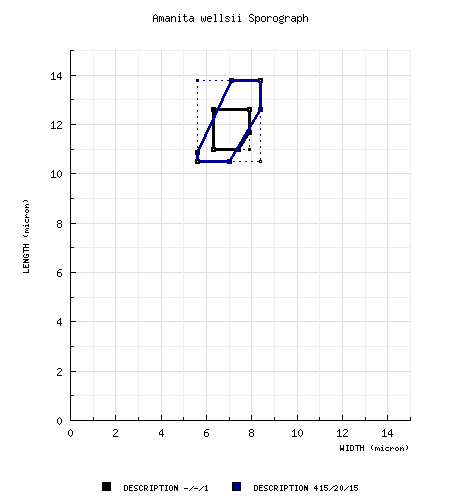
from type study of Jenkins (1979): [-/-/1]
11.0 - 12.6 × 6.3 - 7.9 μm, (Q = 1.48 - 2.00; Q' = 1.63),
hyaline, thin-walled, nonamyloid, ellipsoid to cylindric, often adaxially flattened; apiculus sublateral, cylindric; contents guttulate;
color in deposit not recorded.
[415/20/15] (8.7-) 10.5 - 13.8 (-18.0) × (4.9-) 5.6 - 8.4 (-10.8) µm, (L = (10.4-) 10.6 -
13.0 (-13.2) µm; L’ = 11.9 µm; W = (5.3-) 6.4 - 7.6 (-8.6) µm; W’ = 7.1 µm; Q = (1.39-) 1.50 - 1.94 (-2.62); Q =
(1.52-) 1.62 - 1.76 (-1.92); Q’ = 1.69), inamyloid, smooth, thin-walled, hyaline, colorless, ellipsoid to elongate to cylindric, often adaxially flattened, occasionally expanded at one end, occasionally as giant spores; apiculus sublateral, pronounced, truncate-conic to cylindric; contents multiguttulate; ?? in deposit. |
| ecology |
Québec: On sandy soil in mixed woods including (e.g.) Alnus, Betula, Populus, Vaccinium, etc. Newfoundland & Labrador: At 0 - 61 m elev. In heaths (e.g., coastal heath barren) containing dwarf Betula, Empetrum, dwarf Salix, Vaccinium spp., etc. Maine: At 25 - 225 m elev. In blueberry (Vaccinium) patch on sand terrace with Alnus, Acer rubra, Salix, and Spirea or in commercial blueberry field with no other nearby woody plants. New Hampshire: Under Tsuga canadensis and Pinus strobus. New Jersey: At 15 - 250 m elev. In duff and loam under Tsuga canadensis near Gomphidius glutinosus (Schaeff. : Fr.) Fr.
[Note: It is possible that Vaccinium was present in all the cases cited.] |
| material examined |
from type study of Jenkins (1979):
U. S. A.:
NEW HAMPSHIRE— Sullivan Co. -
Springfield,
1.ix.1917 W. A. Murrill s.n. (holotype,
NY 66719).
CANADA: NEWFOUNDLAND &
LABRADOR—Isl. of Newfoundland - Avalon
Peninsula, Cape Saint Mary’s [46°49'23" N/
54°11'44" W, 0-61 m], 28.ix.2005 A. Voitk s.n.
(in herb. Voitk; RET 387-5, nrITS & nrLSU seq'd.).
QUÉBEC—Région Capitale-Nationale -
Lac-Saint-Joseph, Chez Denis
[46°56' N/ 71°38' W, ca. 170 m], 30.vii.1967 R. L.
Shaffer 5604 (MICH). Région
Saugenay-Lac-Saint-Jean - Route 155 S of
Lac-Bouchette, W of km 199,
1.ix.2006 Romain Labrie s.n.
[Tulloss 9-1-06-B] (RET 395-6,
nrITS seq'd.).
U.S.A.:
CONNECTICUT—Unkn. Co. - unkn. loc.,
ix.1984 Aaron Norarevian 9-84-AN1
(RET 234-1).
MAINE—Cumberland Co. - Freeport,
Wolfe’s Neck St. Pk. [43°49'28" N/ 70°05'15" W,
ca. 25 m], 7.ix.1984 student of S. S. Ristich s.n.
[Tulloss 9-7-84-SSR] (RET 237-10 p.p.); N.
Yarmouth, Sligo Rd., 5.ix.1984 S. S. Ristich s.n.
[Tulloss 9-5-84-SSR] (RET 237-10 p.p.); N.
Yarmouth, 3.ix.1988 S. S. Ristich s.n. [Tulloss
9-3-88-SSR1] (RET 001-5). Hancock Co. - Mt.
Desert Island, 8.viii.1991 Arleen Bessette
8-8-91-AB1 (RET 030-8). Oxford Co. -
Greenwood, Locke Mills, N of Portland on Route
26 [44°24'00" N/ 70°42'07" W, 225 m],
23.viii.1986 S. S. Ristich 8-23-86-SSR1
(RET 466-1, nrITS & nrLSU seq'd.); Grafton
Notch St. Pk., 25.viii.1985
S. S. Ristich s.n. [Tulloss 8-25-85-SSR1]
(RET 211-5). Unkn. Co. - unkn. loc.,
2/3.viii.1988 S. S. Ristich s.n. [Tulloss
8-2/3-88-SSR1] (RET 045-4).
MASSACHUSETTS—Worcester Co. -
Leominster, 21.ix.1947 R. Singer s.n. (FH);
Westborough, 2.viii.2011 Dr. Laszlo Nagy 5019
(SZMC; RET 646-3, nrLSU seq'd.).
MICHIGAN—Chippewa Co. - Round
Island Point Nature Reserve [46.4298° N/ 84.4958°
W, 186 m], 9.ix.2015 Bonni Mackintosh
s.n. (RET 726-6, nrITS-LSU seq'd.).
NEW HAMPSHIRE—Hillsborough Co. -
Fox St. For., ca. Valley Tr., 6.ix.1959 O. K.
Miller 526 (VPI as "A. volvata").
Unkn. Co. - unkn. loc., 24.ix.1989 member
Montshire Mycol. Club s.n. (RET 016-3).
NEW JERSEY—Sussex Co. - Stokes St. For.,
Struble Rd. [41°11'05" N/ 74°48'19" W, ca. 242 m],
29.x.1998 H. Tschekunow s.n.
(RET ??).
PENNSYLVANIA—Schuylkill Co. - Locust
Lk. St. Pk. [40°46'44" N/ 76°08'05" W, ca. 423 m],
21.ix.1996 J. A. Lankalis s.n. (RET 259-1, nrITS
& nrLSU seq'd.).
Sullivan Co. - 8-10 km S of Lopez, tr. parall. to
Splashdam Pond on upr. Main Branch Mehoopany
Crk., tr. head W of Rte. 407
[41°24'12" N/ 76°16'44" W, ca. 622],
early ix.2008 David Wasilewski
s.n. (RET 421-9), 3.x.2014 Mrs. Wasilewski s.n.
(RET 654-2, nrITS-LSU seq'd.).
VERMONT—??. |
| discussion |
Material determined in the field in Missouri (RET 576-2) as
A. wellsii has yielded an nrITS sequence
that is over 2.4% distant from sequences based on multiple
sampled collections from Massachusetts and Quebec.
It will be important to obtain more specimens having
the general appearance of A. wellsii from
the Appalachians and from other regions of the
southeastern U.S. |
| citations |
—R. E. Tulloss |
| editors |
RET |
|



 Spore data sets and their composite