| name |
Amanita xanthocephala |
| author |
(Berk.) D. A. Reid & R. N. Hilton in D. A. Reid. 1980. Austral. J. Bot., Suppl. Ser. 8: 65. |
| name status |
nomen acceptum |
| english name |
"Vermilion Amanita" |
| synonyms |
≡ Agaricus xanthocephalus Berk. 1845. London J. Bot. 4: 45.
≡ Volvaria xanthocephala (Berk.) Sacc. 1887. Syll. Fung 5: 661.
= Agaricus pulchellus Cooke & Massee. 1889. Grevillea 18: 1.
≡ Amanitopsis pulchella (Cooke & Massee) Sacc. 1891a. Syll. Fung. 9: 2.
≡ Vaginata pulchella (Cooke & Massee) Kuntze. 1898. Rev. Gen. Plant. 3(2): 539.
≡ Amanita pulchella (Cooke & Massee) E.-J. Gilbert. 1941. Iconogr. Mycol. (Milan) 27, suppl. (2): 203, pl. 1 (fig. 1).
≡ Amanita austropulchella D. A. Reid. 1978.
Victorian Naturalist 95: 48, figs. 3(a-e), 51-53, 96.
The editors of this site owe a great debt to Dr. Cornelis Bas
whose famous cigar box files of Amanita nomenclatural information
gathered over three or more decades were made available to RET for computerization
and make up the lion's share of the nomenclatural information presented on this site.
|
| etymology |
ξανθός, "yellow" + κεφαλά, "head"
pulchellus, "small and beautiful"
australis, "southern" + pulchellus, here treated as a noun because of its being an epithet in A. pulchella S. Imai; hence, "southern pulchella" |
| MycoBank nos. |
118375, 375129, 188046, 308539, 137529, 296051, 560221 |
| GenBank nos. |
Due to delays in data processing at GenBank, some accession numbers may lead to unreleased (pending) pages.
These pages will eventually be made live, so try again later.
|
| holotypes |
Agaricus xanthocephalus—K.
Agaricus pulchellus—K. |
| type studies |
Reid. 1980. Austral. J. Bot., Suppl. Ser. No. 8: 14, figs. 3(a-c), 51-53, 96 [Agaricus pulchellus]; 65 [Agaricus xanthocephalus]. |
| revisions |
Grgurinovic. 1997. Larger Fung. S. Austral.: 387, fig. 258(a-c). |
| selected illustrations |
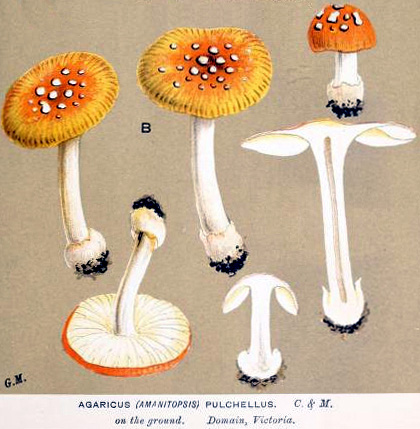
Cooke. 1890. Grevillea 18 (fasc. 88, after p. 360): pl. 3 (fig. B).
E.-J. Gilbert. 1940. Iconogr. Mycol. (Milan) 27 suppl. (1): tab. 1 (figs. 1-2, 4).
[Additional illustrations cited by Reid: 1980. A monograph of the Australian species of Amanita Persoon ex Hooker (Fungi). Austral. J. Bot. Suppl. Ser. 8: 14.] |
| intro |
The following text may make multiple use of each data field.
The field may contain magenta text presenting data from a type study and/or revision of other original material cited in the protolog of the present taxon. Macroscopic descriptions in magenta are a combination of data from the protolog and additional observations made on the exiccata during revision of the cited original
material.
The same field may also contain black text, which is data from a revision of the present
taxon (including non-type material and/or material not cited in the protolog).
Paragraphs of black text will be labeled if further subdivision of this text is appropriate.
Olive text indicates a specimen that has not been thoroughly examined (for example, for microscopic details) and marks other places in the text
where data is missing or uncertain.
The following material is derived from the two relevant protologs of the present taxon, (Reid 1980), (Grgurinovic 1997), and recent observations communicated by Heino Lepp.
The protolog for Agaricus xanthocephalus in its entirety follows:
"26. A. (Volvaria) xanthocephalus, Berk.; pileo convexo aureo e volva albo-maculato; stipite bulboso, volva adnata margine sublibero[;] lamellisque remotis attenuatis liberis pulcherrime pallido-gilvis. Drumm. n. 107.
"On the ground.
"Pileus 1-2 inches broad, convex, sometimes umbonate, subcarnose with the margin very thin, varying from bright orange to golden yellow spotted by the volva. Stem 1-2 inches high, 2-3 lines broad, strongly bulbous at the base, slightly dilated above, furnished at the base with an adnate volva whose borders are free of a beautiful cream colour. Gills of the same colour as the stem, moderately broad, but not ventricose, much attenuated behind and leaving a circular space round the top of the stem. Ring none.
"The specimens of this species are not so perfect as could be wished, especially as regards the gills, so that I am not absolutely certain as to the colour of the spores, but as far as I can judge from their appearance under the microscope and especially from the circumstance of the gills being remote, I think myself justified in considering it a Volvaria. Without the aid of Mr. Drummond's notes, I should not have ventured to describe it, but the characters are so marked, that there can be no difficulty in recognizing it, and I shall hope shortly to obtain more perfect specimens."
The protolog for Agaricus pulchellus comprises a brief Latin diagnosis:
"Pileo convexo-expanso (1-2 unc. diam.) miniato, verrucis irregularibus, facile secedentibus obtecto, margine croceo, striatulo; stipite mox cavo, albo, (2-2½ unc. long[.], ¼ unc. crass.), volva adnato, marginato, basi ovato-bulbosa, annulo obsoleto, lamellis liberis, ventricosis, confertis, albis, demum flavotingentibus. Sporis subglobosis, 7-8 μ.
"On the ground. Victoria. (Mrs. Martin, 448, with figs.)
"Very much resembling a diminutive form of Ag. muscarius without a ring." |
| pileus |
from protolog: 25 - 50 mm wide, bright orange to golden yellow, convex, sometimes umbonate; context not very thick, very thin near margin; margin not described; universal veil as pallid spots.
from protolog of Agaricus pulchellus: 25 - 50 mm wide, flame scarlet, saffron yellow over margin, broadly convex; context not described; margin short-striate; universal veil as irregular warts, deterile.
from non-type material, Reid (1980): ?. |
| lamellae |
from protolog: remote, density not described, pale dull yellow, concolorous with stipe; moderately broad, not ventricose, much attenuated toward stipe; lamellulae not described.
from protolog of Agaricus pulchellus: free, crowded, white becoming tinged with yellow, ventricose; lamellulae not described.
from non-type material, Reid (1980): ?. |
| stipe |
from protolog: 25 - 50 × 4 - 6 mm, pale dull yellow, flaring at apex; bulb distinct; context not described; exannulate; universal veil as raised limb on bulb, "beautiful cream color." [Note: The protolog gives no color for the stipe; however, the gills are said to be concolorous with the stipe and pallido-gilvus and the latter term is thereforee applied to the stipe here.—ed.
from protolog of Agaricus pulchellus: 50 - 62 × 6 mm, white; bulb ovoid; context soon hollow; exannulate; universal veil "adnate, marginate." [Note: The term "adnate" applied to the universal veil often indicates that an author saw no distinct evidence of a volva, but assumed that it provided a surface layer to the stipe's bulb. The term "marginate" could apply to either the stipe itself or to the universal veil. Knowing the species from modern material, the editor suggests that description is of the volva which can form a ring around the upper part of the ovoid bulb.—ed.]
from type study, Reid (1980): .
from non-type material, Reid (1980): ?. |
| odor/taste |
not described. |
macrochemical
tests |
none recorded. |
| pileipellis |
not described. |
| pileus context |
not described. |
| lamella trama |
not described. |
| subhymenium |
not described. |
| basidia |
from type study, Reid (1980): up to 42 × 8 μm.
from type study of Agaricus pulchellus, Reid (1980): 27 - 34 × 6.5 - 9.0 μm; clamps not observed. |
| universal veil |
from type study, Reid (1980): "exactly the same structure...described for A. austropulchella."
from type study of Agaricus pulchellus, Reid (1980): On pileus: filamentous hyphae not described; inflated cells up to 50 × 40 μm; vascular hyphae 5 - 13 μm wide, pale brown, ?glassy. On stipe: not described. [Note: It is puzzling to have vascular hyphae described as "glassy." There may be some confusion here.—ed.] |
| partial veil |
not described. |
| lamella edge tissue |
not described. |
| basidiospores |
from type study, Reid (1980): [-/-/-] 6.5 - 8.0 × 5.0 - 6.2 μm, (est. Q = 1.29 - 1.30), inamyloid, broadly ellipsoid; apiculus not described; contents not described; color in deposit not recorded.
from type study of Agaricus pulchellus, Reid (1980): [-/-/-] (6.5-) 7.0 - 9.5 × (5.8-) 6.5 - 8.0 μm, (est. Q = 1.08 - 1.19), inamyloid, subglobose to broadly ellipsoid; apiculus sublateral and cylindric to narrowly truncate-conic (both per figure); contents not described; color in deposit not recorded.
non-type material no. 1, Reid (1980): [-/-/-] 6.5 - 9.2 × 5.5 - 6.8 μm, (est. Q = 1.18 - 1.35), inamyloid, broadly ellipsoid to ellipsoid. [Note that this specimen has spores distinctly narrower than the other two specimens on which Reid reports.—ed.]
non-type material no. 3, Reid (1980): [-/-/-] 7.5 - 8.8 × 6.8 - 7.8 μm, (est. Q = 1.10 - 1.13), inamyloid, subglobose.
non-type material no. 4, Reid (1980): [-/-/-] 7.0 - 8.5 × 6.5 - 8.0 μm, (est. Q = 1.06 - 1.08), inamyloid, subglobose.
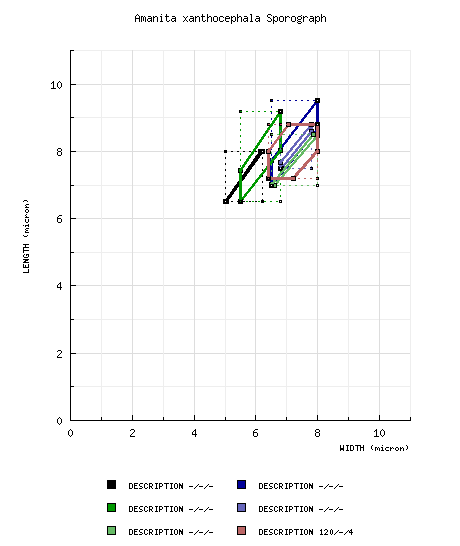
spore data set from HL: [120/-/4] (6.4-) 7.2 - 8.8 (-9.6) × 6.4 - 8.0 (-8.4) µm, (L = 7.8 - 8.1 μm; L' = 8.0 μm; W = 6.9 - 7.3 μm; W' = 7.2 μm; Q = 1.0 - 1.25 (-1.31); Q = 1.08 - 1.13; Q' = 1.11). |
| ecology |
from protolog: Terrestrial.
from protolog of Agaricus pulchellus: Terrestrial.
from non-type material, Reid (1980): . |
| material examined |
from protolog: AUSTRALIA: WESTERN AUSTRALIA—unkn. LGA - Swan River, n.d. Mrs. Martin 448 (holotype, K).
from protolog of Agaricus pulchellus: AUSTRALIA: VICTORIA—unkn. LGA - Domain, n.d. Drummond 107 (holotype, K).
Reid (1980): AUSTRALIA: NEW SOUTH WALES—Unkn. LGA - Myall Lakes Nat. Pk., 18.vii.1976 unkn. coll. s.n. [Reid 4] (K). VICTORIA—unkn. LGA - Domain, n.d. Drummond 107 (holotype of Agaricus pulchellus, K); Wilson's Promontory, Little Norman Bay, 7.vii.1976 D. A., D. G. & P. M. Reid s.n. [Reid 3] (K). WESTERN AUSTRALIA—City of Perth - Dale Forest [32°15' S/ 116°25'E], Brookton Hwy., 9.v.1976 D. G. Reid s.n. [Reid 1] (K). unkn. LGA - Swan River, n.d. Mrs. Martin 448 (holotype, K); Walpole, 5 km along Franklin Rd. from Hwy. 1, 13.v.1976 D. A. Reid s.n [Reid 2] (K).
HL: AUSTRALIA: AUSTRALIA CAPITAL TERRITORY—??.
NEW SOUTH WALES— ca. Bundanoon [34°40' S/ 150°17/ E, 640 m], 17.iv.1988 H. Lepp 185 (??). |
| discussion |
from type study, Reid (1980): "The reason for the change of epithet from pulchella to austropulchella has been discussed in the text. It is, therefore, regrettable that a further name-change has become unavoidable.
"I am grateful to Dr. R. N. Hilton for drawing my attention to the possibility that the fungus described be Berkeley as Agaricus (Volvaria) xanthocephalus, based on material collected by Drummond (No. 107), from Swan River, W.A., might be conspecific with A. austropulchella. Examination of the holotype at K has confirmed this; the name for this widespread and easily recognizable species becomes Amanita xanthocephala."
....
"It is surprising that Berkeley assigned this fungus to the section Volvaria of the Friesian genus Agaricus when Drummond in his letter to Hooker (Australian Letters 1843-1851, 73, No. 109, in Kew Library) specifically noted that it was 'allied to Agaricus muscarius.
"It must be admitted that the majority of the spores seen were distinctly smaller than those found on most fruit bodies of A. austropulchella, but the material is in a very poor state of preservation and spores are extremely scanty; many mounts were made before spores could be found. It is quite possible, therefore, that the observed spores were immature.
"The change of the name of the species has also necessitated the corresponding transfer of the epithet form mcalpiniana as follows.
"Amanita xanthocephala forma mcalpiniana (Cleland and Cheel) D. A. Reid, comb. nov.
Amanitopsis mcalpiniana Cleland and Cheel. Agric. Gaz. N.S.W. 25: 1049. 1914." [Note: The editor revised all author citations to meet current standards.—ed.]
from type study of Agaricus pulchellus, Reid (1980): "This readily recognized species is very widespread in Australia, having been reported from Western Australia (Gentilli 1953), South Australia (Cleland 1934, Gilbert 1940 & 1941), Victoria (Cooke 1889, Willis 1957), and New South Wales (Cleland and Cheel 1914, Gilbert, 1940 & 1941).
"The epithet pulchella Cooke & Massee cannot be transferred to Amanita as the combination is preoccupied by A. pulchella S. Imai (1933). Hence it has been necessary to provide a new name for the Australian fungus. In order to minimize the change the epithet austro-pulchella has been selected."
The editor decided to exclude spore data from material attributed to this species by Gilbert because (unusually for Gilbert) the reaction of spores with iodine is not mentioned and the spore size and shape is variable enough to include material with distinctly ellipsoid spores over 10 μm long (in particular, material from Mt. Compass, South Australia, having spores ca. 10.0 - 10.9 × 7.0 - 8.0 μm, with Q ca. 1.26 - 1.56).
One cannot avoid the question of whether there are in fact two or more species of similar macroscopic appearance having spores of different size and shape. Consider the spores Reid reports from non-type material he numbered "1" in comparison with the spore size and shape he reports for the type of A. xanthocephala. Then consider the same comparison for the spore data from his non-type collections numbers "3" and "4" with the spore data from his type study of A. austropulchella. With three collections in one grouping and two collections in the other, it is premature to draw conclusions; however, note that one group contains only collections from Western Australia, while the other group contains collections from Victoria and New South Wales.
Some years ago, Heino Lepp was kind enough to send me data from his measurements of spores of the present species collected in SE New South Wales and in the Australian Capital Territory. I computed the following ranges from his data: (6.4-) 7.2 - 8.8 (-9.6) × 6.4 - 8.0 (-8.4) µm, (Q = 1.0 - 1.25 (-1.31)). Note that these ranges are most compatible with what might be called the "eastern grouping" of collections on which Reid reported. See the sporograph, above.
Could Reid have been looking at two distinct species? Should A. xanthocephala and A. austropulchella be considered as distinct?
If the spores of the Mt. Lofty material revised by Gilbert were inamyloid, did this material represent a third spore size-shape grouping within the current concept of A. xanthocephala? We note that the very broad spore range reported by Grgurinovic (1997) is based on a set of collections including one from Mt. Lofty; the spore range of Grgurinovic is [52/-/7] 7.2 - 10.8 × 6.3 - 8.8 μm, (L' = 9.1 μm; W' = 7.4 μm; Q' = 1.2). This is the only reported spore range that is broad enough to include spores such as those illustrated by Gilbert. Grgurinovic reports the spores she measured to have been inamyloid.
It would be very interesting to examine multiple collections currently identified as A. xanthocephala coming from multiple sites in much greater detail than has been done to date. DNA sequencing of a geographically diverse collection of material currently assignable to A. xanthocephala would undoubtedly be productive. |
| citations |
—R. E. Tulloss |
| editors |
RET |
|


 Spore data sets and their composite