| name |
Amanita roseitincta |
| author |
(Murrill) Murrill. 1914b. Mycologia 6: 269. |
| name status |
nomen acceptum |
| english name |
"Rose-Tinted Amanita" |
| synonyms |
≡ Venenarius roseitinctus Murrill. 1914a. N. Amer. Fl. 10(1): 75.
≡ Amanita roseitincta (" roseo-tincta") (Murrill) Sacc. & Trotter. 1925. Syll. Fung. 23: 4. [Superfluous combination.]
= Amanita komarekensis Dav. T. Jenkins & Vinopal. 1979. Mycotaxon 8: 177, figs. 1-2.
?= Amanita guzmanii Cifuentes, Villegas & G. Santiago. 1984. Bol. Soc. Mexicana Micol. 19: 100. [Note: Research on the status of this name is underway (Guzmán-Dávalos, pers. corresp.)—eds.]
The editors of this site owe a great debt to Dr. Cornelis Bas
whose famous cigar box files of Amanita nomenclatural information
gathered over three or more decades were made available to RET for computerization
and make up the lion's share of the nomenclatural information presented on this site.
|
| variant spellings |
roseotincta |
| MycoBank nos. |
517685, 308562, 105034 (?) |
| GenBank nos. |
Due to delays in data processing at GenBank, some accession numbers may lead to unreleased (pending) pages.
These pages will eventually be made live, so try again later.
|
| holotypes |
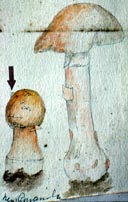
A. komarekensis—in herb. Dav. T. Jenkins, Univ. Alabama, Birmingham. Venenarius roseitinctus—NY (reported to be sterile, accompanied by colored pencil sketches and numerous original material collected nearly simultaneously with holotype by same collector). |
| type studies |
A. roseitincta—Jenkins. 1979. Mycotaxon 10: 189. |
| revisions |
Bas. 1969. Persoonia 5: 564. [Discussion of status]
Rodríguez Caycedo and Tulloss, herein. |
| intro |
The following text may make multiple use of each data field.
The field may contain magenta text presenting data from a type study
and/or revision of other original material cited in the protolog of the present taxon.
Macroscopic descriptions in magenta are a combination of data from the protolog and
additional observations made on the exiccata during revision of the cited original
material.
The same field may also contain black text, which is data from a revision of the present
taxon (including non-type material and/or material not cited in the protolog).
Paragraphs of black text will be labeled if further subdivision of
this text is appropriate.
Olive text indicates a specimen that has not been
thoroughly examined (for example, for microscopic details) and marks other places in the text
where data is missing or uncertain.
The following material not directly from the protolog of the present taxon or from the protolog of A. komarekensis (Jenkins & Vinopal 1976) is based upon original research by C. Rodríguez Caycedo and R. E. Tulloss. |
| pileus |
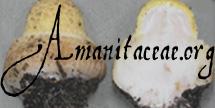
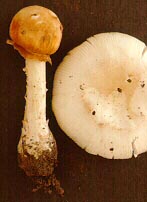
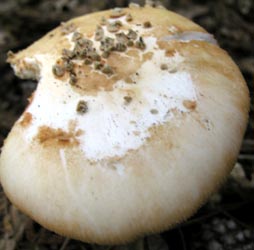
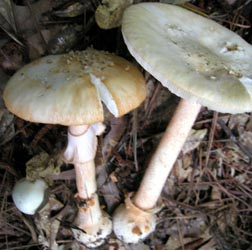
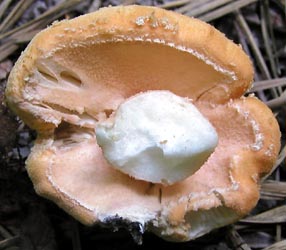
35 - 65 mm wide, cream-white becoming beige with age, reddish where bruised, convex, becoming plano-convex, then planar with slight umbo, dry to tacky; context white, sometimes with salmon tint, up to 5 mm thick over stipe; margin moderately striate, incurved at first; universal veil appearing to have two components, as an underlying salmon to rose-pink to pinkish to pinkish beige (2.5YR 7/6 to 2.5YR 4/10 and sometimes 3.75YR 7/12 mainly at margin) detersile pulverulence sometimes in coherent patches, and as distinct detersile sordid brown pyramidal warts with somewhat striate sides. |
| lamellae |
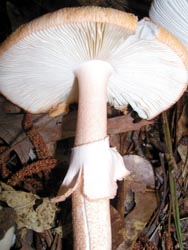
free to subdistant, close crowded, white to cream-white to sordid white, 5 mm broad, broadest near margin, ventricose, with pinkish fimbriate margin; lamellulae truncate, plentiful, ??. |
| gleba |
double click in markup mode to edit. |
| stipe |
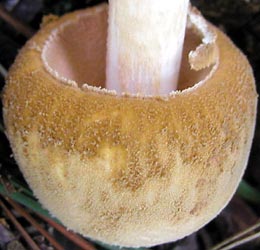
25 - 150- × 5 - 20 mm, cream-white reddish stains where bruised, cylindric or tapering upward, flaring at apex, with pinkish to rose-pink (2.5YR 7/6) pulverulence or fibrillose squamules near apex, with less pulverulence below partial veil; bulb subnapiform to napiform to ovoid to subglobose, 20 - 25+ × 18± - 20+ mm; context ??, stuffed to partially stuffed to hollow; partial veil apical to superior, very thin, membranous, skirt-like, with pulverulent covering and pinkish (2.5YR 7/4, at least at first) below, pale pinkish beige to whitish and striate above, with block-like warts of pinkish beige universal veil on underside at edge, rather persistent, but often eventually evanescent; universal veil as single broken ridge or ring of blocky warts on top of bulb, 2± mm high, pinkish-beige, ??, detersile. |
| odor/taste |
Odor sometimes with distinctly fruity odor—like apricots—detectable when large collection massed together; mild to indistinct in individual specimens. Taste not? indistinct. |
macrochemical
tests |
Spot test for tyrosinase (L-tyrosine) - in aging material, instantaneously positive in lamellae and on stipe surface, positive in stipe context, not recorded for other tissues. Test voucher: Tulloss 10-26-85-B. |
| basidiospores |
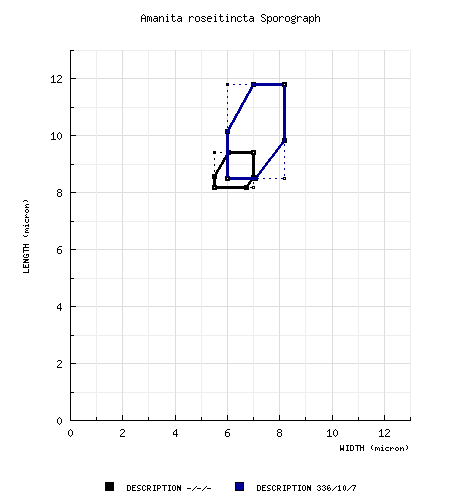
from protolog of A. komarekensis: [-/-/-] 8.2 - 9.4 (-10.2) × 5.5 - 7.0 (-7.8) μm, (Q = 1.22 - 1.56; Q = 1.38), hyaline, thin-walled, broadly ellipsoid to ellipsoid, often adaxially flattened; apiculus sublateral, cylindric; contents guttulate; color in deposit note recorded.
[336/10/7] (7.6-) 8.5 - 11.8 (-14.4) × (5.1-) 6.0 - 8.2 (-10.0) µm, (L = 9.2 - 10.9 µm; L' = 9.8 µm; W = 6.3 - 7.6 µm;
W' = 7.0 µm; Q = (1.09-) 1.20 - 1.69 (-2.08); Q = 1.33 - 1.50; Q' = 1.42), hyaline, colorless, smooth, thin-walled, inamyloid, broadly ellipsoid to ellipsoid to (occasionally) elongate, often adaxially flattened, often with rather narrow ends; apiculus sublateral, cylindrical; contents ??; ?? in deposit |
| ecology |
from protolog of A. komarekensis: Florida: In annually burned mixed forest including Pinus taeda, Liquidambar styraciflua, Cornus florida, with Quercus virginiana dominant.
Solitary to gregarious. Alabama: In dry Pinus woods. Maryland: Under Pinus in sandy soil. Mississippi: In mixed woods in sandy soil. New Jersey: In mixed forest of P. rigida, Quercus spp., etc. in sandy soil. North Carolina: Under Pinus. Texas: Under Pinus in sandy soil or under Pinus in lawn. |
| material examined |
from protolog of A. komarekensis: U.S.A.:
FLORIDA—Leon Co. - Tall Timbers Res. Stn., 7.vii.1977 J. Vinopal 40833 (holotype of A. komarekensis, TENN), 14.vii.1977 J. Vinopal 1049 (paratype of A. komarekensis, in herb. J. Vinopal).
Jenkins (1979):
U.S.A.: MISSISSIPPI— Harrison Co. - Biloxi,
13.ix.1904 Mrs. F. S. Earle F 182 (holotype, ??FLAS).
U.S.A.: MARYLAND—Worcester Co. - Milburn Landing St. Pk. [38.1284° N/ 75.4942° W, 3 m], s.d. L. T. Biechele s.n. [R. E. Tulloss 9-5-91-LTB1] (RET 032-7).
MISSISSIPPI—Harrison Co. - Biloxi, 13.ix.1904 Mrs. F. S. Earle F 182 (holotype, NY).
NEW JERSEY—Atlantic Co. - Oceanville,
Edwin B. Forsythe Nat. Wildlife Refuge, Brigantine
Div. [39°27’53" N/ 74°26’59" W, 7 m], 18.viii.1984
D. C. Tulloss s.n. [Tulloss 8-18-84-G]
(RET 206-4).
NORTH CAROLINA—Unkn.
Co. - ca. border of Orange and Durham Cos., ca.
Chapel Hill, viii.1985 Bill Burk et al. s.n.
(in herb. David T. Jenkins, Univ. Alabama,
Birmingham; photos in RET).
TEXAS—Hardin Co. - 16 km N of Silsbee,
Big Thicket Nat. Preserve, Jack Gore Baygall Unit,
17.vi.1981 D. P. Lewis 2595 (F; RET 013-3),
10.vi.2000 Arlene R. Bessette s.n. [Tulloss
6-10-00-E] (RET 313-5); Silsbee, 16.viii.1984 D. P.
Lewis 3720 (F; RET 012-3), 26.x.1985 Jay
Justice s.n. [Tulloss 10-26-85-B] (RET 132-5);
Saratoga, Big Thicket Nat. Preserve, Lance Rosier
Unit, Teel Rd. at Cypress Swamp [30º 15.860’ N/
94º 30.751’ W], 13.vi.2001 D. P.
Lewis 9107 (RET 430-3, nrLSU seq'd.).
San Jacinto Co. - Sam Houston Nat. For., Big Creek
Scenic Area, 10.vii.1982 D. P. Lewis 3167 (F; RET
013-4).
Tyler Co. - Forest Lk. Experim. For., 7.vi.1997
D. P. Lewis 5780 (F?; RET 284-10).
[Note: Additional original
material including colored sketches are in NY; some
may be from Alabama as well as from
Mississippi.
Note: There is very likely to be material of this
species from Alabama in herb. Dr. David T. Jenkins,
Univ. Alabama, Birmingham.
Note: Additional collections in SFSU, H. D. Thiers’
numbers 6112, 6134, 6248, 6583, 6763, 7138,
7235.] |
| discussion |
Note: Dr. Nancy Weber (pers. corresp.) called our attention to water colors and additional collections of V. roseitinctus deposited in NY (see discussion of holotypes) and provided unpublished observations. See the photographs of the present species in (Weber and A. H. Smith. 1985. Field Guide S. Mushr.: 156-157). |
| citations |
—C. Rodríguez Caycedo and R. E. Tulloss |
| editors |
RET |
|



 Spore data sets and their composite