

| name | Amanita calochroa |
| name status | nomen acceptum |
| author | C. Simmons, T. Henkel & Bas |
| english name | "Pakaraima Red Amanita" |
| images |
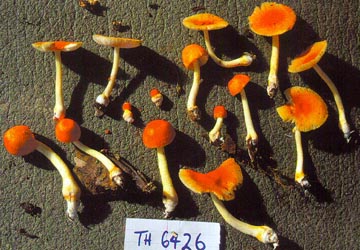  1. Amanita calochroa, from the Pakaraima Mtns., Guyana. 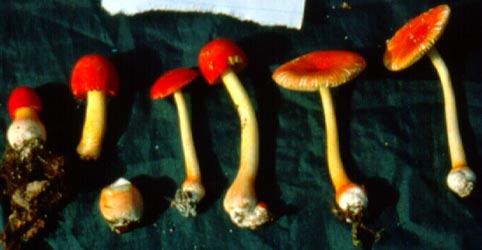 2. Amanita calochroa, from the Pakaraima Mtns., Guyana. |
| intro |
This description is based on the original description (2002). |
| cap |
The cap of Amanita calochroa is 18 - 30 mm wide, at first hemispherical to convex with a smooth margin (in the button stage) and flattened center, later applanate with a strongly sulcate-striate margin (30 - 50% of the radius) and somewhat crenulate margin with a depressed center. The cap is densely covered with a bright red to orange-red volval layer that is powdery or appearing to have a covering of tiny hairs. |
| gills |
The gills are free, subdistant, thickish, narrow, with even to eroded edges, white to pale cream. The short gills are truncate. |
| stem |
The stem is 40 - 60 × 2.5 - 5 mm, slightly tapering upward, and white to pale yellow. The stem has a small bulbous base which sometimes has noticeably fibers (hyphae) on its base. The bulb is 3 - 7.5 mm wide, and the orange powdery volva forms a distinct zone on the upper part of the bulb. The stem is exannulate. |
| spores |
The spores measure 6.3 - 7.8 (-8.4) × 5.5 - 7.8 µm and are globose to broadly ellipsoid, rarely ellipsoid and inamyloid. Clamps are absent at the bases of basidia. |
| discussion |
Amanita calochroa originally described from the Pakaraima Mountains in western Guyana from mixed hardwood forests including species of Dicymbe. Dicymbe is a leguminous genus in the family Caesalpiniaceae. Therefore one might look for closest relatives among other taxa with leguminous hosts such as are found, for example, in Africa and Australia. To date this species is only known from the original collecting region. While the knowledge of Amanita bingensis (Beeli) R. Heim is incomplete, it bares some similarities to the present species. The authors of the present species point out that the Chilean species Amanita aurantiovelata Schalkw. & G. M. Jansen is similar to Amanita calochroa, however, the Chilean species has larger spores, abundant clamp connections, and larger fruit bodies with a different form to the volval remnants.—R. E. Tulloss |
| brief editors | RET |

 Spore data sets and their composite