| name |
Amanita constricta |
| author |
Thiers & Ammirati. 1982. Mycotaxon 15: 163. |
| name status |
nomen acceptum |
| english name |
"Great Gray-Sack Ringless Amanita" |
| MycoBank nos. |
261724 |
| GenBank nos. |
Due to delays in data processing at GenBank, some accession numbers may lead to unreleased (pending) pages.
These pages will eventually be made live, so try again later.
|
| holotypes |
SFSU |
| type studies |
Tulloss. 1994. Mycotaxon 52: 321. |
| revisions |
Tulloss, here |
| intro |
The following text may makes multiple use of each data field.
The field may contain magenta text representing data specifically from a type study
by Tulloss.
The same field may also contain black text, which will represent a revision of the
species by Tulloss. Paragraphs of black text will be labeled if further subdivision of
this text is appropriate.
Olive text indicates a specimen that has not been
thoroughly examined (for example, for microscopic details) and marks other places in the text
where data is missing or uncertain.
The following is based on the field notes with the holo- and paratypes, on the text of the protolog, and on original research of R. E. Tulloss. |
| pileus |
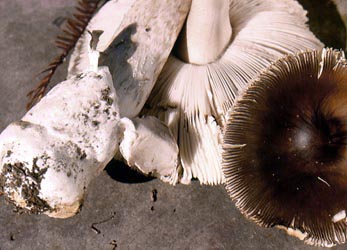
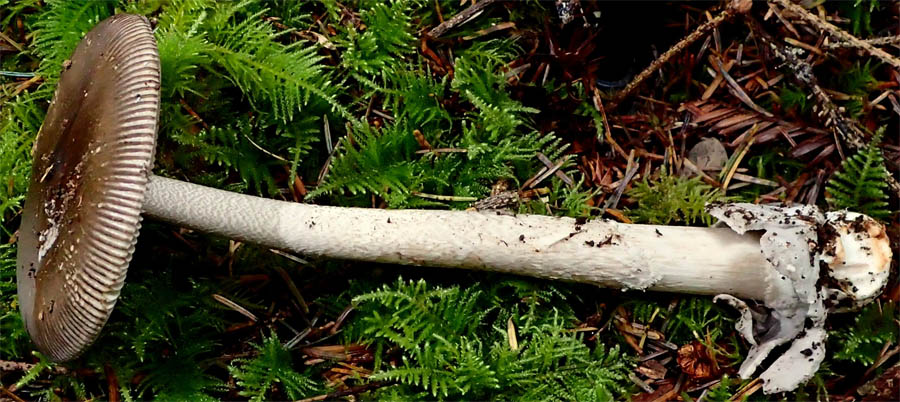
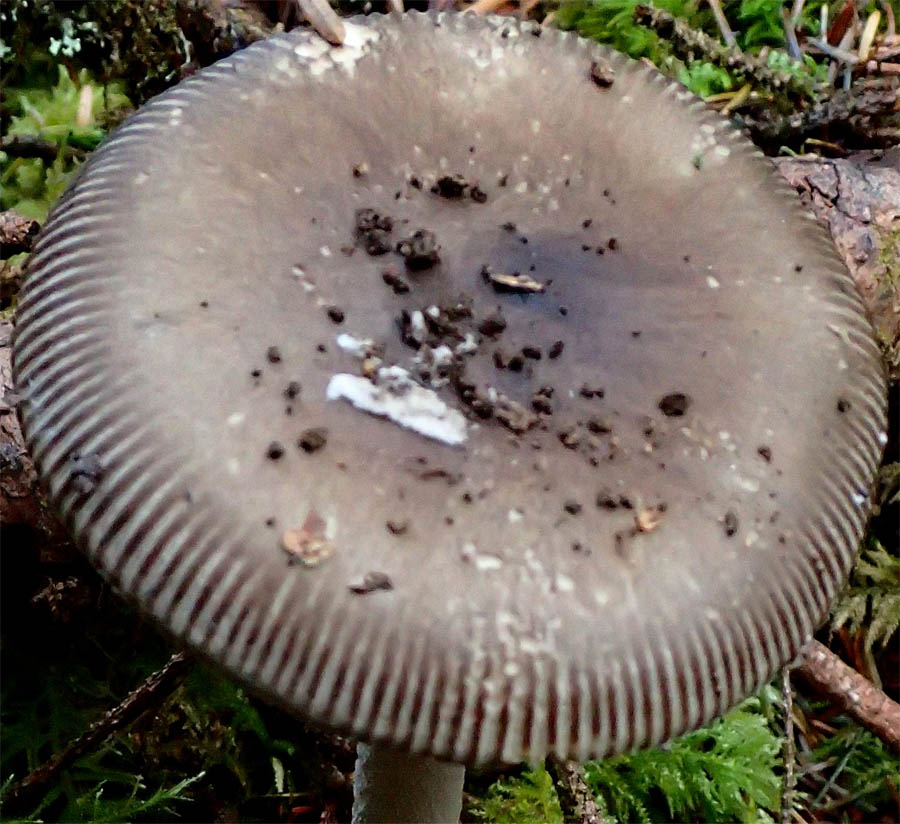
Tulloss (1994): 50 - 130 mm wide, gray to brownish gray, Pale Mouse Gray to Light Drab Gray to Drab to Hair Brown, disc at time as dark as Chaetura Black, often with inconspicuous dark radial streaks, convex when young, becoming plano-convex to plane, eventually subumbonate to umbonate in age; context white except next to the pileipellis where it is gray to drab, sometimes become faintly pinkish on exposure especially in young basidiomes, 5 - 17 mm thick at disc, thinning toward margin; margin decurved at first, soon plane to undulate, slightly uplifted in age, en-tirely becoming rimose, strongly sulcate to tuberculate striate (0.2 - 0.25R); universal veil absent or as a membran-ous somewhat fibrillose patch over disc, typically less than 1 mm thick, sometimes breaking up around the edges in age, white to buff to Smoke Gray or sometimes with pale vinaceous shades, bruising salmon color when wetted, slowly returning to white. |
| lamellae |
Tulloss (1994): close to crowded, adnate to decurrent by a short hook when young, becoming free, white at first becoming gray, Smoke Gray to Pallid Mouse Gray to Pale Drab Gray, drying tan to sordid tan to brownish gray, (grayer than 7.5YR 6/6 to 10YR 5/4 to 10YR 7-8/4), moderately broad; edge usually gray, fimbriate; lamellulae in several ranks. |
| stipe |
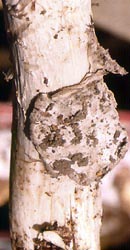
Tulloss (1994): 100 - 160 (-200) mm long, 7 - 17 mm wide at apex, white, cylindric or narrowing upward, apex longitudinally striate or pruinose, becoming appressed fibrillose below, stipipellis often rupturing and forming rings of appressed fibrillose scales which are gray and darken when bruised; context white, stuffed, becoming hollow; exannulate; universal veil membranous, white to pale buff or pale yellow, bruising reddish when wet then fading, becoming gray and submembranous at maturity and then rather easily fragmented and sometimes remaining in large patches in substrate or on lower stipe, adnate to stipe for one-third to one-half of limb length, then flaring in a manner suggesting an annulus, collapsing with age. |
| odor/taste |
Tulloss (1994): Odor and taste not distinctive. |
macrochemical
tests |
Breckon (1968)—on exposed context of the lower stipe and bulb unless otherwise noted: Concentrated H2SO4 - turning lamellae pink to lilac, but not always; FeSO4, 15% KOH, Melzer’s Reagent - negative; 3% phenol - positive; tincture of guaiac - varying from strongly and rapidly positive to weakly and slowly positive; phenolaniline - rapidly positive. Any variable reactions must be questioned because Breckon had as many as four taxa mixed together among the collections cited under the present species in his thesis. |
| pileipellis |
Tulloss (1994): 200± µm thick; thin layer at surface gelatinized; upper 40± µm incompletely gelatinized; upper 80 - 95 µm hyaline to pale yellowish; lower portion light brownish orange (mounted in 10% NH4OH); filamentous, undifferentiated hyphae 2.2 - 8.5 µm wide, criss-crossed, largely uncurving, many subradially arranged, a few containing red-brown granules (mounted in 3% KOH); vascular hyphae not observed. |
| pileus context |
Tulloss (1994): filamentous, undifferentiated hyphae 1.5 - 14.0 µm wide, branching, very loosely interwoven; acrophysalides dominating, subglobose to pyriform to ellipsoid to broadly clavate to clavate, up to 129 × 74 µm; vascular hyphae 6.0 - 17.5 µm wide, loosely coiling. |
| lamella trama |
Tulloss (1994): bilateral, with divergence obscured by plentiful hyphae parallel to the hymenial surface and the tangled nature of the subhymenial tree except near the edge of the lamella; central stratum having boundaries somewhat difficult to define because of density of subhymenium and fact that divergence begins within central stratum and many hyphae of the subhymenial base diverge at very shall angles which are maintained for relatively long distances, sometimes imperfectly rehydrating and then dense and brown to orange-brown, with wcs = 110 - 145 µm in cases of most complete rehydration (65 - 85 µm in most common degree of moderate rehydration, 30 - 55 µm in poorly rehydrating trama); with hyphae of subhymenial base diverging at angles from very shallow to over 60°; filamentous, undifferentiated hyphae 1.8 - 9.8 µm wide, sometimes coiling, interwoven, frequently branching, with central stratum and subhymenial base including intercalary inflated cells [thin-walled, subventricose to ventricose to subclavate to clavate to broadly clavate to irregular, up to 53 × 35 µm (most often about half this width)]; divergent, terminal, inflated cells not observed; vascular hyphae 2.5 - 12.5 µm wide, occasionally branching, infrequent to somewhat common to common. |
| subhymenium |
Tulloss (1994): wst-near = 80 - 140 µm in cases of most complete rehydration [(25-) 30 - 80 µm in most common degree of moderate rehydration, 0 - 30 µm in poorly rehydrating trama]; wst-far = 110 - 175 µm in cases of most complete rehydration (60 - 105 µm in most common degree of moderate rehydration, 35 - 60 µm in poorly rehydrating trama); a complexly interwoven structure comprising frequently septate, frequently branching hyphae, with segments uninflated or partially inflated (or occasionally inflated and then clavate to subpyriform to somewhat irregular, e.g., 19 × 14 µm), with hyphae of the subhymenium occasionally running parallel to the hymenial surface (sometimes in rather dense clusters) within 10 µm of bases of longest basidia, with basidia often arising from uninflated segments (80% or more of cases examined), but also from any type of cell cited, with 1/2 to 2 1/2 (rarely 3) cells between base of short basidiole and longest nearby basidium/ ole, with cell immediately below some short basidioles uninflated (9.0 - 21 × (2.5 ) 3.2 - 6.8 µm) to narrowly clavate or with short branch giving rise to second basidiole (12.6 - 20 × 5.8 - 8.8 µm) to ellipsoid or pyriform (7.5 - 10.0 × 7.8 - 11.8 µm). |
| basidia |
Tulloss (1994):
54 - 78 × 8.5 - 19.5 µm,
thin-walled, dominantly 4-, but occasionally 1- or
2-sterigmate; sterigmata up to 16.0 × 3.5 µm; clamps
rather rare to rather common.
[This report of clamps is unlikely to be correct.—ed.] |
| universal veil |
Tulloss (1994): On pileus, upper portion: filamentous, undifferentiated hyphae 1.5 - 8.2 µm wide, occasionally in fascicles, often collapsed; inflated cells dominating, thin-walled, clavate to broadly clavate to subpyriform to ellipsoid, often pale brownish or pale orange-brown, terminal, single, up to 46 × 33 µm, collapsed; vascular hyphae not observed. On pileus, lower portion (adjacent to pileipellis): hyphae more frequent; all elements extensively compressed. On stipe about 10 mm above base: structures similar to those on pileus; inflated cells (collapsed and partially gelatinized) and fragments of same easily dissociated from surface leaving mostly tangled hyphae; inflated cells up to 95 × 67 µm, with walls thin or up to 0.8 µm thick, with unbroken cells often not pigmented; vascular hyphae 3.0 - 6.0 µm, scant, fragmentary. |
| stipe context |
Tulloss (1994): longitudinally acrophysalidic; filamentous, undifferentiated hyphae 1.5 - 11.5 µm wide, branching, plentiful; acrophysalides thin-walled, plentiful, up to 271 × 45 µm, those of broader diameter often broadening rapidly close to basal septum; vascular hyphae 2.8 - 10.5 µm wide, loosely coiling. |
| lamella edge tissue |
not described |
| basidiospores |
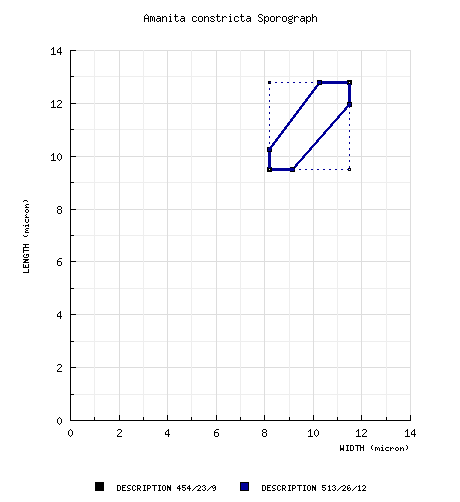
Tulloss (1994): [454/23/9] (7.2-) 9.5 - 12.8 (-19.0) × (6.2-) 8.2 - 11.5 (-17.8) μm, (L = (10.3-) 10.4 - 11.8 μm; L' = 11.0 μm; W = (8.8-) 9.0 - 10.5 (-10.9) μm; W' = 9.9 μm; Q = (1.0-) 1.04 - 1.25 (-1.56); Q = (1.06-) 1.07 - 1.17 (-1.18); Q' = 1.12).
composite of data from all material revised by RET: [513/26/12] (7.2-) 9.5 - 12.8 (-19.0) × (6.2-) 8.2 - 11.5 (-17.8) µm, (L = (10.3-) 10.4 - 11.7 (-11.8) µm; L’ = 11.0 µm; W = (8.8-) 9.2 - 10.5 (-10.9) µm; W’ = 9.9 µm; Q = (1.0-) 1.04 - 1.25 (-1.56); Q = (1.06-) 1.09 - 1.17 (-1.18); Q’ = 1.12), colorless, hyaline, smooth, thin-walled, inamyloid, globose to subglobose to broadly ellipsoid, occasionally ellipsoid, in some specimens frequently lacrymoid, adaxially flattened (often strongly so), often swollen at one end, suceptible to conversion to crassospores on occasion (Tulloss 1-19-03-Ba); apiculus sublateral, cylindric to truncate-conic, at times quite prominent; contents mono- to multiguttulate to granular; white in deposit. |
| ecology |
from type study of
(1994):
Single to scattered to
gregarious. Along the Pacific Coast of the
U.S.A., apparently limited to coastal forest, under
hardwoods such as coastal spp. of Quercus
(e.g., Q. agrifolia) and Arbutus
menziesii, on occasion under Pseudotsuga
menziesii or in mixed woods of P.
menziesii and Q. agrifolia or under
Umbellularia californica in an area of
mixed Quercus and
Umbellularia. The holotype was
collected under Quercus and A.
menziesii.
California: In wet soil with
Picea, Pinus, and Lithocarpus
densiflorus (Tanoak) or in forest dominated by
Picea sitchensis. |
| material examined |
RET: U.S.A.:
CALIFORNIA—Del Norte Co. - Jedediah Smith
St. Pk., Howland Hill Tr. [41.7844° N/
124.1035° W, 213 m], 3.i.2018 Ronald L.
Pastorino 1-3-18B [mushroomobserver
#305220]
(RET 817-8, nrITS seq'd.).
Humboldt Co. - Prairie Creek Redwoods St. Pk.
[1.4154° N/ 124.0455° W, 146 m], 15.i.2014 Hunter
Sezen s.n. [mushroomobserver
#162877]
(RET 666-9, nrITS & nrLSU seq'd.).
Marin Co.
- Alpine Lk., 20.xii.1963 Harry D. Thiers 11146
(paratype, SFSU); Muir Woods Nat. Mon., 1.i.1967 D. E.
Madden 904 (paratype, SFSU), 25.i.1967 Gary A.
Breckon 881 (paratype, SFSU), 31.i.1967 G. A.
Breckon 906 (paratype, SFSU).
Mendocino Co. - W of Navarro,
Cameron Rd., 19.i.2003 Howard Higley s.n.
[Tulloss 1-19-03-Ba] (RET 366-6, nrITS seq'd.).
San Mateo Co. - San
Francisco
Watershed, 22.xii.1963 H. D. Thiers 11184
(paratype,
SFSU), 11.i.1965 H. D. Thiers 12064 (paratype,
SFSU), 22.i.1965 G. A. Breckon 302 (holotype,
SFSU; isotype, NY 00618736), 22.ii.1965 H. D.
Thiers 12211 (paratype, SFSU), 6.i.1967 G. A.
Breckon & H. D. Thiers [Breckon] 674
(paratype,
SFSU).
Solano Co. - Green
Valley,
1.iii.1968 Walter J. Sundberg 1167 (paratype,
SFSU).
Unkn. Co. - Redwoods Nat. Pk., Davison Rd.,
20.xii.2011 Noah Siegel s.n. (RET 601-1,
nrITS-LSU seq'd.).
OREGON—Clackamas Co. - unkn. loc.,
Riverside Tr., 20.v.1987 Wanda Caruthers s.n.
[Tulloss 5-20-87-WC1] (RET 244-9), 24.v.1987 W.
Caruthers s.n. [Tulloss 5-20-85-WC1] (RET
244-8).
WASHINGTON—Pacific Co. - Ilwaco,
11.xii.2014 Mikeal No-Line s.n. [mushroomobserver
#193286]
(RET 667-8, nrITS seq'd.).
Whatcom Co. - Bellingham,
Stimpson Nature Preserve, 21.x.2004 Buck McAdoo pg.
358#1 (RET 662-1, nrITS-LSUJ seq'd.), 27.x.2010 Buck
McAdoo 212 (RET 662-7, nrITS-LSUJ seq'd.),
26.x.2013 Jack Waytz s.n.
(RET 615-8, nrITS seq'd.), 27.x.2013 J. Waytz s.n.
[McAdoo 12] (RET 615-9, nrITS seq'd.).
|
| discussion |
Large lacrymoid spores (not uncommon in some
specimens) are extremely difficult to measure
accurately because the large end tends to sink
producing a foreshortening of the spore as viewed,
preventing a lateral view, and making the process of
spore measurement for this taxon extremely
tedious. Lacrimoid spores were not measured
unless they could be viewed fully in focus in optical
cross-section of a lateral view. This
methodological decision tends to produce a lower than
actual Q for specimens in which lacrimoid
spores occur with any frequency. In the
specimens with lacrimoid spores, subglobose to
globose spores were always present and in equal or
greater number than the lacrimoid ones. As a
consequence, the distribution of Q for spores
measured from these specimens is often distinctly
bimodal.
nrITS sequences in GenBank attributed
to Amanita constricta
At this writing (2.xii.2018), I find seven (7) nrITS
sequences attributed to A. constricta in
GenBank. For three of these, the attribution
is clearly incorrect:
-
HQ650724 - a collection from British Columbia with
nrITS a 100% match for A. obconicobasis.
-
JN182881 - a collection from China with nrITS very
close to that of A. lignitincta and
distant from that of A. constricta.
-
KF007934 - a Tennessee collection from the Great
Smoky Mountains Nat. Park with nrITS identical to
that of many of our nrITS sequences derived from
samples of A.
rhacopus.
This leaves four sequences that are mutually
consistent if trimmed tightly to include only
nrITS. If this is not done, apparent errors
occurring
outside of nrITS affect the results.
The remaining sequences that RET believes represent
A. constricta are these:
-
AY228351 (material from UBC herb.)
-
AY750165 (material from Univ. of
Washington)
-
DQ384583 (material from UBC)
-
EU597073 (material from Vancouver Island).
To these four sequences were added seven from
morphologically genetically identified collections
in the Roosevelt herbarium as follows:
-
RET 366-6
-
RET 615-8
-
RET 615-9
-
RET 662-1
-
RET 662-7
-
RET 666-9
-
RET 817-8
The eleven (11) sequences were aligned to
observe variation
in pairwise genetic distance within the group.
Sequence length ranged from 493 - 495
characters.
The range of genetic distance is 0.0 - 0.6
(-0.8)%. Only one pairwise comparison yielded
0.8%. . Fifteen (15) of the 28 non-self
comparisons
were in the range of 0.0 - 0.2% (maximum difference
involving one nucleotide), and 23 of 28 were in
the range of 0.0 - 0.4% (maximum difference
involving two nucleotides).
The types of variations were recorded as follows:
-
a variable length "AT" repeat ca. character 160
accounted for the difference in sequence lengths.
-
three (3) possible SNPs occurred as follows:
an A/G SNP at character 20,
a C/T SNP at character 307, and
an A/G SNP at character 346.
Material explicitly excluded from the
species
Material originally sent to, or collected by, RET
under the name Amanita constricta and now
excluded from that species has mostly not been
been identified with a published or provisional
name. The exceptions to date (20.xii.2020) is
one collection
of A.
crassiputamen (RET 289-8).
Two other species have probably been mistaken
for A. constricta in the
past—Amanita
calisorora and A.
constrictisorora.
Some collections of Amanita
protecta were inadvertently
included among the paratypes of the present
species.
Others have been temporarily coded as follows:
-
Amanita
sp-constricta01 (RET 366-5) from Mendicino
Co., California
-
Amanita sp-constricta03 (GenBank MK580747,
Mycoportal 3951995) from Monterey Co., California
-
Amanita
sp-constricta04 (RET 279-10) from Skamania
Co., Oregon
|
| citations |
—R. E. Tulloss |
| editors |
RET |
|



 Spore data sets and their composite