| name |
Amanita crassiputamen |
| author |
Tulloss, Kudzma & Pastorino |
| name status |
nomen provisorum |
| english name |
"Thick Shell Ringless Amanita" |
| GenBank nos. |
Due to delays in data processing at GenBank, some accession numbers may lead to unreleased (pending) pages.
These pages will eventually be made live, so try again later.
|
| intro |
Olive text indicates a specimen that has not been
thoroughly examined (for example, for microscopic details) and marks other places in the text
where data is missing or uncertain.
The following material not directly from the protolog of the present taxon and not cited as the work of Dr. Z. L. Yang or another researcher is based upon original research by R. E. Tulloss. |
| pileus |
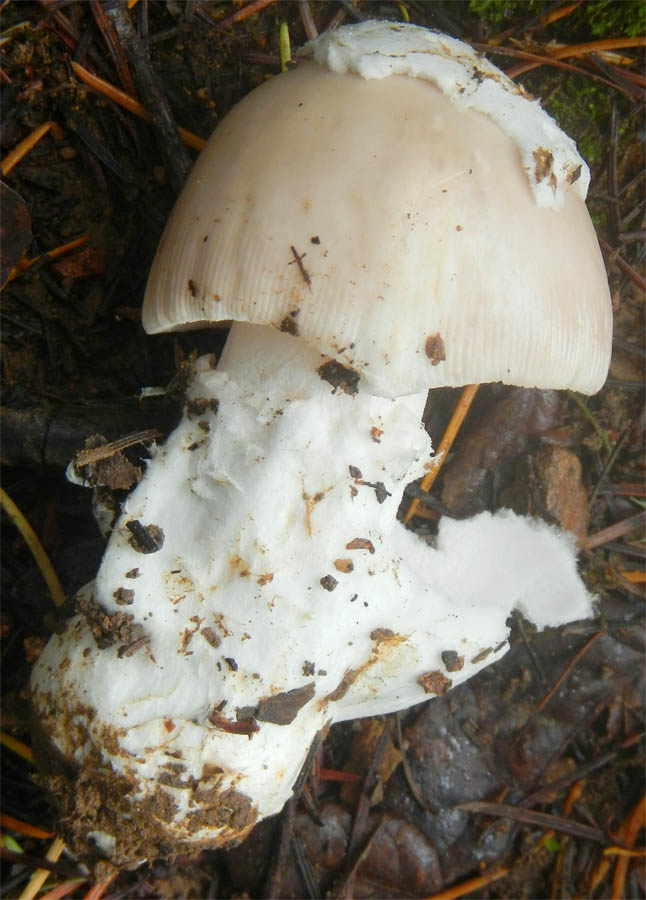
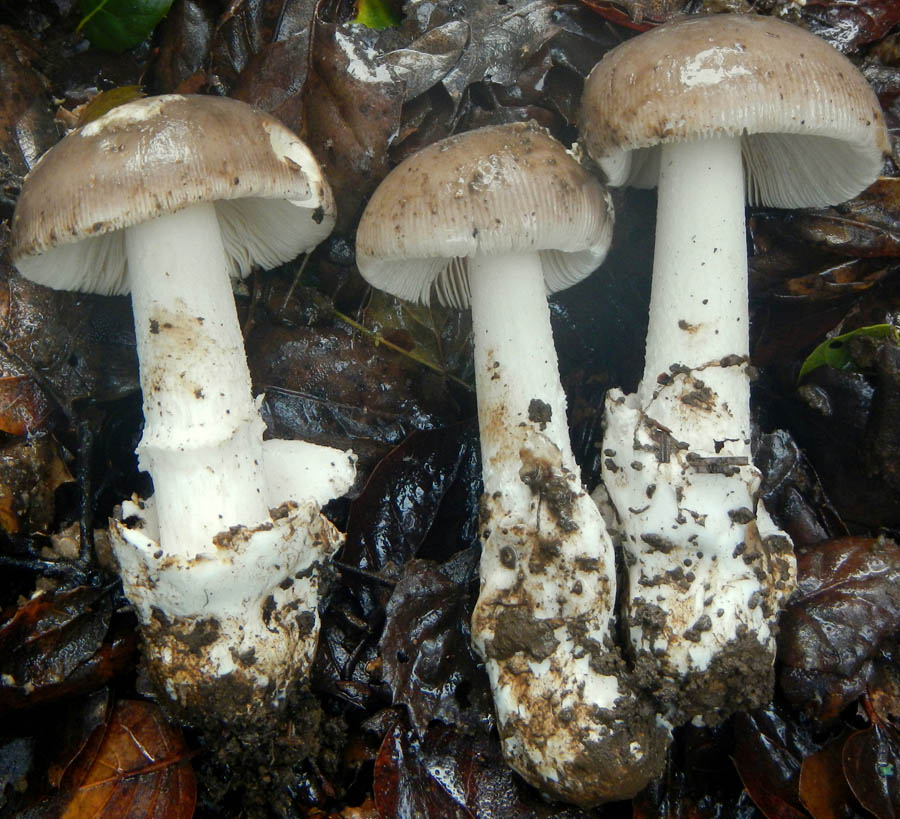
52 - 88 mm wide, brownish gray, drying a slightly reddish brown shading to a more grayish brown over the striae, faintly virgate, slight umbo when young, convex with downcurved margin to planoconvex, tacky, subshiny, no color change when bruised or wounded; context white, sometimes sordid under pileipellis in disk or in randomly distributed areas, bruised or wounded areas becoming pale brownish pink overnight, 4 - 7 mm thick, thinning evenly to within a few mm of margin, then a membrane to margin; margin striate (0.15 - 0.2R), nonappendiculate; universal veil as large white patch or several contiguous patches, breaking up into thick areolate areas and taking on ochraceous-brownish stains, cottony-fibrous in thin patches and felted in thicker ones, detersile, membranous to submembranous, occasionally with upper surface becoming areolate, occasionally absent. |
| lamellae |
free or occasionally very narrowly adnate with decurrent line up to 15 mm or more long on stipe apex, close, off-white to cream in mass, very pale cream in side view, brownish orange to orangish brown to warm tan as dried, 3 - 7.5 mm broad, with edge white and finely fimbriate; lamellulae truncate to subtruncate, unevenly distributed, of diverse lengths. |
| stipe |
42 - 140+ × 12 - 18 mm, white, when bruised or wounded becoming very pale reddish brown very slowly (overnight), cylindric or narrowing upward slightly, not flaring at apex, may be slightly flattened, longitudinally striate zone at apex, finely shaggy with upward pointing fibrillose scales below; context pale cream to off-white, very firm, no change observed when bruised or wounded, hollow to stuffed (with white cottony material), with central cylinder 5± mm wide; exannulate; universal veil as saccate volva, fragile and often breaking up into large patches which may be distributed on lower stipe (distance from stipe base to highest point on such patch > 60 mm), collapsing on stipe, off-white with orangish-brown stains, very thin, somewhat leathery and tough, highest point of limb 24 - 40+ mm from stipe base. |
| odor/taste |
Odor faintly fruitlike. Taste not recorded. |
macrochemical
tests |
Spot test for tyrosinase (paracresol) - positive within two minutes in all parts of basidiome except for universal veil remains on stipe base. Spot test for laccase (syringaldazine) - negative everywhere in basidiome except for very bottom of universal veil (exterior surface). |
| pileipellis |
144 - 240 µm thick, pale brownish orange to orange-brown in 3% KOH, with pigment extending into adjacent pileus context; filamentous, undifferentiated hyphae 2.1 - 6.3 µm wide, partially gelatinized near and at surface, subradially arranged, branching; vascular hyphae not observed. |
| pileus context |
filamentous, undifferentiated hyphae 3.5 - 12.3 µm wide, plentiful, closely packed and dominating near pileipellis, elsewhere loosely interwoven, sometimes in fascicles, frequently branching; acrophysalides ellipsoid to clavate to subfusiform to fusiform, up to 152 × 58 µm, with slightly thickened walls, dominating except near pileipellis; vascular hyphae 3.5 - 15.4 µm wide, occasionally tightly coiled or tangled, often with lumpy and irregular outline. |
| lamella trama |
bilateral, with subhymenial tree containing branching, filamentous, undifferentiated hyphae interlaced among plentiful intercalary inflated cells [subglobose to obpyriform to ellipsoid to obclavate to clavate, up to 52 × 30 µm, usually thin-walled, infrequently with slightly thickened wall (up to 0.5 µm thick)]; wcs = 50 - 85 µm; filamentous, undifferentiated hyphae 2.5 - 14.0 µm wide, branching, with hyphae of the central stratum having intercalary inflated segments up to 78 × 20 µm (usually thin-walled, but a few with walls up to 0.8 µm thick); terminal, inflated cells not observed; vascular hyphae up to 14.0 µm wide, not common; clamps ??common?? [very doubtful—RET] in central stratum. |
| subhymenium |
ws-near = (0?-) 5 - 50 µm; ws-far = 25 - 75 µm; with basidia most often arising from small inflated cells (tending to be in clusters), with basidia occasionally arising from (roughly in descending order of frequency) partially inflated cells or the sides of hyphal segments subparallel to the central stratum or from the end of an hyphal segment, with a (sometimes branching) chain 2 1/2 to 5 cells [subglobose to ellipsoid to clavate to cylindric or partially inflated, 7.8 - 14.5 × 7.0 - 12.5 µm] between base of long basidium/-ole and base of nearby short basidiole, with an uninflated hyphal segment included in such a chain infrequently, with smallest basidioles differing only slightly in size and shape from the cell from which they arise, with many interstices between large basidia/-oles filled with chains of these small cells; ??prominent clamps common?? [very doubtful—RET] especially joining two cells in the chains of small cells just mentioned. |
| basidia |
35+ - 63 × 11.8 - 19.0 µm, 4-sterigmate; clamps ??plentiful?? [doubtful—RET]. |
| universal veil |
On pileus, adjacent to pileipellis: filamentous, undifferentiated hyphae and inflated cells partially to extensively gelatinizing; filamentous, undifferentiated hyphae 1.8 - 11.0 µm wide, dominating, frequently branching, sometimes in fascicles, somewhat loosely interwoven; inflated cells terminal, clavate, occasional; vascular hyphae 3.8 - 8.0 µm wide, branching, knobby and irregular. On pileus, away from pileipellis: filamentous, undifferentiated hyphae 1.8 - 16.8 µm wide, frequently branching, plentiful to dominating, loosely interwoven, sometimes in fascicles; inflated cells plentiful, narrowly fusiform to subfusiform to narrowly clavate to clavate to broadly clavate to ovoid to ellipsoid to subglobose, terminal or dissociated, up to 79 × 51 µm, with walls thin or slightly thickened (up to 0.8 µm thick), with slender, thick-walled, dissociated cells rather frequent; vascular hyphae not observed. On stipe base, exterior surface: a very few hyphal diameters thick, a loose open weave of filamentous, undifferentiated hyphae 1.8 - 10.5 µm wide, moderately frequently branching, occasionally slightly gelatinized, relatively frequently in sublongitudinally oriented fascicles; with inflated cells close to the surface; vascular hyphae 4.0 - 6.0 µm wide, scant. On stipe base, interior: general appearance suggesting many elements have sublongitudinal orientation; filamentous, undifferentiated hyphae 2.0 - 11.2 µm wide, branching, dominating to plentiful (near exterior surface, more plentiful than on pileus; away from the exterior surface, about the same frequency as on pileus), often in fascicles, sometimes sinuous and loosely coiling; inflated cells locally plentiful to locally dominant, becoming more common away from exterior surface, terminal, subcylindric (e.g., 104 × 21 µm) to narrowly clavate (e.g., 76 × 20 µm) to clavate (up to 98 × 25 µm) to subfusiform (e.g., 113 × 36 µm) to fusiform to broadly clavate (up to 109 × 51 µm) to ovoid to ellipsoid to subglobose (up to 64 × 60 µm), hyaline or very faintly sordid (possibly due to wall gelatinizing), thin-walled or with walls to 1.0 µm thick; vascular hyphae 3.5 - 11.2 µm wide, occasional, unevenly distributed, branching, knobby and irregular in outline; clamps ??common?? [doubtful—RET]. On stipe base, inner surface: like interior, but with elements slightly collapsed and slightly gelatinized, with numerous small terminal inflated cells (often thick-walled, ellipsoid to broadly clavate to clavate). |
| stipe context |
longitudinally acrophysalidic; filamentous, undifferentiated hyphae 3.0 - 12.8 µm wide, branching, with those of larger diameter having walls up to 0.8 µm thick; acrophysalides up to 407 × 42± µm, plentiful to dominant in interior, scant near surface, with walls up to 1.2 µm thick at apex; vascular hyphae 7.0 - 21 µm wide, branching, relatively common, frequently having a knobby or irregular outline, locally tangled in rather dense knots; clamps ??present??. |
| partial veil |
absent. |
| lamella edge tissue |
sterile. |
| anatomical figures |
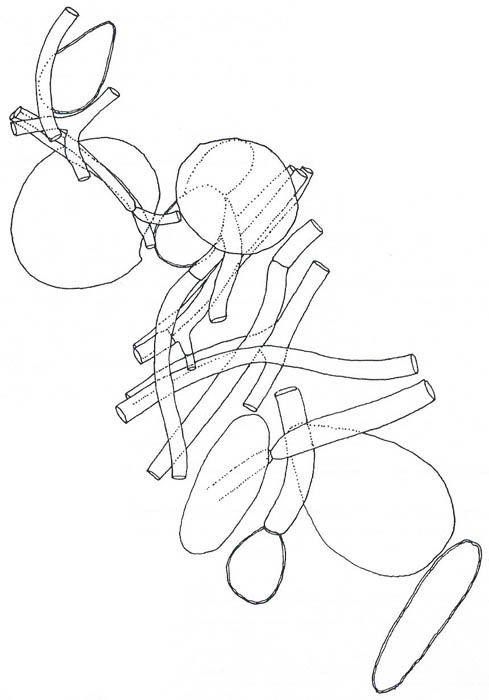
1. Amanita crassiputamen - (Breckon 669 in SFSU) universal veil illustrating presence of thick-walled inflated cells (Tulloss 1994). |
| basidiospores |
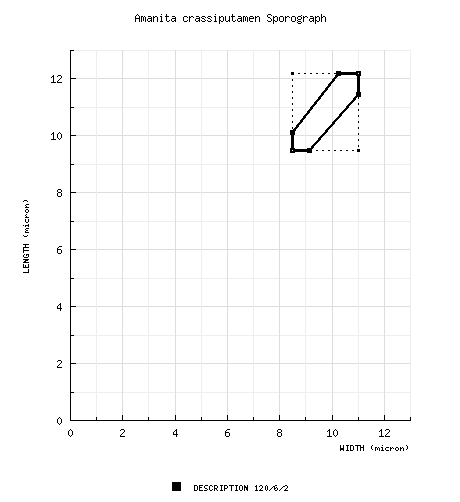
[120/6/2] (7.8-) 9.5 - 12.2 (-16.2) × (7.5-) 8.5 -
11.0 (-13.8) µm, (L = 10.2 - 11.6 µm;
L’ = 10.7 µm; W = 9.1 - 10.6 µm;
W’ = 9.7 µm; Q = (1.02-) 1.04 - 1.19 (-1.49);
Q = 1.09 - 1.13; Q’ = 1.10), hyaline,
colorless, thin-walled, smooth, inamyloid, globose to
subglobose to broadly ellipsoid, occasionally
ellipsoid, occasionally lacrymoid or pyriform;
apiculus sublateral, cylindric to
truncate-conic, prominent; contents
monoguttulate, occasionally with additional small
granules; white in deposit. |
| ecology |
Solitary to scattered to subgregarious.
California: At ca. 250
m elev. In humus over clay with vascular plants
not recorded or under hardwoods or in woods dominated
by Quercus agrifolia and Arbutus
menziesii or among trees dominated by Quercus
agrifolia.
Washington: In deep leaf litter from vine maple with
Pseudotsuga menziesii and Tsuga
heterophylla nearby—at edge of CAT road on
raised area. |
| material examined |
U.S.A.: CALIFORNIA—Marin
Co. - Bon Tempe Reservoir, 8.xii.2014 Ronald L.
Pastorino 12-8-14-B [mushroomobserver
#193058]
(RET 664-4, nrITS and nrLSU seq'd.), 16.xii.2014 R.
Pastorino 12-16-14CD [mushroomobserver
#193965]
(RET 666-1, nrITS-LSU seq'd.); Mt. Tamalpais St. Pk.,
Bootjack Tr., 24.xi.1989 Marsha Heidt s.n. [Tulloss
11-24-89-B] (RET 092-1, nrITS seq'd.).
Nevada Co. - Grass Valley [39.137° N/ 121.048° W,
651 m], 13.i.2018 Ben Anderson s.n. (RET 822-10,
nrITS & nrLSU seq'd.)
San
Mateo Co. - San Francisco Watershed, 23.xii.1966 G.
A. Breckon 669 (SFSU, as nonconformant paratype of
Amanita constricta).
Shasta Co. - Castella [41.1399° N / 122.315° W,
762 m], 23.x.2014 David Kent DK1023143 (RET 660-3,
nrITS & nrLSU seq'd.).
Solano Co. - Stebbins Cold Canyon Reserve [38.508°
N/ 122.1065° W, 410 m], 28.xii.2011 Hunter Sezen s.n.
[mushroomobserver
#137695]
(RET 666-6, nrITS-LSU seq'd.).
WASHINGTON—Skamania
Co. - Gifford Pinchot Nat. For., Pacific Crest,
Nat. Scenic Tr., Panther Crk., 21.x.1998 Janet
E. Lindgren 98240 (RET 289-8, nrITS & nrLSU seq'd.). |
| discussion |
The rather plentiful, slender inflated cells with
thickened walls that are dissociated and distributed
throughout the universal veil on the pileus seem like
they may be an important diagnostic character.
The chains of little inflated cells that are below the
shortest basidioles are also valuable as are the recorded characters of the lamella trama.
This entity has been called "Amanita species
C12" in (Tulloss,
1994),
correspondence, and regional checklists.
One collection (RET 644-4) was briefly referred to
Amanita sp-C23. Molecular study showed
that the temporary code was unnecessary, and that
that collection belonged in the present
taxon.
Notes on stirps Crassiputamen
The five species presently included in the stirps
are
Amanita crassiputamen
Amanita sp-44
Amanita sp-N66
Amanita sp-N68
Amanita sp-S14
The first twelve sequences available to
us are reviewed below.
Description of the "shared" nrLSU
The lengths of the derived nrLSU sequences for
the collections reviewed range from 1421 to 1486
characters. The shortest is lacking the 5'
terminus of nrLSU. All others include it.
None are attached to any portion of nrITS—for
the purpose of this description.
The variations within the twelve available nrLSU
sequences are as follows:
There are three multi-"T" repeats.
length varies from three to four characters (starts
at character position 115)
length
varies from six to seven characters (starts at
character position 483).
length varies from one to two characters (starts at
character position 510).
Otherwise, variation within the group or within
a species of the
group occurs in only three columns of the alignment:
character 187 - The dominant character is "A";
the single exception is a "G" in one of four
sequences of sp-N66.
character 499 - The dominant character is "C"; all
three crassiputamen sequences present a "T"
in this position.
character 627 - The dominant character is "C"; the
six sp-N66 sequences present evidence of
a "C/T/Y" SNP (3 "C's", 2 "Y's", 1 "T").
At present sp-S14 is represented by a single
sequence, and there is, consequently, no way to know
if its sequence might show a distinctive variation.
We intend to track this information as more
sequences of species in this informal grouping are
derived and reviewed.
It appears that the more recently described species,
A. alseides
should be included in the above list of taxa. |
| citations |
—R. E. Tulloss |
| editors |
RET |
|



 Spore data sets and their composite