| name |
Amanita protecta |
| author |
Tulloss & G. Wright. 1989. Mycotaxon 34: 615, figs. 1-5. |
| name status |
nomen acceptum |
| english name |
"Protected Ringless Amanita" |
| etymology |
protectus, "defended" or "guarded" or "shielded," because of the thick universsal veil |
| MycoBank nos. |
125093 |
| GenBank nos. |
Due to delays in data processing at GenBank, some accession numbers may lead to unreleased (pending) pages.
These pages will eventually be made live, so try again later.
|
| holotypes |
NY |
| intro |
The following text may make multiple use of each data field.
The field may contain magenta text presenting data from a type study
and/or revision of other original material cited in the protolog of the present taxon.
Macroscopic descriptions in magenta are a combination of data from the protolog and
additional observations made on the exiccata during revision of the cited original
material.
The same field may also contain black text, which is data from a revision of the present
taxon (including non-type material and/or material not cited in the protolog).
Paragraphs of black text will be labeled if further subdivision of
this text is appropriate.
Olive text indicates a specimen that has not been
thoroughly examined (for example, for microscopic details) and marks other places in the text
where data is missing or uncertain.
The information on this page is derived from the protolog and additional original research of R. E. Tulloss.
The original description of Amanita protecta (Tulloss and G. Wright 1989) is available here in the form of a PDF. (open) |
| pileus |
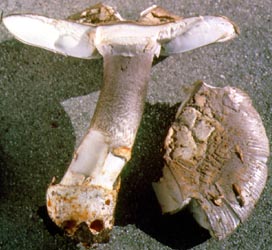
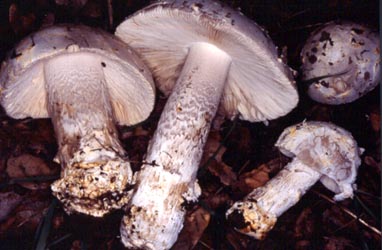
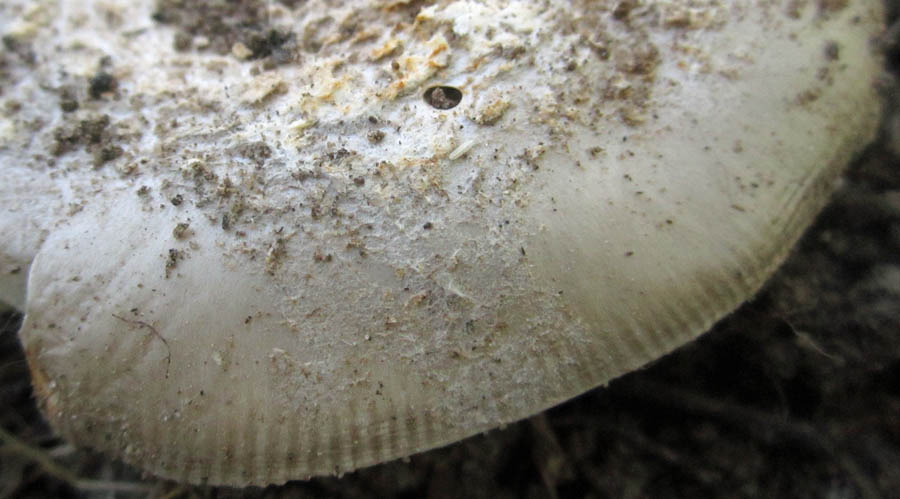
40 - 152 mm wide, from pale to dark gray or brownish grey or deep brownish gray (11D-E2), viscid when moist, becoming shiny when dry, convex expanding to plano-convex with deflexed margin to finally concave, sometimes umbonate in age, occasionally deeply rimose; context 4± - 10 mm thick at disk thinning evenly to margin or to about 90% of radius and then membranous to margin, firm, whitish to pale grayish, becoming faintly pink or ochraceous on exposure, occasionally dark grayish below the pileipellis in disk; margin weakly striate to striate (0.1R - 0.25R); universal veil up to 3 mm thick, occasionally appearing to have two layers (then the “outer layer” thin, whitish with ochraceous staining, rather fragile, submembranous), otherwise whitish or pale grayish at first, eventually cream or grayish with ochraceous stains, subatomate to atomate, in large floccose-felted patches becoming smaller toward margin where the remnants are reduced to a fine pulverulence, detersile. |
| lamellae |
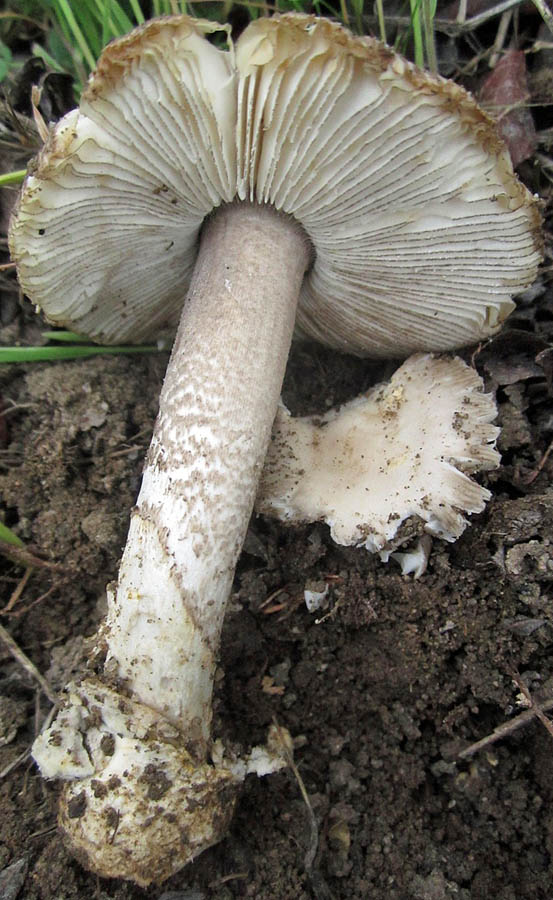
free to very narrowly adnate with a white decurrent line on stipe, close to subdistant, white, marginate with dark gray or gray-brown and minutely fimbriate edge (10× lens), unchanging, after drying 4A-B3 or 5A4 or 5B5 (slightly browner than 7.5YR 7/6) or 2.5Y 8/2-4 or 7.5YR 8/6, 4.5 - 12.5 mm broad; lamellulae not numerous (McMurphy), truncate, frequently with line of truncation concave, occasionally anastomosing with neighboring lamellae. |
| stipe |
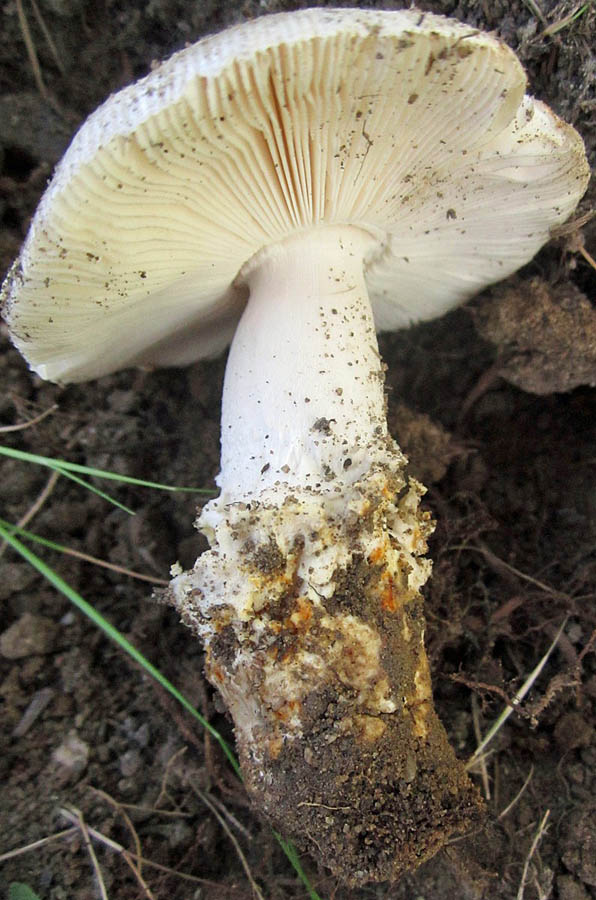
75 - 152 × 10.0 - 29 mm, white to pale grayish at apex, creamy white to grayish with ochraceous stains for 10 - 20 mm above attachment of volval sac (sometimes with pallid silky fibrils in this area), otherwise medium gray to very dark gray to gray-brown fibrils (sometimes in chevron pattern) on a sordid ground, subcylindrical, flaring at apex; rounded to somewhat pointed at base, staining ochraceous with exposure; context white above and white, fulvous, tannish, or salmon-cinnamon in base, faintly becoming pink or staining ochraceous, the discoloration becoming more intense toward the base, stuffed to partially hollow, central cavity diam. about one third to one half that of stipe, or rarely solid, at times becoming hollow near base; exannulate; universal veil saccate, subcircumscissile to limbate, highest point of limb reaching to 20 - 40+ mm from stipe base, up to 5 mm thick at point of connection to stipe, surface white to whitish with ochraceous stains, occasionally the surface dessicates producing a thin, submembranous to hardened or shell-like “outer layer” sometimes having the texture of a chicken eggshell; interior pale grayish white to grayish, floccose-felted, at times largely carried up onto pileus so that the “outer layer” forms a limb separated considerably from the stipe, occasionally leaving only one or more concentric ridges between the volval sac and the stipe, occasionally remaining as a separate second limb (not a limbus internus) which may even project above the limb formed by the “outer layer”; no noticeable limbus internus. |
| odor/taste |
Odor slightly sweet (Wright) or “mild” (Thiers, 1982) or “agreeable” (McMurphy) to faintly unpleasant in age (Tulloss). Taste slightly sweet (Wright) or “mild” (Thiers, 1982) or “agreeable” (McMurphy). Wright experienced no symptoms of poisoning after eating about 30 g of the cooked mushroom. |
macrochemical
tests |
Spot test for laccase (syringaldazine) - negative. Spot test for tyrosinase (paracresol) - positive except in universal veil, lamellae, marginal pileus context, and very base of stipe. Phenol on stipe: wine-red. KOH on pileus: no reaction. Meixner
?? test (Vergeer, 1986) negative for amatoxins—unreactive or dull orangish or orange-reddish with a yellow ring around the acid drop. Results according to Breckon (1968)—on exposed context of the lower stipe and bulb unless otherwise noted: 10% FeSO4 - yellow-brown; 15% KOH - negative; conc. KOH - pale yellow; Melzer’s reagent - negative; 3% phenol - positive; phenolaniline - positive; tincture of guaiac - slowly and very weakly positive. |
| pileipellis |
up to 560 µm thick, not having a clear boundary with pileus context; filamentous, undifferentiated hyphae 2.1 - 3.5 µm wide, frequently branching, interwoven, gelatinizing near surface. |
| pileus context |
filamentous, undifferentiated hyphae 3.5 - 10.5 µm wide, branching, interwoven, with lengthy thick-walled (wall thickness here and below to 1.2 µm except as noted) terminal or subterminal segments inflated up to 28 µm wide; inflated cells thick-walled, plentiful, terminal, singly or in chains, subglobose to pyriform to clavate to elongate to irregular, up to 106 × 63 µm (larger cells more often elongated than smaller ones); vascular hyphae 2.5 - 5.0 µm wide, branching, common. |
| lamella trama |
bilateral, with wcs = 135 - 185 µm (or 55 - 80 µm, in cases of imperfect rehydration); angle of divergence shallow; central stratum rather broad and a tangle of coiling, interweaving hyphae; filamentous, undifferentiated hyphae 3.5 - 5.6 µm wide, branching, with some inflated intercalary cells; inflated cells of subhymenial base up to 70 × 24.5 µm, thin-walled, intercalary, in three to four layers through which weave the hyphae that give rise to the subhymenium; vascular hyphae 3.5 - 4.9 µm wide, uncommon; clamps rare. |
| subhymenium |
wst-near = 55 - 90 (-100) µm; wst-far = 75 - 125 µm; with basidia arising from branching chains of short hyphal segments which are uninflated or slightly inflated, with basidia also arising directly from some of the larger inflated cells of the subhymenial base. |
| basidia |
47 - 92 × 10.0 - 17.5 µm, clavate to narrowly or very narrowly clavate, 4-spored, rarely 3- or 2-spored, thin-walled, continuing the curve of divergent trama elements for most of length, apical portion finally perpendicular to central stratum; clamps not observed. |
| universal veil |
On the stipe base, exterior surface: tissues difficult to reinflate; filamentous, undifferentiated hyphae 4.2 - 5.9 µm wide, dominating, gelatinizing, branching, disorderly, intertwining or in intertwining fascicles, some with intercalary and/or terminal segments slightly inflated to 19.6 µm wide; inflated cells terminal, clavate (up to 77 × 25 µm) and pyriform to lachrimiform (up to 65.1 × 44.1 µm); vascular hyphae 3.5 - 4.2 µm wide, occasional. On the stipe base, interior: filamentous, undifferentiated hyphae 3.1 - 8.0 µm wide, branching, tightly coiled or twisted, with terminal and subterminal sequences of hyphal segments often inflated up to 14.0 µm wide; inflated cells thin- or thick-walled, plentiful, terminal, subglobose to ellipsoid (up to 64 × 50.5 µm) and clavate (up to 126 × 33 µm); vascular hyphae 4.9± µm wide, scattered. On the pileus, region immediately above the pileipellis: dominated by globose to subglobose to ovoid inflated cells, terminal, singly or in chains of up to 4, thin- and thick-walled (these with wall thickness to 1.5 µm), up to 61.6 × 52.5 µm; filamentous, undifferentiated hyphae 2.1 - 8.4 µm wide, extensively branching, sometimes gelatinizing in thin region just above pileipellis leaving only inflated cells in that region. On pileus, further from pileipellis: filamentous, undifferentiated hyphae more curved and with some coiling as in veil at stipe base, with terminal and subterminal segments inflated to 14 µm wide; terminal subglobose to clavate cells thick-walled, up to 56 × 29.4 µm. |
| stipe context |
longitudinally acrophysalidic; filamentous, undifferentiated hyphae, 2.8 - 4.9 µm wide, branching; acrophysalides up to 215 × 52 µm (most narrower), dominating, thick-walled; vascular hyphae 10.5 - 12.6 µm wide, uncommon; clamps very rare. |
| partial veil |
absent. |
| lamella edge tissue |
not described. |
| basidiospores |
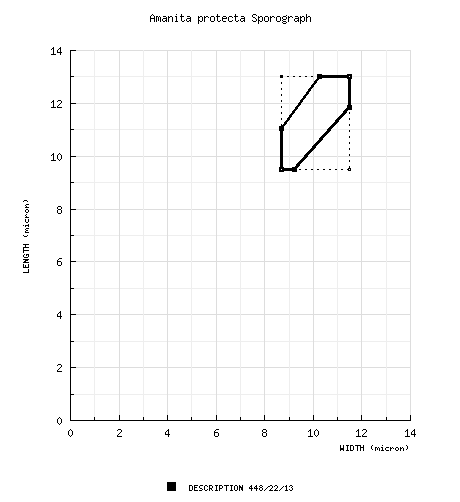
composite of all material revised by RET: [448/22/13] (8.7-) 9.5 - 13.0 (-20.5) × (7.3-) 8.7 - 11.5 (-16.2) µm, (L = 10.3 - 12.3 (-12.4) µm; L’ = 11.2 µm; W = (9.0-) 9.1 - 10.8 (-11.2) µm; W’ = 9.9 µm; Q = (1.0-) 1.03 - 1.27 (-1.43); Q = (1.07-) 1.10 - 1.19; Q’ = 1.14), inamyloid, thin-walled, hyaline, smooth, globose to subglobose to broadly ellipsoid, occasionally ellipsoid, sometimes slightly expanded at one end, frequently adaxially flattened or slightly so; contents guttulate; apiculus sublateral, truncate conic; contents ??; white in deposit. |
| ecology |
Solitary to subgregarious. California: At up to 800 m
elev. “Nearly buried in leaves under trees” or
“solitary in soil under Oak and Laurel” or in litter
under Quercus agrifolia or with pure stand of
Pinus radiata or near Salix,
Pinus, and Quercus. According to
Thiers (1982),
this species is “[s]olitary in conifers and
hardwoods. Apparently rare in California, but
recorded from the northern coastal forests and from
the foothills of the Sierra Nevada.”
In recent years it has been reported
(Noah Siegel and Christian Schwartz, pers. comm.) that
Salix is often found in association with A.
protecta and may occur in moist areas with
Salix where Quercus and Pinus are
not present. One such collection (from an
environment lacking Quercus and Pine was
sent to RET by Noah (RET 601-4). |
| material examined |
U.S.A.: CALIFORNIA—Alameda
Co. - Union City, Dry Creek Regional Park [39°39'07" N/
122°00'26" W, 185 m], 30.xii.2009 B. Kuznik
20091230DC16 [mushroomobserver.org
#31101]
(RET 473-6, nrITS seq'd.).
Humboldt Co. - Big Lagoon Co. Pk.,
8.xi.2011 Noah Siegel s.n. [mushroomobserver
#81848]
(RET 601-4, with Salix).
Los Angeles Co. - Santa
Catalina Isl., Grand Cyn., 27.xii.1920 L. W. Nuttall
988 (paratype, F, as “A. velosa”); Santa
Monica Mtns., Cold Crk. Cyn. Preserve, Stunt Cyn.,
3.i.1987 Barry Silver s.n. [Tulloss 1-3-87-BS1,
Wright 1383A] (holotype, NY 00066692, nrITS seq'd.),
10.i.1987 B. Silver s.n. [Wright 3701] (paratype,
RET 086-6, nrITS seq'd.). Marin Co. - Muir
Woods Nat. Mon., 15.i.1967 G. Breckon 865 (SFSU, as
paratype of A. constricta). Riverside
Co. - Santa Ana Mtns., El Cariso, 17.ii.1987 G.
Wright 3701A (paratype, RET 086-8); Slaughterhouse
Cyn., Clinton Keith Rd., 3.iii.1987 G. Wright 3712
(paratype, DTJ; paratype, RET 123-7; paratype,
XAL).
San Diego Co. - San Diego,
Carmel Mountain Preserve [32.940° N/
117.223° W, 25 m], 1.iv.2018 Cindy Trubovitz
s.n. [mushroomobserver
#313779]
(RET 820-4, nrITS-LSU seq'd.), s.n.
[mushroomobserver
#313720]
(RET 820-10, nrLSU seq'd.),
4.iv.2018 Cindy Trubovitz s.n.
[mushroomobserver.org
#313781]
(RET 820-5, nrLSU seq'd.).
San Mateo Co. - Pacifica, 7.xii.1984 Mycol. Soc. San Francisco member s.n. [H. D. Thiers 48390] (SFSU, as “A. inaurata”); Pacifica, Sharps Pk. Golf Course, 20.ii.1998 Fred Stevens s.n. (RET 277-5, nrITS seq'd.). Santa Barbara Co. - Santa Ynez Mtns., Los Prietos Campgrd., 30.iii.1979 Florence Nishida s.n. [Wright 1383] (paratype, RET 123-8). Sonoma Co. - Petaluma, Helen Putnam Regional Pk., 22.xii.2004 R. Pastorino 12-22-04A (in herb. R. Pastorino; RET 400-8, nrITS seq'd.). Unkn. Co. - ca. border of San Mateo & Santa Clara Cos., Stanford Univ., Los Trancos Crk., 16.i.1916 James McMurphy 200 (BPI, as “Amanita sp.”), 17.i.1918 J. McMurphy s.n. (BPI, as “A. vaginata”).
[NOTE: See Thiers 12961
(SFSU—Theirs’ voucher for “A. inaurata”).] |
| discussion |
Amanita protecta is a member of section Vaginatae. It is a medium- to large-sized mushroom with gray to gray-brown pileus, an exannulate stipe covered for much of its length with dark gray to black fibrils, and a robust universal veil leaving thick felted/fibrillose patches over a layer of fine pulverulence on the pileus and a thick, lobed, volva at the stipe base. The volval limb is rather widely separated from the stipe by a gap partially due to the fact that the inner 1-2 mm of the volva is carried up on the expanding pileus. All parts of the basidiocarp have a tendency to develop ochraceous stains when damaged and due to aging. The context of the pileus and stipe, as well as the universal veil tissue, display many terminal hyphal segments and terminal inflated cells (sometimes in chains) with thick walls. In the portion of the universal veil below its desiccated surface, the hyphae are coiled and twisted. The basidia of this species can be quite long for the genus. Clamps were observed only in the stipe context and the lamella trama; in both tissues, they were rare.
The most remarkable macroscopic feature of A. protecta is its universal veil. In some specimens the veil appears to have a tough outer layer covering a second layer of floccose-felted material which is separated from the pileus by a third, pulverulent layer. However, there are really only two layers. Microscopically, the sometimes hardened surface is revealed to be a desiccated layer of tissue nearly identical to that underlying it; the portion of the veil nearest the pileus is composed mostly of small inflated cells, sometimes in chains, which make up the fine pulverulent layer visible where no volval patch is present. In Amanita section Vaginatae, this form of universal veil is known only from the present species.
In the field, if the limb of the volval sac were completely broken away, one might mistake this species for a member of section Amanita close to A. pantherina because the specimen would appear to have a cothurnate, even abrupt, bulb; however, the peculiar character of the volval material remaining on the pileus, the dark gill margins, and the dark fibrils on the exannulate, completely elongating (bulbless) stipe should serve to prevent such an error.
Amanita constricta can be distinguished from A. protecta in the field by the former’s having a sulcate to tuberculate sulcate pileus margin and a thinner, constricted and flaring, submembranous universal veil that reaches up one third to one half of its stipe and bruises reddish or salmon when moist. There is no tendency to ochraceous staining in the tissues of A. constricta; the lamellae of A. constricta turn gray or grayish with age; and its universal veil lacks a pulverulent inner layer. Moreover there are plentiful clamps on the basidia of A. constricta; its basidia are shorter; and its spores are slightly smaller[?]. The structures of the universal veils also differ markedly in the two species (see, above).
Amanita pseudovaginata Hongo has some macroscopic similarities to A. protecta (gray material on stipe and gill margins and a relatively robust stipe base), but is smaller according to Hongo (1983). Also, the spores of A. pseudovaginata are much narrower (7.0 - 9.0 (-9.5) µm) and the basidia shorter (40 - 58 µm).
Nuttall 988 was determined originally to be A. velosa; this latter species has a pallid, yellowish to orangish pileus; a relatively pointed stipe base; narrower spores; no marked tendency to ochraceous staining in the tissues; a more membranous volva which does not break up into pulverulence and floccose patches on the pileus and which tends to leave a single membranous calyptra over the disk; etc.
The upper limit for the length of basidia in A. protecta considerably exceeds that for any taxa in section Vaginatae treated by Jenkins (1986).
Thiers' concept of A. inaurata (according to
exsiccata examined in SFSU) is largely based on
A. protecta; however, the photograph Thiers
uses to illustrate the species looks very much like
the entity called “A. inaurata” or “A.
ceciliae” in recent times by Jenkins (198??) and other eastern U.S.
authors. The photograph does not match the
accompanying text.
This species has be treated under the names "A.
sp-C26," "A. sp-C28," and "A.
torreyana" on this site. |
| citations |
The original description of Amanita protecta (Tulloss and G. Wright 1989) is available here in the form of a PDF. (open)—R. E. Tulloss |
| editors |
RET |
|



 Spore data sets and their composite