

| name | Amanita lignitincta |
| name status | nomen acceptum |
| author | Zhu L. Yang ex Yang-Yang Cui, Qing Cai & Zhu L. Yang |
| intro | The following data is from the description of Yang (1997). |
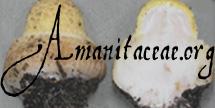
| cap | The fruiting bodies of A. lignitincta are small to medium-sized. Its undecorated cap is 40 - 60 mm wide, convex to plano-convex, and woody-brown to leather-brown, with the darkest region in the center. The center of the cap is often slightly depressed. The cap's margin is tuberculate-striate (extending 30% to 50% of the cap radius), and non-appendiculate, with a darker colored ring-like zone at the inner ends of the marginal striations. The cap's flesh is white and thin. |
| gills | The gills of this species are free, crowded to moderately crowded, and white. The short gills are squarely cut-off or nearly so. |
| stem | The ringless stem is 80 - 100 × 6 - 10 mm, nearly cylindric, grayish to dirty white, undecorated or bearing small fibrils, and hollow. Its flesh is white, no basal bulb is present on the stem. The volva is saccate, membranous, 20 - 35 mm high, 10 - 15 mm wide, and has both inner and outer surfaces white. |
| odor/taste | The odor is indistinct. |
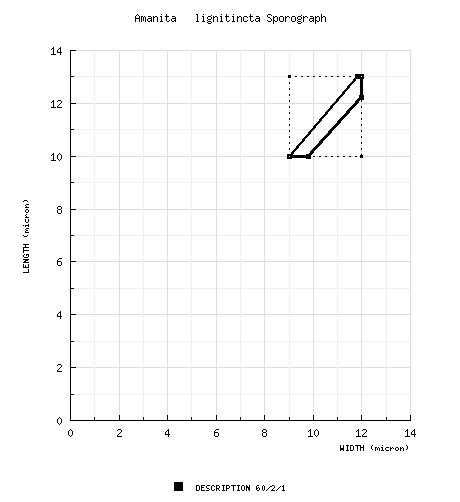
| spores | The spores of this species measure (9.5-) 10.0 - 13.0 (-13.5) × (8.5-) 9.0 - 12.0 (-13.0) µm and are globose to subglobose and inamyloid. Clamps are not present at the bases of basidia. |
| discussion |
Amanita lignitincta was tentatively described from Yunnan Province, China. It is not yet a well-known species; consequently, the name remains provisional.—Z.-L. Yang [Note: The reader may wish to compare the present species with A. umbrinolutea, the range of which is believe to extend from Europe into Himalayan India.—ed.] |
| brief editors | RET |
| name | Amanita lignitincta |
| author |
Zhu L. Yang ex Yang-Yang Cui, Qing Cai & Zhu L.
Yang.
2018.
in Cui, Y.-Y., Q. Cai and Z. L. Yang. 2018. Fungal
Diversity 91(1): 82, figs.
??. =Amanita lignitincta Zhu L. Yang nom. prov. 1997. Biblioth. Mycol. 170: 83, figs. 63-67. |
| name status | nomen acceptum |
| etymology | lignus, wood + tincta, color |
| MycoBank nos. | 444650, 825009 |
| GenBank nos. |
Due to delays in data processing at GenBank, some accession numbers may lead to unreleased (pending) pages.
These pages will eventually be made live, so try again later. |
| intro |
Olive text indicates a specimen that has not been
thoroughly examined (for example, for microscopic details) and marks other places in the text
where data is missing or uncertain. NOTE: Spore measurements from papers by Z. L. Yang use his "Times New Roman" face for "Q" and "Q'"—respectively, " |
| basidiospores |
From Yang (1997): [60/2/1] (9.0-) 10.0 - 13.0 (-13.5) × (8.5-) 9.0 - 12.0 (-13.0) μm, ( |
| ecology | Solitary. China: At 3500± m elev. In forests including Quercus and Abies species. |
| material examined | CHINA: YUNNAN—Lijiang (prefecture level) City - Unkn. Co., Sandaowan, 1.viii.1995 Z.-L. Yang 2121 (HKAS 29512). |
| discussion |
As of this writing (December, 2010), this species is still considered poorly known. A sporograph comparison of the present taxon with Amanita umbrinolutea follows. |
| citations | —Zhu-L. Yang |
| editors | RET |
Information to support the viewer in reading the content of "technical" tabs can be found here.
| name | Amanita lignitincta |
| bottom links | [ Keys & Checklists ] |
| name | Amanita lignitincta |
| bottom links | [ Keys & Checklists ] |
 Spore data sets and their composite
Each spore data set is intended to comprise a set of measurements from a single specimen made by a single observer; and explanations prepared for this site talk about specimen-observer pairs associated with each data set. Combining more data into a single data set is non-optimal because it obscures observer differences (which may be valuable for instructional purposes, for example) and may obscure instances in which a single collection inadvertently contains a mixture of taxa.

Text and User-Generated Sporographs are published under the Creative Commons License.

In the case of a taxon page, image credits are on the 'image' tab.