| ecology |
Solitary to occasionally subgregarious. At 10-1,000+ m elev. Maine: In mixed woods of Abies, Picea, and Thuja. Massachusetts: In thin layer of damp loam over rock in moss under A. balsamea or in loam under Acer, Fraxinus, Betula papyrifera, and scattered Fagus grandifolia. Michigan: In Tsuga canadensis and northern hardwoods forest. New Jersey: With B. lutea f., T. canadensis, Tilia sp., and Ulmus sp. or in typical Quercus-Pinus rigida barrens or in sandy soil of woods dominated by A. rubrum, Q. alba, Q. velutina, and Rhododendron. New York: In duff over acid, glacial out-wash sands under T. canadensis, F. grandifolia, and Prunus sp. or in wet loam in mixed deciduous woods composed of Acer sp., Carya sp., Quercus coccinea and . West Virginia: In moist loam of mixed forest locally dominated by F. grandifolia, T. canadensis, A. balsamea, and Acer. New York: At ca. 500 m elev. In old growth forest with Acer, Fagus grandifolia, Betula, Prunus, and T. canadensis. |
| material examined |
U.S.A.: CONNECTICUT—New London Co. - Pachaug St. For., 2.vii.2008 NEMF 2008 participant s.n. (RET 446-9).
MAINE—Aroostook Co. - ca. Guerrette, “state game preserve,” 13.vii.1956 H. E. Bigelow 3963 (MICH). Cumberland Co. - Wolf Neck St. Pk., 16.x.1988 Moselio Schaechter s.n. [Tulloss 10-16-88-MS1] (RET 001-6). Hancock Co. - W of Pickerel Pond, 11.viii.1991 Stachula s.n. [Tulloss 8-11-91-E] (RET 029-3). Penobscot Co. - Univ. of Maine, 12.viii.1991 NEMF participant s.n. [Tulloss 8-12-91-C] (RET 031-8).
MASSACHUSETTS—Berkshire Co. - Adams, 15.viii.1986 M. A. King & R. E. Tulloss 8-15-86-C (paratype, L); Balance Rock St. Pk., 15.viii.1986 R. Roper s.n. [Tulloss 8-15-86-L] (paratype, RET 465-5); Cheshire, Camp Mohawk, 15.viii.1986 S. Sheine s.n. [Tulloss 8-15-86-F] (paratype, RET 465-10); Mt. Greylock summit, 17.viii.1986 R. E. Tulloss 8-17-86-A (paratype, in herb. C. Lavorato; paratype, RET 027-8). Unkn. Co. - Mt. Tom St. Reservation, ca. border of Hampshire & Hampden Cos., 27.ix.1986 Ellen Greer s.n. [Tulloss 9-27-86-EG8] (paratype, RET 224-6).
MICHIGAN—Marquette Co. - Sullivan Creek area, 12.vii.1968 N. Smith & T. Gilliam [Gilliam 165] (MICH). Ontonagon Co. - Porcupine Mtns. St. Pk., Government Peak Trail, 24.viii.1962 R. L. Shaffer 3783 (MICH, as “A. vaginata”).
MINNESOTA—??.
NEW HAMPSHIRE—Hillsborough Co. -
Harris Center, 18.viii.1989 NEMF participant s.n.
[Tulloss 8-18-89-C] (RET 246-2).
NEW JERSEY—Mercer
Co. - Hopewell, 6.vii.1981 R. E. Tulloss 7-6-81-B
(paratype, RET ??), 7.vii.1981 R. E. Tulloss
7-7-81-C (paratype, RET ??), 18.vii.1984 R. E.
Tulloss 7-18-84-D (paratype, RET ??).
Monmouth Co. - Roosevelt, on
hill in SE corner of Block 7 Lot 10.01
[40°12’49” N/ 74°28’19” W], 22.ix.1999 R. E.
Tulloss 9-22-99-N (RET 303-2); Shark River Co. Pk. [40°12’18” N/
74°05’44” W, 16 m], 8.vii.1984 Susan Hopkins s.n.
[Tulloss 7-8-84-F] (paratype, RET 057-2),
28.viii.1985 R. E. Tulloss 8-28-85-D (paratype,
RET 098-3), 8-28-85-F (paratype, RET 098-4),
3.viii.1986 Bruce Vansant s.n. [Tulloss 8-3-86-H]
(paratype, RET 090-7). Sussex Co. -
Stokes St. For., 15.vi.1985 M. A. King & R. E.
Tulloss 6-15-85-A (paratype, RET 053-7);
Stokes St. For., Kittle Field Recreation Area,
6.x.1985 NJMA member s.n. [Tulloss 10-6-85-A]
(holotype, NY 00618735),
28.ix.1997 M. A. & R. E. Tulloss 9-28-97-A
(RET 270-9); Wallpack Center, 6.x.1985 Neal
Macdonald s.n. [Tulloss 10-6-85-E] (paratype,
RET 205-10).
NEW YORK—Essex Co. - North Elba,
21.viii.1987 NEMF participant s.n.
[Tulloss 8-21-87-L] (paratype, DTJ).
Franklin Co. - Floodwood Mtn. Rd. [44.3476°
N/ 74.4424° W, 501 m], 22.viii.1987 Joe Arnold
s.n. [Tulloss 8-22-87-E] (paratype, RET 006-4);
Harrietstown, 21.viii.1987 Smith s.n.
[Tulloss 8-21-87-K] (paratype, DTJ).
Hamilton Co. - Raquette Lake, 21.viii.1987 Bill
Roody s.n. [Tulloss 8-21-87-N] (paratypes,
RET 006-3; paratype, in herb. T. Borgen; paratype,
XAL). Otsego Co. - Arnold St. For.,
16.viii.1985 R. M. Fatto s.n. [Tulloss 8-16-85-C]
(paratype, RET 098-2). Schenectady Co. -
Mariaville, 18.viii.1986 M. A. King & R. E.
Tulloss 8-18-86-C (paratype,
RET 670-1).
PENNSYLVANIA—Pike Co. - Dingman's
Ferry, Pocono Environmental Education
Ctr. [41°10'17" N/ 74°54'52" W, 235 m],
20.vi.1981 M. A. King &
R. E. Tulloss 6-20-81-A (paratype, RET 175-5),
6-20-81-H (paratype, RET 175-4), 24.vi.1989 Hanna Tschekunow s.n.
[Tulloss 6-24-89-B] (RET 247-10).
TENNESSEE—Sevier Co. - ca. Gatlinburg,
GSMNP, Cherokee Orchard
[35.6811° N/ 83.4625° W, 945 m],
12.vii.2004 S. Tieken & J. Rahart s.n.
[Tulloss 7-12-04-AG] (RET 374-6,
nrITS seq'd.).
VERMONT—Bennington? Co. - NEMF81 site, 30.viii.1981 NEMF participant s.n. [Tulloss 8-30-81-A] (paratype, RET 166-3). Pownal Co. - NEMF81 foray site, 29.viii.1981 NEMF participant s.n. [Tulloss 8-29-81-D] (paratype, RET 166-5).
VIRGINIA—Grayson Co. - Grayson Highlands St. Pk., Cabin Crk. Tr., 9.ix.1986 Robert S. Williams 323 (paratype, RET 088-3).
WEST VIRGINIA—Tucker Co. - Canaan Valley St. Pk., E. terminus Abe Run Tr., jct. w/ Deer Run Tr. [39°00’57” N/ 79°27’49” W], 31.viii.1996 R. E. Tulloss 8-31-96-A (RET 248-10). |


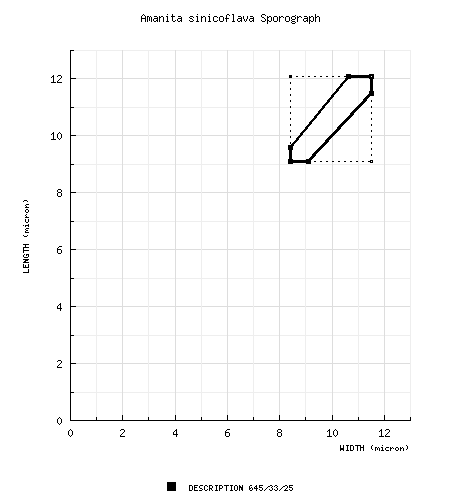
 Spore data sets and their composite