| name |
Amanita aprica |
| author |
J. Lindgr. & Tulloss in Tulloss & J. Lindgr. 2005. Mycotaxon 91: 194 |
| name status |
nomen acceptum |
| english name |
"Sunshine Amanita" |
| etymology |
apricus, growing in the sunshine, exposed to the sun, sunny; because of the species' being found most often in places exposed to direct sun and because of the bright “apricot-like” color of the pileus. |
| MycoBank nos. |
343980 |
| GenBank nos. |
Due to delays in data processing at GenBank, some accession numbers may lead to unreleased (pending) pages.
These pages will eventually be made live, so try again later.
|
| holotypes |
WTU; isotypes in L, NY, & RET |
| intro |
The following text may make multiple use of each data field.
The field may contain magenta text presenting data from a type study
and/or revision of other original material cited in the protolog of the present taxon.
Macroscopic descriptions in magenta are a combination of data from the protolog and
additional observations made on the exiccata during revision of the cited original
material.
The same field may also contain black text, which is data from a revision of the present
taxon (including non-type material and/or material not cited in the protolog).
Paragraphs of black text will be labeled if further subdivision of
this text is appropriate.
Olive text indicates a specimen that has not been
thoroughly examined (for example, for microscopic details) and marks other places in the text
where data is missing or uncertain.
Unless indicated otherwise, this description is drawn directly from the protolog.
The original description by Tulloss and Lindgren (2005) is available as a PDF. (open) |
| pileus |
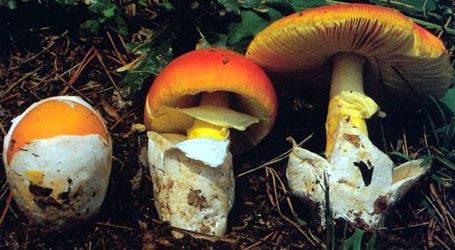
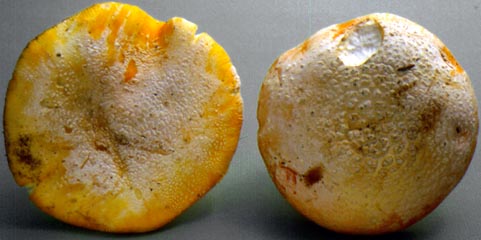
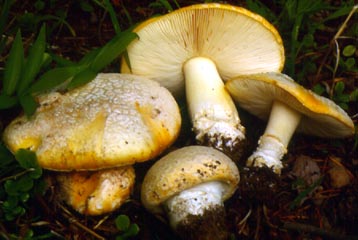
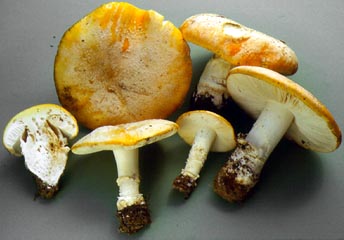
50 - 150 mm wide, bright yellow to egg yellow to lemon yellow or bright orangish yellow, occasionally orange (especially over disc), colors sometimes fading and becoming duller after exposure to sun, globose at first, then convex to plano-convex, finally plane with or without disc depressed, glabrous, tacky to subviscid where pileipellis exposed at maturity or in moist weather; context white, yellow under pileipellis, 6 - 20 mm thick at stipe, thinning evenly to less than 2 mm at margin; margin nonstriate or faintly striate (even in age), entire, inrolled at first, slightly uplifted in age, sometimes bearing fragments of partial veil; universal veil as thin appressed downy fibrils or small floccose warts or patches or as a nearly complete floccose-felted to “woolly-felted” covering, or as a nearly complete covering of confluent broadly subpyramidal warts, white to creamy white to yellowish white, detersile, quite commonly remaining attached over much of pileipellis and becoming thinner as stretched by expanding pileus. |
| lamellae |
free to seceding, with faint decurrent lines on stipe apex, close to subdistant, white to creamy white in mass and in side view, unchanging when cut or bruised, 5 - 12 mm broad, broadest at midpoint, with fimbriate sometimes uneven edges; lamellulae truncate to excavate-truncate, numerous. |
| stipe |
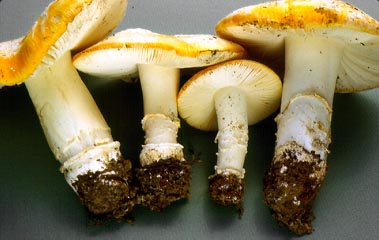
33 - 91 × 14 - 35 mm, white to
cream to creamy tan, bruising light tan where handled,
usually cylindric, occasionally narrowing upward,
surface pruinose to flocculose to scurfy below partial
veil, flocculence in young specimens easily removed by
handling; bulb often not distinct, merely clavate
base of stipe, (10-) 16 - 34 × 18 - 40 ( 50) mm, with
either rounded or pointed base, sometimes slightly
radicating; context white to pale yellow,
infrequently with brownish stains in spots on cut
surface, firmly stuffed with white tissue when young,
becoming hollow or partially hollow; partial
veil superior to median, white to cream,
felted-membranous at first, soon fragile,
skirt-like, sometimes collapsing on stipe, sometimes
evanescent; universal veil as low free limb
encircling top of bulb, white to cream to creamy
tan to pale tan, seldom rolled outward, 1 - 3 mm
thick at about half height of limb, 25 - 38 mm
from base of bulb to highest point on limb, sometimes
also as detersile rings on lower stipe above limb,
also often left in soil or as patches or warts on
stipe. |
| odor/taste |
Odor and taste not distinctive. |
macrochemical
tests |
10-20% KOH - partial veil turning orange in less than 5 min., context of pileus and stipe pale yellowish. NH4OH - context of pileus and stipe slightly yellow in 5 min., fading. H2SO4 (dilute) - negative. FeSO4 - negative. Ethanol - negative. Phenol - wine red spot in pileus context and upper stipe after 10 min. Spot test for tyrosinase (paracresol) - positive (reddish brown) in stipe context near stipe base, partial veil, and pileus context in 10 min. Spot test for laccase (syringaldazine) - negative throughout basidiocarp. Macrochemical test voucher: Lindgren 92-5. POISONOUS: producing nausea, vomiting, intestinal cramps, muscle spasms, diarrhea, disorientation, and hallucinations, with these accompanied by drowsiness and the desire to sleep. |
| pileipellis |
295 - 300 µm thick at approximately midradius, up to 440 ( 535) µm thick in disc, entirely ungelatinized well beyond initiation of sporulation in most specimens and, hence, lacking distinctive supra-/subpellis, with most elements subradially oriented, with occasional regions below upper surface having many elements distinctly nonradial; filamentous, undifferentiated hyphae 1.8 - 7.0 µm wide, branching, densely packed vertically, with many at and near upper surface connected to universal veil well into maturity in most specimens, with hyphae and inflated cells like those of universal veil sometimes arising below uppermost hyphal layers (Fig. 2b); vascular hyphae 3.0 - 19.6 µm wide, branching, sinuous, scattered to locally common, sometimes entangled, occasionally crossing ungelatinized into universal veil well into maturity. |
| pileus context |
filamentous, undifferentiated hyphae 0.6 - 9.3 µm wide, branching rather frequently, plentiful, sometimes in fascicles, sometimes with yellowish subrefractive walls, forming open lattice-like structure; acrophysalides plentiful, terminal and solitary, narrowly clavate to clavate (up to 222± × 51± µm) or broadly clavate to ellipsoid (up to 108 × 47 µm); vascular hyphae 3.0 - 23 µm wide, branching, sinuous, infrequent, locally common (especially in upper part of context). |
| lamella trama |
bilateral, markedly divergent, rather broad; wcs = 95 - 135 µm (very good rehydration); central stratum including numerous intercalary partially inflated to narrowly ventricose cells (e.g., 154 × 18.2 µm); angle of divergence from very shallow to about 45°; filamentous, undifferentiated hyphae 1.0 - 10.5 µm wide, frequently branching, sometimes with yellowish tint, sometimes with constrictions at septa, occasionally markedly changing diameter at septa; divergent inflated cells broadly to narrowly clavate to narrowly ventricose to only slightly inflated, sometimes slightly curved, up to 117 × 32 µm (commonly about half this size), apparently all intercalary; vascular hyphae 4.5 - 9.3 µm wide, rare; clamps infrequent in subhymenial base, not observed elsewhere. |
| subhymenium |
wst-near = 80 - 115 µm (very good rehydration); wst-far = 100 - 135± µm (very good rehydration); (2 ) 3 - 4 (-5) layers of cells thick, with basal layer cells arising from hyphal segments or inflated intercalary cells, generally appearing subcellular to cellular, with (however) basidia arising from both subglobose to barrel-shaped cells and occasionally from only slightly inflated hyphal segments; clamps infrequent to rare. |
| basidia |
48 - 70 × 10.0 - 11.5 µm, projecting up to 12.0 - 16.0 µm beyond surrounding basidioles, dominantly 4-, occasionally 2-sterigmate; sterigmata up to 5.8 × 4.0 µm; clamps and proliferated clamps unevenly distributed, infrequent, sometimes small and very thin-walled, requiring persistent search. |
| universal veil |
On pileus: with substantial number of filamentous, undifferentiated hyphae and some vascular hyphae connecting to pileipellis often well into maturity, with gelatinization beginning in hyphae near base simultaneously with some hyphae of pileipellis surface, with elements having subvertical to vertical orientation; filamentous, undifferentiated hyphae 3.0 - 8.0 µm wide, branching, plentiful to dominant in base, plentiful above basal region; inflated cells plentiful, terminal singly, broadly to narrowly ellipsoid (up to 78 × 40 µm), broadly to narrowly clavate (up to 105 × 50 µm), sometimes slightly constricted; vascular hyphae 4.2 - 11.5 µm wide, scattered to locally clustered, sinuous, occasionally branching, occasionally entangled locally. On stipe base, exterior surface: filamentous, undifferentiated hyphae in broad (but not very thick) interwoven fas-cicles, partly gelatinized. On stipe base, interior: filamentous undifferentiated hyphae 1.8 - 12.6 µm wide, branching, dominating, sometimes constricted at septa, sometimes with yellowish walls, plentiful, often dominating; inflated cells terminal, singly or in chains of two, globose to broadly globose to pyriform (up to 55 × 52 µm) or broadly ellipsoid to broadly clavate to ellipsoid to elongate (up to 64 × 39 µm), plentiful; vascular hyphae not observed. |
| stipe context |
longitudinally acrophysalidic; filamentous, undifferentiated hyphae 1.4 - 9.1 µm wide, branching, sometimes in narrow fascicles, sometimes with yellowish subrefractive walls, dominantly longitudinally oriented, dominating near surfaces, plentiful in interior; acrophysalides plentiful, smaller and less frequent toward surfaces, plentiful in interior, up to 195 × 37 µm; vascular hyphae 3.2 - 28 µm wide, sinuate to hypersinuate, sometimes loosely coiled (corkscrew-like), unevenly distributed, scattered to locally common, yellowish. |
| partial veil |
filamentous, undifferentiated hyphae 2.1- 4.4 µm wide, branching, dominating, disordered except for occasional fascicles up to 10 hyphae wide, sometimes with yellowish subrefractive walls; inflated cells plentiful, narrowly cavate, terminal, usually singly, occasionally subtended by a smaller somewhat inflated hyphal segment, up to 88 × 17.6 µm wide, infrequently producing hyphae laterally or apically; vascular hyphae not observed. |
| lamella edge tissue |
sterile. |
| anatomical figures |
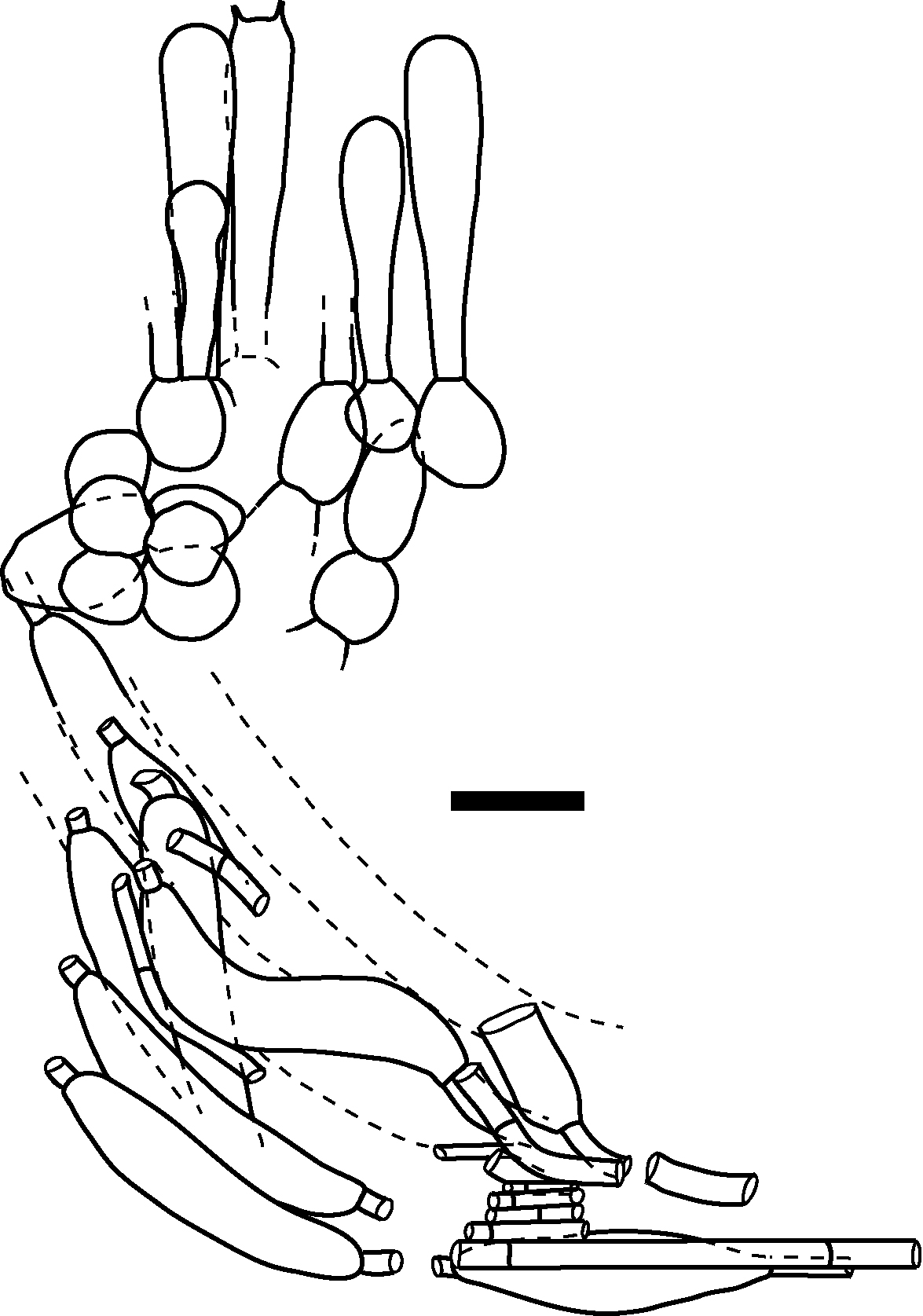
1. Amanita aprica (holotype), elements of lamella trama and hymenium (some elements displaced by sectioning—for example, apparently sinuate intercalary element in subhymenial base). Scale bar=20 μm. 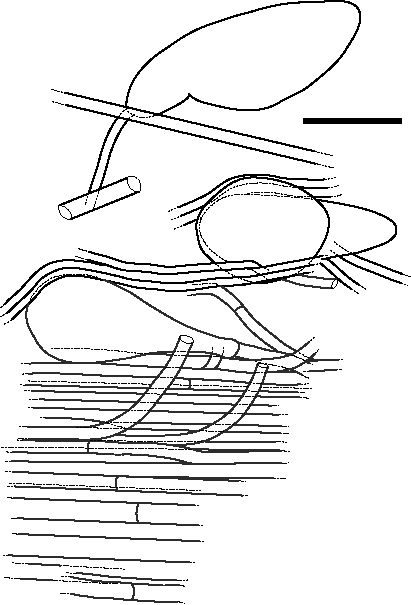
2. Amanita aprica (holotype), elements of lower part of universal veil from pileipellis illustrating interconnection with pileipellis. Scale bar=20 μm. 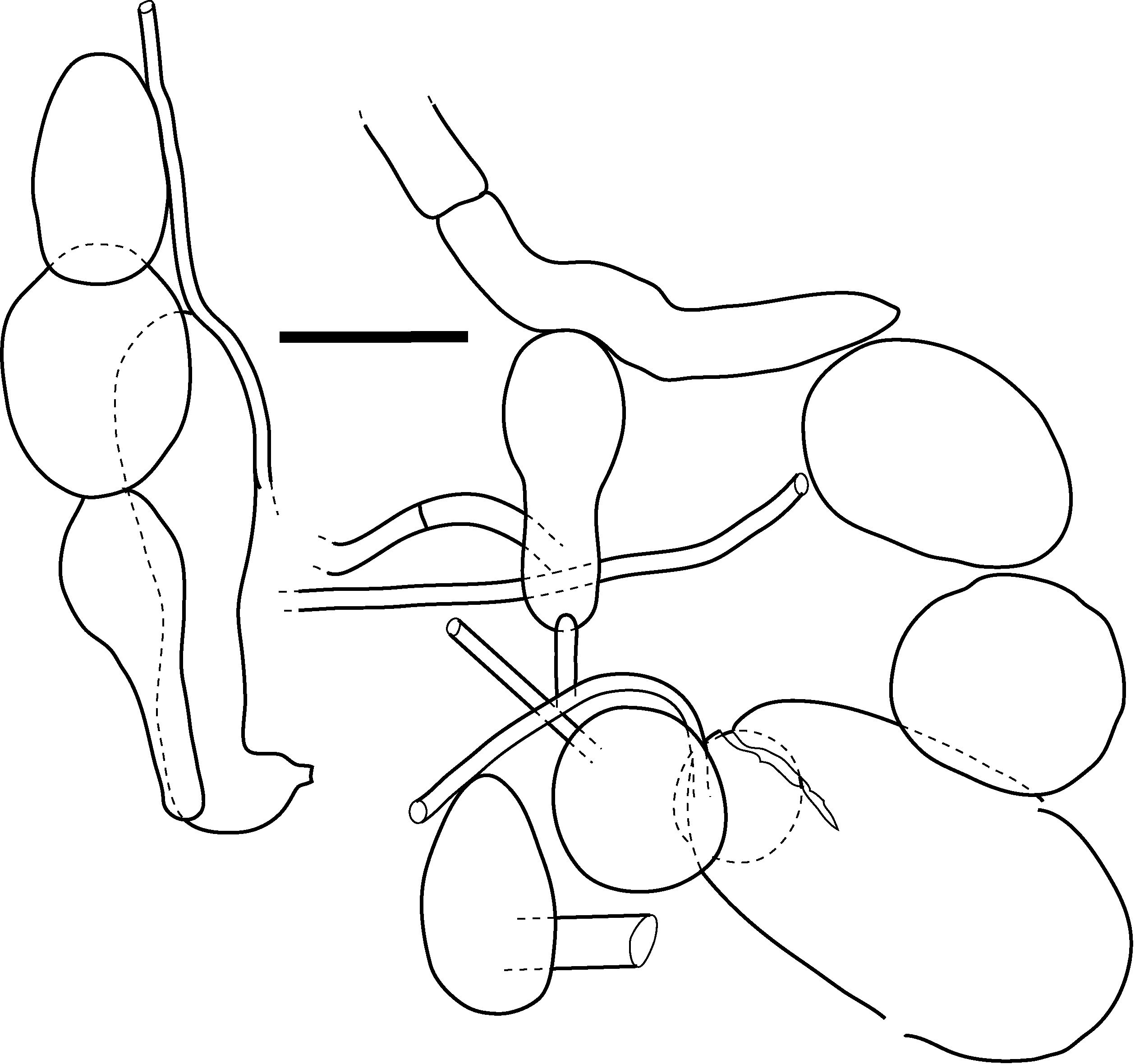

3. Amanita aprica (holotype), elements of universal veil from pileus (upper portion, crush mount, some hyphae not shown). Scale bar=20 μm. 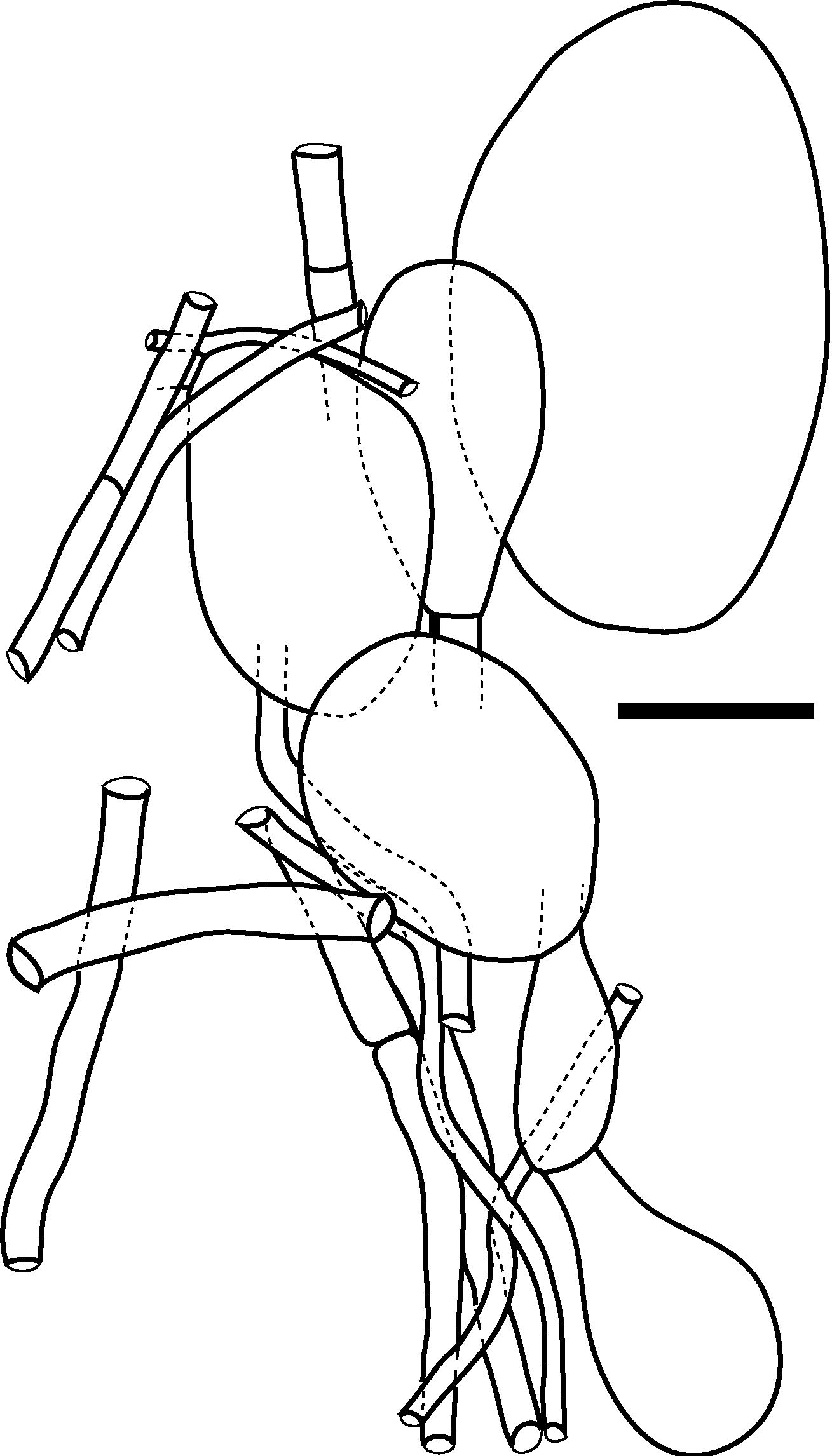
4. Amanita aprica (holotype), elements of universal veil from interior of limb above stipe's bulb (crush mount, some hyphae not shown). Scale bar=20 μm. 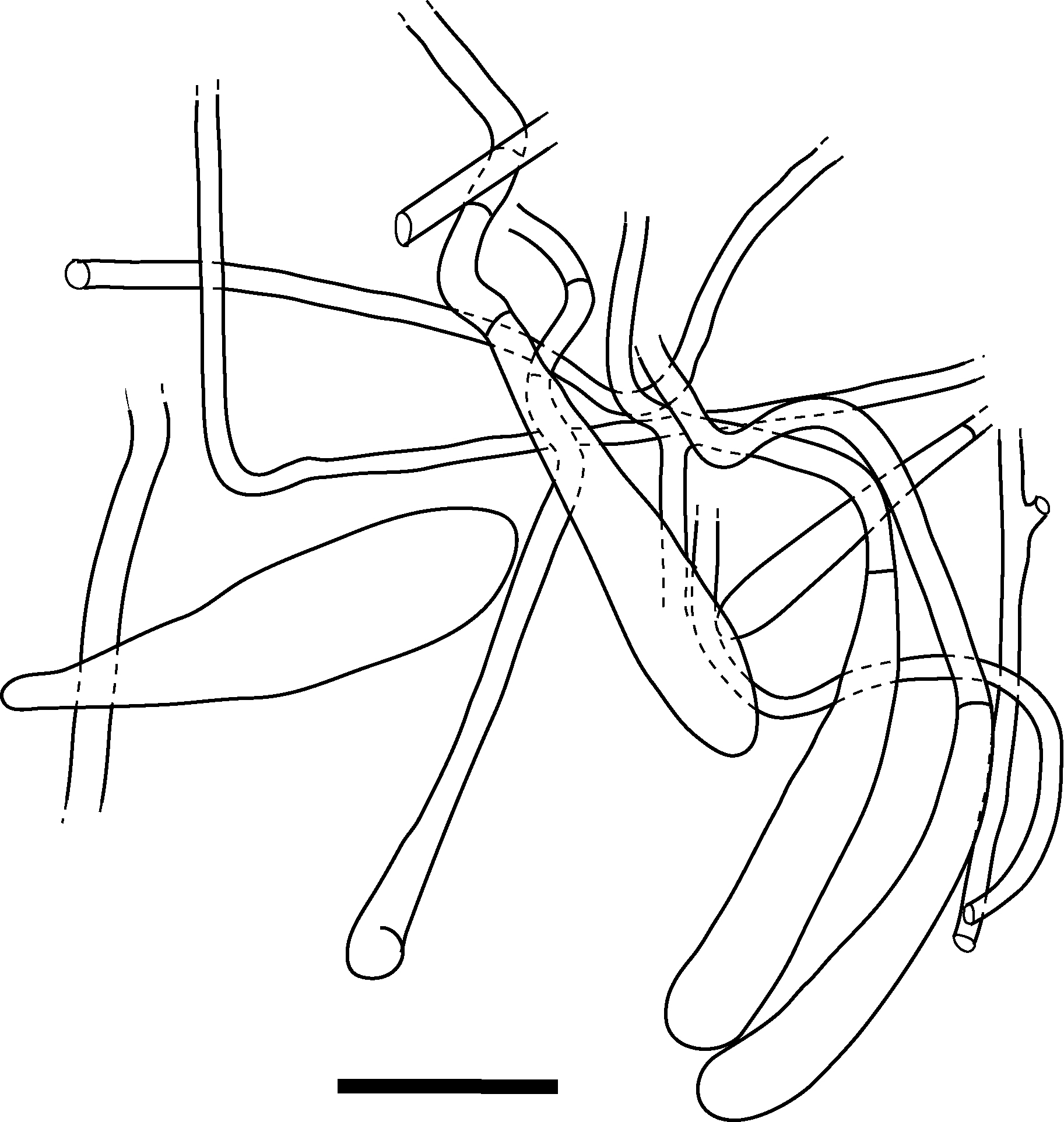
5. Amanita aprica (Trudell 96-165-01), elements of partial veil, excluding any cells remaining from former attachment to edges of lamellae (crush mount, some hyphae not shown). Scale bar=20 μm. |
| basidiospores |
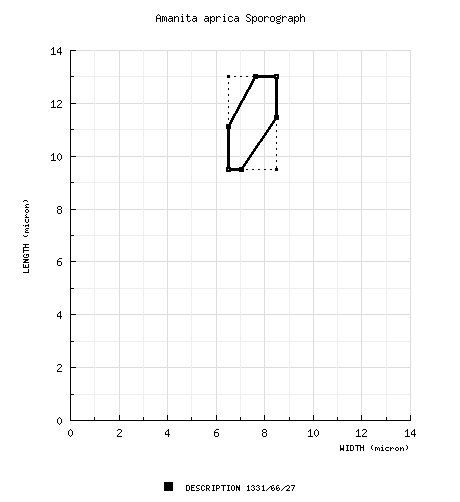
[1331/66/27] (8.0-) 9.5 - 13.0 (-21) × (5.0-) 6.5 - 8.5 (-12.5) µm, (L = (9.8-) 10.1 - 12.2 (-13.1) µm; L´ = 11.1 µm; W = (6.6-) 6.8 - 8.1 (-8.4) µm; W´ = 7.4 µm; Q = (1.22-) 1.35 - 1.71 (-2.13); Q = (1.38-) 1.42 - 1.62 (-1.80); Q´ = 1.52), hyaline, colorless, smooth, thin-walled, inamyloid, ellipsoid to elongate, occasionally broadly ellipsoid, often adaxially flattened, sometimes swollen at one end, occasionally langeniform, infrequently “giant”; apiculus sublateral, cylindric to truncate-conic, proportionately rather large; contents granular to mono- or multiguttulate, dominantly monoguttulate with additional small granules; white to creamy white in deposit. |
| ecology |
Solitary to gregarious, at 600 - 1850 m elev. Often in sunny locations such as road cuts, along trails, campgrounds, and under other breaks in the forest canopy; occurring with conifers, mainly Pseudotsuga menziesii (Mirb.) Franco, less frequently with Pinus (e.g., P. contorta Dougl. ex Loud., P. monticola Dougl. ex D. Don, and P. ponderosa Dougl. ex Lawp;s.). For example, basidiocarps of Lindgren 90-23 collected under P. monticola with understory of Achlys triphylla (Sm.) DC, Pachistima myrsinites (Pursh) Raf., Vaccinium sp., Pyrola sp., and grass. Quite common in the Cascade Mountains of Oregon and Washington. |
| material examined |
CANADA:
BRITISH COLUMBIA—Brackendale, 2.v.1993 P.
Kroeger 1658 (paratype, DAVFP n.v.; paratype, RET
327-2; paratype, UBC n.v.).
U.S.A.:
CALIFORNIA—El Dorado Co. - 1.6 km
E of Ice House Reservoir [38.8213° N/ 120.3767° W,
1510 m], 14.v.2013 Mike McCurdy s.n.
[mushroomobserver.org
#134573]
(RET 534-7, nrITS & nrLSU seq'd.). Sierra Co. - N of Downieville, ca.
Hwy. 49, 5.vii.2003 Mark Lockaby “A” (paratype, RET
369-10); Sierra Nevada Field Camp on Hwy. 49,
6.vi.1986 R. E. Halling 4659 (paratype, NY).
Siskiyou Co. - Shasta National
Forest, E of McCloud, ca. 1.6 km from Rte. 89/For.
Rd. 13 jct, E of For. Rd. 13 [aka Pilgrim
Crk. Rd.] [41.2742° N/ 122.056° W,
1055 m], 15.v.2013 Ronald Pastorino 5-15-13-C
[mushroomobserver
#133931]
(RET 531-8).
Tulare Co. - ca. Sequoia Nat.
Pk., 14.ix.1991 Bruce Kuechman s.n. [Lindgren
91-28] (paratype, RET 318-9). Unkn. Co. —
Sierra Nevada, 5.vi.2003 Mark Lockaby “B” (paratype,
RET 369-9). OREGON—Clackamas Co.
- BLM Table Rock Tr., 8.vi.1994 J. E. Lindgren 94-8
(paratype, JEL; paratype, RET 128-1); MHNF, Salmon
Butte Tr., 16.vi.1990 J. E. Lindgren 90-7 (paratype,
JEL; paratype, RET 326-5); MHNF, Salmon R. Tr.,
5.vi.1991 J. E. Lindgren 91-19 (paratype, JEL;
paratype, RET 326-8). Hood River Co. - MHNF,
Pebble Ford Campgrd., 27.vi.1990 Dick Bishop s.n.
[Lindgren 90-11] (paratype, JEL; paratype, RET
326-4); MHNF, Rd. 48, 19.v.1994 J. E. Lindgren
94-04 (paratype, JEL; paratype, RET 128-4); MHNF,
Surveyor’s Ridge, 1991 J. E.
Lindgren 91-21 (paratype, JEL; paratype, RET
323-6). Multnomah Co. - ca. Portland,
30.v.1990 poisoning victim (Bulgarian immigrant)
s.n. [Lindgren 90-13] (paratype, JEL; paratype, RET
090-3). Unkn. Co. - unkn. loc., 3.v.1988
member of Oregon Mycol. Soc. s.n. [Lindgren 116]
(paratype, JEL; paratype, RET 326-6). <
big>WASHINGTON—Chelan Co. - Wenatchee Nat.
For., at boundary of Glacier Peak Wilderness, ca.
tr. to Twin Lakes, 14.vi.1997 J. E. Lindgren 97-02
(paratype, JEL; paratype, RET 281-7). King Co.
- Mt. Baker-Snoqualmie Nat. For., E of Enumclaw
& W of Mt. Ranier Nat. Pk. entrance, St. Hwy.
410, Dalles Campgrd., 30.iv.1992 Steve Trudell
s.n. [Lindgren 92-16] (paratype, JEL; paratype, RET
326-2); Snoqualmie Nat. For., on Rd. 54, 1.6 km S
of Stampede Pass (1.3 km S of Lizard Lk.), less
than 0.2 km from point where power lines cross rd.,
13.vi.1996 Steve Trudell 96-165-01 (paratype, JEL;
paratype, RET 264-1). Kittitas Co. - Wenatchee
Nat. For., E of Snoqualmie Pass, 8.6 km NE of U.S.
Interst. Hwy. 90 on For. Rd. 228, Kachess Campgrd.,
11.v.1992 Steve Trudell s.n. [Lindgren 92-18]
(paratype, JEL; paratype, RET 326-7).
Klickitat Co. - Trout Lk., 30.v.1987 J. E. Lindgren
s.n. [Tulloss 5-30-87-JL1] (paratype, JEL; paratype,
RET 016-1), 28.v.1994 J. E. Lindgren 94-07
(holotype, WTU; isotype, JEL; isotype, L; isotype,
NY; isotype, RET 128-5, nrITS & nrLSU
seq'd.). Skamania Co. - GPNF, 6.5 km N of
Beacon Rock St. Pk., 22.v.1997 J. E. Lindgren 97-04
(paratype, JEL; paratype, RET 281-6); GPNF, ca.
Goose Lk., 18.vi.1990 J. E. Lindgren 90-23 (RET
090-4); GPNF, Rd. 80 [?Nat. For. Development Rd.
8040?] to Morrison Crk. Cmpgrds., ca. Trout Lk.,
5.vi.1990 J. E. Lindgren 90-18 (paratype, JEL;
paratype, ET 015-4); GPNF, Morrison Crk., Road 80,
7.vi.1990 J. E. Lindgren 90-19 (paratype, JEL;
paratype, RET 015-2); GPNF, Takhlakh Lk., 8.vi.1989
J. E. Lindgren 139 [89-39] (paratype, JEL; paratype,
RET 326-10); GPNF, Trout Lk., vi.1991 J. E. Lindgren
91-18 (paratype, JEL; paratype, RET 323-5),
23.v.1995 J. E. Lindgren 95-3 (paratype, JEL;
paratype, RET 264-8); GPNF, Trout Lake Crk. valley,
Nat. For. Development Rd. 8810, 2.v.1992 J. E. &
P. Lindgren & Frank Kopecky [Lindgren 92-17]
(paratype, JEL; paratype, RET 326-3); GPNF, Trout
Lk. Ranger Distr., Rd. 23, 22.v.1994 Shirley Boothby
s.n. [Lindgren 94-05] (paratype, JEL; paratype, RET
128-2); GPNF Trout Lk. Ranger Distr., Rd. 23 &
Rd. 8040, 7.vi.1991 J. E. Lindgren 91-20 (paratype,
JEL). Thurston Co. - Olympia, Evergreen St.
Coll. parking area, 1992 Michael
Beug s.n. [Lindgren 92-5] (paratype, JEL; paratype,
RET 323-7). |
| discussion |
Amanita aprica is assignable to Amanita section Amanita. For many years in the Pacific Northwest of the U.S.A., A. aprica has been identified as other taxa of that section: Amanita muscaria var. formosa Pers., A. gemmata, or A. jonquillea Quél.—also spelled “junquillea”—a posterior synonym of A. gemmata. It seems very likely to have been treated by Nakamura (1965) as both a “form” of A. junquillea sensu Nakamura having ellipsoid spores and as “form B” of A. muscaria var. formosa sensu Nakamura. Regrettably, none of Nakamura’s personal collections are to be found at WTU.
Although its macroscopic appearance sometimes suggests otherwise (and, indeed, some collections thought at first to be A. aprica and examined during the work on this paper proved to be A. muscaria subsp. flavivolvata Singer), A. aprica is readily segregatable from all the described varieties of A. muscaria and phenetically closely related taxa by the fact that these all bear common to plentiful basidial clamps.
One collection thought at first to be A. aprica proved to be A. breckonii Thiers & Ammirati (1982). Tulloss has examined the type of A. breckonii and found the latter species differs from A. aprica at least in having
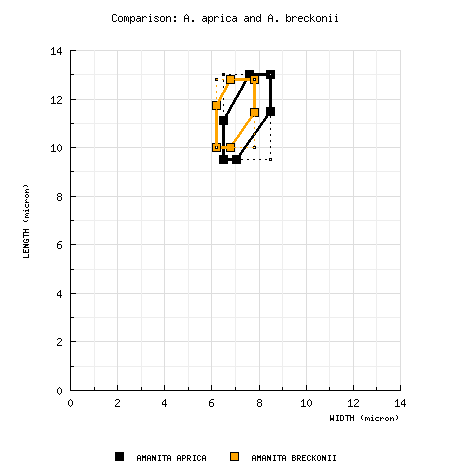
- spores proportionately narrower, with Q = (1.51-) 1.52 - 1.74 (-1.85) and Q´ = 1.63
- locally common basidial clamps
- submedian partial veil
- pileus margin becoming distinctly tuberculate-striate in age
- pileus disc often becoming Cinnamon Buff (1Y 7.2/6.0) in age.
The following figure compares sporographs for A. aprica and A. breckonii.
The supposed double annulus of A. breckonii comprises a weakly structured partial veil and, below this, a substantial ring of tissue of the limbus internus of the universal veil. The latter has a triangular cross-section having its apex pointing upward—strongly suggesting a second partial veil at first glance. In the several exsiccata of A. breckonii examined by Tulloss, the “lower annulus” is not always present.
Amanita gemmata (the European “taxon” may be a complex of several entities) can be distinguished from A. aprica by means of the following characteristics:
- spores proportionately broader than those of A. aprica, having Q = 1.29 - 1.36 (Tulloss and Gulden 1999) or with Q = 1.42 ± 0.13 (Yang and Doi 1999) or with Q’ = 1.31 based on data of Neville and Poumarat (2004: 381) or, estimating from data of Breitenbach and Kränzlin (1995), having Q approximately 1.25 - 1.27.
- universal veil on pileus dominated by filamentous, undifferentiated hyphae disordered or with subradial orientation and also including scattered or locally fairly abundant inflated cells (Yang 1997: 51).
- pileus color ranging from yellow-orange (material of southern France) to tannish shades of yellow to pale tan (material of Norway) to nearly white with tan restricted to disc (material of Turkey)
- pileus margin distinctly striate
- basidiocarps more gracile and with cap width reaching only about a bit more than half (Marchand 1997; Neville and Poumarat 2004: 380) to two-thirds the maximum size of those of A. aprica (Bresinsky and Besl 1990; Persson 1992; Breitenbach and Kränzlin 1995).
Kauffman (1926: 122-123) describes material from Mt. Hood determined by him as A. jonquillea with spores 10-12 × 7-8 mm (his comments indicate that he excludes extremes of length and, hence, presumably, width). It is very possible that Kauffman’s material determined as jonquillea is assignable to A. aprica.
The habit and spores described for A. muscaria var. formosa sensu Nakamura are rather good matches to the habit and spores of A. aprica. In addition, Nakamura’s “form B” is the only yellow entity of Amanita section Amanita described by Nakamura that occurs in the April-June period—apparently the most common fruiting period for A. aprica—indeed, all our collections from Oregon and Washington were made in this period.
While accepting with minimal comment Nakamura’s observations on A. muscaria, Breckon (1968: 51-57) appears to have interpreted A. aprica as “montane specimens” of “Amanita junquillea sensu A. H. Sm.” Among the characters noted for the “montane specimens,” Breckon includes a pileus with nonstriate margin and universal veil tending to cover much of the surface. The fruiting period for these specimens is described as “late spring through the autumn,” which is compatible with the dates of collection of the California paratypes of A. aprica.
North American taxa referred to A. gemmata include A. russuloides (Peck) Sacc. (1887) (Jenkins 1977), A. xylinivolva Tulloss, Ovrebo and Halling (1992), and several apparently distinct, undescribed species. Both of the above-named species are smaller and more gracile than A. aprica; both have striate margins; and both have proportionately broader spores.
Asian species, including those recently described by Zhu L. Yang and others, do not include any taxa that are comparable with A. aprica in all of the following: color, stature, form of universal veil, and spore dimension and shape.
Lindgren 92-5 and 94-08 and Lockaby “A” (so marked by Tulloss) comprise immature material.
In correspondence and keys, we have used the code “Amanita sp. NW2” for A. aprica.
In several sections of Amanita, there have been noted taxa that characteristically fail to produce, or delay in producing, a gelatinizing zone allowing separation of pileipellis and universal veil.
In subsection Vittadiniae Bas of Amanita section Lepidella, as well as in other notable species of that section such as A. rhoadsii (Murrill) Murrill and A. magniverrucata Thiers & Ammirati, the universal veil remains long attached to the pileus context and a pileipellis is reduced to a layer of context including rather densely placed hyphae or, quite often, is entirely absent.
In other sections, a freshly opened pileus may have a frosty appearance caused by the dense distribution of hyphal stubs pro-jecting upward from the ungelatinized or minimally gelatinized pileipellis after a submembranous or membranous universal veil has been pulled away during expansion of the basidiome.
In section Amanita, in particular, there are a number of taxa that retain much of the universal veil on the pileus because of delayed or absent gelatinization—as has been noted in A. aprica. Some examples are A. basiana Tulloss & M. Traverso, A. farinosa Schwein., A. friabilis (Karst.) Bas, A. nehuta G. S. Ridl., and A. xerocybe Bas. The long-term attachment of pileipellis and universal veil does not appear to be a character that should be considered justification for grouping A. aprica taxonomically with these other taxa. The above group is characterized by the following: Significantly smaller basidiomes (and consequent markedly striate pileus margins), frequent absence of a partial veil (in the single exception, A. basiana, the partial veil is very weakly structured and detersile), powdery universal veil, and spores with Q between 1.0 and 1.35 (95% of A. aprica spores have Q falling above this range).
Observations on toxicity:
We know of one poisoning involving the present species. On May 30, 1990, Lindgren was involved as the mushroom identifier in a case involving an 80 year-old Bulgarian immigrant who spoke no English. He had eaten a frying pan full of A. aprica spread over both breakfast and lunch and, possibly, sampled the mushroom the previous day. The number of fruiting bodies ingested was not established. There were four remaining mushrooms cleaned, but uncooked upon which the determination was based (Lindgren 90-13).
|
| citations |
The original description by Tulloss and Lindgren (2005) is available as a PDF. (open)—R. E. Tulloss |
| editors |
RET |
|



 Spore data sets and their composite