| name |
Amanita
xerocybe |
| author |
Bas. 1978. Persoonia 10: 7, figs. 9-13. |
| name status |
nomen acceptum |
| english name |
"Dry-capped Amanita" |
| etymology |
double click in markup mode to edit. |
| MycoBank nos. |
308602 |
| GenBank nos. |
Due to delays in data processing at GenBank, some accession numbers may lead to unreleased (pending) pages.
These pages will eventually be made live, so try again later.
|
| holotypes |
INPA; isotype L |
| revisions |
C. Simmons, T. Henkel and Bas. 2002. Persoonia 17(4): 578, fig. 6(a-e), pl. 7. |
| intro |
The following text may make multiple use of each data field.
The field may contain magenta text presenting data from a type study
and/or revision of other original material cited in the protolog of the present taxon.
Macroscopic descriptions in magenta are a combination of data from the protolog and
additional observations made on the exiccata during revision of the cited original
material.
The same field may also contain black text, which is data from a revision of the present
taxon (including non-type material and/or material not cited in the protolog).
Paragraphs of black text will be labeled if further subdivision of
this text is appropriate.
Olive text indicates a specimen that has not been
thoroughly examined (for example, for microscopic details) and marks other places in the text
where data is missing or uncertain.
The following material is derived from the protolog and from Simmons et al. (2002).
from protolog: medium-sized, fairly slender, fleshy, rather fragile. |
| pileus |
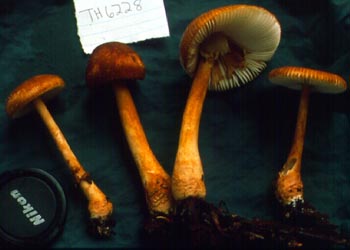
from protolog: 40 - 67 mm wide, at first sordid whitish, later becoming ochraceous, at center brownish ochraceous yellow to ochraceous brown [Chipmunk (MP) to Antique Brown (MP) to 10YR 5/6-8 to ca. 7.5YR 5/6], from conico-convex with broadly rounded apex to convex, soon flattened around low obtuse umbo; context ; margin sulcate-striate (0.25 - 0.35R), with marginal ridges 1.8 - 2 mm broad, with edge crenulate; universal veil as subfelted-subflocculose covering breaking up into minute granular-subflocculose "dots," gilvous, especially dense over disc, more sparse at margin, adnate. |
| lamellae |
from protolog: free, distant, whitish at first, soon becoming cream, in dried specimens cream to buff, somewhat intervenose, broad, with edge minutely subflocculose-subgranular and concolorous; lamellulae truncate, very scarce, at times partially adnate to lamellae. |
| stipe |
from protolog: up to 90 × 5 mm, narrowing upward, gilvous to ochraceous tan, in dried material sordid brownish ochraceous, with thin covering of universal veil remnants; bulb as "enlarged" or slenderly fusiform base (about lower quarter of stipe), up to 9 mm wide; context stuffed, white to creamy, unchanging, with narrow central cylinder; partial veil apical, easily separating, deciduous, thickish and fluffy, smooth, concolorous with stipe surface, minutely granular above when dried, felted-subflocculose below when dried; universal veil as narrow fragmented rim around upper bulb (hardly visible when dried). |
| odor/taste |
from protolog: Odor lacking. Taste not recorded. |
macrochemical
tests |
none recorded. |
| pileipellis |
from protolog: lacking gelatinized suprapellis; filamentous hyphae ca. 3 - 6 μm wide. |
| pileus context |
not described. |
| lamella trama |
from protolog: "very loose and therefore difficult to section when dried." |
| subhymenium |
from protolog: comprising rather small, mostly sphaeropedunculate cells. |
| basidia |
from protolog: 35 - 45 × 9.5 - 11.0 μm, 4-sterigmate; clamps absent. |
| universal veil |
from protolog: On pileus: as relatively thin broken layer, with upper three-quarters comprising mainly erect inflated terminal cells, with lower quarter comprising mainly more or less erect hyphae; filamentous hyphae 3 - 8 μm wide, colorless, with thin to slightly thickened walls; inflated cells 28 - 62 × 24 - 54 μm, abundant, broadly ellipsoid to obovoid, more rarely broadly clavate or globose, with brown vacuolar pigment and slightly thickened walls, terminal singly. On stipe base: Similar to material on pileus, with more frequent hyphae and more elongate inflated cells. |
| stipe context |
from protolog: [longitudinally acrophysalidic—ed.] acrophysalides abundant, up to 280 × 35 μm.
[Note: The surface of the stem in Amanita usually comprises more frequent hyphae than does the interior and has acrophysalides significantly smaller. In the present species Bas notes in the protolog that the latter are sphaeropedunculate to broadly clavate, brownish, and often mucronate.—ed.] |
| partial veil |
from protolog: two-layered. Upper layer: filamentous hyphae 2.5 - 6 μm wide; inflated cells crowded, globose to ovoid or pyriform, usually pedunculate, pale brown, 28 - 60 μm long, terminal. Lower layer: filamentous hyphae more abundant than in upper layer; inflated cells smaller than in upper layer. |
| lamella edge tissue |
from protolog: as proportionately rather broad, yellow-brown (in NH4OH) strip; inflated cells globose to ellipsoid, of pedunculate, sometimes clavate, 28 - 50 (-60) × 24 - 34 μm, colorless to pale brown, often with slightly thickened walls, sometimes with "pale amorphous substance" on exterior. |
| basidiospores |
from protolog: [10/1/1] 7.8 - 9.1 (-9.7) × 7.6 - 9.1 (-9.5) μm, (Q = 1.0 - 1.05), smooth, with very slightly thickened wall, inamyloid, globose to subglobose, often attenuate toward apex; apiculus "normal or rather broad"; contents mono- to multiguttulate; color in deposit not recorded.
from Simmons et al. (2002): [49/3/3] 6.0 - 9.0 × 6.0 - 8.6 (-9.4) μm, (Q = 1.0 - 1.10; Q = 1.03 - 1.04), smooth, with slightly thickened wall, inamyloid, globose to subglobose; apiculus "normal"; contents not recorded; color in deposit not recorded. |
| ecology |
Brazil: "Solitary. On raw humus under trees in campinarana vegetation..., forming ectomycorrhiza with Sapotaceae and/or Leguminosae.
Guyana: from Simmons et al. (2002): In "riverine swamp forest and adjacent slope forest dominated by Dicymbe corymbosa (Paluwayek) and other mixed hardwoods, on sand soils with thick organic accumulations and on exposed sandstone and cliff boulders." |
| material examined |
from protolog: BRAZIL: AMAZONAS—rd. from Manaus to Caracarai, km 45, 28.ii.1978 H. St-John & R. Singer B10730 (holotype, INPA; isotype, L).
from Simmons et al. (2002): GUYANA: POTARI-SIPARUNI REGION—Pakaraima Mtns., Upper Ireng watershed - Suruwaburu Crk., 1-2 km upstream from juncture with Jurka R., 2.iii.1997 T. Henkel TH6217 (BRG); ca. Sukabi R., 1-2 km upstream from confluence with Ireng R., 22.v.1998 Terry Henkel TH 6434 (BRG); Mt. Kukuinang, ca. 3 km WSW from peak, 25.v.1998 T. Henkel TH6614 (BRG; L); Upper Ireng R. 0.2-1 km downstream from Kurutuik Falls, 15.ii.1997 Terry Henkel TH6261 (BRG; L). |
| citations |
—R. E. Tulloss |
| editors |
RET |
|



 Spore data sets and their composite