| name |
Amanita friabilis |
| author |
(P. Karst.) Bas. 1974. Bull. Soc. Linn. Lyon, No. Spéc., Trav. Déd. Kühner: 17. |
| name status |
nomen acceptum |
| english name |
"Alder Ringless Amanita" |
| synonyms |
≡Amanitopsis vaginata subsp. friabilis P. Karst. 1879. Bidrag Kännedom Finlands Natur Folk 32: 547.
≡ Amanitopsis friabilis (P. Karst.) Sacc. 1887. Syll. Fung. 5: 22.
≡ Pseudofarinaceus friabilis (P. Karst.) Kuntze. 1891. Rev. Gen. Plant. 2: 868.
≡ Vaginata friabilis (P. Karst.) Kuntze. 1898. Rev. Gen. Plant. 3(2): 539.
= Amanita alnicola Rouzeau & F. Massart in Rouzeau nom. inval. 1970 ["1967"]. Actes Soc. Linn. Bordeaux 104 sér. (9): 4. [Lacking designation of holotype. ICBN §37.1] ≡Amanita alnicola Rouzeau & F. Massart nom. inval. 1966. Actes Soc. Linn. Bordeaux 103(A3): 5. [?? ICBN §??]
= Amanita sternbergii Velen. 1920. České Houby 1: 192. ≡ Amanita vaginata f. sternbergii (Velen.) Veselý. 1933. Ann. Mycol. 31(4): 296. ≡Amanitopsis sternbergii (Velen.) J. Favre nom. inval. 1960. Ergebn. Wiss. Unters. Schweiz. NatnParks 6 (Neue Folge): fig. 100. [Lacking full and direct reference to basionym. ICBN §33.2] ≡Amanitopsis vaginata var. sternbergii (Velen.) J. Favre. nom. inval. 1960. op. cit.: 566. [Lacking full and direct reference to basionym. ICBN §33.2]
The editors of this site owe a great debt to Dr. Cornelis Bas
whose famous cigar box files of Amanita nomenclatural information
gathered over three or more decades were made available to RET for computerization
and make up the lion's share of the nomenclatural information presented on this site.
|
| MycoBank nos. |
308552, 278854 |
| GenBank nos. |
Due to delays in data processing at GenBank, some accession numbers may lead to unreleased (pending) pages.
These pages will eventually be made live, so try again later.
|
| holotypes |
A. sternbergii—PRC |
| lectotypes |
A. friabilis—H |
| lectotypifications |
A. friabilis—??Bas. 1974. op. cit.: 21. |
| type studies |
A. sternbergii—Bas. 1982. Persoonia 11: 441, fig. 4(b-b'). |
| selected illustrations |
Zecchin. 2000. Boll. Gruppo Micol. G. Bresadola 43(2): 164. |
| intro |
The following text may make multiple use of each data field.
The field may contain magenta text presenting data from a type study
and/or revision of other original material cited in the protolog of the present taxon.
Macroscopic descriptions in magenta are a combination of data from the protolog and
additional observations made on the exiccata during revision of the cited original
material.
The same field may also contain black text, which is data from a revision of the present
taxon (including non-type material and/or material not cited in the protolog).
Paragraphs of black text will be labeled if further subdivision of
this text is appropriate.
Olive text indicates a specimen that has not been
thoroughly examined (for example, for microscopic details) and marks other places in the text
where data is missing or uncertain.
The following material not directly from the protolog of the present taxon or the protolog of one of its taxonomic synonyms and not cited as the work of C. Bas or another researcher is based upon original research by R. E. Tulloss. |
| pileus |
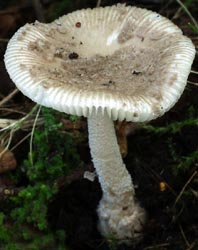
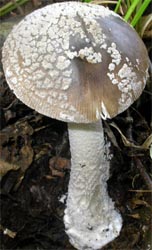
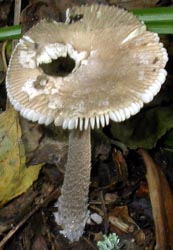
protolog: universal veil
covering pileus with sordid gray patches. |
| stipe |
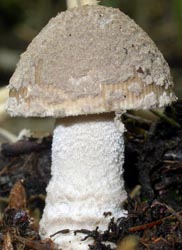
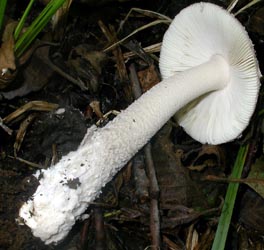
protolog: universal veil
soon breaking up into sordid gray patches. |
macrochemical
tests |
none described. |
| basidiospores |
Bas (1974): [180/17/10] (9.5-) 10 - 12.5 (-14.5) × (7-) 8 - 10 (-10.5) μm, (Q = (1.0-) 1.10 - 1.50 (-1.55); Q = 1.20 - 1.35), colorless, hyaline, inamyloid, subglobose to broadly ellipsoid to ellispoid, rarely globose; apiculus abrupt; contents mostly as single large guttule; white in deposit [per Rouzeau (1970: 3)].
Bas (1982) from holotype of A. sternbergii: [10/1/1] 10.2 - 12.1 × 8.5 - 9.8 (-10.8) μm, (Q 1.10 - 1.35; Q = 1.20), colorless, hyaline, thin-walled, inamyloid, subglobose to broadly ellipsoid, rarely ellipsoid, sometimes obovoid; apiculus medium-sized, abrupt, subtruncate; contents not described; color in deposit not recorded.
composite from all material revised by RET: [125/6/5] (8.4-) 9.5 - 12.8 (-17.8) × (6.6-) 7.4 - 9.9 (-11.5) μm, (L = 10.8 - 11.9 μm; L' = 11.2 μm; W = 7.9 - 9.0 μm; W' = 8.4 μm; Q = (1.06-) 1.13 - 1.62 (-1.89); Q = 1.23 - 1.43; Q' = 1.34),
hyaline, colorless, smooth, thin-walled, inamyloid, subglobose to broadly ellipsoid to ellipsoid, infrequently elongate, sometimes swollen toward one end, predominantly adaxially flattened, rarely constricted, with "giant" spores sometimes present; apiculus sublateral, cylindric, often rather large proportionately; contents granular or dominantly monoguttulate with additional small granules; color in deposit not recorded. |
| ecology |
Solitary to abundant. In Alnus bush or in moist Alnus thicket with some Betula and several taxa of Russulaceae or with Alnus by stream in rich Picea forest or with Alnus glutinosa. |
| material examined |
Bas (1974):
FINLAND: Pohjois-Savo,
Lapinlahti, Rasila, 20.viii.1956 O. v.
Schulmann (H); Etalä-Häme,
Tammela, Heinämaa, 5.x.1879 P. A. Karsten
868 (lectotype, H); Tammela, Mustiala,
1.viii.1952 O. v. Schumann (H).
FRANCE:
GIRONDE—Mérignac, ca. Bordeaux,
1.ix.1966 C. Rouzeau s.n. (L, from putative type
locality of A. alnicola).
GERMANY:
BRANDENBURG—Fresdorf, ca. Potsdam,
22.x.1968 D. Benkert s.n. (in herb. Benkert),
10.viii.1970 D. Benkert s.n. (in herb.
Benkert). RHEINLAND—Eifel
Gerolstein, 5.x.1971 F. Tjallingii s.n.
[C. Bas 5730] (L).
NETHERLANDS:
LIMBURG—Nederweert, "Groote Moost," 15.x.1972 J. Frencken & G.-A. de Vries s.n. (in herb. Frencken; L).
SWITZERLAND: GRAUBÜNDEN—Swiss Nat. Pk., Bugliauna et Val Trupchun, 31.viii-1.ix.1975 J. Favre 755 (CHUR).
Bas (1982): CZECH REPUBLIC: CENTRAL BOHEMIA—Prague, Mnichovice s.d. Velenovsky s.n. (holotype of Amanita sternbergii, PRC). [Note: The collection cannot be dated later than 1920.—ed.]
RET: AUSTRIA:
Hauswandel, ca. 5 km SSE of Klagenfurth,
7.x.1978 C. Bas 7422 (L; RET 278-3).
FRANCE:
SAVOIE—le Bourget -
en Huile “les Berthollets,”
26.viii.2006 Pierre-Arthur Moreau 06082601
(LIP; RET 395-5, nrITS seq'd.); en Huile-Marais des Bords
du Gelon, 26.viii.2006 Pierre-Arthur Moreau
06082602 (LIP; RET 395-10, nrITS seq'd.),
06082603 (LIP: RET 396-1, nrITS seq'd.).
GERMANY: BRANDENBURG—ca. Potsdam, Fresdorf, 22.x.1968 D. Benkert s.n. (L; RET 278-4).
NORWAY:
HEDMARK—Ringsaker, Furnesåsen, Putten
[UTMED50 (PN10-11,53-54)], 22.ix.1995
G. Gulden 91/95 (0 58532).
OPPLAND—Gjövik komm., Svennesvollene
naturreservat [NN 8760 (1816I)], 24.vii.1985 T. E.
Brandrud & J. Stordal 24310 (O 58532).
ÖSTFOLD—Hvalar, Kirköy, 2.ix.1982 Ö.
Weholt 191182 (L; RET 278-2, nrITS seq'd.).
[Note: The Austrian material is genetically distinct
and will be moved.—ed.]
|
| discussion |
The entire protolog is as follows: "Hatten fullsatt
med breda, oregelbundna, smutsgrå fjäll; slidan snart
upplöst till fjäll."
Material from the intended type locality of
A. alnicola (which has no nomenclatural
significance) is located in both L and in the
herbarium of Soc. Linn. Bordeaux. |
| citations |
—R. E. Tulloss |
| editors |
RET |
|



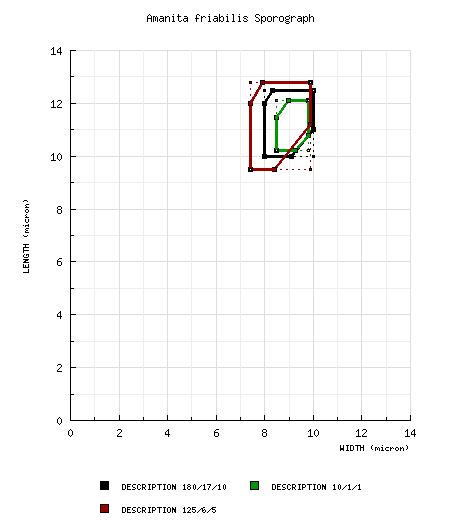
 Spore data sets and their composite