| name |
Amanita magniverrucata |
| author |
Thiers & Ammirati. 1982. Mycotaxon 15: 161. |
| name status |
nomen acceptum |
| english name |
"Great-Warted Lepidella" |
| MycoBank nos. |
109591 |
| GenBank nos. |
Due to delays in data processing at GenBank, some accession numbers may lead to unreleased (pending) pages.
These pages will eventually be made live, so try again later.
|
| holotypes |
SFSU |
| revisions |
Tulloss. 2009. Mycotaxon 108: 93-104. |
| intro |
The following text may make multiple use of each data field.
The field may contain magenta text presenting data from a type study
and/or revision of other original material cited in the protolog of the present taxon.
Macroscopic descriptions in magenta are a combination of data from the protolog and
additional observations made on the exiccata during revision of the cited original
material.
The same field may also contain black text, which is data from a revision of the present
taxon (including non-type material and/or material not cited in the protolog).
Paragraphs of black text will be labeled if further subdivision of
this text is appropriate.
Olive text indicates a specimen that has not been
thoroughly examined (for example, for microscopic details) and marks other places in the text
where data is missing or uncertain.
The following material not directly from the protolog of the present taxon is from a recent revision (Tulloss 2009) of Amanita magniverrucata that is available here in PDF form. (open) However, note that one specimen included in that paper has had to be removed from the description here along with all data that derived from that specimen. |
| pileus |
Tulloss (2009):
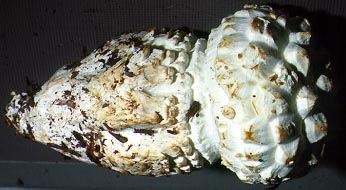
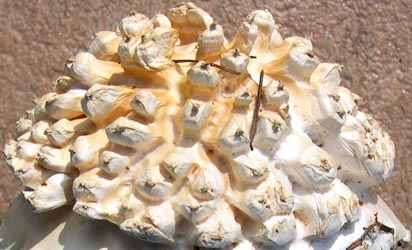
60 - 156 mm wide, white to whitish at first, darkening
slightly when bruised, becoming sordid yellowish-cream
with gelatinization in senility, globose to convex
becoming plano-convex to plane or shallowly depressed in
age, with surface having dry dull appearance until age,
then moist to subviscid
in senility or (if universal veil fissuring extending
into context) with visible color that of universal veil
at first, context sometimes visible in senility,
lacking distinct pileipellis;
context 8 - 30 mm thick at stipe, thinning
evenly to margin, white, unchanging when cut or
bruised, firm; margin nonstriate, strongly
incurved at first, decurved at maturity, often strongly
appendiculate [with flocculence from universal veil on
marginal region and with substantial (often
subpolygonal) pieces of partial veil]; universal
veil at first as thick and rather smooth covering of
entire pileus, then becoming areolate, later as
conspicuous pyramidal warts, large over disc and much of
pileus at first, smaller or absent toward margins (even
at first), fleshy, with surfaces longitudinally
striatulate, further stretching and flattened or
breaking up with further pileus expansion, white to tan
to light brown (5-7D4-8) to Warm Buff (1Y7.8/6.0),
becoming darker brown to reddish brown on tips,
sometimes becoming brownish to pale reddish brown
(below brown tips) from disc outward, up to 20 mm wide
at base and 10 mm high, adnate until age (but rather
easily broken and then leaving irregular scar on
remaining universal veil tissue). |
| lamellae |
Tulloss (2009): narrowly adnate or shallowly notched at first, becoming free, with decurrent line on stipe at least until loss of partial veil material, subdistant to crowded, white to off-white to pale ivory to pale buff, 9± mm broad, with fimbriate margin, often with partial veil remnants attached, broadest at about 75% of distance from stipe to pileus margin; lamellulae subattenuate, unevenly distributed, of diverse lengths, plentiful. |
| stipe |
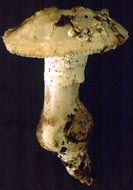
Tulloss (2009): 28–120 × 10–34 mm, white to whitish, often with brown to reddish brown to buff stains, cylindric to subcylindric or narrowing upward, not flaring at apex, dry, glabrous above partial veil, appressed fibrillose to flocculose
below, eventually becoming longitudinally striatulate at least in part; bulb 35 - 105 × 18 - 60 mm, dauciform or napiform at first (about equal in width to developing pileus in some “button” specimens), becoming less strongly differentiated from stipe as both diameters decrease during expansion of stipe, often with shallow vertical splitting in upper half, sometimes doglegged; context white, unchanging when cut or bruised, solid, dense; partial veil apical to superior, eventually breaking and tearing and (subsequently) lost or collapsing on stipe, white, submembranous to subfelted to floccose-fibrillose, with plentiful soft white cottony patches on underside; universal veil as scattered warts on stipe below partial veil and as one to 11 or more irregular or concentric rings (entire or comprising scales or warts) on upper bulb and lower stipe, white, becoming brownish or orange-brown with age, friable, often disappearing with age. |
| odor/taste |
Tulloss (2009): Odor indistinct at first, later strong and unpleasant. Taste mild. |
macrochemical
tests |
Tulloss (2009): FeSO4 - greenish then gray on pileus context (protolog). Spot test for tyrosinase (paracresol) - only minor reactions in bulb in “button” specimen. Spot test for laccase (syringaldazine) - negative throughout basidiome. [Chemical test voucher for phenoloxidases: Tulloss 11-24-89-D.] |
| pileipellis |
Tulloss (2009): poorly differentiated or absent. |
| pileus context |
Tulloss (2009): filamentous, undifferentiated hyphae 2.5 - 17.5 μm wide, branching, plentiful to dominating, curving, interwoven or tangled loosely, without dominant orientation, with thin to slightly thickened walls, sometimes with yellowish subrefractive walls; acrophysalides plentiful, clavate to fusiform to ellipsoid to ovoid to subpyriform, up to 85 × 38 μm or larger; vascular hyphae 3.8 - 16.8 μm wide, branching, yellow-brown, scattered, locally common. |
| lamella trama |
Tulloss (2009): bilateral, divergent; wcs = 75 - 115 μm; with elements of subhymenial base [uninflated and partially inflated hyphal segments and intercalary clavate cells (e.g., 32 × 16.5 μm, 41 × 15.0 μm)] diverging at angles up to 45° and concatenated in sweeping curve to subhymenium; filamentous, undifferentiated hyphae 3.2 - 11.0 μm wide, branching, with constrictions at some septa, with some intercalary segments slightly inflated; divergent, terminal inflated cells absent(?); vascular hyphae not observed; clamps infrequent. |
| subhymenium |
Tulloss (2009): wst-near = 80 - 110 μm; wst-far = 110 - 150 μm; comprising a branching structure of inflated cells (subglobose to pyriform nearest to subhymenial base and fusiform nearest basidia) and short uninflated hyphal segments, with elements having major diameter perpendicular to central stratum for at least two cell lengths below bases of longest basidia, with basidia arising from uninflated or
partially inflated hyphal segments or fusiform cells or very small subglobose inflated cells or branched elements (with varying degrees of inflation), with 2 to 2½ cells between bases of shortest and longest basidia; clamps infrequent. |
| basidia |
Tulloss (2009): 28 - 52 × 7.0 - 11.8 μm, thin-walled, dominantly 4-, but also occasionally 2- or 1-sterigmate; clamps and proliferated clamps
infrequent, sometimes thin-walled and inconspicuous. |
| universal veil |
Tulloss (2009): On pileus: with
orientation of elements dominantly periclinal in base of wart but anticlinal or periclinal in upper part, with elements of lower part of wart dominantly hyaline and colorless and (at very base) arising from hyphae of dense upper portion of pileus context; with elements of upper part yellow-brown to orange-brown in mass (individually clouded and sordid yellowish to yellow to yel-
low-brown) and gelatinizing and somewhat disordered; filamentous, undifferentiated hyphae 3.5- 19.5 μm wide, branching, common, occasionally with yellowish subrefractive walls, with those segments or parts of segments of largest diameter having slightly thickened walls; inflated cells dominating, terminal, singly or in short chains, with cells in such chains often easily dissociating, subglobose to ellipsoid to ovoid to clavate to broadly fusiform or subcylindric (with latter two forms the least common and restricted to smaller cells), up to 76 × 56 μm, with walls 0.5
- 1.0+ μm thick; vascular hyphae 4.0 - 12.2 μm wide, sometimes brownish yellow, branching, unevenly distributed, locally common; clamps thin-walled, inconspicuous, infrequent. On stipe base, at top of bulb in immature specimen: very similar to material on pileus,
with greater proportion of filamentous, undifferentiated hyphae, with some inflated cells brown, with inflated cells smaller (on average) than on pileus. |
| stipe context |
Tulloss (2009): longitudinally acrophysalidic; filamentous, undifferentiated hyphae 1.8 - 11.0 μm wide, plentiful, branching, often in longitudinally oriented fascicles, occasionally with yellowish subrefractive walls, with walls thin or up to 1.0 μm thick; acrophysalides dominating, up to 203 × 55+ μm, with walls thin or up to 0.5 μm thick; vascular hyphae not observed. |
| partial veil |
Tulloss (2009): filamentous, undifferentiated hyphae 3.2 - 8.0 μm wide, dominating, frequently branching, twisting and coiling, often in fascicles of rather few hyphae, sometimes with yellowish subrefractive walls, with walls thin to slightly thickened; inflated cells scattered, occurring more frequently in region adjacent to stipe surface, clavate, terminal (singly), up to 51 × 11.5 μm
(but often about 60% of this size or less), with walls slightly thickened or up to 0.5 μm thick; vascular hyphae 6.0 - 9.0 μm wide, infrequent. |
| lamella edge tissue |
sterile. |
| basidiospores |
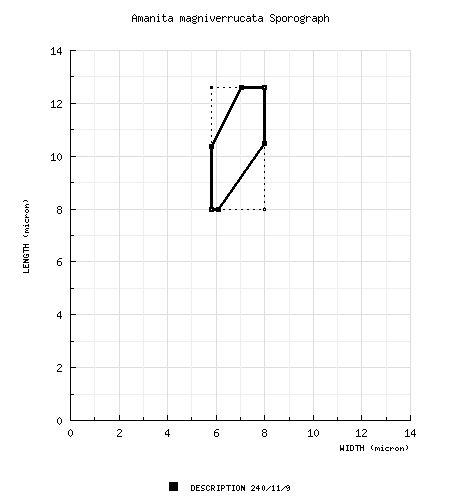
[240/11/9] (6.5–) 8.0–12.6 (–15.5) × (4.5–) 5.8–8.0 (–9.5) µm, (L = 8.5–11.6 (–12.0) µm; L’ = 10.3 µm; W = 6.0–7.4 (–7.5) µm; W’ = 6.8 µm; Q = (1.17–) 1.31–1.79 (–3.75); Q = (1.39–) 1.42–1.66; Q’ = 1.52), hyaline, colorless, thin-walled, smooth, amyloid, ellipsoid to elongate, rarely bacilliform or irregularly shaped in specimens with sporulation just beginning when dried, adaxially flattened, sometimes inflated at one end; apiculus sublateral, cylindric; contents mono- to multiguttulate; white in deposit. |
| ecology |
Solitary to gregarious, apparently uncommon in some
years throughout its range, but sometimes producing
common fruitings (protolog). California: In
coastal forests, with Pinus muricata D. Don
and Quercus agrifolia Née or with Q.
agrifolia or with Quercus and Arbutus
menziesii Pursh or with P. muricata and
Arctostaphylos manzanita Parry and
Vaccinium ovatum Pursh or in dark loam under
conifers. Possibly associated with similar
trees in Baja California Norte, Mexico.
With regard to recovery after forest fire, the
following was received from T.D. Bruns (UBC) (pers.
comm., 10.vi.2008): "The ... [A.
magniverrucata collecting] location on
Limantour Rd. in Pt. Reyes burned in 1995, and the
species disappeared from the site for over a
decade. But this year we got several
collections of it from the area again." |
| material examined |
U.S.A.:
ARIZONA—Coconino Co. - unnamed loc.
[35.6308º N/ 112.0525º W, 1860 m]. 8.ix.2016 Terri
Clements 1602 [mushroomobserver
#251626]
(RET 771-1, nrITS-LSU seq'd.).
CALIFORNIA—Alameda Co. - Huckleberry Botanical Preserve [37.8423 N 122.190 W, 269 m], 17.v.2005 Debbie Viess s.n. (RET 383-6, nrLSU seq’d);
Oakland, ca.
Skyline Blvd., 20.i.2003 Mark Lockaby s.n.
[Tulloss 1-20-03-A] (RET 366-8), 31.i.2003 Debbie
Viess s.n. (RET 366-9). Marin Co. - Bon Tempe
Reservoir [37.987° N/ 122.67° W, 207 m
elev.], 4.iv.2014 R Pastorino 4-4-14F
[mushroomobserver
#163095]
(RET 594-10, nrLSU seq'd.);
Inverness Ridge, 24.xi.1989 Chris Thayer & Phil
Baird s.n. [Tulloss 11-24-89-D] (RET 092-5); Tomales
Bay St. Pk. [38.2922° N/ 122.986 ° W, 113 m], 21.i.2003 R. Pastorino s.n. (RET
366-7), 6.iv.2014 R. Pastorino 4-6-14C
[mushroomobserver
#163115]
(RET 594-5, nrITS & nrLSU seq'd.).
Mendocino
Co. - Mendocino, xi.1991 D. Arora 2001 (RET 039-8)
& 2002 (RET 040-1).
Orange Co. - Laguna Niguel, Aliso and Wood Canyons
Wilderness Park [33.5501° N / 117.746° W, 139 m],
3.iii.2015 Kevin Lentz s.n. [mushroomobserver.org
#200108]
(RET 686-5, nrITS seq'd.).
Santa Barbara Co. -
Montecito, E. Valley Rd., 12.ii.1950 M. G. Rea F.11
(MICH); unkn. loc., 21.iii.1944 P. M. Rea H.1341
(MICH).
Santa Clara Co. - E. of Los Gatos, Reynolds
Rd. [37.1961 N/ 121.8907 W, 356 m], 4.ii.2020 Dora
Panayotova s.n. [iNat
#38313319]
(RET 893-4, nrLSU
seq'd.),
Santa Cruz Co. - Santa Cruz,
19.iii.1987 Marsha Heidt s.n. [H. D. Thiers 51203]
(SFSU). San Mateo Co.
- San Francisco Watershed, 13.iii.1970 Robert S.
Keller 801 (holotype, SFSU; isotype, NY,
n.v.).
OREGON—Washington Co. - Banks,
x.2004 coll. unkn. s.n. (RET 382-5, nrITS seq'd.) |
| discussion |
Tulloss (2009): "This species was placed in A. sect. Lepidella when originally published; and, so far as I know, all subsequent authors treating the species have agreed (e.g., see the listed sources of illustrations, above). Within the cited section, placement in lower supraspecific ranks has not been attempted to the author’s knowledge.
"The protolog includes an apparent misinterpretation of the upper, denser part of the pileus context as a pileipellis, which was compounded by Thiers (1982: 29) who wrote: “pileus cuticle a trichodermium with terminal hyphal cells large and sausage shaped.” While the description of the hyphae and acrophysalides are as in the protolog, the addition of the term “trichodermium” indi-
cates that Thiers may have misinterpreted as a pileipellis that portion of the volva that often continues below the bottoms of the fissures that separate the warts.
"By Bas’ key (Bas 1969: 345), the present taxon could be placed in either A. subsect. Solitariae Bas (1969) or in A. subsect. Vittadiniae Bas (1969)—
according to one’s interpretation of the shape of the inflated cells of the volva. Other possibilities are eliminated because of (e.g.) the absence of an exterior, membranous layer in the universal veil of A. magniverrucata.
Placement within subsect. Vittadiniae would require interpretation of the basal cells of the volva as elongated and organized in chains. No other species in the subsection has cells of the shape illustrated in Fig. 3b. The absence of a
pileipellis is very common (if not universal) in the known species of subsect. Vittadiniae. On the other hand, a scattering of taxa in other of Bas’ subsections of
A. sect. Lepidella also lack a pileipellis (see below).
The key to the stirpes within subsect. Solitariae (Bas 1969: 386–388) first requires knowledge of the presence or absence of clamp connections. Since, clamp connections were observed in multiple tissues of the material examined for this article, we are led to the choice of stirps Microlepis because the universal veil warts of the present species lack a “pad” dominated by hyphae at their bases and have their elements anticlinally oriented—at least in the upper
portions of a wart.
One species placed by Bas (1969) within stirps Microlepis is of particular interest in terms of comparison to the present taxon—A. abrupta Peck (1897). This species’ stipe has a subabrupt, napiform or turbinate bulb with continuous or occasionally broken, often rather finely delineated, concentric rings of universal veil tissue on its upper surface,somewhat mirroring the coarser concentric rings of volval material on the upper bulb of A. magniverrucata. The pyramidal, volval warts on the pileus of A. abrupta are much the largest of any of the other taxa Bas placed in stirps Microlepis. These pyramidal warts are (at first) connected to a pileipellis as little as 30 μm thick and lacking a noticeable, gelatinized suprapellis. Amanita abrupta differs from A. magniverrucata by having a distinct separation of universal veil from pileus context, having notably more rapid loss of volval warts due to eventual gelatinization at the surface of the limited pileipellis, having a membranous and persistent partial veil, having smaller globose to subglobose spores, having surface fibrils of the stipe that are drawn upward (suggesting a cortina) on the underside of the partial veil, having a distribution limited to the eastern US, having an unusually strong and pervasive positive reaction to the syringaldazine spot test for the presence of laccase, etc.
Amanita sphaerobulbosa Hongo (1969) is an east Asian taxon that appears to be quite similar to
A. abrupta. Maintaining distinction between the two species is recommended by Yang and& Doi (1999)—a position supported by the present author. Amanita magniverrucata is distinct from A. sphaerobulbosa by an argument similar to the one applied in the case of A. abrupta, above.
Arguments for either of the possible placements would require suppositions that do not seem entirely justified. The present species may be sufficiently unique to fail to fit into any of the stirpes Bas described. It seems preferable
to await further evidence, perhaps from molecular studies.
The report of the present species from Mexico (Ayala et al. 1988) should be reinvestigated. The pileus on the material from Baja California is described as subviscid, the pyramidal warts are described as only 1 mm high (possibly a typographical error?), the partial veil is described as membranous, and the concentric rings of universal veil on the stipe’s bulb are described as floccose.
In southern California, it may be possible to mistake A. magniverrucata for A. subcaligata (A.H. Sm. & P.M. Rea) A.H. Sm. ex Tulloss (Volk & Burdsall 1995) [=
A. salmonea Thiers (1957) (Bas 1969: 360–361, figs. 45–47)] or vice versa because some specimens of the latter can have rather large warts on the pileus and many specimens have pinkish, orangish or rusty coloration, sometimes bruising to buff. However, A. subcaligata is clearly a species of A. subsect. Vittadiniae and can be distinguished from the present species by its having plentiful, concatenated, elongate inflated cells in the universal veil on the pileus.
Other taxa of section Lepidella that lack a well-formed pileipellis, are not assignable to subsect. Vittadiniae, and can easily be distinguished from the present taxon by Bas’ keys (Bas 1969) include A. rhoadsii (Murrill) Murrill (1939) and A. crassiconus Bas nom. prov. (1969).
While a number of the new species described by Thiers & Ammirati (1982) originally were treated provisionally in unpublished MSc theses of Breckon (1968) and Nakamura (1965), the present species was not.
The present taxon has been called Amanita species C15 and A. species Vitt4 by the
present author in old versions of regional keys and correspondence."
[Note: Unfortunately, the molecular data on this species published by Wolfe et al. (2012) was based on material that proves not to be A. magniverrucata; and this data is, consequently, omitted from this page. All data based on Pastorino 1-21-05E (RET 387-10) has been removed in preparation of this text for the website. The latter collection is the basis for A sp-C17, a species of section Amanita.—ed.] |
| citations |
A recent revision (Tulloss 2009) of Amanita magniverrucata is available here in PDF form. (open)—R. E. Tulloss |
| editors |
RET |
|




 Spore data sets and their composite