| name |
Amanita basiana |
| author |
Tulloss & M. Traverso. 2001. Mycotaxon 77: 47, figs. 1-3. |
| name status |
nomen acceptum |
| english name |
"Bas' Amanita" |
| etymology |
Bas + -ana, suffix indicating possession; hence, "of Bas"
Honoring RET's late mentor, Dr. Cornelis Bas. |
| MycoBank nos. |
466451 |
| GenBank nos. |
Due to delays in data processing at GenBank, some accession numbers may lead to unreleased (pending) pages.
These pages will eventually be made live, so try again later.
|
| holotypes |
GDOR; isotypes in L, herb. M. Traverso, & RET |
| selected illustrations |
Tulloss & M. Traverso. 2000. Boll. Gruppo Micol. G. Bresadola 43(2): figs. a-d. |
| intro |
The following text is derived directly from the protolog of the present species (Tulloss and Traverso 2001), PDF 1.1MB (open) |
| pileus |
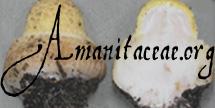
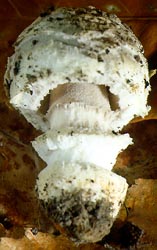
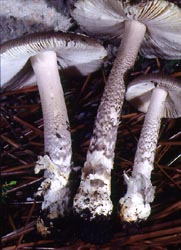
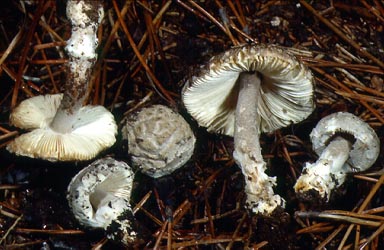
protolog: (30-) 40 - 75 (-100) mm wide, pale ash gray to brownish gray at first, becoming darker with age such as brownish gray with bronze tint or yellowish brown or brown (e.g., 5E5 or 6E4), usually darker over disc, rarely entirely fuligineous, globose at first, then hemispheric, finally convex to plano-convex, not umbonate, slightly viscid in humid weather but not sticky; context white, unchanging when cut or bruised, 6 - 8 mm thick over stipe; thinning evenly to 75±% of radius then membranous to margin; margin striate (0.3R - 0.5R), nonappendiculate; universal veil as broad felted patches or confluent warts, whitish in button stage then grayish and finally brownish, friable, difficult to remove entirely even after heavy rains, often eventually detersile in age. |
| lamellae |
protolog: usually free, briefly uncinate in some basidiomes, with short decurrent lines on stipe apex, subdistant, 1.5 - 2 mm apart at pileus margin at maturity, white to cream-white, 8 - 9 mm broad, neither forking nor anastomosing, with finely floccose edge concolorous with or slightly darker than hymenial surface; lamellulae truncate, of diverse lengths (from 0.3 - 0.8× length of lamellae), irregularly distributed, common. |
| stipe |
protolog: (10±-) 35 - 90 (-110) × 10 - 13 (-20) mm, cylindric or narrowing upward slightly, flaring very slightly at apex, with fine pale brownish gray squamules on upper part, decorated with blackish brown somewhat subtle zebrature becoming denser and coarser toward stipe base or when interrupted in this region forming obliquely oriented rings (see below); bulb subovoid, 20± × 10 - 20 (-25) mm, sometimes very minimal in mature material; context white, unchanging when cut or bruised, often with brown-orange or ferruginous spots in base of bulb, stuffed with pithy material at first, then hollow, with central cylinder 3 - 5 mm wide; partial veil as very thin membrane clearly visible in partially expanded button specimens, whitish, often evanescent and quickly lost; universal veil as friable layer on upper part of bulb, sometimes lost at least in part, concolorous with material on pileus, sometimes with incomplete cottony ring of limbus internus on lower stipe suggesting inferior to subbasal annulus. |
| odor/taste |
protolog: Odor not distinctive. Taste not recorded. |
macrochemical
tests |
none recorded. |
| pileipellis |
protolog: 60 - 170 µm thick, with colorless upper layer 25 - 55 µm thick and brown-orange lower layer 35 - 120 µm thick, often ungelatinized below warts or patches of universal veil but becoming partially gelatinized in colorless layer in age, with occasional openings allowing view of lower layers of pileipellis hyphae, with broken stubs of filamentous, undifferentiated hyphae (common) and vascular hyphae (infrequent) scattered over surface (apparently remnants of hyphae formerly crossing boundary between pileipellis and universal veil); filamentous, undifferentiated hyphae 2.3 - 7.6 µm wide, branching, in fascicles, dominantly radially arranged except over disc, there less tightly packed and interwoven, minimally gelatinized even in areas lacking universal veil (in Traverso 30.2); vascular hyphae 3.8 - 11.4 µm wide, sinuous, rarely branching, scattered, but locally common and somewhat mutually interwoven. |
| pileus context |
protolog: filamentous, undifferentiated hyphae 2.2 - 8.9 µm wide, common, commonly branched, comprising open lattice structure, infrequently with yellowish subrefractive walls, with plentiful intercalary inflated cells up to 159 ´ 38 µm (sometimes in short chains, subfusiform to fusiform to broadly fusiform, thin-walled); acrophysalides up to 89 ´ 39 µm, often with inflated subtending hyphal segment, clavate to elongate-ellipsoid, common, thin-walled; vascular hyphae 3.8 - 15.0 µm wide, uncommon, sinuous, infrequently with tight loop or self-entangled. |
| lamella trama |
protolog: bilateral; wcs = 55 - 60 µm (moderate rehydration); subhymenial base dominated by diverging inflated to partially inflated hyphal segments, usually one or two such segments sufficient to connect central stratum to subhymenium; filamentous, undifferentiated hyphae 2.5 - 3.6 µm wide with frequent slightly inflated intercalary segments up to 13.0 µm wide and in both central stratum and subhymenial base; terminal, inflated cells not observed; vascular hyphae 3.0 - 5.5 µm wide, scattered, tangled locally, sinuous, branching very infrequently. |
| subhymenium |
protolog: wst-near = 70 - 75 µm (moderate rehydration); wst-far = 85 - 90 µm (moderate rehydration); [wst-far - wst-near] = 15 - 40? µm; having frequently branching short-segmented structure with segments variously uninflated, partially inflated or fully inflated, with inflated cells usually having major diameter less than 12.5 µm, with basidia arising from segments of any of these types. |
| basidia |
protolog: 35 - 69 × 12.7 - 17.1 µm, 4- or infrequently 2-sterigmate, with sterigmata up to 10.0 × 2.8 µm; clamps not observed here or in any other tissue. |
| stipe context |
protolog: longitudinally acrophysalidic; filamentous, undifferentiated hyphae 4.2 - 10.3 µm wide, branching, plentiful, dominating near stipe surface; acrophysalides up to 300 × 40 µm (predominantly less than 230 µm long), sometimes subtended by similarly shaped inflated cell, dominating away from stipe surface; vascular hyphae 4.1 - 7.6 µm wide, sinuous, unbranching, infrequent, sometimes sublongitudinally oriented in narrow elongate coil. |
| partial veil |
protolog: On upper stipe surface: largely gelatinized; where remnants discernible, scattered clavate inflated cells of uniform proportions dominating, with major axes longitudinally oriented, 28 - 65 × 15.0 - 23 µm, singly terminal on filamentous, undifferentiated hyphae. From fresh material: see (Tulloss & M. Traverso, 2000: fig. c). |
| lamella edge tissue |
not described. |
| basidiospores |
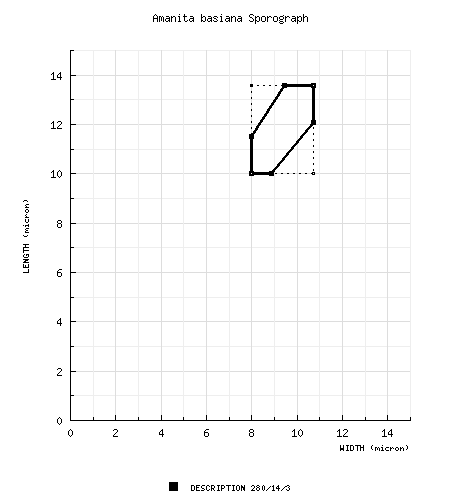
protolog: [280/14/3] (8.5-) 10.0 - 13.6 (-26) × (7.5-) 8.0 - 10.7 (-15.3) µm, (L = (9.7-) 11.2 - 12.1 (-13.2) µm; L' = 11.6 µm; W = (7.9-) 8.7 - 10.6 µm; W' = 9.2 µm; Q = (1.08-) 1.13 - 1.44 (-2.34); Q = 1.21 - 1.33 (-1.36); Q' = 1.27), hyaline, colorless, thin-walled, smooth, inamyloid, subglobose to broadly ellipsoid to (occasionally) ellipsoid, rarely elongate or cylindric (in such cases malformed), rarely constricted, often adaxially flattened, often swollen at one end, in immature material (especially) sometimes elongate-pyriform or peanut-shaped or subclavate or subfusiform or otherwise malformed; apiculus sublateral, cylindric; contents sometimes granular or multiguttulate but predominantly monoguttulate, often with additional small granules; white in deposit. |
| ecology |
protolog: Subgregarious to gregarious or in troops. Italy: At 230 - 250 m elev. In pure Pinus pinaster Ait. forest in dry area exposed to sunlight 50 m to 1 km from Mediterranean coast. |
| material examined |
protolog: ITALY: LIGURIA - Genoa, Piani di Prà, 2.xii.1997 M. Traverso s.n. (paratype, L; paratype, RET 273-6; paratype, in herb. M. Traverso), 28.x.1998 M. Traverso 30.2 (paratype, NY; RET 308-5; paratype, in herb. M. Traverso), 26.x.1999 M. Traverso & P. Roncallo [Traverso 30.0] (holotype, GDOR; isotype, L; isotype, RET 308-4, nrITS & nrLSU seq'd.; isotype, in herb. M. Traverso). |
| discussion |
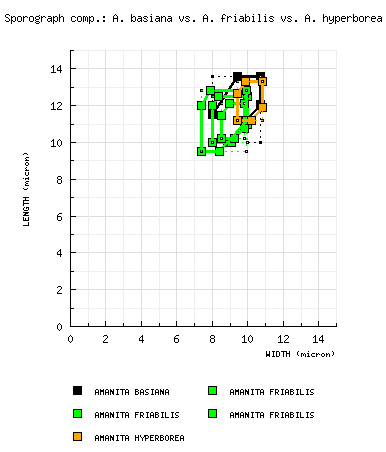
The following sporograph compares spores of the present species with those of A. friabilis (green figure) and A. hyperborea (orange figure).
|
| citations |
This species was originally illustrated in (Tulloss and Traverso 2000).
Original description, with text as published with addition of colored illustrations (Tulloss and Traverso 2001), PDF 1.1MB (open)
—R. E. Tulloss |
| editors |
RET |
|



 Spore data sets and their composite