| name |
Amanita suballiacea |
| author |
(Murrill) Murrill. 1941. Mycologia 33: 448. |
| name status |
nomen acceptum |
| english name |
"False Garlic-Odored Death Cap" |
| synonyms |
≡ Venenarius suballiaceus Murrill. 1941. Mycologia 33: 437.
The editors of this site owe a great debt to Dr. Cornelis Bas
whose famous cigar box files of Amanita nomenclatural information
gathered over three or more decades were made available to RET for computerization
and make up the lion's share of the nomenclatural information presented on this site.
|
| MycoBank nos. |
284076, 291955 |
| GenBank nos. |
Due to delays in data processing at GenBank, some accession numbers may lead to unreleased (pending) pages.
These pages will eventually be made live, so try again later.
|
| holotypes |
FLAS |
| type studies |
Jenkins. 1979. Mycotaxon 10: 191. |
| intro |
The following text may make multiple use of each data field.
The field may contain magenta text presenting data from a type study
and/or revision of other original material cited in the protolog of the present taxon.
Macroscopic descriptions in magenta are a combination of data from the protolog and
additional observations made on the exiccata during revision of the cited original
material.
The same field may also contain black text, which is data from a revision of the present
taxon (including non-type material and/or material not cited in the protolog).
Paragraphs of black text will be labeled if further subdivision of
this text is appropriate.
Olive text indicates a specimen that has not been
thoroughly examined (for example, for microscopic details) and marks other places in the text
where data is missing or uncertain.
The following material not directly from the protolog of the present taxon and not cited as the work of another researcher is based on uncompleted research by R. E. Tulloss. |
| pileus |
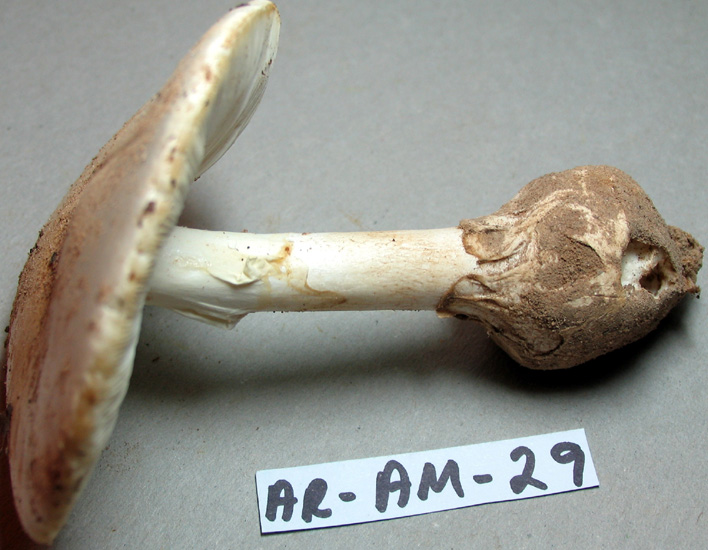
30 - 40 mm wide, convex to planoconvex, slightly viscid, smooth, white, sordid at margin; context thin, white, unchanging on exposure; margin nonstriate, nonappendiculate; universal veil absent??. |
| lamellae |
just free, without decurrent lines on upper stipe, close, white, unchanging on bruising or with age, entire; lamellulae not described. |
| stipe |
90 × 5 - 10 mm, white, subcylindric, smooth to subglabrous, slender; context not described; bulb [not present in holotype collection—ed.] ellipsoid, deeply buried; partial veil white, membranous, thin, weak, apical or just subapical, hanging like wet skirt; universal veil limbate, lobed, white(??), rather thick relative to stature of basidiocarp. |
| odor/taste |
Odor (holotype) strongly of garlic or onion when collected. Taste not recorded. |
macrochemical
tests |
none recorded.
10% KOH - brilliant yellow on pileipellis and pileus
context. Test vouchers: 21.ix.2014 Bunyard s.n., Justice
AR-AM-29, and Nelson 10-31-82-EN1.
one drop of concentrated H2SO4 - pileus context
at mid-radius - negative; stipe context in cross-section
- negative; at mid-length of lamella - slightly purple,
becoming more distinct; pilepellis - quickly brown, then
deep purple; context of stipe's bulb - negative; limb
surface near upper edge - quickly deep purple. |
| pileipellis |
from partial type study of RET: 40 - 50 µm thick, orange-brown in contrast to hyaline context, extensively gelatinized at surface; filamentous, undifferentiated hyphae 2.0 - 8.0 µm wide, subradially arranged in part, but with regions lacking dominant orientation, tightly interwoven in cross-section, branching; vascular hyphae not observed at surface. |
| pileus context |
from partial type study of RET: filamentous, undifferentiated hyphae 1.8 - 9.2 µm wide; acrophysalides dominating, clavate to broadly clavate to ??, up to ?? × ?? µm, thin-walled; vascular hyphae ?? µm wide. |
| lamella trama |
from partial type study of RET: not rehydratable in holotype |
| subhymenium |
from partial type study of RET: not rehydratable in holotype |
| basidia |
composite data from non-type material revised by RET: ?? × ?? μm, dominantly 4-sterigmate, infrequently 2-sterigmate, with sterigmata up to 8.0 μm long and having proportionately broad base (2.0± μm wide). |
| universal veil |
composite data from non-type material revised by RET: From limb on stipe's bulb, exterior layer: interwoven, gelatinized hyphae. From limb on stipe's bulb, interior: filamentous, undifferentiated hyphae 2.8 - 6.8 μm wide, plentiful, branching, containing minute particles; inflated cells plentiful, broadly clavate to ovoid, 60 - 76 × 35 - 50 μm, thin-walled, occasionally appearing to contain guttules; vascular hyphae 4.0 - 8.5 μm wide, branching. |
| stipe context |
from partial type study of RET: longitudinally acrophysalidic; filamentous, undifferentiated hyphae 1.4 - 18.2 µm wide, with even those of largest diameter not having noticeably inflated segments; acrophysalides thin-walled, up to 201 × 62 µm; vascular hyphae 4.9 - 7.7 µm wide, uncommon.
composite data from non-type material revised by RET: longitudinally acrophysalidic; filamentous, undifferentiated hyphae 2.5 - 9.5 μm wide, thin-walled; acrophysalides 80 - 209 × 34 - 36 μn, thin-walled; vascular hyphae up to 8.8± μm. |
| lamella edge tissue |
sterile. |
| basidiospores |
from type study of RET:
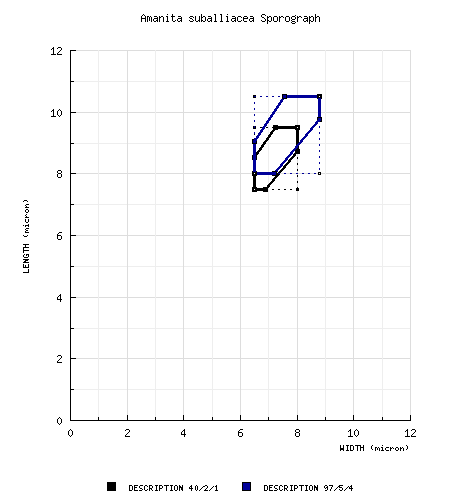
[40/2/1] (7.2-) 7.5 - 9.5
(-9.8) × 6.5 - 8.0 (-8.2) µm, (L = 8.7 -
8.9 µm; L’ = 8.8 µm; W = 7.2 - 7.3
µm; W’ = 7.2 µm; Q = (1.04-) 1.09 - 1.31
(-1.36); Q = 1.20 - 1.23; Q’ = 1.21),
hyaline, colorless, thin-walled, smooth, amyloid,
subglobose to broadly ellipsoid to occasionally
ellipsoid, somewhat adaxially flattened; apiculus
sublateral, small, cylindrical; contents
guttulate; ?probably whitish in
deposit.
composite of data from all materials revised by
RET: [97/5/4] (7.2-) 8.0 - 10.5 (-11.5) × 6.5 - 8.8
(-9.2) μm, (L = 8.7 - 10.1 μm; L' = 9.1
μm; W = 7.2 - 8.0 μm; W' = 7.5 μm; Q =
(1.04-) 1.11 - 1.39 (-1.50); Q = 1.20 - 1.28;
Q' = 1.22), colorless, hyaline, smooth,
thin-walled, amyloid, subglobose to broadly ellipsoid
to ellipsoid, rarely globose; apiculus
sublateral, cylindric, proportionately small;
contents guttulate; color in deposit not
recorded. |
| ecology |
Solitary or (frequently) in small groups.
Arkansas: In mixed woods.
Florida: In mixed woods
including Pinus taeda and Quercus
virginiana or under Serenoa repens with
nearby Quercus.
Pennsylvania: By Pinus.
Texas: In sandy soil. |
| material examined |
from protolog:
U.S.A.:
FLORIDA— Alachua Co. - Gainesville,
22.vi.1938 W. A. Murrill F 16495 (holotype,
FLAS).
RET: CANADA:
NEW BRUNSWICK—Charlotte Co. -
Campobello Isl., Herring Cove Prov. Pk., tr. to
Gibraltar Rock (rec tr.), 25.ix.2016 Amanda Bremer
s.n. [RET 9-25-16-C] (RET 739-7, nrITS-LSU
seq'd.).
U.S.A.:
ARIZONA—Cochise Co. - 2.4 km northwest of
Southwest Research Station, Onion Saddle Rd.,
Chiricahua Mycoflora Project site 33, 23.viii.1994
R. E. Tulloss 8-23-94-E [CMP 3403] (RET 678-1, nrLSU
seq'd.; 4.2 km NW of
Southwestern Research Station, road to Onion Saddle,
Chiricahua Mycoflora Proj. site 37, 24.viii.1994 R. E.
Tulloss 8-24-94-E [CMP 3961] (RET 676-2, nrLSU
seq'd.).
ARKANSAS—Montgomery Co. - Mt.? Ida,
31.x.1982 Edith Nelson s.n. [Tulloss 10-31-82-EN1]
(RET 238-7). Van Buren Co. - South Fork
Nature Center [35°33.697’ N/ 92°22.703’ W],
17.x.2010 Jay Justice AR-AM-29 (RET 458-10).
CONNECTICUT—Middlesex Co.
- East Haddam, Devil's Hopyard St. Pk., 4.ix.2011
Kevin Scalzo s.n. [Tulloss 9-4-11-K] (RET 490-1,
nrITS seq'd.).
Tolland Co. - Hebron, The Hemlocks Nature Educ. Ctr.
[41.6197° N/ 72.3894° W, 160 m], 22.ix.1996 R. E.
Tulloss 9-22-96-C (RET 249-7, nrITS seq'd.).
FLORIDA—Alachua
Co. - Gainesville, 22.vi.1938 W. A. Murrill
F 16495 (holotype, FLAS).
Charlotte Co. - Unkn. loc., 14.v.1997 Bruce Kuechmann
s.n. (RET 260-1, nrLSU & mtLSU seq'd.).
Lee Co. - Fort Myers, 3.v.2013 Benjamin Dion s.n.
[mushroomobserver
#132960]
(RET 539-2, nrITS & nrLSU seq'd.).
MAINE—Cumberland Co. -
Standish, Rte. 114 & Plummer Rd. 0.4 km
from Sebago Lk. [43.7528° N/ 70.5099° W,
93 m], 26.ix.1996 Samuel S. Ristich s.n.
[Tulloss 9-26-96-SSR1]
(RET 686-8, nrITS seq'd.).
MICHIGAN—McComb
Co. - Shelby Twp., ca. Washington, Stony Brook
Metropolitan Pk. [42.73° N/ 83.07° W, 250-260 m],
30-31.viii.2011 Sandy Sheine s.n. (RET 491-7,
nrITS seq'd.).
NEW JERSEY—Monmouth Co. -
Roosevelt, public school yard [40.2179° N/ 74.4748° W,
42 m], 26.viii.1993 R. E.
Tulloss 8-26-93-A (RET 096-6, nrITS fragment
seq'd.).
OHIO—Unkn Co. - on border of Delaware
& Franklin Cos., Westerville [40.1209º N/ 82.9262º W,
268 m], 10.x.2016 Michael McKnight s.n. (RET
744-3, nrITS-LSU seq'd.).
PENNSYLVANIA—Butler Co. - Slippery Rock,
Armco Pk. [41.0306° N/ 80.0216° W, 326 m],
21.viii.2014 Walt Sturgeon s.n. [mushroomobserver
#174935]
(RET 637-8, nrITS & nrLSU seq'd.).
Clarion Co. - Clarion, St.
Game Lands 63, Robert's Hill Rd. [41.1421° N/
79.2830° W, 419 m], 6.viii.2011 Bill Bynum s.n.
[Tulloss 8-6-11-C] (HKAS; RET 478-6, nrITS &
nrLSU seq'd.). Luzerne Co. - Moon Lake Park,
6.x.2012 David Wasilewski s.n. [mushroomobserver
#112828]
(RET 524-8, nrITS & nrLSU seq'd.).
TEXAS—Aransas Co. - Aransas Wildlife
Refuge, 30.i.1989 Dr. Robert Harvey s.n.
[Tulloss 1-30-89-AWR] (RET 244-1).
WISCONSIN—Bayfield Co. - Cable
[46.2019° N/ 91.2656° W, 400 m],
23.ix.2013 Britt Bunyard s.n. [mushroomobserver
#146238]
(RET 572-4, nrLSU seq'd.).
Sauk Co. - Devil's Lake St. Pk. [43.4218° N/ 89.6972° W,
447 m], 28.ix.2013 Britt Bunyard s.n. [mushroom observer
#146910]
(RET 631-5, nrITS & nrLSU seq'd.),
21.ix.2014 B. Bunyard s.n. [mushroom observer
#179726]
(RET 671-2, nrITS-LSU seq'd.), [mushroom observer
#179727]
(RET 671-6, nrITS seq'd.). |
| discussion |
A note in Murrill's hand in the packet containing the
holotype indicates that the bases of the stems of the
two specimens comprising the type were lost.
The type study of Jenkins
(1979) is
erroneous with regard to spore size and shape.
It looks as though spore data from some other taxon
were inadvertently substituted for the data from the
present species. It is possible that Jenkins’
spore data for the present species somehow became
swapped with his spore data for A.
pseudoverna in (Jenkins
1979).
In some correspondence and regional keys, RET once
referred to this species as Amanita
sp. T27. |
| citations |
—R. E. Tulloss |
| editors |
RET |
|




 Spore data sets and their composite