

| name | Amanita verna |
| name status | nomen acceptum |
| author | (Bull.: Fr.) Lam. |
| english name | "European Springtime Destroying Angel" |
| synonyms |
=Amanita verna var. decipiens Trimbach |
| images |
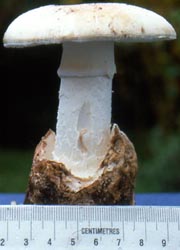 1. Amanita verna, southwestern France. 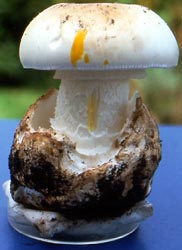 2. Amanita verna, showing reaction to KOH solution, southwestern France. |
| intro |
The following is largely based on the description of Neville and Poumarat (2004). |
| cap | The cap of Amanita verna is 45 - 65 mm wide, white, yellow-ochre in the center, at first hemispheric with a flattened center, then convex, finally nearly planar, smooth, shiny, slightly viscid when moist, quickly drying becoming satiny, with a nonstriate and nonappendiculate margin. The flesh is white, about 3 - 5 mm thick over the stem, and relatively firm. |
| gills | Gills are free at maturity, white to cream white, up to 6 mm broad, somewhat uneven on the edges, with a finely flocculent edge in young specimens. The short gills are subtruncate for the most part, some are sharply truncate. |
| stem | The stem is 85 - 105 × 7 - 13 mm, cylindric, white, stuffed then hollow, smooth with fine scales, with a soft round bulb at the base. The ring is membranous, thin, skirt-like, persistent, with a few vague striations on the upper side. The volva is limbate, white, membranous, arising from the top of the bulb, lacking an internal limb, with the top of the limb 25 - 30 mm from the top of the bulb. |
| odor/taste | The odor is lacking at first then a little disagreeable. Amanita verna is deadly POISONOUS. |
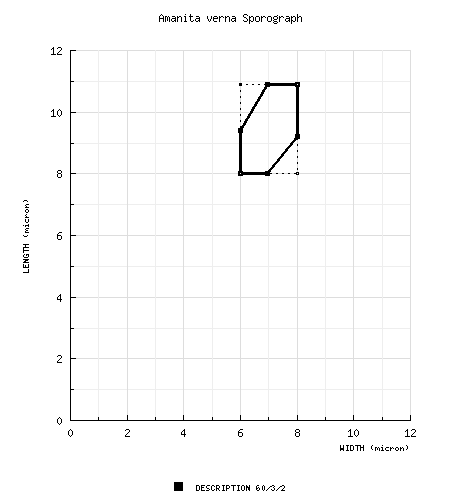
| spores | Spores from those specimens that become yellow in KOH solution measure (8.0-) 8.2 - 11.0 (-11.9) × (5.7-) 6.0 - 7.5 (-8.5) µm and are broadly ellipsoid to ellipsoid, infrequently elongate and amyloid, according to RET''s observations. Clamps are absent at the bases of basidia. Spores measured by Neville and Poumarat are as follows: (8-) 9 - 11.5 (-12) × (5.5-) 6 - 8.5 (-9.5) µm and are subglobose to broadly ellipsoid to ellipsoid, infrequently elongate and amyloid. |
| discussion |
Amanita verna was originally described from France and occurs with a
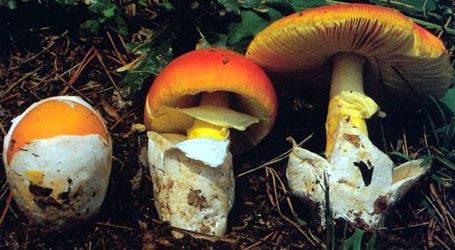
wide variety of trees including oak (Quercus). There is no type specimen for Amanita verna. Its lectotype is an illustration provided by Bulliard with the original description of the species. Given this fact, how could one create a case for a species concept of A. verna? Prior to research into chemical spot testing (which had considerable and unfortunate impact on the species concept of A. verna), A verna could be understood as follows: It was an entirely white, toxic species of Amanita similar in general habitat to A. phalloides, and usually occurring in the spring. It differed from the also entirely white A. virosa because the latter often had an irregularly shaped cap and a rather shaggy stem. Moreover, the range of A. virosa, while overlapping with that of A. verna extended much farther to the north (well into Scandinavia). When microscopy was included in descriptions, it was noted that A. verna by the previous delineation bore ellipsoid rather than globose or subglobose spores—a fact that further segregated A. verna from A. virosa. In the early Twentieth Century, a report appeared on the yellow reaction of a macrochemical spot test on A. virosa with KOH and the fact that this reaction was lacking in A. phalloides var. alba (Bataille, 1926). When this report was included in a larger work, Bataille (1948) replaced "var. alba" with "var. verna," apparently considering the names synonymous. The revised text name consequently interpreted to state that A. verna had been tested with KOH and failed to produce a color reaction. This interpretation was an error as is documented by Neville and Poumarat (2004). It appears that Bataille never tested A. verna, and the belief that he did and got a negative result is based on a misinterpretation. Due to the misinterpretation, which was widely reported and eventually accepted without question, a new name was introduced for the taxon illustrated above: Amanita decipiens (Trimbach) Andary & Bon. This taxon was said to differ from the "true" A. verna solely in having a yellow response to spot testing with KOH. We propose that readers consider the following statements in addition to the above misunderstanding: 1. Romagnesi (1984) stated that in the environs of Paris he had never seen A. verna that was not reactive to KOH. Romagnesi pointed out that Bulliard's familiarity with A. verna was undoubtedly based on material from the vicinity of Paris. 2. During the years 1990 to 2001 in the départements of Gironde and Landes, Francis Massart, his colleagues, and his correspondents carried out a search for material otherwise assignable to the above general concept of A. verna and not reacting to KOH. They found that all collected specimens that appeared to be A. verna reacted positively (yellow-orange) when tested with KOH. Duplicates of a number of their collections were sent to RET and are listed in the "material examined" data field of the technical tab on this taxon page. 3. It is reasonable to base the interpretation of A. verna on material found in the area from which the taxon in question was originally reported. Hence, there is no evidence to contradict that proposal that A. verna reacts positively to KOH solution. On the other hand there is much evidence to suggest that it does. While this proposal seems to us logical and simple, this is of course no proof of its certainty. We expect molecular studies to produce information that is relevant to the question of whether there are separable taxa within Amanita verna. Amanita verna or something similar and not positively reacting to KOH is known from North Africa. Spores from North African material measured by Zhu L. Yang were (8.5-) 9.5 - 12 (-14.5) × (6.0-) 6.5 - 8.0 (-10.5) µm and are broadly ellipsoid to ellipsoid, occasionally elongate. These are, on average, larger and very slightly narrower (proportionately) than those RET measured from KOH-positive, French material. Amanita verna is probably related to A. virosa< (Fr.) Bertillon in DeChambre, A. ocreata Peck, A. exitialis, A. subjunquillea var. alba, and A. bisporigera G. F. Atk., among other taxa of the Phalloideae. Notice the difference in color (purer yellow—less orange) of the KOH spot test reaction in the photo of the latter species. The reader may want to examine the recently revised key to the taxa of sect. Phalloideae in North America.—R. E. Tulloss and L. Possiel, revised by RET (15 April 2011) |
| brief editors | RET |

 Spore data sets and their composite