| name |
Amanita subjunquillea var. alba |
| author |
Zhu L. Yang. 1997. Biblioth. Mycol. 170: 174, figs. 143-144. |
| name status |
nomen acceptum |
| english name |
"East Asian Destroying Angel" |
| MycoBank nos. |
444655 |
| GenBank nos. |
Due to delays in data processing at GenBank, some accession numbers may lead to unreleased (pending) pages.
These pages will eventually be made live, so try again later.
|
| holotypes |
HKAS |
| revisions |
Z. L. Yang & Y. Doi. 1999. Bull. Natl. Sci. Mus. Tokyo B 25(3): 126-127, figs. 30-31.
Z. L. Yang & T. H. Li. 2001. Mycotaxon 78: 445, figs. 7-9. |
| intro |
The following text may make multiple use of each data field.
The field may contain magenta text presenting data from a type study
and/or revision of other original material cited in the protolog of the present taxon.
Macroscopic descriptions in magenta are a combination of data from the protolog and
additional observations made on the exiccata during revision of the cited original
material.
The same field may also contain black text, which is data from a revision of the present
taxon (including non-type material and/or material not cited in the protolog).
Paragraphs of black text will be labeled if further subdivision of
this text is appropriate.
Olive text indicates a specimen that has not been
thoroughly examined (for example, for microscopic details) and marks other places in the text
where data is missing or uncertain.
NOTE: Spore measurements from papers by Z. L. Yang use his "Times New Roman" face for "Q" and "Q'"—respectively, "Q" and "Q." |
| basidiospores |
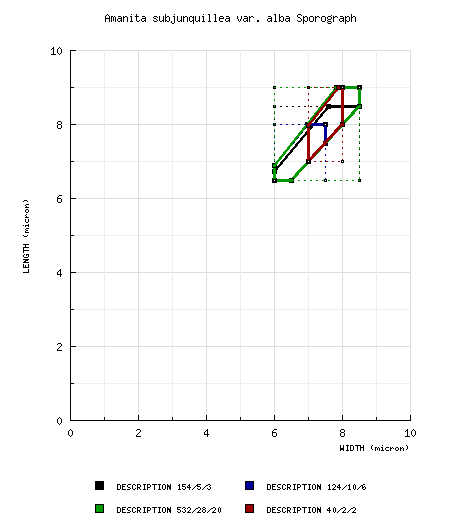
from protolog: [154/5/3] (6.0-) 6.5 - 8.5 (-9.0) × 6.0 - 8.5 (-9.0) μm, (Q = 1.0 - 1.12 (-1.21); Q = 1.07 ± 0.04), globose to subglobose, rarely broadly ellipsoid, amyloid, smooth, thin-walled, colorless, hyaline; apiculus up to 1.0 μm long.
from Yang and Doi (1999): [124/10/6] (6.0-) 6.5 - 8.0 (-9.0) × (5.0-) 6.0 - 7.5 (-8.5) μm, (Q = 1.0 - 1.15 (-1.30); Q = 1.07 ± 0.05), hyaline, colorless, smooth, thin-walled, amyloid, globose to subglobose, rarely broadly ellipsoid; apiculus small.
from Yang and Li (2001): [532/28/20] (6.0-) 6.5 - 9.0 (-10.5) × (5.5-) 6.0 - 8.5 (-10.0) μm, (Q = 1.0 - 1.15 (-1.23); Q = 1.08 ± 0.05), hyaline, colorless, smooth, thin-walled, amyloid, globose to subglobose to broadly ellipsoid; apiculus small.
from Yang (2002a): [40/2/2] 7.0 - 9.0 (-9.5) × (6.5-) 7.0 - 8.0 (-9.0) μm,
(Q = 1.0 - 1.14 (-1.19); Q = 1.08 ± 0.05), hyaline, colorless, smooth, thin-walled, amyloid, globose to subglobose, rarely broadly ellipsoid; apiculus proportionately small; contents not recorded; color in deposit not recorded. |
| ecology |
Solitary to gregarious. China: At up to 2100 m elev. In mixed or coniferous forest dominated by species of the Fagaceae and/or Pinaceae; for example, with Pinus langbianensis or with P. yunnanensis and Quercus spp. Japan: In forests. |
| material examined |
From protolog: CHINA:
GUIZHOU—Zunyi (prefecture level) City - Daozhen Gelao and Miao
Autonomous Co., Dashahe, 20.vii.1988 J. Z. Ying et al. 471 (paratype, HMAS 58289, as "Amanita virosa" in (Ying & Zang 1994)).
SICHUAN—Liangshan Yi Autonomous Prefecture - Xichang (county level) City, Luojishan, 18.vii.1983 M. S. Yuan 31 (holotype, HKAS 1183).
YUNNAN—Xishuangbanna Dai Autonomous Prefecture - Menghai Co., Mangao, 14.viii.1991 Z. L. Yang 1530 (paratype, HKAS 24169).
Yang and Doi (1999): JAPAN: HONSHU—Chiba Prefecture - Kiyosumi, Fudagou, Do-zawa, 14.vii.1983 Y. Doi s.n. (TNS F-174870). Kyoto Prefecture - Ahiu, Kyoto Univ. For., 24.vii.1964 Y. Doi s.n. (TNS F-194890). Tokyo Metropolis (Pref.) - Oume City, Kurosawa 3-Chôme, left-side ridge of Kurosawa-gawa R., along hiking course, 5.x.1997 Y. Doi s.n. (TNS F-237599), s.n. (TNS F-237594), s.n. (TNS F-237748); Oume City, Kurosawa 3-Chôme, right-side ridge of Kurosawa-gawa R., 25.ix.1997 Y. Doi s.n. (TNS F-237846).
Yang and Li (2001): CHINA:
BEIJING—Miyun Co. - unkn. loc., 4.viii.1978 Y.-C. Zong s.n. (HMAS 40501), 1970 X.-L. Mao & Y.-C. Zong s.n. (HMAS 35536).
GANSU—Longnan (prefecture level) City - Wen Co., Tielou, ix.1992 M.-L. Tian 7003 (HMAS 61678 as "A. verna" in (Mao 1997)), M.-L. Tian 6506 (HMAS 61692); Wudu Distr., unkn. loc., ix.1992 X.-L. Mao 7039 (HMAS 61629 as "A. verna" in (Mao 1997)).
GUIZHOU—Zunyi (prefecture level) City - Daozhen Gelao and Miao
Autonomous Co., Dashahe, 20.vii.1988 J.-Z. Ying et al. 471 (HMAS 58289 as "A. verna" in (Ying & Zang 1994)).
HENAN—Sanmenxia (prefecture level) City - Lushi Co., Siziping, 18.viii.1968 H.-Z. Li, X.-L. Mao & J.-Z. Ying 14 (HMAS 35743 as "A. verna" in (Mao 1997)).
HUBEI—Shennongjia Forestry Distr. - unkn. loc., 29.viii.1984 X.-Q. Zhang & S.-X. Sun 402 (HMAS 53766 as "A. verna" in (Mao et al. 1989)).
JILIN—Yanbian Korean Autonomous Prefecture - Antu Co., unkn. loc., 4.ix.1960 Y.-C. Yang et al. 1039 (HMAS 29134 as "A. verna" in (Teng 1963??, 1996)).
SHAANXI—Hanzhong (prefecture level) City - Unkn. Co., unkn. loc., ix.1991 X.-L. Mao 6394 (HMAS 61495 as "A. verna" in (Mao 1997)), 4014 (HMAS 61731 as "A. virosa" in (Mao 1997)), 19.ix.1991 X.-L. Mao 3811 (HMAS 61594 as "A. verna" in (Mao 1997)), 20.ix.1991 X.-L. Mao 6367 (HMAS 61671 as "A. verna" in (Mao 1997).
SICHUAN—Leshan (prefecture level) City - Emeishan Co., Emeishan, 29.viii.1971 S.-X. Wu, Y.-C. Zong & X.-L. Mao 284 (HMAS 35540 as "A. virosa" in (Ying & Zang 1994)). Liangshan Yi Autonomous Prefecture - Xichang (county level) City, Luojishan, 18.vii.1983 M.-S. Yuan 31 (HKAS 11831). Unkn. Prefecture - Unkn. Co., unkn. loc. 1894 Farges s.n. (in herb. Patouillard in FH 4285 as "A. vaginata").
XIZANG AUTONOMOUS REGION (TIBET)—Nyingchi Prefecture - Zayü Co., unkn. loc., 1.ix.1976 M. Zang 665 (HKAS 5664 as "Lepiota cristata" in (Wang and Zang 1983)).
YUNNAN—Kunming (prefecture level) City - Yiliang Co., Mugan, 20.ix.1998 Z.-L. Yang 2517 (HKAS 32665). Xishuangbanna Dai Autonomous Prefecture - Menghai Co., Mangao, 14.viii.1991 Z. L. Yang 1530 (HKAS 24169).
Yang (2002a): CHINA: JILIN—Yanbian Korean Autonomous Prefecture - Antu Co., Mt. Changbai, s.d. Y. Wang 79340 (IFP); Changbai Mtns., s.d. Z. X. Xie 820568 (IFP).
Zhang et al. (2004) voucher for sequencing: CHINA: YUNNAN—Unkn. loc., s.d. unkn. coll. s.n. (HKAS 32665). |
| discussion |
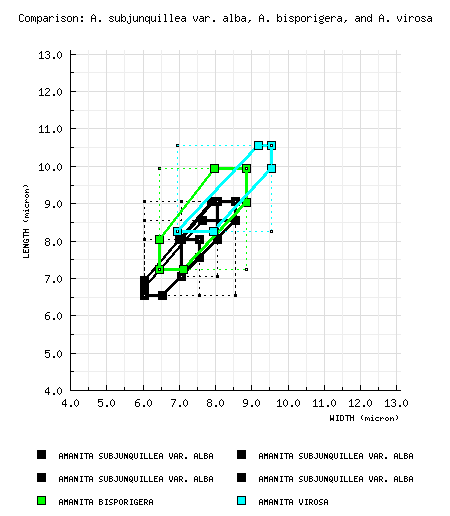
In the technical tab discussion data field for A. exitialis, sporograph comparisons are made between a number of white taxa of sect. Phalloideae that have a yellow reaction to macrochemical spot testing with KOH. Of the compared taxa the two with spore size and shape most similar to the present species are A. bisporigera and A. virosa. Sporographs for these species and the present taxon appear in the following figure.
|
| citations |
—R. E. Tulloss |
| editors |
RET |
|


 Spore data sets and their composite