
| name | Amanita thiersii |
| name status | nomen acceptum |
| author | Bas |
| english name | "Thiers' Lepidella" |
| images |
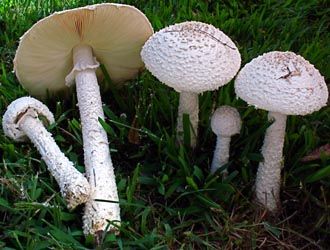  1. Amanita thiersii, Kansas, USA. 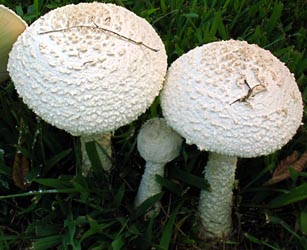 2. Amanita thiersii, Kansas, USA. 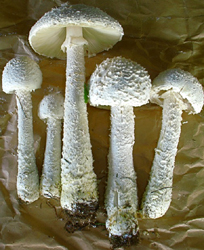 3. Amanita thiersii, Kansas, USA. 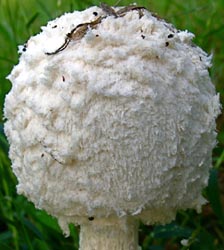 4. Amanita thiersii, Kansas, USA. 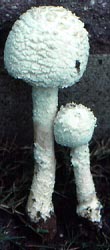 5. Amanita thiersii, Arkansas, USA. 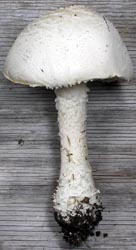 6. Amanita thiersii, Kansas, USA. 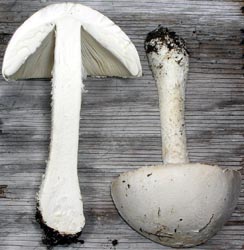 7. Amanita thiersii, Kansas, USA. 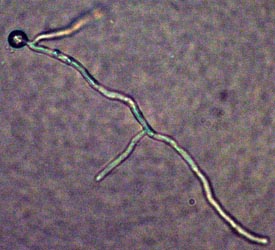 8. Amanita thiersii spore germinating - courtesy Pringle Lab and Benjamin Wolfe 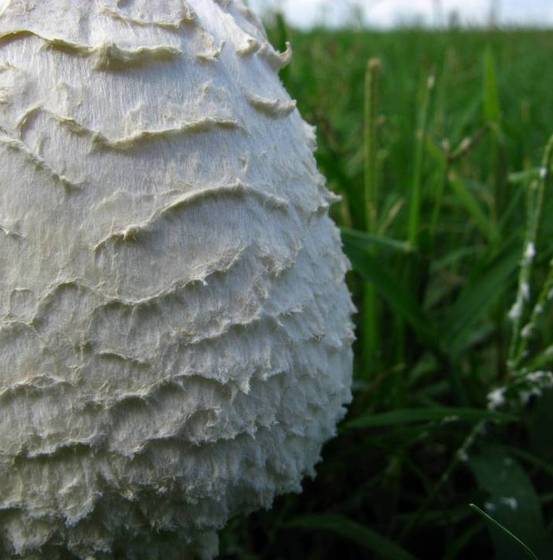 9. Amanita thiersii, Rutherford Co., Tennessee, U.S.A. 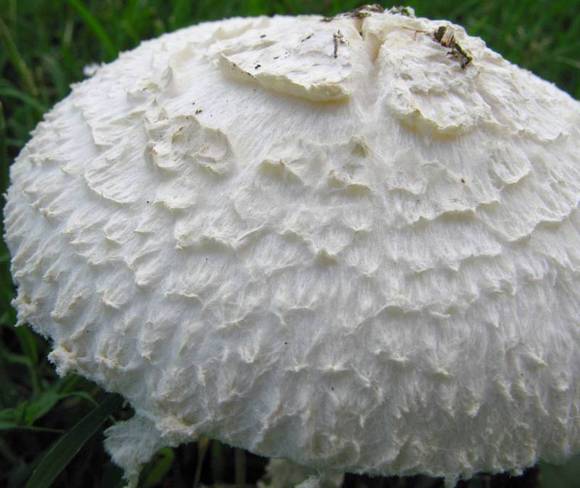 10. Amanita thiersii, Rutherford Co., Tennessee, U.S.A. 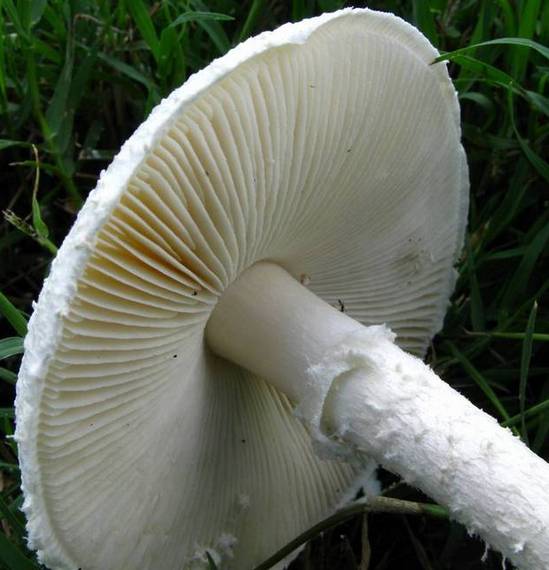 11. Amanita thiersii, Rutherford Co., Tennessee, U.S.A. |
| intro | Amanita thiersii is a species that may have been introduced to the U.S. It is spreading north and east from Texas, from which it was originally described. It is known to be able to digest lawn clippings and commercially produced cellulose. There is no known evidence that A. thiersii ever forms mycorrhizae. |
| cap |
The cap of A. theirsii is 35 - 100 mm wide, convex to conico-convex to plano-convex, mostly with a low, broad umbo, white, dry, sometimes slightly viscid with age, with a non sulcate, appendiculate margin; cap flesh up to 10 mm thick. At first the cap is entirely covered by soft, subpulverulent, lanose-floccose, squamulose, white volva; later becoming more or less glabrous with scattered, floccose-fibrillose to felted, patch- or scale-like, at center sometimes wart-like remnants of volva. |
| gills |
The gills are crowded to subdistant, free, rather narrow to broad. In mass they appear white to yellowish to creamy yellow or yellowish cream. In side view they are white to cream to yellowish cream to sometimes almost color of egg yolk (in early stages of expansion). The short gills are attenuate to subattenuated to subtruncate to rounded-truncate, of many lengths, unevenly distriubted, and rather common to plentiful. |
| stem |
The stem is 80 - 200 × 10 - 20 mm, equal, stuffed to hollow, white, bruising yellow in some specimens (associated with yellowing in other parts of the fruiting body and an odor of cheese). The bulb is merely a slight broadening of the stipe base, e.g., 25 × 22 mm. At first, below the ring is densely covered by lanose-squamulose volva, with age breaking into easily removable, incomplete, floccose-squamose girdles, finally becoming scanty flocculose-squamulose to merely fibrillose. |
| odor/taste | The odor is described as indistinct, may become unpleasant in age and then of decay or cheese (associated with yellowing specimens so far as is known). Tthe taste is reported as oily bitter or bitter metallic. |
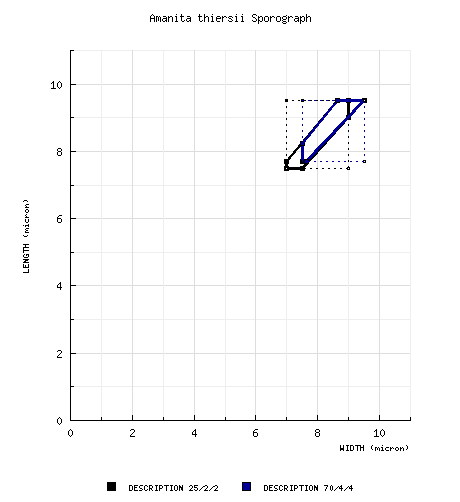
| spores | Spores of A. thiersii measure (7.0-) 7.7 - 9.5 (-11.0) × (6.8-) 7.5 - 9.5 (-10.0) µm and are globose to subglobose (rarely broadly ellipsoid) and amyloid. Clamps are absent from bases of basidia. |
| discussion |
This species is found in grassy areas distant from
trees, such as in lawns and public parks. It
is now known from as far north as Indiana, Illinois,
Kansas, and Maryland, U.S.A. and southward
to the state of Puebla, Mexico. Bas created stirps Thiersii in which the present species is placed along with A. albofloccosa A. V. Sathe & S. D. Deshp. (SW India), A. aureofloccosa Bas (Republic of Congo), A. foetens Singer (Argentina), and A. praeclara (Pearson) Bas (South Africa). Unjustified claim of toxicity: About two decades ago there was a report of a case of serious poisoning attributed to this species, from the state of Puebla, Mexico (Tulloss, unpub. data). The outcome of the poisoning is unknown. RET was in Mexico at the time, and the only amanita found where the poisonous species was collected was brought to RET, he identified the specimen (by microscopy) as Amanita thiersii. It is important to know that the mushroom was not from the material collected and cooked by the poisoning victim. It was collected by students who scoured the site after the poisoning was reported. A Wieland [Meixner] test on the material involved in the cited poisoning case was negative for amatoxins. Given other (then recent) poisonings by taxa of section Roanokenses, I considered that A. thiersii might contain allenic norleucine. There was no evidence demonstrating this and the symptoms of the poisoned person never became known. RET's unjustified guess proved out to be wrong. In recent years an extensive study of large amino acids that are toxic to humans was carried out—searching for these amino acids in many amanitas. The experiment was designed in part by RET in order to get broad coverage of amanitas of every section of the genus then recognized. Within section Lepidella (sensu Bas 1969) we sampled at least one species of every stirps to which we had access in the Roosevelt herbarium and the herbaria of other institutions. The results were very informative and contradicted the presumption of norleucine in A. thiersii. The allenic norleucine associated with severe kidney damage in cases of ingestion of A. smithiana of section Lepidella stirps Rhopalopus of Bas was demonstrated to be restricted to the three known species from that stirps—A. rhopalopus, A. smithiana, and A. magniradix. The individual study of A. thiersii showed that it did not contain allenic norleucine. At the time the A. ovoidea-A. proxima-A. neoovoidea group was incorrectly thought to belong to section Amidella. This group is now cited as belonging in the recently re-established section Roanokenses for those following Cui et al. (2018). In this group, at least A. proxima contains allenic norleucine. Unfortunately, the author of the study went out of contact with RET and with his supervisor and the results of the study have not been published. RET has just been contacted by the supervisor (January, 2020). An attempt is being made to gather the existing data and to carry out a repeat or an extension of the experiments with a goal of publishing all the relevant data. Yellow bruising in A. thiersii: Specimens with yellow bruising reactions and/or an odor of cheese may be infected by one or more hyphomycetes as has been noted in other taxa such as A. subsolitaria (Murrill) Murrill and A. polypyramis (Berk. & M. A. Curtis) Sacc. Lawns and cellulose: Recent work in the Pringle Lab (Harvard Univ.) has provided DNA-based support for the morphologically-based hypothesis of C. Bas (1969) that species of subsect. Vittadiniae [like A. thiersii were taxa with few "evolved" or "derived" characters (as was said in the 1960's)]. This has been done by showing that, based on those segments of genetic material that have been sequenced to date, the so-called "least derived" taxa form a group with one or a few ancestors that came into existence very early in the evolution of the genus Amanita. This research is still on-going. The same research group, with much of the research in the hands of Benjamin Wolfe, also carried out a number of experiments demonstrating that indeed many of the basal taxa are at least capable of living as saprobes. Some species (the number is not yet known) operate only as saprobes. Among these latter is Amanita thiersii. The picture at the head of this paragraph shows a spore of A. thiersii germinating in the laboratory. Wolfe and Pringle have reported that A. thiersii can be grown easily in culture and can live entirely on industrial cellulose in culture. The highest growth rate was recorded for growth on sterilized grass clippings. Genomic study: In 2009, a grant was received by the Pringle Lab that resulted in sequencing of the genome of A. thiersii. Among the goals of having a complete genome for the present species is the study of the origin of ectomycorrhizal symbiosis in Amanita. The genus Amanita is segregated from all other agarics by the process of development of its fruiting bodies from tiny primordia. DNA evidence suggests with high confidence, that the genus is descendant from a single ancestor. This isolated group has, preserved within its present day boundaries, a diverse set of taxa (particularly in subsect. Vittadiniae) that may serve as "genetic snap shots" of the evolutionary history of an ectomycorrhizal "life style." —R. E. Tulloss |
| brief editors | RET |

 Spore data sets and their composite