| name |
Amanita smithiana |
| author |
Bas. 1969. Persoonia 5: 418, figs. 143-145. |
| name status |
nomen acceptum |
| english name |
"Smith's Lepidella" |
| synonyms |
= Amanita solitaria sensu Hotson. 1936. Mycologia 28: 72, illus.
= Amanita solitaria sensu Stuntz in Benedict et al. 1966. Lloydia 29(4): 335.
The editors of this site owe a great debt to Dr. Cornelis Bas
whose famous cigar box files of Amanita nomenclatural information
gathered over three or more decades were made available to RET for computerization
and make up the lion's share of the nomenclatural information presented on this site.
|
| etymology |
Smith + -ana, suffix indicating possession; hence, "of Smith"
Honoring Alexander Hanchett Smith. |
| MycoBank nos. |
308589 |
| GenBank nos. |
Due to delays in data processing at GenBank, some accession numbers may lead to unreleased (pending) pages.
These pages will eventually be made live, so try again later.
|
| holotypes |
MICH; isotype, L |
| revisions |
Tulloss and Lindgren. 1992. Mycotaxon 45: 374, figs. 1-3. |
| intro |
The following text may make multiple use of each data field.
The field may contain magenta text presenting data from a type study
and/or revision of other original material cited in the protolog of the present taxon.
Macroscopic descriptions in magenta are a combination of data from the protolog and
additional observations made on the exiccata during revision of the cited original
material.
The same field may also contain black text, which is data from a revision of the present
taxon (including non-type material and/or material not cited in the protolog).
Paragraphs of black text will be labeled if further subdivision of
this text is appropriate.
Olive text indicates a specimen that has not been
thoroughly examined (for example, for microscopic details) and marks other places in the text
where data is missing or uncertain.
This description is based on the protolog of the present species and original research of R. E. Tulloss and J. E. Lindgren. |
| pileus |
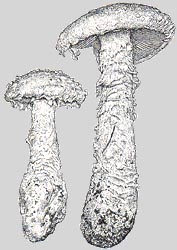
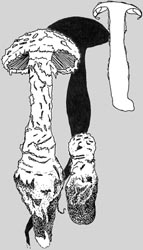
50 - 170 mm wide, white or whitish or ivory, sometimes becoming pale tan in dry weather, infrequently with pinkish staining, sometimes yellowish on margin from handling or drying, subviscid at first, remaining tacky when moist, becoming shiny on drying and taking on texture of smooth kid leather, hemispherical at first then convex to planoconvex, sometimes subumbonate; context white, unchanging when cut or bruised, up to 10 - 20 mm thick at stipe, thinning evenly to margin which projects slightly beyond ends of lamellae; margin nonstriate, appendiculate with dense white floccose submembranous material, decurved at first, finally flaring upward in age; universal veil white to whitish to pale buff to pale pinkish buff to cream buff to tan to brownish, darker colors apparently attributable to effects of warm, dry weather and/or age, occurring as floccose/felted patches (especially in warm, dry weather) or occasionally as easily crushed subpyramidal or subconical warts especially over disk (especially in moist, cool weather), in either case reduced to unevenly distributed finer flocculence toward margin, detersile as long as pileipellis remains moist. |
| lamellae |
free to narrowly adnate, sometimes with faint decurrent line on stipe apex, close to crowded, white to cream to ivory to pale pinkish buff in mass, in side view clay white or occasionally translucent, sometimes becoming cream in age, 6 - 11 mm broad, broadest about half way from stipe to margin, rarely forking, with white fimbriate-flocculose edge; lamellulae truncate to rounded truncate (shorter ones) to attenuate (longer ones), often unevenly distributed among lamellae. |
| stipe |
60 - 160 × 10 - 35 mm, white, bruising slowly buff to pinkish buff where handled, cylindric or narrowing upward, decorated with floccose/squamulose zones sometimes disappearing with age and with fibrils that may become somewhat brownish; bulb white, broadly or narrowly fusiform, occasionally with extended radical (very difficult to collect in its entirety) usually missed in whole or part by collectors, up to 130+ × 55 mm, with occasional radical adding up to 300 mm to length; context white, unchanging when cut or bruised, usually solid, occasionally with short hollow lumen, commonly lacking larva tunnels; partial veil as floccose-fibrillose-submembranous annulus, superior, ragged or lacerate; universal veil in broken rings of irregular warts at top of bulb, detersile. |
| odor/taste |
Odor absent to mild to somewhat faintly pungent or “salty” or like dust from ground bark of Pseudotsuga menziesii (Mirb.) Franco (locally familiar because of its use as garden mulch) to yeast-like or with cut surfaces smelling like green tomatoes or tomato plants, very strong and unpleasant in age [almost ‘hammy’ odor with tinges of chlorine (Norvell LLN111290-2)], truly obnoxious when in decline (Norvell LLN111290-2). Taste mild to somewhat sweet or lacking. The person poisoned in the 1976 poisoning case (see discussion, below) provided additional information on taste: a young basidiome fried had "superb" flavor which was somewhat raphanoid. An older basidiome fried was considered "fair...raphanoid, moderately acidic-bitter." POISONOUS. |
macrochemical
tests |
Paracresol test for tyrosinase - positive except in base of bulb and in lamellae, with strongest reaction in top third of stipe (visible in about 5 min.). Syringaldazine test for laccase - in mature material positive in line parallel to pileipellis and about 2 mm below it in pileus context (almost immediate reaction, but fading away in 5 - 12 min.), also in spots on lamellae, in central stipe (persisting up to 45 min. or more), and very tip of bulb; in immature material (in varying stages of expansion) positive throughout pileus context above lamellae, in a spot in upper stipe and on partial veil near pileus margin or positive only in lower bulb or infrequently negative throughout basidiome (Sierra Co. collection). Test vouchers: Lindgren ?, 9722; Tulloss 2-13-98-A.
Results according to Breckon (1968)—on exposed context of the lower stipe and bulb unless otherwise noted: FeSO4 - negative; 3% KOH - negative; Melzer’s reagent - negative; phenol - negative to weakly positive; phenolaniline - negative to weakly positive; tincture of guaiac - slowly and weakly positive. Lindgren (Tulloss & Lindgren, 1994) has generally confirmed these results: FeSO4, 10% KOH, PADAB, 95% ethanol all negative. |
| pileipellis |
70 - 100 µm thick; filamentous, undifferentiated hyphae 1.0 - 8.7 µm wide, colorless, branching, densely interwoven, subradially arranged; vascular hyphae not observed. |
| pileus context |
filamentous, undifferentiated hyphae 1.8 - 11.5 µm wide, plentiful, branching, interwoven, with subradial orientation dominant for most of pileus thickness, more disordered near lamellae; acrophysalides thin-walled, narrowly ventricose to elongate to narrowly clavate, up to 98 × 36 µm, terminal or in short chains, with only terminal cells fully inflated; vascular hyphae 3.2 - 6.5 µm wide, not common, branching, apparently more frequent near lamellae; clamps present. |
| lamella trama |
bilateral, rather broad, with angle of divergence 20° or less to 60°, mostly under 45°; central stratum pronounced, with wcs = 35 - 45 µm; filamentous, undifferentiated hyphae 1.2 - 7.0 µm wide, branching, with some intercalary segments subinflated ventricose to 11.0 µm wide; divergent, terminal inflated cells apparently absent; vascular hyphae 2.0 - 8.5 µm wide, rather scarce to plentiful and then branching and entangled; clamps present. |
| subhymenium |
75 - 110 µm wide [wst-near = ? µm; wst-far = ? µm]; extensively branched, sweeping away from central stratum in a smooth curve of largely uninflated elements that terminate in a cluster of inflated cells (e.g., ellipsoid, 17.5 × 11.2 µm) and uninflated or barely inflated to narrowly clavate and/or branching hyphal segments oriented roughly perpendicular to central stratum, infrequently containing a slightly inflated to clavate tip cell within the branching structure; clamps present. |
| basidia |
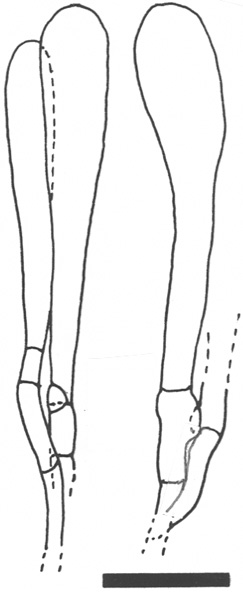
43 - 70 × 8.5 - 13.8 (-15.0) µm, dominantly 4-, also, occasionally, 1-sterigmate, rarely 2- or 3-sterigmate, thin-walled, slenderly clavate; clamps and proliferated clamps rather common. |
| universal veil |
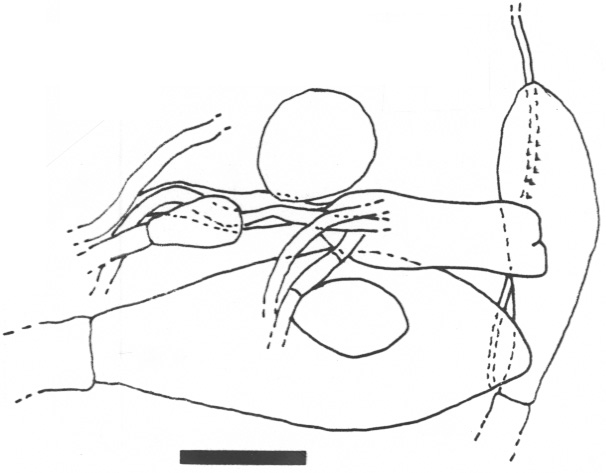
On pileus: filamentous, undifferentiated hyphae 1.8 - 12.2 µm wide, plentiful, branching, with some segments inflated to 22 µm wide; inflated cells terminal or in chains that are vertically aligned in warts, subglobose to broadly ellipsoid to ovoid to ellipsoid to broadly clavate to clavate, up to 77 × 63 µm, with walls thin or slightly thickened; vascular hyphae 1.4 - 9.1 µm wide; in region near pileipellis having thin layer of hyphae running parallel to hyphae of pileipellis; very well illustrated by Bas (1969: 421, fig. 144). On stipe base: absent in material examined. |
| stipe context |
longitudinally acrophysalidic; filamentous, undifferentiated hyphae 1.0 - 8.0 µm wide, dominant, branching; acrophysalides very slender, thin-walled, difficult to distinguish, up to 262 × 25 µm, possibly longer; vascular hyphae scarce or absent. |
| partial veil |
filamentous, undifferentiated hyphae 1.0 - 9.0 µm wide, interwoven, branching, with many branches disordered, often in radially oriented fascicles (apparently causing tissue to split roughly radially in crush mount), plentiful; inflated cells plentiful to dominating, unevenly distributed, sometimes clustered, thin-walled, terminal or in short chains, gelatinizing, bacilliform to cylindrical to narrowly clavate to clavate to fusiform to ellipsoid to subpyriform, up to 71 × 34 µm (such cells distributed throughout tissue and distinguishable from cells which separate the partial veil from lamellae—these latter more subglobose, yellower in 3% KOH, and more completely gelatinized); vascular hyphae 1.2 - 10.5 µm wide. |
| lamella edge tissue |
not described. |
| anatomical figures |
|
| basidiospores |
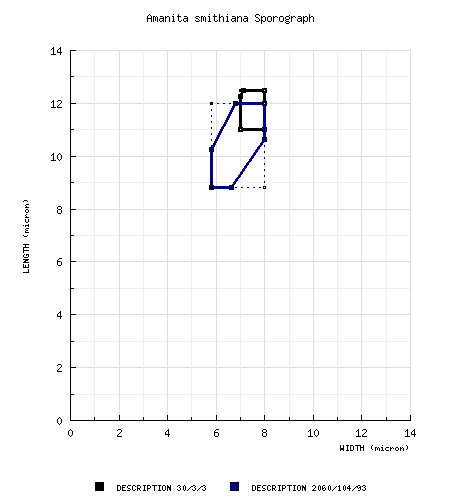
from protolog (Bas 1969): [30/3/3] (10.5) 11.0 - 12.5 (-13.5) × 7.0 - 8.0 μm, (Q = 1.30 - 1.75; Q = 1.45 - 1.65), thin-walled, amyloid, ellipsoid to elongate, sometimes obovoid; apiculus not described; contents guttulate, refractive; color in deposit not recorded.
[2060/104/93] (6.5-) 8.8 - 12.0 (-16.0) × (4.3-) 5.8 - 8.0 (-10.8) µm, (L = (8.6-) 9.4 - 11.2 (-11.7) µm; L’ = 10.4 µm; W = (5.5-) 6.0 - 7.4 (-7.8) µm; W’ = 6.8 µm; Q = (1.12-) 1.33 - 1.77 (-2.36); Q = (1.29-) 1.43 - 1.68 (-1.98); Q’ = 1.54), hyaline, thin-walled, smooth, amyloid to strongly amyloid, ellipsoid to elongate, often adaxially flattened, sometimes swollen at one end; apiculus sublateral, cylindric; contents multi- or monoguttulate or granular; white to pale cream or pale buff in deposit. |
| ecology |
From central California north to southwestern British Columbia and from the Pacific coast eastward to northern Idaho in the northern portion of that range and to the foothills of the Sierra Nevada mountains in central California, to 770+ m elev. With isolated collections from considerably further south: in New Mexico at 2750 m elev. and from Santa Barbara Co., California, in sandy soil at about 920 m elev. One collection is known from the state of Michoacan in central Mexico. Solitary to subgregarious to gregarious. In main portion of known range occurring September to December, occasionally in July, August, or January; one occurrence in May in Sierra Nevada foothills; one occurrence in October in the Sierra Nevada; New Mexican material collected during August monsoon period.
In forest including Pseudostuga menziesii, Tsuga heterophylla, Acer circinatum, and Rhododendron macrophyllum (O’Dell 435) or in forest including P. menziesii, T. heterophylla, Polystichum munitum, Berberis nervosa, and (possibly) Abies (O’Dell 603) or near P. menziesii, Thuja plicata, and T. heterophylla (Kroeger PK379) or in Picea sitchensis and T. heterophylla forest (Big Lagoon collection) or in Picea forest (Lipse 415) or in subfreezing temperatures near stream in ravine in Picea/Pinus forest (Sierra Co. collection) or in forest with overstory of P. menziesii, T. heterophylla, and Acer glabrum and understory of B. nervosa, Gaultheria shallon, and Vaccinium parvifolium (Bull Run watershed collections) or under P. menziesii (Bothell and Bridal Trails St. Pk. collections, A. H. Smith 17550) or in deep moss with plentiful woody debris in 50 to 80 year old second growth forest dominated by P. menziesii, T. heterophylla, T. plicata, and A. circinatum with understory including G. shallon, P. munitum, Pteridium aquilium, and B. nervosa (Lindgren 91-50) or under Alnus and conifers (A. H. Smith 17941) or in forest of P. menziesii and Larix sp. (1978 Priest Lake, Idaho collection) or hypogeous under P. menziesii (Trappe 8301) or under P. muricata D. Don (Desjardin 857, Thiers 41754) or under P. ponderosa Dougl. ex Laws (Breckon 660) or under Quercus (M. Norris 54, P. K. Smith 148, Breckon 221) or from Sequoia sempervirens forest (A. H. Smith 9472) or near Pinus and Arctostaphylos (Santa Cruz collection of i.1992) or in Pinus-Quercus forest on bare, loose, orange soil (Guzmán 17803).
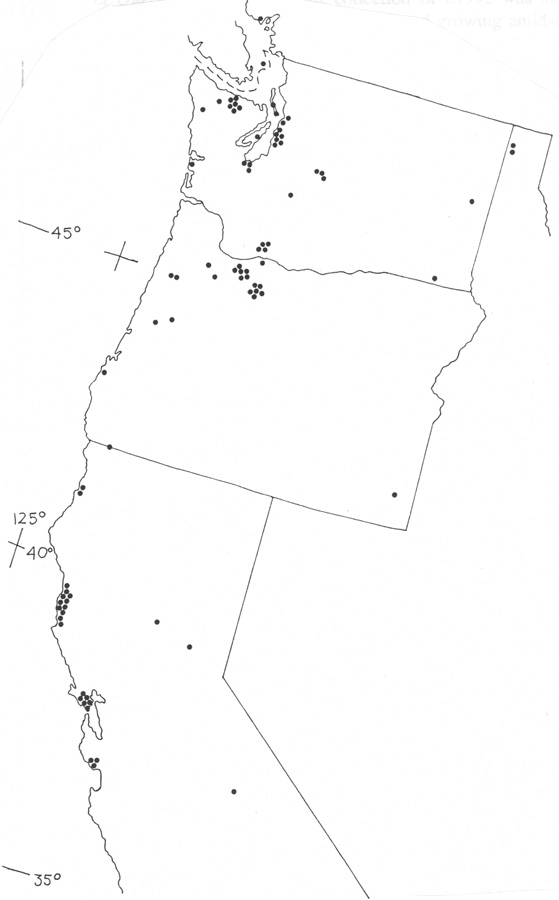
Amanita smithiana is often found growing amidst or near very rotten wood. Thiers (1982) reports that, in northern California, A. smithiana has been collected more often along the coast than in the mountains and is often associated with Pinus spp. Many collectors noted "under conifers" in all parts of the known range. Distribution information is somewhat limited because A. smithiana has been considered so common that specimens collected at forays are often not retained.*nbsp; On the other hand we were fortunate enough to find a large number of collections in the herbaria we surveyed. These collections were made over a broad geographic region and over a period of 77 years. When the plotted distribution of A. smithiana [Tulloss and Lindgren (1992: fig. 4)] is compared to maps of distribution of P. menziesii and T. heterophylla (Little, 1980), we note a very strong correlation. It is possible that the species may be found throughout the Douglas Fir/Western Hemlock Zone of the Pacific Northwest (Eyre, 1980).] |
| material examined |
CANADA: BRITISH COLUMBIA—Saturna Isl., top of Mt. Warburton Pike, 8[or 22?].x.1982 Paul Kroeger PK379 (UBC?); Saturna Isl., 8.x.1984 Basil & Wendy Sagar s.n. [P. Kroeger PK812] (UBC F12291); Sechelt, 7[?].x.1988 Timothy McFarlane s.n. (WTU).
MÉXICO: MICHOACAN—Morelia a Ciudad Hidalgo, Sierra de Mil Cumbres, ca. la prada El Mirador, 8.ix.1979 G. Guzmán 17803 (ENCB).
U.S.A.: CALIFORNIA—Butte
Co. - Oroville, 16.v.1966 Harry D. Thiers s.n.
[Gary J. Breckon 371] (SFSU). Fresno Co. -
Rancheria Campg. & Huntington Lk., 13.ix.1975
H. D. Thiers 34815 (SFSU). Humboldt Co. - Big
Lagoon, 6.5 km N of Patrick Pt., 15.x.1977 H. D.
Thiers 38315 (SFSU); Eureka, 30.xi.1933 P. C.
Richardson s.n [Fungi of Pacific States 287] (BPI);
Murray Rd., 10.xi.1979 Jeane Rockas M174 (SFSU); O
rick, 6.xii.1937 A. H. Smith 9472 (MICH as "A.
solitaria"). Marin Co. - Alpine Lk.,
25.xi.1979 P. K. Smith 148 (SFSU); Inverness,
Inverness Ridge, 19.i.1981 Dennis E. Desjardin s.n.
[H. D. Thiers 41752] (SFSU), 30.i.1981 D. E.
Desjardin s.n. [H. D. Thiers 41754] (SFSU);
Inverness Ridge, along Sunnyside Rd., 27.xi.1981
D. E. Desjardin 857 (SFSU); Phoenix Lk., 30.xi.1963
H. D. Thiers 10898 (SFSU); Tomales Bay St. Pk.,
12.xi.1970 B. Shervanick 359 (SFSU); unkn. local,
4.xii.2004 David Campbell s.n. (RET 382-6).
Mendocino Co. - Jackson St. For., 18.xi.1961 H. D.
Thiers 8880 (SFSU), 19.x.1962 H. D. Thiers 9270
(SFSU), 1.xii.1962 H. D. Thiers 9652 (SFSU),
7.xii.1963 H. D. Thiers 11101 (SFSU), 12.xi.1965
W. J. Sundberg s.n. [G. J. Breckon 264] (SFSU),
1.xii.1967 H. D. Thiers 21724 (SFSU), 9.xi.1969
Alix Wennekens 74 (SFSU), 11.xii.1969 H. D. Thiers
24477 (SFSU), xi.1977 B. Tamm s.n. (SFSU); Jackson
St. For., ca. Ft. Bragg, Simpson Lane, 24.xi.1979
H. D. Thiers 40476 (SFSU); Jackson St. For., ca.
Mendocino, 9.xi.1968 H. D. Thiers 23089 (SFSU);
Mendocino 1.i.2009 Ryane Snow s.n.
[mushroomobserver
#15940]
(RET 425-8, nrITS-LSU seq'd.).
Nevada Co. - Skillman Campgrd., Hwy. 20, 13.x.1984
H. D. Thiers 47999 (SFSU). Santa Barbara
Co. - unkn. loc., 30.xi.1941 Edward Lewis s.n.
[P. M. Rea 1037] (MICH as
"A. chlorinosma"). Santa Cruz Co. -
Graham Hill Rd., 10.xii.1966 H. D. Thiers s.n.
[G. J. Breckon 660] (SFSU); Oram Hill Rd.,
21.xi.1963 G. J. Breckon 221 (SFSU); ca. Santa
Cruz, i.1992 David Arora s.n. (RET 039-7).
Sierra Co. - ca. Bassetts, 15.x.1994 Michael Boom
s.n. (RET 136-4). IDAHO—Bonner
Co. - Priest Lk., 30.ix.1972 A. H. Smith 82497
(MICH), 30.ix.1978 member of Spokane Mushroom Club
s.n. (WTU as "A. radicata var.
solitaria [sic]").
NEW MÉXICO—Sandoval Co. - Jemez Mtns.,
viii.1981 Charles Barrows 1981-#15 (MICH).
OREGON—Clackamas Co. - MHNF, Bull Run
watershed, 6.ix.1989 J. E. Lindgren 182 (RET 037-8),
15.x.1989 J. E. Lindgren 185 (RET 038-2), 25.x.1990
J.
E. Lindgren s.n. (RET
??); MHNF, 23.x.1988
Herman Oppgenorth s.n. [Lindgren 135] (RET 008-8),
12.x.1997 participant Ore. Mycol. Soc. fall show
s.n. [Lindgren 9722] (RET 271-5); 11 km E of
Woodlawn, 3.xii.1984 James M. Trappe 8301
(OSC 44695). Coos Co. - Bandon, s.d.
Catherine Ardrey 1097 (WTU as "A. smithii"
[sic]). Hood River Co. - MHNF, Herman Creek
Tr., 4.xi.1987 J. E. Lindgren 108 (RET 038-3).
Josephine Co. - U.S. Rte. 199, ca. California state
line, 20.ix.1937 A. H. Smith 8960 (MICH as "A.
solitaria"). Lane Co. - Elmira,
11.xi.1943 Frank P. Lipse 415 (MICH as "A.
solitaria"); unkn. loc., 9.xi.1991 Freeman
Rowe s.n. [Lindgren 91-56] (WTU; RET
??). Polk Co. -
close to Black Rock Rd., W of Camp Tapawingo,
9.xi.1991 Dick Bishop & J. E. Lindgren [Lindgren
91-50] (WTU; JEL; RET
??); ca. Camp Tapawingo,
9.xi.1991 participants in Oregon Myc. Soc. foray
[Lindgren 91-55] (WTU; RET
??). Tillamook
Co. - Tillamook St. For., ca. Brown Camp, 31.x.2010
Sava Kristić s.n.
[mushroomobserver
#57708 p.p.]
(RET 589-2). Wasco Co. - MHNF, Bear Springs,
24.x.1954 A. H. Smith 49468 (MICH); MHNF, Clear Crk.
area, 9.x.1973 Ruth Oswald 6 (MICH); MHNF, Skyline
Rd., "Cascades," 16.x.1944 A. H. Smith 19810 (MICH);
Warm Springs Indian Reservation (WSIR),
Bear Springs, Mt. Wilson Rd.,
25.x.1946 W. B. Gruber s.n. [A. H. Smith 24981]
(paratype, MICH); WSIR, Beaver Crk., 21.x.1947 A. H.
Smith 28106 (paratype, MICH).
Washington Co. - Cipole Stn., 12.xi.1942 W. B.
Gruber s.n.
(MICH as "A. solitaria").
WASHINGTON—Clallam Co. - Olympic Nat.
Pk. (ONP), 12.x.1915 C. H. Kauffman s.n.
(MICH as "A. solitaria"); ONP, Lk. Mills,
15.x.1941 A. H. Smith 17941 (MICH as "A.
solitaria"); ONP, Mt. Angeles, 4.x.1941 A. H.
Smith 17550 (MICH as "A. solitaria");
ONP, Olympic Hot Springs,
2.x.1941 A. H. Smith 17501 (holotype, MICH;
isotype, L n.v.), 10.x.1941 A. H. Smith
17802 (MICH as "A. solitaria"), 15.x.1941
A. H. Smith 17911 (MICH as "A. solitaria");
ONP, ca. Winslow Spring, 0.4 km up Elwha R. Tr.,
30.ix.1992 Thomas E. O’Dell 603 (WTU).
Columbia Co. - Tucannon R., Meadow Crk., 11.x.1980
A. H. Smith 90917 (MICH). Island Co. -
Whidbey Isl., 23.x.1966 K. A. Harrison 6476 (MICH
as "A. solitaria"); Whidbey Isl., Langley
woods, 14.xi.1967 D. Hall s.n. [Stuntz 14537] (WTU
as "A. solitaria"). Jefferson Co. -
ONP, Elwha R. below Lk. Mills, 15.x.1941 A. H.
Smith 17933 (MICH as "A. chlorinosma"); ONP,
by Hoh R., ca. Hwy. 101, 7.x.1981 J. M. Trappe
6444 (OSC 40595). King Co. - ca. Bothel,
26.x.1958 D. E. Stuntz Is-735a (WTU as "A.
solitaria"); Bridle Trails St. Pk., Bellevue,
12.xi.1990 Lorelei Norvell LLN111290-2 (WTU); ca.
Redmond, Watermain Woods, 18.x.1975 D. E. Stuntz
& students [Stuntz 19168] (WTU as "A.
solitaria"); Seattle, N 240 St. woods, 9.x.1948
D. E. Stuntz 4860 (WTU as "A. chlorinosma");
Seattle, Holman Rd., x.1953 D. E. Stuntz 8629 (WTU
as "A. chlorinosma?"). King
Co./Snohomish Co. line - Point Wells, 18.x.1935
D. E. Stuntz 383 (WTU as "A.
solitaria"). Kitsap Co. - Bremerton,
xi.1939 J. B. Flett s.n. (MICH as "A.
chlorinosma"). Kittitas Co. - Cle
Elum-Roslyn area, 29.x.1958 D. E. Stuntz 10787
(WTU as "A. solitaria"); Lk. Kachess,
5.x.1986 foray participant [Joseph F. Ammirati
9318] (WTU); Keechelus Lk., “Divis” [Davis?] Pt.,
7.5 km E of Keechelus Dam, 27.ix.1969 D. E. Stuntz
15546 (WTU as "A. solitaria"). Mason
Co. - Lk. Cushman St. Pk., 16.xi.1991 T. E. O’Dell
435 (WTU). Pacific Co. - ca. Grayland,
11.xi.1990 Veronica Williams s.n. (WTU).
Pierce Co. - Mt. Ranier Nat. Pk., Tahoma Creek Rd.,
15.x.1984 E. Farwell 6018 (F 1060248).
Skamania Co. - Gifford Pinchot Nat. For. (GPNF),
Little Soda Springs, 18.x.1987 Ron Ostrem s.n.
[Lindgren 107] (RET 038-1); GPNF, Paradise Creek
Campg., 14.xi.1987 J. E. Lindgren 110 (RET 038-4);
GPNF, Trout Crk. on Pacific Crest Tr., 14.xi.1987
J. E. Lindgren 114 (RET 038-5; XAL); GPNF, Wind
River [formerly Hemlock] Ranger Stn., 27.x.1957 R.
Brooks s.n. (MICH). Snohomish Co. - woods
S of Edmonds, 9.x.1934 D. E. Stuntz 182 (WTU as
"A. solitaria"); S of Meadowdale, 21.x.1934
D. E. Stuntz 198A (WTU as "A.
solitaria"). Spokane Co. - N end of
Newman Lk., 5.x.1976 R. Boynton s.n. (WTU as
"A. solitaria"). Thurston Co. -
Millersylvania St. Pk., 13.xi.1971 D. E. Stuntz
17008 (WTU as "A. solitaria"); Olympia,
24.ix.1948 McKenny s.n. [A. H. Smith 31826] (MICH as
"A. chlorinosma"), xi.1958 D. E. Stuntz
& L. Brady s.n. (WTU). Whatcom Co. - ca.
Bellingham, Beaver Lk., 5.ix.1992 B. McAdoo 209#2
(RET ??). Unkn.
Co. - unkn. loc., 15.x.1978 participant in Puget
Sound Myc. Soc. show [Stuntz 20485] (WTU); xi.1982
poisoning victim [Stuntz 21823] (WTU). |
| discussion |
This striking mushroom is conspicuous because of its often robust stature, the frequently extensively radicating bulb, and its stark whiteness when young. As A. smithiana matures, the delicate, floccose, universal veil can be washed off by rain or, in hot, dry weather, change to flat tan warts. This variation has led to misidentification and much confusion about this species. Often little or no trace of partial or universal veil is present on mature specimens. Such specimens may not be recognized by a collector as belonging to Amanita.
There is increasing danger of mistaken identity on the part of ill-informed collectors attracted by the current high prices for “matsutake” and increasing pothunter interest in Tricholoma magnivelare (Peck) Redhead [=Tricholoma ponderosum (Peck) Sing.≡Armillaria ponderosa (Peck) Sacc.]. Amanita smithiana is common in southern British Columbia, Washington, Oregon, and northern California; it occurs, at least occasionally, in southern California, Idaho, and New Mexico. Particularly because it appears to be poisonous, it should be more widely and completely known.
The literature often ascribes a strong odor to A. smithiana. It is the impression of Lindgren (who has collected the species frequently) that the presence of a strong odor is associated with the aging or decay of the basidiome. (Decay is usually noticeable first at the base of the bulb.) Her field notes indicate that some fresh, sporulating specimens were still odorless four days after collection—even when longitudinally sectioned. Further, in our examination of many collections made by Drs. C. H. Kauffman (MICH), A. H. Smith (MICH), D. E. Stuntz (WTU), and H. D. Thiers (SFSU) and by the correspondents of Dr. Smith (MICH), we found a number of cases in which the collector noted that the specimens had no odor when fresh.
Spores of immature basidiomes may have an average Q equal to or greater than the average Q seen in mature ones. The second highest Q noted (1.84) was from Breckon 660 which had very few mature basidia. It should also be noted that Breckon 660 may be abnormal because of its having been collected near the apparent southern extreme (Santa Cruz Co., Calif.) of what appears to be the main body of the range of A. smithiana. The highest value of Q noted was from Breckon 221, a depauperate specimen, again from Santa Cruz Co. The lowest value of Q noted was found in Thiers 38316 the lamellae of which were extensively attacked by a mold. Because very few collections included spore prints, only spores on lamellae were measured for the sake of consistency. In all cases, a portion from the mid-region of a lamella was used.
It is noteworthy that the two collections made at considerable distance from all the others (Santa Barbara Co., Calif., and New Mexico collections) were collected after rain and had spores with Q of 1.56 and 1.41 respectively. Specimens of the Santa Barbara Co. collection are somewhat to very contorted, and one seems to lack lamellae under part of the pileus.
We ran across a small number of collections of A. silvicola misdetermined as A. smithiana. We find that macrochemical spot tests can be used to distinguish the two taxa. Phenoloxidase spot tests were carried out by Lindgren on Lindgren 91-50, on an additional collection of A. smithiana, and on three collections of A. silvicola. The reactions reported above for A. smithiana were seen in both tests of that species. The response in all tests of A. silvicola (for both laccase and tyrosinase) was negative. Since paracresol and syringaldazine are easily carried into the field, the application of either reagent to a longitudinal section of a basidiome provides a quick chemical test that will distinguish between these two white taxa. In the laboratory, the lack of basidial clamps, the lack of chains of inflated cells in the universal veil remnants left on the pileus, and smaller spores with higher Q aid in distinguishing A. silvicola from A. smithiana (Bas, 1969).
A question has been raised as to whether it is correct to identify the toxin in this species with allenic norleucine and similar compounds (Kirchmair et al., 2012). The ability to detect the kidney toxin or toxins in this species and in soup prepared from it has been reported recently (Apperley et al., 2013). Clearly the substance thought to be the primary toxin in A. smithiana is not broken down by heat—it survives boiling. In addition, the substance does not deteriorate with age in herbarium specimens (I. Garber, pers. comm.). |
| citations |
—R. E. Tulloss and J. E. Lindgren |
| editors |
RET |
|



 Spore data sets and their composite